• Home
  • Latest
  • Fortune 500
  • Finance
  • Tech
  • Leadership
  • Lifestyle
  • Rankings
  • Multimedia
CommentaryCOVID-19 vaccines

Inequity in health care made the AIDS crisis worse. Why are we making the same mistake with COVID-19?

By
Jennifer Lotito
Jennifer Lotito
Down Arrow Button Icon
By
Jennifer Lotito
Jennifer Lotito
Down Arrow Button Icon
January 31, 2022, 5:01 PM ET
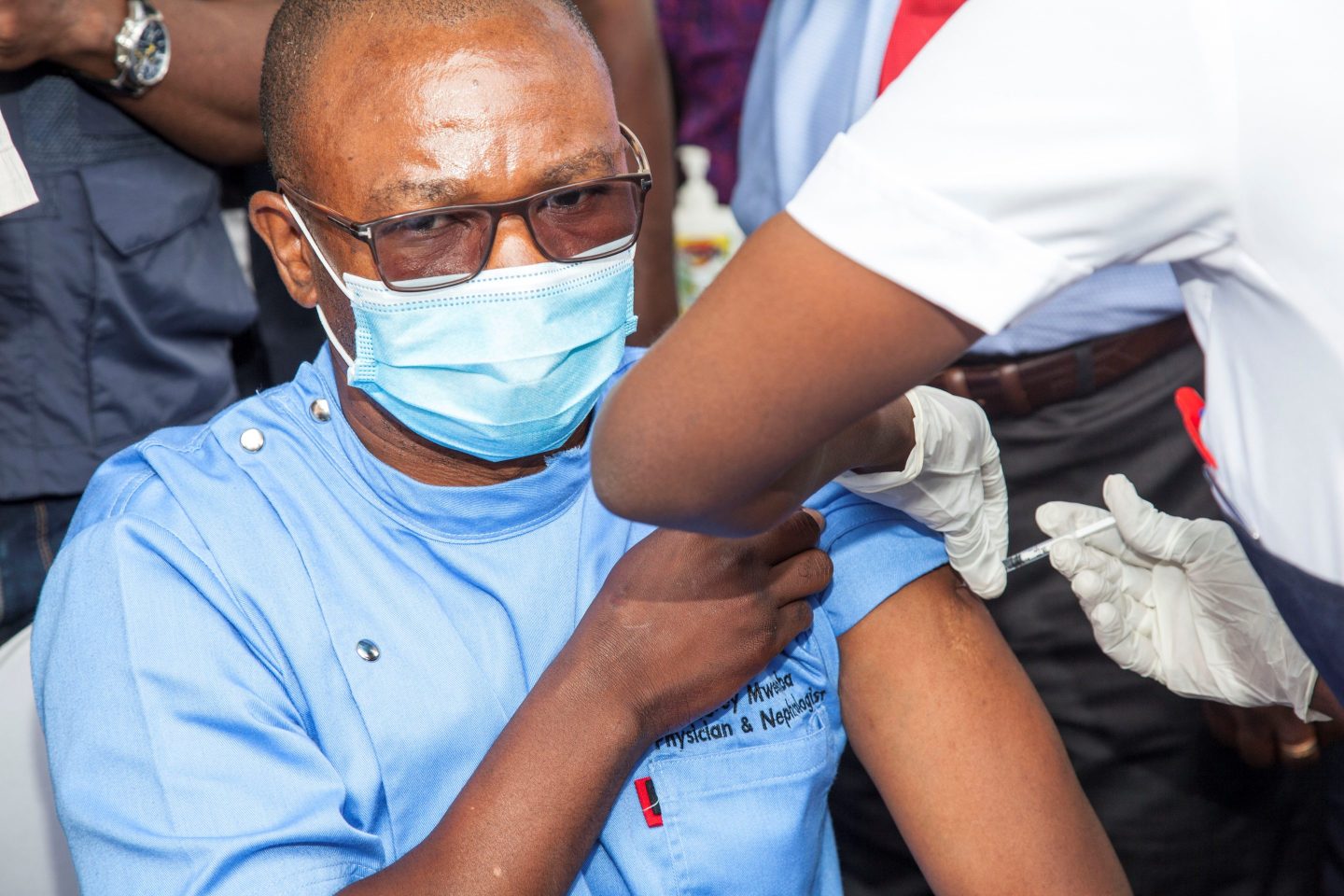
A front-line medical worker receives the COVID-19 vaccine at a hospital in Lusaka, Zambia. "If we want to stop the spread of COVID, we need to make it easier and cheaper for people everywhere to get access to diagnostics," writes Jennifer Lotito.
A front-line medical worker receives the COVID-19 vaccine at a hospital in Lusaka, Zambia. "If we want to stop the spread of COVID, we need to make it easier and cheaper for people everywhere to get access to diagnostics," writes Jennifer Lotito.Martin Mbangweta—Xinhua/Getty Images

In the early 2000s, over 5,000 people were dying from AIDS-related deaths every single day.

After losing each of her three children to AIDS, many assumed Zambian native Connie Mudenda would be next. But in 2004, something extraordinary happened. Access to free antiretroviral drugs became available and Connie started treatment, which not only saved her life but also gave her a future.

Connie’s remarkable story is proof of what’s possible in the fight against AIDS, but it’s also a powerful reminder of the importance of equity in global health.

Nearly two decades later, the scenario that kept the world’s poorest nations from accessing life-saving AIDS medications is happening again, as wealthy nations stockpile tools to fight COVID-19 while the rest of the world fights for the scraps. And until we start applying the important lessons of the last major global health crisis and start tackling health inequities head on, it’s becoming clearer with each new variant that we’ll never truly beat this pandemic.

We need to increase global access to the full set of tools available to fight COVID beginning with diagnostics. Like AIDS patients, COVID patients can be asymptomatic, or have minimal symptoms, increasing the likelihood that they will unwittingly spread the virus to others if left undiagnosed. This is why testing must be easily available to all.

But most places in the world still lack access to affordable COVID testing. Consider Kenya, where an average COVID test costs $11 in a nation where nearly 4 out of 10 people live on less than $1.90 per day. In Zambia, some COVID tests sell for upwards of $99, a price tag that might be palatable for some Americans, but is unconscionable for most Zambians, over half of whom live in extreme poverty. If we want to stop the spread of COVID, we need to make it easier and cheaper for people everywhere to get access to diagnostics.

But even if we magically increase the availability of diagnostics overnight, there needs to be an incentive for people to get tested. Amid the AIDS crisis in Africa before antiretroviral drugs were readily available, a common retort was: Why bother getting tested if there’s no hope for treatment? That’s why we also need to invest in the availability of therapeutics, which is a powerful tool not only for preventing COVID mortality, but also for encouraging testing and stopping the spread. 

In recent months we’ve seen several promising therapeutics emerge for COVID. These should be made available at low cost in low-income countries immediately, not years from now. Early signs show that some companies, including Pfizer, are applying learnings from the AIDS crisis and are submitting drugs to the Medicines Patent Pool and working with generic manufacturers to boost supply of their drugs globally, which will increase the likelihood that therapeutics will be available to all, not just the privileged few. We must see this through.

And finally, we must attack the most glaring injustice of all: global inequities around COVID-19 vaccines. To date, less than 10% of people in the world’s poorest countries have received a single COVID vaccine. This isn’t just morally reprehensible, it’s prolonging the pandemic for everyone, everywhere.

According to an analysis from The ONE Campaign, 14.4 times as many people in wealthy countries have received booster shots than people in low-income countries who have received first doses. At this unacceptable rate of progress, it will take over a decade before low-income countries achieve vaccination levels similar to high-income countries. In order to beat back the pandemic, wealthy countries must prioritize equity, share vaccine doses faster and stop monopolizing the limited global supply of vaccines.

To do all of this better, we need to fully finance the global response and lean on the proven global health partnerships that successfully helped us stop the rapid spread of AIDS. One of the most important developments in combating AIDS in the early 2000s was the creation of The Global Fund to Fight AIDS, Tuberculosis and Malaria, which is celebrating its 20th anniversary this week. Amid COVID-19, the fund is taking the lessons it has learned from fighting AIDS and applying them to this pandemic, helping over 100 low-and middle-income countries fight the virus and strengthen health systems. But the Global Fund, and many other critical global health institutions, are hanging on for dear life as they valiantly battle this pandemic on top of other preventable diseases.

Later this fall, the United States will play host to the Global Fund’s seventh replenishment conference. By agreeing to host the conference, the U.S. has sent a clear signal that it’s committed to doubling down on global health partnerships, but other wealthy countries and the private sector must show up to the conference with strong financial pledges to keep the Global Fund operating at full speed.

Not long ago, the world was at risk of AIDS engulfing an entire continent. But thanks to concerted efforts to combat global health inequities, as well as the creation of programs like the Global Fund and advancements in diagnostics and therapeutics, AIDS is no longer a death sentence for many.

And as for Connie Mudenda, today she is healthy and thriving. And in 2012, she gave birth to a beautiful, HIV-free daughter named Lubona, whose name means wisdom.

The AIDS crisis taught us an important lesson about inequity, which has made beating COVID-19 possible. Failure to apply that wisdom will make losing to COVID-19 inevitable.

Jennifer Lotito is the president and chief operating officer of (RED).

Never miss a story: Follow your favorite topics and authors to get a personalized email with the journalism that matters most to you.

About the Author
By Jennifer Lotito
See full bioRight Arrow Button Icon

Latest in Commentary

Finance
Lorem ipsum dolor sit amet, consectetur adipiscing elit, sed do eiusmod tempor incididunt ut labore et dolore magna aliqua. Ut enim ad minim veniam
By Fortune Editors
October 20, 2025
Finance
Lorem ipsum dolor sit amet, consectetur adipiscing elit, sed do eiusmod tempor incididunt ut labore et dolore magna aliqua. Ut enim ad minim veniam
By Fortune Editors
October 20, 2025
Finance
Lorem ipsum dolor sit amet, consectetur adipiscing elit, sed do eiusmod tempor incididunt ut labore et dolore magna aliqua. Ut enim ad minim veniam
By Fortune Editors
October 20, 2025
Finance
Lorem ipsum dolor sit amet, consectetur adipiscing elit, sed do eiusmod tempor incididunt ut labore et dolore magna aliqua. Ut enim ad minim veniam
By Fortune Editors
October 20, 2025
Finance
Lorem ipsum dolor sit amet, consectetur adipiscing elit, sed do eiusmod tempor incididunt ut labore et dolore magna aliqua. Ut enim ad minim veniam
By Fortune Editors
October 20, 2025
Finance
Lorem ipsum dolor sit amet, consectetur adipiscing elit, sed do eiusmod tempor incididunt ut labore et dolore magna aliqua. Ut enim ad minim veniam
By Fortune Editors
October 20, 2025

Most Popular

Finance
Lorem ipsum dolor sit amet, consectetur adipiscing elit, sed do eiusmod tempor incididunt ut labore et dolore magna aliqua. Ut enim ad minim veniam
By Fortune Editors
October 20, 2025
Finance
Lorem ipsum dolor sit amet, consectetur adipiscing elit, sed do eiusmod tempor incididunt ut labore et dolore magna aliqua. Ut enim ad minim veniam
By Fortune Editors
October 20, 2025
Finance
Lorem ipsum dolor sit amet, consectetur adipiscing elit, sed do eiusmod tempor incididunt ut labore et dolore magna aliqua. Ut enim ad minim veniam
By Fortune Editors
October 20, 2025
Finance
Lorem ipsum dolor sit amet, consectetur adipiscing elit, sed do eiusmod tempor incididunt ut labore et dolore magna aliqua. Ut enim ad minim veniam
By Fortune Editors
October 20, 2025
Finance
Lorem ipsum dolor sit amet, consectetur adipiscing elit, sed do eiusmod tempor incididunt ut labore et dolore magna aliqua. Ut enim ad minim veniam
By Fortune Editors
October 20, 2025
Finance
Lorem ipsum dolor sit amet, consectetur adipiscing elit, sed do eiusmod tempor incididunt ut labore et dolore magna aliqua. Ut enim ad minim veniam
By Fortune Editors
October 20, 2025
Fortune Secondary Logo
Rankings
  • 100 Best Companies
  • Fortune 500
  • Global 500
  • Fortune 500 Europe
  • Most Powerful Women
  • Future 50
  • World’s Most Admired Companies
  • See All Rankings
Sections
  • Finance
  • Fortune Crypto
  • Features
  • Leadership
  • Health
  • Commentary
  • Success
  • Retail
  • Mpw
  • Tech
  • Lifestyle
  • CEO Initiative
  • Asia
  • Politics
  • Conferences
  • Europe
  • Newsletters
  • Personal Finance
  • Environment
  • Magazine
  • Education
Customer Support
  • Frequently Asked Questions
  • Customer Service Portal
  • Privacy Policy
  • Terms Of Use
  • Single Issues For Purchase
  • International Print
Commercial Services
  • Advertising
  • Fortune Brand Studio
  • Fortune Analytics
  • Fortune Conferences
  • Business Development
About Us
  • About Us
  • Editorial Calendar
  • Press Center
  • Work At Fortune
  • Diversity And Inclusion
  • Terms And Conditions
  • Site Map
Fortune Secondary Logo
  • About Us
  • Editorial Calendar
  • Press Center
  • Work At Fortune
  • Diversity And Inclusion
  • Terms And Conditions
  • Site Map
  • Facebook icon
  • Twitter icon
  • LinkedIn icon
  • Instagram icon
  • Pinterest icon

Latest in Commentary

heitmann
CommentaryEntrepreneurship
Here’s how to build something that lasts, from the founder of a $300 million bootstrapped company that’s been growing for 28 years straight
By Tim HeitmannMarch 1, 2026
2 hours ago
world's fair
CommentaryRobots
Something big is happening in AI, but panic is the wrong reaction
By Peter CappelliFebruary 28, 2026
1 day ago
putin
CommentaryRussia
Exclusive analysis: we looked at the 400 western firms still in Russia. Their paltry size strips Putin’s bluff bare naked
By Jeffrey Sonnenfeld, Stephen Henriques, Jake Waldinger and Giuseppe ScottoFebruary 27, 2026
2 days ago
roth
CommentaryLeadership
The AI resource reallocation challenge: How can companies capture the value of time?
By Erik RothFebruary 27, 2026
2 days ago
will
CommentaryAdvertising
I’m one of America’s top pollsters and I’ve got a warning for the AI companies: customers aren’t sold on ads
By Will JohnsonFebruary 27, 2026
2 days ago
the pitt
CommentaryDEI
‘The Pitt’: a masterclass display of DEI in action 
By Robert RabenFebruary 26, 2026
3 days ago

Most Popular

placeholder alt text
Success
Japanese companies are paying older workers to sit by a window and do nothing—while Western CEOs demand super-AI productivity just to keep your job
By Orianna Rosa RoyleFebruary 27, 2026
2 days ago
placeholder alt text
AI
The week the AI scare turned real and America realized maybe it isn't ready for what's coming
By Nick LichtenbergFebruary 28, 2026
1 day ago
placeholder alt text
Middle East
Iran is now on 'death ground' amid existential threat from U.S. attacks and could 'go big' in retaliation, former NATO commander warns
By Jason MaFebruary 28, 2026
19 hours ago
placeholder alt text
Success
Walmart exec says U.S. workforces needs to take inspiration from China where ‘5 year-olds are learning DeepSeek’
By Preston ForeFebruary 27, 2026
2 days ago
placeholder alt text
Personal Finance
Current price of gold as of February 27, 2026
By Danny BakstFebruary 27, 2026
2 days ago
placeholder alt text
Middle East
Dubai’s worst nightmare unfolds as Iran strikes Gulf neighbors
By Dana Khraiche, Fiona MacDonald and BloombergFebruary 28, 2026
14 hours ago

© 2026 Fortune Media IP Limited. All Rights Reserved. Use of this site constitutes acceptance of our Terms of Use and Privacy Policy | CA Notice at Collection and Privacy Notice | Do Not Sell/Share My Personal Information
FORTUNE is a trademark of Fortune Media IP Limited, registered in the U.S. and other countries. FORTUNE may receive compensation for some links to products and services on this website. Offers may be subject to change without notice.