• Home
  • Latest
  • Fortune 500
  • Finance
  • Tech
  • Leadership
  • Lifestyle
  • Rankings
  • Multimedia
CommentaryBitcoin

U.S. crypto companies are at the crossroads of regulation

By
Tor Constantino
Tor Constantino
Down Arrow Button Icon
By
Tor Constantino
Tor Constantino
Down Arrow Button Icon
October 19, 2021, 6:30 PM ET
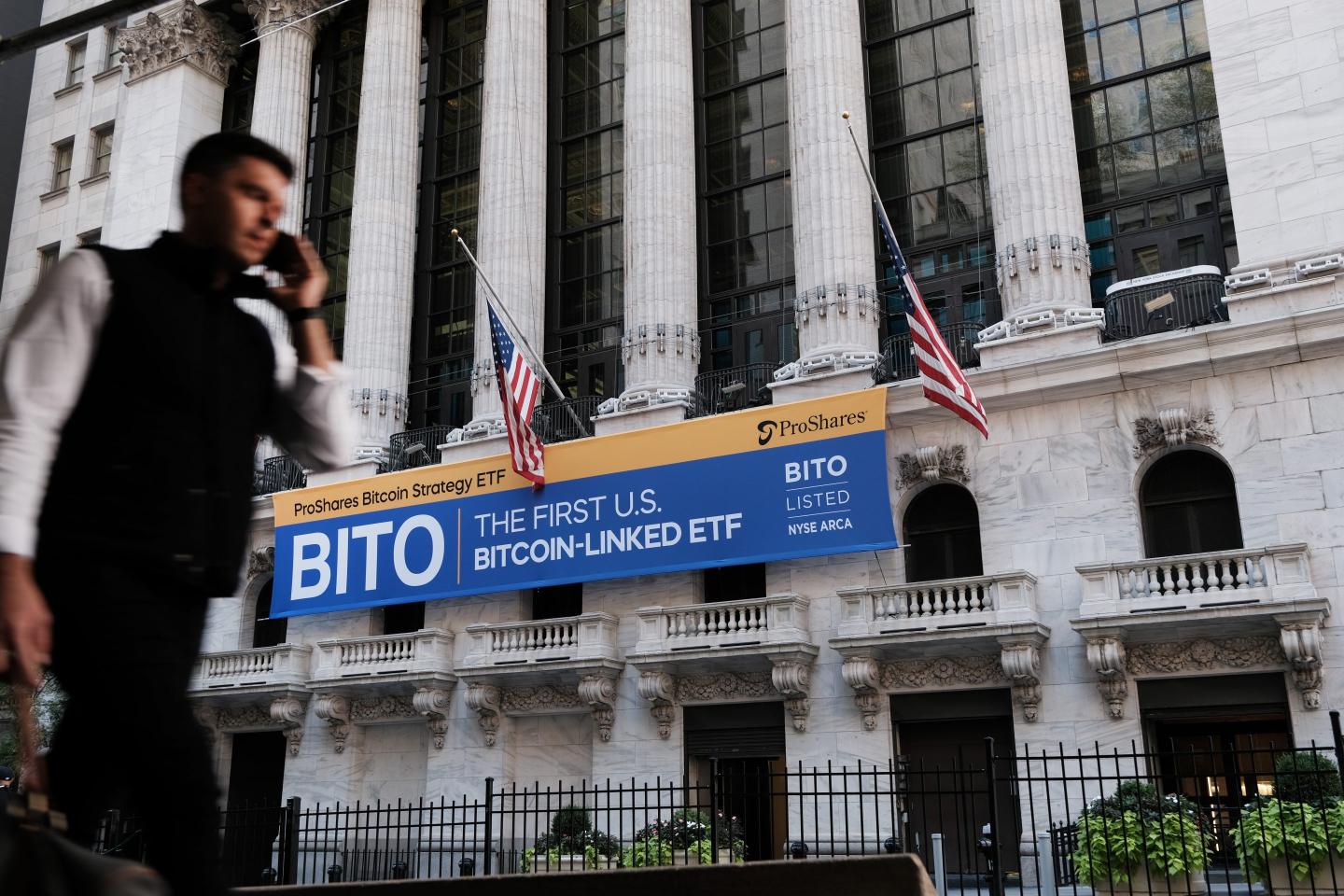
Proshares had to comply with rules from 1940 for its ETF application.
Proshares had to comply with rules from 1940 for its ETF application.Spencer Platt - Getty Images

Cryptocurrencies are at a regulatory crossroad as the executive and legislative branches of the U.S. government try to decide what path the oversight of programmable money should take.

Congress had some vague language within its languishing infrastructure bill to manage crypto, but that bill is not certain to pass both houses. Meanwhile, the White House is considering an expansive executive order that seeks to divvy up oversight of encrypted digital assets across various agencies of the executive wing. That order would also appoint a single regulatory ringmaster to lead the crypto circus.

This week, the first Bitcoin futures exchange-traded fund (ETF) was made available to U.S. investors. The first firm to secure clearance, ProShares, made its initial application to the SEC back in early August and recently filed its amended prospectus­–completing the necessary regulatory requirements for listing. 

It’s worth noting that this ETF application was made under the Investment Act of 1940 and is linked to current Bitcoin futures trading on the Chicago Mercantile Exchange (CME). That’s because Bitcoin has been available for futures trading on the CME since 2017, and Bitcoin options trading on the CME began in 2019. This suggests that the SEC seems to prefer well-worn paths rather than blazing new trails.

It’s a bit ironic that the first Bitcoin ETF approval needed to comply with a piece of legislation that’s more than 80 years old. The irony gets thicker when you consider that a Bitcoin-futures ETF opens the door for financial intermediaries such as online brokers or brokerage dealers to insert themselves–as well as corresponding fees and extended settlement delays­–into the transaction process.

The stated purpose of the seminal white paper outlining peer-to-peer payment in 2009–leading to Bitcoin’s creation­–was to show a way to eliminate the need for monetary middlemen during financial transactions. Yet, that underlying principle is being paved over to spur mass adoption and the expected inflows of tens of billions in new money from institutional investors into cryptos as additional ETFs come online.

It’s unclear when or if the executive order will be issued, but make no mistake: Regulation is coming to crypto. In an effort to try and plot its own path forward, the largest U.S.-based cryptocurrency exchange, Coinbase, resorted to preemptive policymaking by drafting its own proposed regulatory framework to govern crypto and blockchain. 

While reading through the early sections of the regulatory blueprint, you get the sense that Coinbase Chief Policy Officer Faryar Shirzad sought to strike the right tone–assertive but not antagonistic, collaborative but not complacent. “We understand that high-level proposals don’t become law overnight–nor should they. But what they can do is evolve the debate in ways that are helpful for everyone, including members of Congress who are increasingly focusing on this area,” Shirzad wrote.

The wording got more pointed in his assertion that outdated policies haven’t kept pace with the times or tech, so Coinbase wants a regulatory reboot that starts from scratch. “Laws drafted in the 1930s to facilitate effective oversight of our financial system could not contemplate this technological revolution,” Shirzad wrote. “They do not accommodate the efficiency, seamlessness, and transparency of digital asset markets, and thus risk serving as an unintended barrier to current innovations in the digital asset economy.”

Coinbase clearly wants a seat at the regulatory discussion table, and it goes so far as to propose four “pillars” for regulating the crypto market. Most importantly, it wants digital assets to be regulated under a separate framework. Coinbase sees crypto as an asset class by itself, distinct from securities, bonds, and commodities. However, regulators may beg to differ and are unlikely to build a unique regulatory construct for crypto assets.

The company also wants to see one regulator designated to oversee the market for digital assets, efforts to protect and empower digital asset holders, and rules to promote interoperability and fair competition.

It remains to be seen what role crypto companies such as Coinbase will have in determining the direction of regulation, as well as whether regulators can lower their crosshair sights long enough to listen and collaborate with the industry. If you care about this issue, you should reach out to the offices of your congressional lawmakers.

It would be hyperbolic and premature to start speculating whether this is the beginning of the end or the end of the beginning for cryptocurrencies. But one thing is certain: Regulation is coming and cryptos’ path forward will never be the same.

Tor Constantino is a former journalist, current corporate executive, and business writer. Since 2017, he has also written about cryptocurrencies, blockchain, DeFi, NFTs, and crypto’s potential to revolutionize finance. His writing has appeared in outlets including Inc, Entrepreneur, DailyCoin, Success, Forbes, CEOWorld, and Yahoo! Finance. He has holdings in Bitcoin, Ethereum, Cardano, and XRP. His views are his own.

More must-read commentary published by Fortune:

  • The immense reward of banishing ‘no’ from your creative dictionary
  • Healthcare sourcing for dummies: How to find the best benefits deals
  • America is hooked on seafood imports. We need to expand aquaculture in federal waters
  • Two girls walk into a job fair (or why I raised a VC fund)
  • Don’t underestimate the role of generalists in innovation

Subscribe to Fortune Daily to get essential business stories straight to your inbox each morning.

About the Author
By Tor Constantino
See full bioRight Arrow Button Icon

Latest in Commentary

Finance
Lorem ipsum dolor sit amet, consectetur adipiscing elit, sed do eiusmod tempor incididunt ut labore et dolore magna aliqua. Ut enim ad minim veniam
By Fortune Editors
October 20, 2025
Finance
Lorem ipsum dolor sit amet, consectetur adipiscing elit, sed do eiusmod tempor incididunt ut labore et dolore magna aliqua. Ut enim ad minim veniam
By Fortune Editors
October 20, 2025
Finance
Lorem ipsum dolor sit amet, consectetur adipiscing elit, sed do eiusmod tempor incididunt ut labore et dolore magna aliqua. Ut enim ad minim veniam
By Fortune Editors
October 20, 2025
Finance
Lorem ipsum dolor sit amet, consectetur adipiscing elit, sed do eiusmod tempor incididunt ut labore et dolore magna aliqua. Ut enim ad minim veniam
By Fortune Editors
October 20, 2025
Finance
Lorem ipsum dolor sit amet, consectetur adipiscing elit, sed do eiusmod tempor incididunt ut labore et dolore magna aliqua. Ut enim ad minim veniam
By Fortune Editors
October 20, 2025
Finance
Lorem ipsum dolor sit amet, consectetur adipiscing elit, sed do eiusmod tempor incididunt ut labore et dolore magna aliqua. Ut enim ad minim veniam
By Fortune Editors
October 20, 2025

Most Popular

Finance
Lorem ipsum dolor sit amet, consectetur adipiscing elit, sed do eiusmod tempor incididunt ut labore et dolore magna aliqua. Ut enim ad minim veniam
By Fortune Editors
October 20, 2025
Finance
Lorem ipsum dolor sit amet, consectetur adipiscing elit, sed do eiusmod tempor incididunt ut labore et dolore magna aliqua. Ut enim ad minim veniam
By Fortune Editors
October 20, 2025
Finance
Lorem ipsum dolor sit amet, consectetur adipiscing elit, sed do eiusmod tempor incididunt ut labore et dolore magna aliqua. Ut enim ad minim veniam
By Fortune Editors
October 20, 2025
Finance
Lorem ipsum dolor sit amet, consectetur adipiscing elit, sed do eiusmod tempor incididunt ut labore et dolore magna aliqua. Ut enim ad minim veniam
By Fortune Editors
October 20, 2025
Finance
Lorem ipsum dolor sit amet, consectetur adipiscing elit, sed do eiusmod tempor incididunt ut labore et dolore magna aliqua. Ut enim ad minim veniam
By Fortune Editors
October 20, 2025
Finance
Lorem ipsum dolor sit amet, consectetur adipiscing elit, sed do eiusmod tempor incididunt ut labore et dolore magna aliqua. Ut enim ad minim veniam
By Fortune Editors
October 20, 2025
Fortune Secondary Logo
Rankings
  • 100 Best Companies
  • Fortune 500
  • Global 500
  • Fortune 500 Europe
  • Most Powerful Women
  • World's Most Admired Companies
  • See All Rankings
  • Lists Calendar
Sections
  • Finance
  • Fortune Crypto
  • Features
  • Leadership
  • Health
  • Commentary
  • Success
  • Retail
  • Mpw
  • Tech
  • Lifestyle
  • CEO Initiative
  • Asia
  • Politics
  • Conferences
  • Europe
  • Newsletters
  • Personal Finance
  • Environment
  • Magazine
  • Education
Customer Support
  • Frequently Asked Questions
  • Customer Service Portal
  • Privacy Policy
  • Terms Of Use
  • Single Issues For Purchase
  • International Print
Commercial Services
  • Advertising
  • Fortune Brand Studio
  • Fortune Analytics
  • Fortune Conferences
  • Business Development
  • Group Subscriptions
About Us
  • About Us
  • Press Center
  • Work At Fortune
  • Terms And Conditions
  • Site Map
  • About Us
  • Press Center
  • Work At Fortune
  • Terms And Conditions
  • Site Map
  • Facebook icon
  • Twitter icon
  • LinkedIn icon
  • Instagram icon
  • Pinterest icon

Latest in Commentary

tillis
CommentaryCongress
Thom Tillis: Free markets built American prosperity. Government intervention puts it at risk
By Thom Tillis and John StanfordApril 30, 2026
30 minutes ago
iran
CommentaryIran
The Strait of Hormuz is a data problem, not just a military one
By Erik Bethel and Ami DanielApril 30, 2026
1 hour ago
hollywood
CommentaryMarketing
I spent 20 years learning to navigate an industry. Then I built a campaign for the man who’s dismantling it
By Matti YahavApril 29, 2026
20 hours ago
aging
HealthLongevity
We’re the CEOs of Peloton and the Hospital for Special Surgery. Living longer isn’t enough, we need to live better, too
By Bryan T. Kelly and Peter SternApril 29, 2026
21 hours ago
gen z
Commentarydisruption
AI won’t kill your job — it will kill the path to your first one
By Jeffrey Sonnenfeld, Stephen Henriques, Johan Griesel, Andrew Alam-Nist and Peter YuApril 29, 2026
22 hours ago
greer
CommentaryTariffs
No, tariffs are not strengthening the economy
By Alex DuranteApril 29, 2026
23 hours ago

Most Popular

Apple cofounder Ronald Wayne—whose stake would be worth up to $400 billion had he not sold it in 1976—says that at 91, he has no regrets
Success
Apple cofounder Ronald Wayne—whose stake would be worth up to $400 billion had he not sold it in 1976—says that at 91, he has no regrets
By Preston ForeApril 27, 2026
3 days ago
‘Take the money and run’: Johns Hopkins economist Steve Hanke on why the UAE quit OPEC
Energy
‘Take the money and run’: Johns Hopkins economist Steve Hanke on why the UAE quit OPEC
By Shawn TullyApril 29, 2026
1 day ago
‘The cost of compute is far beyond the costs of the employees’: Nvidia executive says right now AI is more expensive than paying human workers
AI
‘The cost of compute is far beyond the costs of the employees’: Nvidia executive says right now AI is more expensive than paying human workers
By Sasha RogelbergApril 28, 2026
2 days ago
Jamie Dimon gets candid about national debt: ‘There will be a bond crisis, and then we’ll have to deal with it’
Economy
Jamie Dimon gets candid about national debt: ‘There will be a bond crisis, and then we’ll have to deal with it’
By Eleanor PringleApril 29, 2026
23 hours ago
‘They left me no choice’: Powell isn’t going anywhere—blocking Trump from another Fed appointee
Banking
‘They left me no choice’: Powell isn’t going anywhere—blocking Trump from another Fed appointee
By Eva RoytburgApril 29, 2026
14 hours ago
More than two-thirds of U.S. schools say they’re unable to afford the cost of student free lunch—and MAHA’s dietary guidelines may make it worse
Economy
More than two-thirds of U.S. schools say they’re unable to afford the cost of student free lunch—and MAHA’s dietary guidelines may make it worse
By Sasha RogelbergApril 29, 2026
1 day ago

© 2026 Fortune Media IP Limited. All Rights Reserved. Use of this site constitutes acceptance of our Terms of Use and Privacy Policy | CA Notice at Collection and Privacy Notice | Do Not Sell/Share My Personal Information
FORTUNE is a trademark of Fortune Media IP Limited, registered in the U.S. and other countries. FORTUNE may receive compensation for some links to products and services on this website. Offers may be subject to change without notice.