• Home
  • Latest
  • Fortune 500
  • Finance
  • Tech
  • Leadership
  • Lifestyle
  • Rankings
  • Multimedia

Trendingnow

1

Bolt CEO says he let go of his entire HR team for creating problems that didn’t exist: ‘Those problems disappeared when I let them go’ 

2

Despite a $500 million net worth, Shaq just finished his fourth degree. He warns graduates: 'Your character will take you further than your resume'

3

Meet a 21-year-old community college student who's going to China as the first American woman welder in the trades Olympics

1

Bolt CEO says he let go of his entire HR team for creating problems that didn’t exist: ‘Those problems disappeared when I let them go’ 

2

Despite a $500 million net worth, Shaq just finished his fourth degree. He warns graduates: 'Your character will take you further than your resume'

3

Meet a 21-year-old community college student who's going to China as the first American woman welder in the trades Olympics
Commentary

Why a key Georgia county flipped from red to blue—and what it means for Democrats

By
James C. Cobb
James C. Cobb
Down Arrow Button Icon
By
James C. Cobb
James C. Cobb
Down Arrow Button Icon
December 27, 2020, 7:30 AM ET
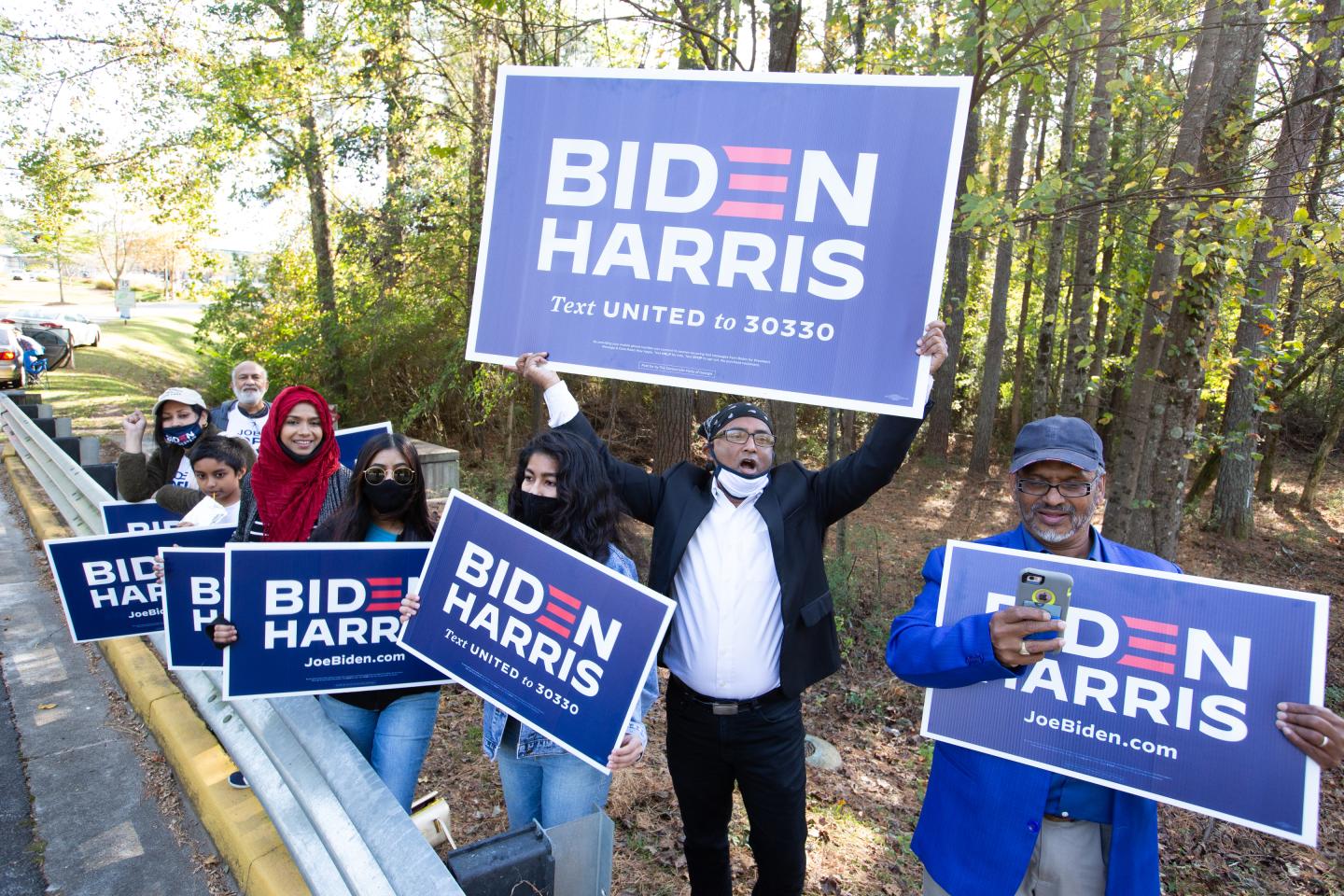
Biden-Harris supporters near a polling station in Norcross, Ga., on Election Day. Barack Obama lost Gwinnett County by nine points in 2012, only to see Joe Biden win it by 18 points just eight years later.
Biden-Harris supporters near a polling station in Norcross, Ga., on Election Day. Barack Obama lost Gwinnett County by nine points in 2012, only to see Joe Biden win it by 18 points just eight years later. Jessica McGowan—Getty Images

Joe Biden’s victory in Georgia was surely the most surprising red state flip in the 2020 presidential election. Exploring the strikingly rapid transformation of Gwinnett County, the state’s largest suburban county, shows how this upset happened, while offering insights into the state’s upcoming U.S. Senate runoffs.

At the midpoint of the 20th century, Gwinnett, 30 miles northeast of Atlanta, was largely rural, with just 32,000 inhabitants, more than 95% of them white. Scarcely 2% of the residents had completed four years of college, and only 25% of the workforce held professional or managerial jobs. Who could have imagined that today, Gwinnett County would be home to nearly 950,000 people and one of the most diverse counties in the country?

Gwinnett’s path would be shaped by nearby Atlanta, which lost 162,000 white residents between 1960 and 1980. Gwinnett saw its white population swell by 102,000 over the same period. The county also grew with the arrival of thousands of white migrants from elsewhere in the nation, drawn by the dynamic metropolitan Atlanta economy. By 1990, some 357,000 people, more than nine out of 10 of them white, lived in Gwinnett County.

Growth in Gwinnett would accelerate, even as the new arrivals became more diverse. By 1990, metro Atlanta, including suburban counties like Gwinnett, was becoming a top destination for African-Americans on the move from other parts of the U.S. Meanwhile, the allure of the suburbs was accelerating the outmigration of upwardly mobile Black people from Atlanta itself. The share of Gwinnett’s population that was African-American more than doubled in the 1990s, and the Black population grew by 140% in the decade that followed. With this influx continuing, and many Gwinnett whites heading off to the decidedly whiter exurbs like Barrow and Walton counties, by 2020, 30% of Gwinnett residents were Black.

This is only part of the story of Gwinnett’s diversification. The explosion of construction jobs spawned by the 1996 Olympic Games, in combination with a falloff in employment in the Texas and Louisiana oilfields, exerted a push-pull effect on Latino in-migrants, so that today, Latin Americans constitute 20% of the county’s population. The heated pursuit of foreign investment, reflected in a current count of more than 600 foreign-owned companies in the county, also drew a steadily expanding stream of Asian and Asian-American workers, who liked the county’s highly touted schools and relatively low living costs. By 2020, residents of Asian descent accounted for 13% of Gwinnett’s population. 

These arrivals made Gwinnett more prosperous and diverse but were not universally welcomed by the non-Hispanic white population. While Gwinnett officially became a majority nonwhite county by around 2007, it wasn’t until 2018 that representatives of other ethnic groups first managed to win seats on the county commission and the board of education. 

White resistance had partisan implications. Gwinnett became a Republican stronghold in presidential elections in 1964, and the county voters strayed from the GOP camp only once in the next 50 years, to support fellow Georgian Jimmy Carter for President in 1976. 

But as the county’s nonwhite population grew, Democrats gained ground in Gwinnett during presidential elections. 

Barack Obama, running only five points behind John McCain in Georgia in 2008, captured Newton, Rockdale, and Douglas, three other metro Atlanta counties whose nonwhite populations were on the rise. Obama maintained this suburban beachhead in 2012, and four years later, Hillary Clinton picked up Gwinnett and two other diversifying counties. 

With Democratic hopes buoyed by Clinton’s showing, state legislator Stacey Abrams, who is African-American, ran for governor in 2018. She narrowly lost to Republican opponent Brian Kemp—but bested him in Gwinnett by more than 14 percentage points. Abrams’s performance persuaded the national Democratic Party to mount a serious presidential effort in Georgia.

But instead of persisting in futile efforts to bring blue-collar whites back into the fold, the Democrats would concentrate on molding a growing and more politically engaged nonwhite population into a potent political force in the state. To that end, Abrams and her allies fought voter suppression, expanded registration, and boosted turnout. The effort was decisive for Biden, who carried essentially the same counties as Abrams two years ago, while besting her number of votes statewide by more than 550,000. 

This was the culmination of a speedy political reversal in Gwinnett. Obama lost the county by nine points in 2012 only to see Biden win it by 18 points just eight years later.

This swing is not explained by the “hot take” that Biden owes his victory nationwide to disgusted white establishment Republicans in the suburbs, who crossed party lines rather than vote for Donald Trump but otherwise stuck with GOP candidates down-ballot. Trump certainly lost some support among white suburban voters in Georgia. But ultimately, it was a racially and culturally diverse group of relative newcomers to the burbs who put Democrats over the top.

Sure, the pundits are right that Biden won in the suburbs—the state’s three most populous suburban counties (DeKalb, Cobb, and Gwinnett), along with Fulton, where Atlanta is located, accounted for over half of Biden’s vote gains over Hillary Clinton’s totals from four years ago. But it’s also true that of those counties, Cobb is the only one where nonwhites are not the majority. (And Cobb misses being majority nonwhite by a single percentage point.) 

There are limits to what may be inferred from comparing voter registration percentages to shares of the actual vote, but in Gwinnett County the correlation is too close to ignore: Whites now account for 40% of the county’s registered voters, and Trump won 40% of the vote. Likewise, in Georgia’s Seventh District, the only House seat in the state that Democrats flipped, Carolyn Bourdeaux’s vanquished Republican adversary garnered the same share of the vote in Gwinnett as Trump. 

Moreover, the perceived national pattern of white suburban Republicans voting for Biden but for the GOP in other races certainly did not play out in Gwinnett. Instead, Democrats racked up large margins in the two senatorial contests, while local matchups saw more ousters of white Republicans by nonwhite candidates, including the election of Gwinnett’s first Black sheriff. Here Democrats didn’t raid the traditional Republican base, but simply overwhelmed it. 

Despite this, Republicans in January’s U.S. Senate runoffs are doubling down on their presidential election strategy of tailoring their message to the die-hard Trumpers and casting Democratic challengers Jon Ossoff and Raphael Warnock as America-hating socialists, communists, or anarchists.

The Republicans are gambling that the traditional wisdom that nonwhite turnout fades badly in runoff elections will hold true yet again. But much has changed in the nonwhite population, especially in the suburbs. 

Should Georgia Democrats prevail in these two races, they will have managed an even greater feat than the one they pulled off on Nov. 3. They will also have shown the rest of the country that the demographic forces transforming Georgia’s politics could fuel further Democratic success in rapidly diversifying suburban areas nationwide. 

James C. Cobb is a contributing editor at Zócalo Public Square and the Spalding Distinguished Professor of History Emeritus at the University of Georgia. His latest book is The South and America Since World War II. This piece was written for Zócalo Public Square.

About the Author
By James C. Cobb
See full bioRight Arrow Button Icon

Latest in Commentary

Finance
Lorem ipsum dolor sit amet, consectetur adipiscing elit, sed do eiusmod tempor incididunt ut labore et dolore magna aliqua. Ut enim ad minim veniam
By Fortune Editors
October 20, 2025
Finance
Lorem ipsum dolor sit amet, consectetur adipiscing elit, sed do eiusmod tempor incididunt ut labore et dolore magna aliqua. Ut enim ad minim veniam
By Fortune Editors
October 20, 2025
Finance
Lorem ipsum dolor sit amet, consectetur adipiscing elit, sed do eiusmod tempor incididunt ut labore et dolore magna aliqua. Ut enim ad minim veniam
By Fortune Editors
October 20, 2025
Finance
Lorem ipsum dolor sit amet, consectetur adipiscing elit, sed do eiusmod tempor incididunt ut labore et dolore magna aliqua. Ut enim ad minim veniam
By Fortune Editors
October 20, 2025
Finance
Lorem ipsum dolor sit amet, consectetur adipiscing elit, sed do eiusmod tempor incididunt ut labore et dolore magna aliqua. Ut enim ad minim veniam
By Fortune Editors
October 20, 2025
Finance
Lorem ipsum dolor sit amet, consectetur adipiscing elit, sed do eiusmod tempor incididunt ut labore et dolore magna aliqua. Ut enim ad minim veniam
By Fortune Editors
October 20, 2025

Most Popular

Finance
Lorem ipsum dolor sit amet, consectetur adipiscing elit, sed do eiusmod tempor incididunt ut labore et dolore magna aliqua. Ut enim ad minim veniam
By Fortune Editors
October 20, 2025
Finance
Lorem ipsum dolor sit amet, consectetur adipiscing elit, sed do eiusmod tempor incididunt ut labore et dolore magna aliqua. Ut enim ad minim veniam
By Fortune Editors
October 20, 2025
Finance
Lorem ipsum dolor sit amet, consectetur adipiscing elit, sed do eiusmod tempor incididunt ut labore et dolore magna aliqua. Ut enim ad minim veniam
By Fortune Editors
October 20, 2025
Finance
Lorem ipsum dolor sit amet, consectetur adipiscing elit, sed do eiusmod tempor incididunt ut labore et dolore magna aliqua. Ut enim ad minim veniam
By Fortune Editors
October 20, 2025
Finance
Lorem ipsum dolor sit amet, consectetur adipiscing elit, sed do eiusmod tempor incididunt ut labore et dolore magna aliqua. Ut enim ad minim veniam
By Fortune Editors
October 20, 2025
Finance
Lorem ipsum dolor sit amet, consectetur adipiscing elit, sed do eiusmod tempor incididunt ut labore et dolore magna aliqua. Ut enim ad minim veniam
By Fortune Editors
October 20, 2025
Fortune Secondary Logo
Rankings
  • 100 Best Companies
  • Fortune 500
  • Global 500
  • Fortune 500 Europe
  • Most Powerful Women
  • World's Most Admired Companies
  • See All Rankings
  • Lists Calendar
Sections
  • Finance
  • Fortune Crypto
  • Features
  • Leadership
  • Health
  • Commentary
  • Success
  • Retail
  • Mpw
  • Tech
  • Lifestyle
  • CEO Initiative
  • Asia
  • Politics
  • Conferences
  • Europe
  • Newsletters
  • Personal Finance
  • Environment
  • Magazine
  • Education
Customer Support
  • Frequently Asked Questions
  • Customer Service Portal
  • Privacy Policy
  • Terms Of Use
  • Single Issues For Purchase
  • International Print
Commercial Services
  • Advertising
  • Fortune Brand Studio
  • Fortune Analytics
  • Fortune Conferences
  • Business Development
  • Group Subscriptions
About Us
  • About Us
  • Press Center
  • Work At Fortune
  • Terms And Conditions
  • Site Map
  • About Us
  • Press Center
  • Work At Fortune
  • Terms And Conditions
  • Site Map
  • Facebook icon
  • Twitter icon
  • LinkedIn icon
  • Instagram icon
  • Pinterest icon

Latest in Commentary

trump
CommentaryWhite House
Trump Accounts have a bigger problem than billionaire stock donations
By Jin Huang and Stephen RollMay 21, 2026
28 minutes ago
brigham
CommentaryRailroads
The U.S. freight network is broken by design. One merger could start fixing it
By Brigham A. McCownMay 21, 2026
1 hour ago
Elon Musk sits with his fists together, looking up.
Commentaryspace
SpaceX will be worth trillions, but the space station that made it possible is worth even more — if we don’t squander it
By Tejpaul BhatiaMay 20, 2026
15 hours ago
trader
CommentarySoftware
The 50-year-old law that governed every software company just broke. Here’s what replaces it
By Martin Casado and Abhishek NagarajMay 20, 2026
23 hours ago
FJ Campbell, MD, is chief medical officer at Ardent Health.
CommentaryHealth
A doctor shortage is coming. AI could be the only realistic fix
By FJ CampbellMay 20, 2026
1 day ago
trump
CommentaryCongress
Milken-Harris Poll: 80% of Americans want AI workforce programs now — and Washington hasn’t delivered
By Karen Kornbluh and Libby RodneyMay 20, 2026
1 day ago

Most Popular

Bolt CEO says he let go of his entire HR team for creating problems that didn’t exist: ‘Those problems disappeared when I let them go’ 
Workplace Culture
Bolt CEO says he let go of his entire HR team for creating problems that didn’t exist: ‘Those problems disappeared when I let them go’ 
By Preston ForeMay 19, 2026
2 days ago
Despite a $500 million net worth, Shaq just finished his fourth degree. He warns graduates: 'Your character will take you further than your resume'
Success
Despite a $500 million net worth, Shaq just finished his fourth degree. He warns graduates: 'Your character will take you further than your resume'
By Preston ForeMay 20, 2026
21 hours ago
Meet a 21-year-old community college student who's going to China as the first American woman welder in the trades Olympics
Future of Work
Meet a 21-year-old community college student who's going to China as the first American woman welder in the trades Olympics
By Mike Householder and The Associated PressMay 17, 2026
4 days ago
Dr. Bernice King on why companies that walked back DEI were never truly committed: 'If you retreat that quick…that reveals who you really are'
Workplace Culture
Dr. Bernice King on why companies that walked back DEI were never truly committed: 'If you retreat that quick…that reveals who you really are'
By Preston ForeMay 19, 2026
2 days ago
The Bezos family just donated $100 million to help achieve one of Mayor Zohran Mamdani’s top campaign promises
Politics
The Bezos family just donated $100 million to help achieve one of Mayor Zohran Mamdani’s top campaign promises
By Jake AngeloMay 12, 2026
9 days ago
Current price of oil as of May 20, 2026
Personal Finance
Current price of oil as of May 20, 2026
By Joseph HostetlerMay 20, 2026
22 hours ago

© 2026 Fortune Media IP Limited. All Rights Reserved. Use of this site constitutes acceptance of our Terms of Use and Privacy Policy | CA Notice at Collection and Privacy Notice | Do Not Sell/Share My Personal Information
FORTUNE is a trademark of Fortune Media IP Limited, registered in the U.S. and other countries. FORTUNE may receive compensation for some links to products and services on this website. Offers may be subject to change without notice.