• Home
  • Latest
  • Fortune 500
  • Finance
  • Tech
  • Leadership
  • Lifestyle
  • Rankings
  • Multimedia

Trendingnow

1

Despite a $500 million net worth, Shaq just finished his fourth degree. He warns graduates: 'Your character will take you further than your resume'

2

Jeff Bezos wants the bottom half of earners to pay zero income tax—he says nurses making just $75K should save $12K a year

3

Bolt CEO says he let go of his entire HR team for creating problems that didn’t exist: ‘Those problems disappeared when I let them go’ 

1

Despite a $500 million net worth, Shaq just finished his fourth degree. He warns graduates: 'Your character will take you further than your resume'

2

Jeff Bezos wants the bottom half of earners to pay zero income tax—he says nurses making just $75K should save $12K a year

3

Bolt CEO says he let go of his entire HR team for creating problems that didn’t exist: ‘Those problems disappeared when I let them go’ 
CommentaryStartups & Venture

Spotify proves it: Europe can grow its own tech giants

By
Danny Rimer
Danny Rimer
Down Arrow Button Icon
By
Danny Rimer
Danny Rimer
Down Arrow Button Icon
October 1, 2020, 12:01 PM ET
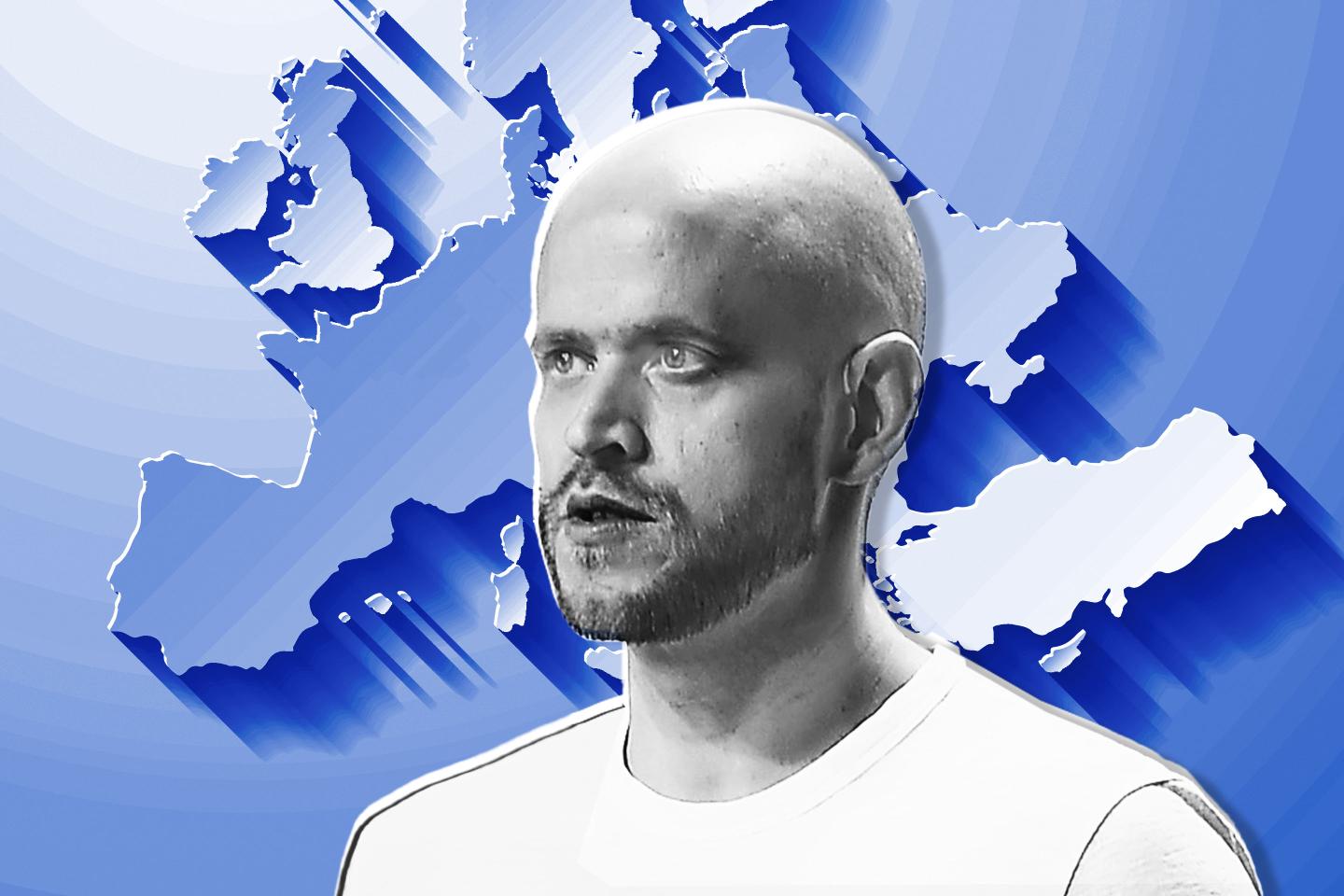
Photo-Illustration by Fortune; original photo, Ek: Courtesy of Spotify; Europe: bgblue—Getty Images

Almost daily, someone asks the question of how close we are in Europe to producing the next global tech titan. At last, it seems that aspiration is within reach.

For decades, founders in the U.S. appeared to share an unknown quality that drove incredible success and was impossible to replicate beyond the confines of Silicon Valley.

But the reality is far less magical and more practical. There is no “secret ingredient,” as such. The fact is that Europe simply didn’t have sufficient talent with experience for building large-scale startups, or investment at its fingertips, to nurture truly revolutionary tech businesses. European founders were forced to relocate to the U.S., or even to move there from the get-go in order to take on the challenge of “making it” in the world’s biggest tech market.

Now it’s a different story. In Spotify and Adyen, Europe boasts two tech giants with market capitalizations of nearly $50 billion. There’s no shortage of talent either, with Europe counting over 6 million developers to the U.S.’s 4.3 million, according to data from StackOverflow. Europe has a proven edge in sectors such as fashion, fintech, and gaming. And investment in European startups has more than doubled between 2015 and 2019, to $38.6 billion, from $15.4 billion, according to data from Dealroom.

Meanwhile, the U.S. labor market is facing its own challenges. The Trump administration’s drive to reduce immigration made the U.S. a less desirable destination for foreign workers, and demand for top talent outstrips supply. Tech salaries are sky-high, which makes it hard to keep valued employees not looking at the next offer. 

As a consequence, European founders are staying in Europe longer, finding funding here, and often keeping leadership teams closer to home. In fact, research we released earlier this month as part of our guide to “Expanding to the U.S.”  shows that, between 2008 and 2014, nearly 60% of European tech businesses expanded to the States before their Series A fundraising (often moving the whole operation there)—but in 2015–19, only 33% did.  

Spotify’s London offices.
Courtesy of Spotify

The still-crucial American market

For European entrepreneurs, tackling the ultracompetitive U.S. market is still a critical step in the journey for global growth. A handful achieve unicorn status without any real presence—including iZettle, Deliveroo, and Just Eat Takeaway, all companies in which our firm has invested—but there are few product categories large enough to support this approach. The U.S. remains the greatest market for tech, especially business-to-business products; according to Gartner, spending on enterprise software in North America will be $240 billion in 2020, compared with $106 billion in Europe. American corporates are more likely to be early adopters, understanding the value of buying software from groundbreaking startups rather than buying software from established vendors.

The real difference is that a wholesale—or even partial—relocation of a company’s primary operations is no longer a prerequisite for success.

Even where the U.S. is the biggest market, a growing number of businesses are maintaining their research and development arms in Europe. “Made in Europe, sold in the U.S.” is now a bona fide way of doing business. Only 50 of the 275 European startups we analyzed that sell products in the U.S. have any R&D headcount there. 

There are clear and distinct models by which European companies can perform a successful U.S. expansion. Businesses that get 15% to 30% of their revenues from the States should stay anchored to Europe, but build an autonomous sales operation stateside. This can involve tradeoffs between securing local market knowledge but ensuring new employees are a cultural fit—something that the cross-border payments group TransferWise, another portfolio company of ours, resolved by sending a “landing team” from their European HQ over to the U.S., who could then make the first, crucial local hires.

Meanwhile, companies that see between 30% and 50% of their market in the U.S. need to maintain balance between the two continents. The company’s CEO might move to the U.S., but later in the company’s journey, it will be the base for some, not all, executive roles. Spotify falls into this group, with the States generating over a third of its revenues. 

Lessons from Daniel Ek

After testing the waters in the U.S. and drawing back right at the start, because of financial constraints, Spotify ended up making its first U.S. hire in 2010. By then, the fact that it had shifted its commercial hub to London (while maintaining an R&D base in Stockholm) meant it had sufficient momentum that U.S. record labels appreciated its potential. “There’s a benefit to growing in concentric circles,” Daniel Ek, Spotify’s cofounder, told us. “If we hadn’t expanded via London and had come straight to the U.S., we’d be dead now.”

Businesses that aim to generate more than half their revenues from the States need to make U.S. success their new true north. Over time, many of these startups gravitate toward a setup where the bulk of R&D remains in Europe, but all the executives, the go-to market teams, and the CEO become based there.

Finally, newer distribution models, through app platforms and self-serve software, allow European companies to function like telescopes—zooming into the U.S. market and winning customers entirely remotely. Gaming companies like King, in which we’ve invested, as well as software company Pipedrive, have followed this model successfully. Strategic partnerships may be in the U.S., but the rest of the leadership team tends to stay in Europe.

All of this should give Europe’s most ambitious minds the confidence to go after the really audacious opportunities, without feeling the need to necessarily relocate the entire company to the States. It may still be the best option for some, but as our research shows, the stark difference between today and 15 years ago is that founders have choices, because Europe now has the money and the talent it needs to build massive companies. 

This is no time for complacency. The U.S. will always hold a magnetic draw for many tech startups. But as the country reckons with deep structural, political, and economic uncertainties, Europe should seize its moment and encourage its culturally risk-averse corporates to “buy in” to the innovative products being built on their doorstep—fueling the next generation of truly transformative businesses and retaining their confidence to maintain operations on the continent.

Roughly a third of the global tech spend lies across the Atlantic. No future “global tech titan” can ignore such a large and influential market. But with new and more sophisticated ways to expand, long-held dreams that the next Amazon, Google, or Facebook is not only made, but stays, in Europe could at last become reality.

Danny Rimer is a partner at Index Ventures, a venture capital firm with offices and investments in the U.S. and Europe.

About the Author
By Danny Rimer
See full bioRight Arrow Button Icon

Latest in Commentary

Finance
Lorem ipsum dolor sit amet, consectetur adipiscing elit, sed do eiusmod tempor incididunt ut labore et dolore magna aliqua. Ut enim ad minim veniam
By Fortune Editors
October 20, 2025
Finance
Lorem ipsum dolor sit amet, consectetur adipiscing elit, sed do eiusmod tempor incididunt ut labore et dolore magna aliqua. Ut enim ad minim veniam
By Fortune Editors
October 20, 2025
Finance
Lorem ipsum dolor sit amet, consectetur adipiscing elit, sed do eiusmod tempor incididunt ut labore et dolore magna aliqua. Ut enim ad minim veniam
By Fortune Editors
October 20, 2025
Finance
Lorem ipsum dolor sit amet, consectetur adipiscing elit, sed do eiusmod tempor incididunt ut labore et dolore magna aliqua. Ut enim ad minim veniam
By Fortune Editors
October 20, 2025
Finance
Lorem ipsum dolor sit amet, consectetur adipiscing elit, sed do eiusmod tempor incididunt ut labore et dolore magna aliqua. Ut enim ad minim veniam
By Fortune Editors
October 20, 2025
Finance
Lorem ipsum dolor sit amet, consectetur adipiscing elit, sed do eiusmod tempor incididunt ut labore et dolore magna aliqua. Ut enim ad minim veniam
By Fortune Editors
October 20, 2025

Most Popular

Finance
Lorem ipsum dolor sit amet, consectetur adipiscing elit, sed do eiusmod tempor incididunt ut labore et dolore magna aliqua. Ut enim ad minim veniam
By Fortune Editors
October 20, 2025
Finance
Lorem ipsum dolor sit amet, consectetur adipiscing elit, sed do eiusmod tempor incididunt ut labore et dolore magna aliqua. Ut enim ad minim veniam
By Fortune Editors
October 20, 2025
Finance
Lorem ipsum dolor sit amet, consectetur adipiscing elit, sed do eiusmod tempor incididunt ut labore et dolore magna aliqua. Ut enim ad minim veniam
By Fortune Editors
October 20, 2025
Finance
Lorem ipsum dolor sit amet, consectetur adipiscing elit, sed do eiusmod tempor incididunt ut labore et dolore magna aliqua. Ut enim ad minim veniam
By Fortune Editors
October 20, 2025
Finance
Lorem ipsum dolor sit amet, consectetur adipiscing elit, sed do eiusmod tempor incididunt ut labore et dolore magna aliqua. Ut enim ad minim veniam
By Fortune Editors
October 20, 2025
Finance
Lorem ipsum dolor sit amet, consectetur adipiscing elit, sed do eiusmod tempor incididunt ut labore et dolore magna aliqua. Ut enim ad minim veniam
By Fortune Editors
October 20, 2025
Fortune Secondary Logo
Rankings
  • 100 Best Companies
  • Fortune 500
  • Global 500
  • Fortune 500 Europe
  • Most Powerful Women
  • World's Most Admired Companies
  • See All Rankings
  • Lists Calendar
Sections
  • Finance
  • Fortune Crypto
  • Features
  • Leadership
  • Health
  • Commentary
  • Success
  • Retail
  • Mpw
  • Tech
  • Lifestyle
  • CEO Initiative
  • Asia
  • Politics
  • Conferences
  • Europe
  • Newsletters
  • Personal Finance
  • Environment
  • Magazine
  • Education
Customer Support
  • Frequently Asked Questions
  • Customer Service Portal
  • Privacy Policy
  • Terms Of Use
  • Single Issues For Purchase
  • International Print
Commercial Services
  • Advertising
  • Fortune Brand Studio
  • Fortune Analytics
  • Fortune Conferences
  • Business Development
  • Group Subscriptions
About Us
  • About Us
  • Press Center
  • Work At Fortune
  • Terms And Conditions
  • Site Map
  • About Us
  • Press Center
  • Work At Fortune
  • Terms And Conditions
  • Site Map
  • Facebook icon
  • Twitter icon
  • LinkedIn icon
  • Instagram icon
  • Pinterest icon

Latest in Commentary

trump
CommentaryWhite House
Trump Accounts have a bigger problem than billionaire stock donations
By Jin Huang and Stephen RollMay 21, 2026
21 hours ago
brigham
CommentaryRailroads
The U.S. freight network is broken by design. One merger could start fixing it
By Brigham A. McCownMay 21, 2026
21 hours ago
Elon Musk sits with his fists together, looking up.
Commentaryspace
SpaceX will be worth trillions, but the space station that made it possible is worth even more — if we don’t squander it
By Tejpaul BhatiaMay 20, 2026
1 day ago
trader
CommentarySoftware
The 50-year-old law that governed every software company just broke. Here’s what replaces it
By Martin Casado and Abhishek NagarajMay 20, 2026
2 days ago
FJ Campbell, MD, is chief medical officer at Ardent Health.
CommentaryHealth
A doctor shortage is coming. AI could be the only realistic fix
By FJ CampbellMay 20, 2026
2 days ago
trump
CommentaryCongress
Milken-Harris Poll: 80% of Americans want AI workforce programs now — and Washington hasn’t delivered
By Karen Kornbluh and Libby RodneyMay 20, 2026
2 days ago

Most Popular

Despite a $500 million net worth, Shaq just finished his fourth degree. He warns graduates: 'Your character will take you further than your resume'
Success
Despite a $500 million net worth, Shaq just finished his fourth degree. He warns graduates: 'Your character will take you further than your resume'
By Preston ForeMay 20, 2026
2 days ago
Jeff Bezos wants the bottom half of earners to pay zero income tax—he says nurses making just $75K should save $12K a year
Success
Jeff Bezos wants the bottom half of earners to pay zero income tax—he says nurses making just $75K should save $12K a year
By Preston ForeMay 21, 2026
17 hours ago
Bolt CEO says he let go of his entire HR team for creating problems that didn’t exist: ‘Those problems disappeared when I let them go’ 
Workplace Culture
Bolt CEO says he let go of his entire HR team for creating problems that didn’t exist: ‘Those problems disappeared when I let them go’ 
By Preston ForeMay 19, 2026
2 days ago
Pay transparency is exposing a bigger problem: Most companies can't explain why they pay what they pay
Workplace Culture
Pay transparency is exposing a bigger problem: Most companies can't explain why they pay what they pay
By Sydney LakeMay 20, 2026
2 days ago
A 'proudly autistic' workplace expert says putting neurodivergent employees in a typical office is like dropping a polar bear in Austin, Texas
Conferences
A 'proudly autistic' workplace expert says putting neurodivergent employees in a typical office is like dropping a polar bear in Austin, Texas
By Tristan BoveMay 20, 2026
1 day ago
Meet a 21-year-old community college student who's going to China as the first American woman welder in the trades Olympics
Future of Work
Meet a 21-year-old community college student who's going to China as the first American woman welder in the trades Olympics
By Mike Householder and The Associated PressMay 17, 2026
5 days ago

© 2026 Fortune Media IP Limited. All Rights Reserved. Use of this site constitutes acceptance of our Terms of Use and Privacy Policy | CA Notice at Collection and Privacy Notice | Do Not Sell/Share My Personal Information
FORTUNE is a trademark of Fortune Media IP Limited, registered in the U.S. and other countries. FORTUNE may receive compensation for some links to products and services on this website. Offers may be subject to change without notice.