This article is part of a Fortune Special Report: Business in the Coronavirus Economy—a look at the impact of the pandemic on more than 50 industries.
Two miles southwest of downtown Denver, a fluorescent glow shone from the windows of a squat brick warehouse. It was nearly 3:30 a.m. on March 6, and inside, 17-year-old Colin Urban and 15-year-old Jason Zahler were about to find out which one would claim the title of North American Pinball Champion. After 15 hours of plunging, flipping, and nudging, suspense had built, and the end was near.
It took more spritzes of hand sanitizer than usual, but the crowd at the International Flipper Pinball Association’s North American Championship had trickled down to just a few family members, IFPA officials, and local organizers by the early morning final match. When Zahler and Urban stepped up to the arena—and a machine themed on Marvel’s Iron Man franchise—no one thought this would be the last pinball tournament they’d watch for the foreseeable future.
A few days earlier, just outside Urban’s hometown of Portland, Ore., officials had announced the state’s first COVID-19 diagnosis. When panic-buying neighbors cleared store shelves of hand sanitizer, Colin and his parents, Thomas and Sara, concocted a homemade substitute of aloe gel and rubbing alcohol.
The Urbans’ hygiene concerns weren’t new. The family had flown around the world as Colin competed in tournaments, and they had previously wondered about other players’ handwashing habits. But as “social distancing” because of the coronavirus had started to become a reality, they felt an increased urgency to keep clean—especially as the outbreak crashed headlong into tight-knit communities that bond over shared passions like competitive pinball.
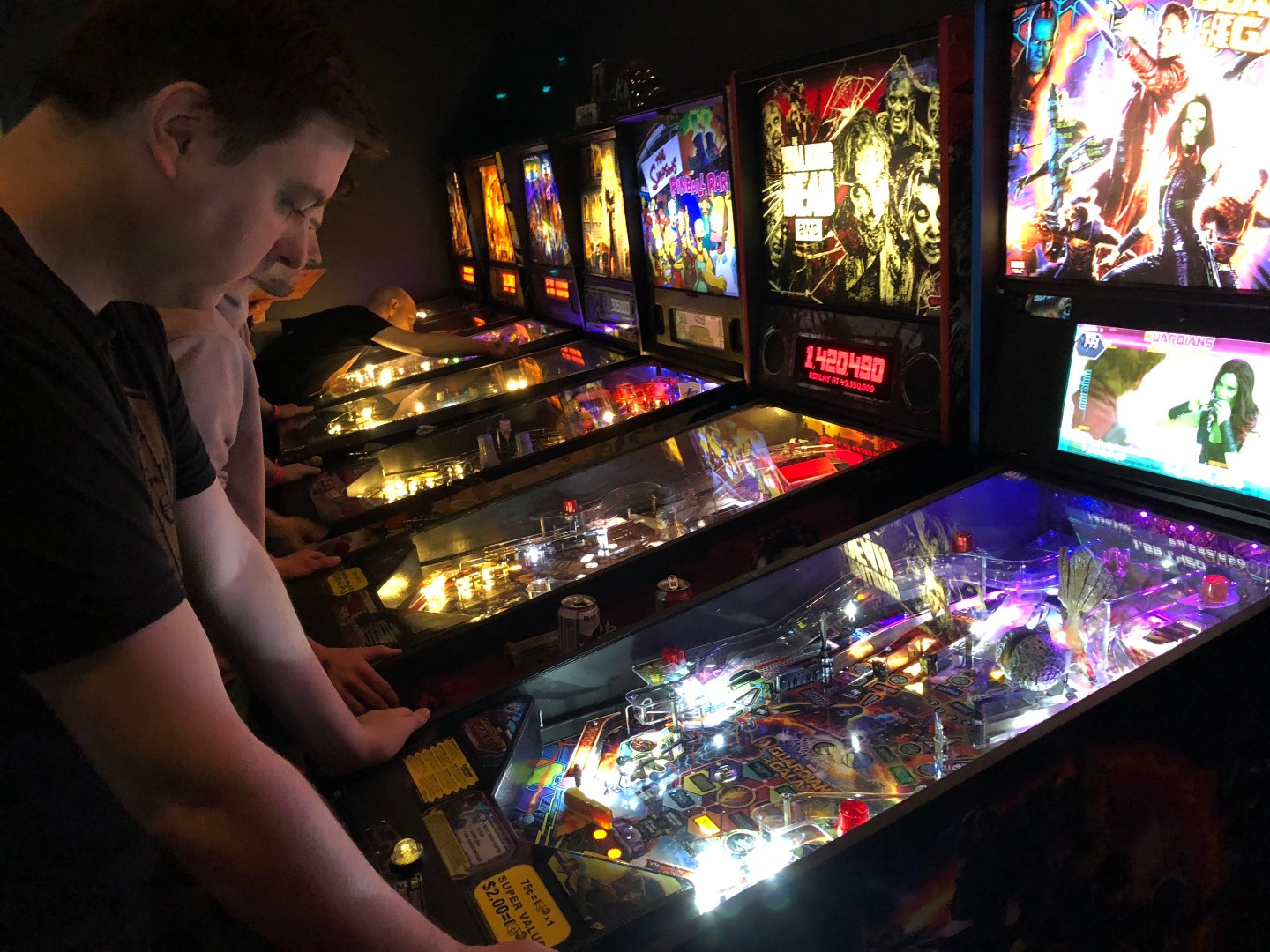
In the past decade, the number of people competing in IFPA-sanctioned tournaments has grown annually by double digits. Last year, more than 7,000 such events took place, a 31% increase over the previous year. In pinball—or more accurately, the places it’s played—this increasingly large group has found a “third place,” a shared space away from home, work, and school, where widely divergent communities can coalesce organically.
Many of history’s best-known third places—from Prohibition-era gambling dens, to postwar bowling alleys, to ’80s arcades—have featured pinball machines. Modern-day “barcades,” dive bars, and entertainment centers even lured dedicated players from their private basement collection of machines to “location” play. There, an often-passionate, unexpectedly warm, and fast-growing global community of players turned to the game for escape, engagement, challenge, reflection, and camaraderie.
Until last week, that is.
“Pinball is somewhat unique in that it’s literally all of the bad things that you can do as far as personal health and cleanliness can go,” says Zoë Vrabel, one of Oregon’s IFPA state directors and a member of the IFPA women’s advisory board.
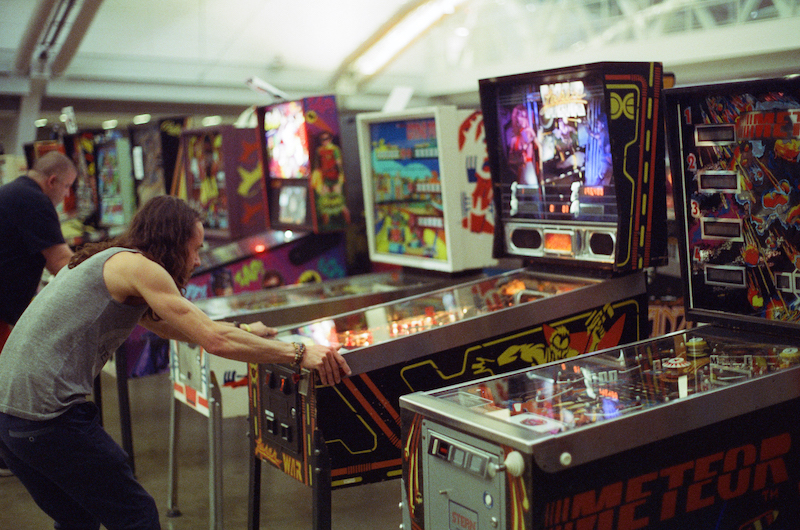
Unlike online video gamers and e-sports players, Urban, Zahler, and tens of thousands of other pinballers worldwide swap turns—and possibly worse—fingering flipper buttons and nudging machines with their bare hands. You can’t win a pinball tournament without pressing the same plastic buttons, leaning on the same metal lockdown bars, or nudging the same wooden cabinets that dozens or hundreds of opponents have already touched, leaned against, or nudged.
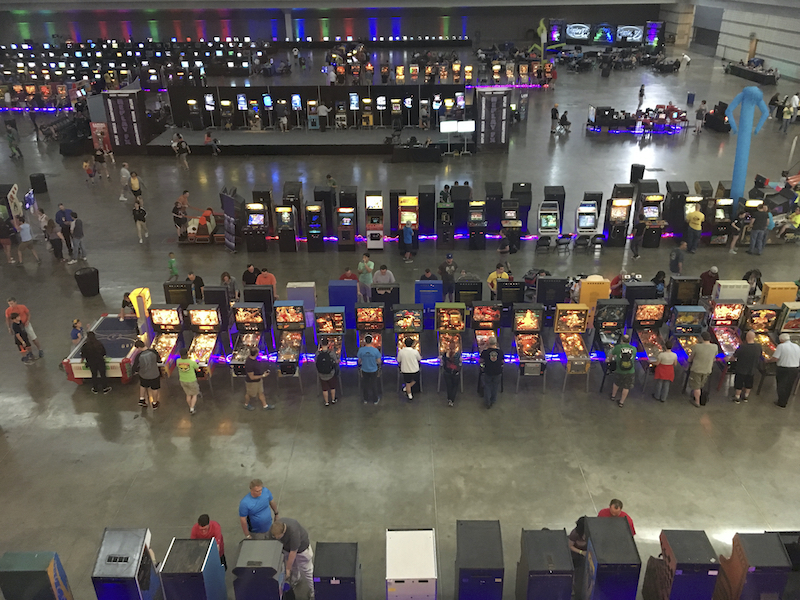
When Zahler approached the Iron Man machine for his last of three balls, both he and Urban had won three games in the best-of-seven final round. After a bad bounce at the end of his final ball, Urban had finished the game with just over 5.6 million points. Zahler’s 2.1 million put him in striking distance. And with few key shots, he could still bring the title home to Long Branch, N.J.
But after Zahler plunged his final ball, it careened around the machine’s right side. Zahler trapped it on a flipper, aimed, flipped, and then watched as his hopes vanished. The ball ricocheted from a super-villain figurine, caromed right, and bounced back toward a ball-ending “outlane” near the teenager’s left hand. Unable to do anything to alter the ball’s trajectory, he shoved the 250-pound machine, wailed in frustration, and walked away, as useless warnings lit the score display.
“Danger,” the orange dot-matrix lettering flashed.
“Danger,” It flashed again.
“Tilt”
“Game Over”
Back in Portland, members of the pinball community watching online celebrated Urban, their hometown hero, with posts on the match’s Twitch live-stream and a Facebook group. “PDX!” they cheered digitally, and “Go Colin!”
But the new champion’s joy would be short-lived. By the time the Urbans returned to Portland, the world itself was hurtling toward a frenzy of social distancing and curve flattening. The goal, in this new game, was to keep the numbers as low as possible by making as little contact as possible.
The fear of the coronavirus’s spread started earlier in Portland and Seattle than in most American cities. At the time of the tournament, Seattle had the highest concentration of reported COVID-19 diagnoses in the U.S. Both Pacific Northwest cities, it so happens, are also home to two of the busiest competitive pinball scenes in the country.
“That was a vastly different world seven days ago,” said IFPA president, Josh Sharpe, a week after his organization’s championships. On March 16 he released a statement announcing that the IFPA wouldn’t sanction new tournaments until March 31—at the earliest.
Great, good game over?
“So many people have found their community in pinball,” says Vrabel, who owns pinball machines of her own. But it’s not the game itself that social distancing is destroying. Vrabel, whose job lets her work from home, calls pinball her excuse to go out into the world. “So much of what the pinball community is,” she says, “is going to bars with your pinball-playing friends. That’s evaporated.”
Vrabel, like people with other hobbies and hangouts, has lost her third place, a term coined by sociologist Ray Oldenburg in his 1989 bestseller, The Great Good Place.
“The real value of a third place is that everybody is equal there,” Oldenburg says via phone from his Pensacola, Fla., home. “You don’t find that in any other kind of situation.”
Oldenburg has long lamented suburbia’s lack of third places, but in the age of the coronavirus and social distancing, residential isolation suddenly has a new value.
“The suburban world was built for the kind of problem we’re having right now with the virus, because the suburban world is designed for loneliness,” Oldenburg says. “There’s no public life.”
Subscribe to Outbreak, a daily roundup of stories on the coronavirus pandemic and its impact on global business. It’s free to get in your inbox.
While quarantining might help protected public health, it may also put third places at risk. Most of these spaces are more mundane than pinball halls, of course. Coffee shops, gyms, and neighborhood stores are just as valuable to their regulars. Third places are defined less by the walls enclosing them than by how people connect within them.
Near Oldenburg’s home, for example, Hardee’s fast-food restaurants are common third places, he says. At one location eight people gather for cups of coffee at 6 a.m., while an 8 a.m. group brings out six regulars.
“All they do is talk,” he says.
“The axis of my social life”
With the halt to public life, right now so much of people’s interaction is happening online, including on pinball-focused message boards like Tilt Forums and numerous regional Facebook groups. Anxiety in posts to these groups heightened as the first weekend of nationwide sequestering approached, and pinball events large and small were either canceled or postponed. Accounts of favorite pinball haunts shuttering and players laid off from their jobs were crippling for some to read. All anyone wanted was to get together to lament the closures together, and they couldn’t.
One post came from Dana Valatka, a drummer who lost his bartending job when another bar and arcade, Portland’s QuarterWorld, closed. Normally, Tuesday night is the highlight of the week for bartenders, restaurant servers, concert light riggers, and other locals who love pinball. That’s when a series of Flip City Weeklies take place around town. By March 17, the series had been put on hold indefinitely.
Valatka described himself as an introvert who generally feels relieved when plans get canceled. “But I’ve always [looked] forward to Tuesdays,” he wrote. “I get cranky when something makes me miss Flip City. Tuesday is the axis of my social life.”
Mario Small, a Harvard sociologist who writes about social networks, says online interactions haven’t eclipsed society’s need to interact in person.
“Physical space ends up being way more important than people realize,” Small says. “It has not ceased to be important in age of the Internet.”
Forced isolation to combat the COVID-19 outbreak will come with other costs. “What’s so ironic about this is that the thing we need most in order to preserve society,” Small says, “is abandoning the entities that we need to preserve society.”
When the owners of some pinball establishments started renting out pinball machines after closing their doors, a poster to another pinball Facebook group wondered how soon people would start opening their own “speakeasies” to play together.
The joke makes sense, says Small. “I would not be surprised if, a few weeks from now—especially here in a country where people are used to personal freedom and a strong sense of self-determination—people start coming up with alternative ways of gathering, quietly,” he says.
Carly Kocurek, an associate professor of humanities at the Illinois Institute of Technology who studies the cultural history of video games, says arcades are community institutions that help players feel “like a whole person.”
But it remains to be seen how such institutions will look after this crisis, she adds: “I really hope that in 10 years we look back and see that we came up with valid solutions, and don’t just remember that time when all the restaurants closed, and all the bars closed, and all the arcades closed.”
Social creatures, solo players
Only 18 months ago, Chris Rhodes, a longtime Portland pinball operator and player, and business partner Alan Robertson opened Wedgehead, a bar, pinball parlor, and restaurant. They were just starting to feel the business turn a corner financially when the outbreak hit. Now they’re shutting their business down.
It’s a painful moment, but Robertson and Rhodes have been soothed somewhat by an outpouring of support. Robertson in particular hadn’t realized how important his business had become for its customers.
“People said things like, ‘This is our second home,’” he says. “When you run a gathering spot, it kind of takes on a mind of its own—you have a clientele that remembers all its times there.”
On March 17, instead of getting ready for a Kirk Russell birthday bash they host annually as a cheeky reply to ubiquitous Saint Patrick’s Day parties, Robertson and Rhodes spent the afternoon emptying coin boxes and liquidating whatever they could to make payroll. (Robertson stressed that as hard a hit as they were taking, it was equally hard, if not more so, for their employees.) As the coronavirus forces all nonessential business to grind to a halt, the duo can’t envision any scenario where they can reopen without some kind of business loan or other outside assistance.
“It does feel like a special part of being human is torn away from us, which is that social gathering aspect,” Robertson says. “There’s no normal coping, because we are social creatures. To be told that we can’t (gather with others) feels particularly cruel.”
Back in Denver, a week and a half and more than 200,000 confirmed coronavirus cases earlier, Sharpe presented Colin Urban with a gigantic pinball-shaped trophy, a plaque, and a golden key good for a free, brand-new pinball machine from Stern Pinball.
Urban was looking forward to playing in the IFPA’s 17th World Pinball Championship in Fort Meyers, Fla., at the end of May, as well as the Epstein Cup, a tournament that pits teams of the best pinball players from the U.S. and Europe against one another, later this year. Only top players qualify for the Epstein Cup, and Urban is worried about how long he can maintain his rank. “All the best players in the world are going to be there,” he says.
At least, they might be—Urban knows the event could be canceled tomorrow. He understands, but he’d be disappointed. Urban has played against his potential teammates in tournaments, and the Epstein Cup offers a rare opportunity to be a part of something much larger than his own point total: a team.
Now, instead of the usually busy summer tournament season, the only pinball Colin might play will be the Jurassic Park–themed game he hopes to ask Stern for as his tournament prize.
He’ll be by himself, but then again, so will everyone else.
And in that, at least, he won’t be alone.
More must-read stories from Fortune:
—Venues are getting a crash course in postponement clauses thanks to the coronavirus
—How my job as a member of the Philadelphia Orchestra has changed
—The coronavirus pandemic could mark a huge shift in the fitness industry
—Listen to Leadership Next, a Fortune podcast examining the evolving role of CEOs
—The global wine industry faces an unknown future in the wake of COVID-19
—WATCH: Can San Francisco Be Saved?
Subscribe to Outbreak, a daily roundup of stories on the coronavirus pandemic and its impact on global business. It’s free to get in your inbox.