• Home
  • Latest
  • Fortune 500
  • Finance
  • Tech
  • Leadership
  • Lifestyle
  • Rankings
  • Multimedia

Trendingnow

1

The millennial generation is split in 2: an older crowd with boomer-style comfort, a younger set going 'back to the early 1900s'

2

'The demographic dividend of the last 40 years is ending': J.P. Morgan says the world is running out of the two things that kept interest rates down

3

Jensen Huang made his $172 billion fortune on AI chips. His family's $75 million gift to Vanderbilt argues art decides what technology is for

1

The millennial generation is split in 2: an older crowd with boomer-style comfort, a younger set going 'back to the early 1900s'

2

'The demographic dividend of the last 40 years is ending': J.P. Morgan says the world is running out of the two things that kept interest rates down

3

Jensen Huang made his $172 billion fortune on AI chips. His family's $75 million gift to Vanderbilt argues art decides what technology is for
Finance

Here’s Why Critics Think Changes to the ‘Volcker Rule’ Could Increase Risk and Leave Taxpayers Bailing Out Banks (Again)

By
Erik Sherman
Erik Sherman
Down Arrow Button Icon
By
Erik Sherman
Erik Sherman
Down Arrow Button Icon
August 26, 2019, 1:08 PM ET
Add Fortune on Google for similar content.

After big banks received a bailout during the Great Recession (with taxpayer money) one guardrail that followed was increased regulation. Part of the overall Dodd-Frank regulatory framework was the Volcker Rule, which put boundaries on types of risky transactions banks could undertake. After years of bank lobbying, two regulatory bodies out of a necessary five last week agreed to a set of changes that would soften the rule. The other three look ready to agree, potentially removing important limits on the types of risk banks can take, critics say.

The Volcker Rule’s intent was to protect taxpayers. “Depository institutions [like consumer banks] are very much under the safety net of the government,” said Andrew Metrick, a professor of finance and management at Yale and director of the university’s Program on Financial Stability who served in the Obama administration on the staff that created the Volcker Rule.

The Federal Deposit Insurance Corporation (FDIC) sticker on your bank’s glass door indicates government insurance that protects up to $250,000 of your deposits. Because it’s a federal program, taxpayers provide the protection. When a bank speculates and loses big, it can involve depositors’ funds and, ultimately, FDIC insurance payments to them. Washington Mutual became insolvent in 2008 because customers became worried over reported trading activity, pulled $16 billion from deposits over a 10-day period, and left the bank unable to operate. The FDIC stepped in.

“If I [am a bank and] get spooked and think Bank A is starting to have problems, I’ll stop lending to it,” said banking regulation consultant Mayra Rodriguez Valladares. “Others will find out and the next thing you know, that bank is over. That’s why it’s so important that banks don’t take on excessive risk.”

Banks object

One activity that helped bring on the economic collapse was reckless investments in byzantine financial instruments called derivatives. A derivative is a contract between two parties. One is is obligated to pay the other, depending on triggers of various financial assets, like the value of a stock price or whether a company defaults on a bond it issues. Derivatives often help companies hedge future losses. For example, airlines use derivatives to lock in future fuel prices.

Banks also use derivatives to offset such things as swings in interest or currency exchange rates, or even help customers engage in derivatives trading. The banks can also speculate to increase profits, called “prop” (for proprietary) trading.

The Volcker Rule tried to ensure that prop trading could not ultimately rely on FDIC insured deposits as insulation against risky decisions and losses. Many types of derivative trading became forbidden. But because the difference between prop and other trading could be difficult to discern, the rule was complicated. In its final form in 2014, the rule was 71 pages long accompanied by 900 pages of explanations.

The banking industry immediately objected and kept doing so. In 2018, the Trump administration—which had publicly expressed its dislike of regulation—suggested the first modifications. The FDIC and another regulator with power over banks, the Office of the Comptroller of the Currency (OCC), have now both approved an extensive set of changes. Three other bank regulators—the Federal Reserve, the Securities and Exchange Commission, and the Commodity Futures Trading Commission—are expected to do so in the near future, which will alter the Volcker Rule.

Critics worry

Martin Gruenberg, the only member of the FDIC to oppose the new rules, created a chart, shown below, to show how much prop trading would be covered under the new rules.
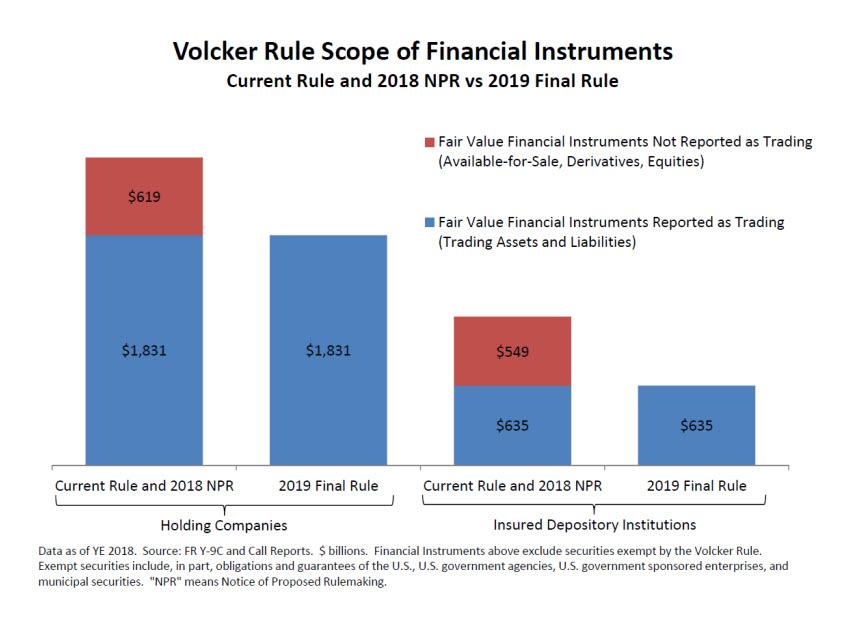
The change is significant, cutting hundreds of billions of activity from regulatory cover and opening the door to more.

Many in the industry think worries are unnecessary and the changes, useful. “The changes to the Volcker Rules provide three very important things to banks,” said Thomas Ko, a partner with law firm Stroock & Stroock & Lavan and an expert in banking law. “It reduces ambiguity. It tailors the Volcker rule to the size and complexity of the institution [and lightens the burden on smaller banks]. Lastly, it increases transparency [to the regulators and banks].”

“I think the [original] rule oversteps in a lot of ways and was very onerous on a lot of banks [when] it didn’t need to be,” said Joe Sergienko, director of banking, insurance, and capital markets at management consulting firm Navigant Consulting.

Not everyone agrees. Banks are full of “traders under a lot of pressure to make more money,” said Valladares. Low and even negative interest rates will make profits harder to find. “Lots of different securities and derivatives will no longer be covered. This will have traders take on more risk. In combination with a very tired economic expansion … I think the timing is terrible.” Even Sergienko, who is in favor of the changes, said of Gruenberg’s analysis, “The chart jumps off the page. His statement rang very true about how much is not covered and that concerns me.”

In a written statement at the time of the FDIC’s vote, Gruenberg explained his opposition, saying it would “effectively undo the Volcker Rule prohibition on proprietary trading by severely narrowing the scope of financial instruments subject to the Volcker Rule.”

“If you leave the decision to the banks to say if it’s a prop trade or not, it looks like the American Bankers Association is saying, ‘Trust us,'” said Kurt Schacht, managing director of standards and advocacy for the CFA Institute. “And the question is, should we?”

More must-read stories from Fortune:

—A rare tech company where women dominate
—Why WeWork won’t be in the S&P 500 after its IPO
—Is it “only human” to feel anxious about money? Talking finance with Sophia the Robot
—Europe’s cyber watchdog for banks has a problem—it keeps getting hacked
—Listen to our audio briefing, Fortune 500 Daily
Follow Fortune on Flipboard to stay up-to-date on the latest news and analysis.

About the Author
By Erik Sherman
See full bioRight Arrow Button Icon
Add Fortune on Google for similar content.

Latest in Finance

Finance
Lorem ipsum dolor sit amet, consectetur adipiscing elit, sed do eiusmod tempor incididunt ut labore et dolore magna aliqua. Ut enim ad minim veniam
By Fortune Editors
October 20, 2025
Finance
Lorem ipsum dolor sit amet, consectetur adipiscing elit, sed do eiusmod tempor incididunt ut labore et dolore magna aliqua. Ut enim ad minim veniam
By Fortune Editors
October 20, 2025
Finance
Lorem ipsum dolor sit amet, consectetur adipiscing elit, sed do eiusmod tempor incididunt ut labore et dolore magna aliqua. Ut enim ad minim veniam
By Fortune Editors
October 20, 2025
Finance
Lorem ipsum dolor sit amet, consectetur adipiscing elit, sed do eiusmod tempor incididunt ut labore et dolore magna aliqua. Ut enim ad minim veniam
By Fortune Editors
October 20, 2025
Finance
Lorem ipsum dolor sit amet, consectetur adipiscing elit, sed do eiusmod tempor incididunt ut labore et dolore magna aliqua. Ut enim ad minim veniam
By Fortune Editors
October 20, 2025
Finance
Lorem ipsum dolor sit amet, consectetur adipiscing elit, sed do eiusmod tempor incididunt ut labore et dolore magna aliqua. Ut enim ad minim veniam
By Fortune Editors
October 20, 2025

Most Popular

Finance
Lorem ipsum dolor sit amet, consectetur adipiscing elit, sed do eiusmod tempor incididunt ut labore et dolore magna aliqua. Ut enim ad minim veniam
By Fortune Editors
October 20, 2025
Finance
Lorem ipsum dolor sit amet, consectetur adipiscing elit, sed do eiusmod tempor incididunt ut labore et dolore magna aliqua. Ut enim ad minim veniam
By Fortune Editors
October 20, 2025
Finance
Lorem ipsum dolor sit amet, consectetur adipiscing elit, sed do eiusmod tempor incididunt ut labore et dolore magna aliqua. Ut enim ad minim veniam
By Fortune Editors
October 20, 2025
Finance
Lorem ipsum dolor sit amet, consectetur adipiscing elit, sed do eiusmod tempor incididunt ut labore et dolore magna aliqua. Ut enim ad minim veniam
By Fortune Editors
October 20, 2025
Finance
Lorem ipsum dolor sit amet, consectetur adipiscing elit, sed do eiusmod tempor incididunt ut labore et dolore magna aliqua. Ut enim ad minim veniam
By Fortune Editors
October 20, 2025
Finance
Lorem ipsum dolor sit amet, consectetur adipiscing elit, sed do eiusmod tempor incididunt ut labore et dolore magna aliqua. Ut enim ad minim veniam
By Fortune Editors
October 20, 2025
Fortune Secondary Logo
Rankings
  • 100 Best Companies
  • Fortune 500
  • Global 500
  • Fortune 500 Europe
  • Most Powerful Women
  • World's Most Admired Companies
  • See All Rankings
  • Lists Calendar
Sections
  • Finance
  • Fortune Crypto
  • Features
  • Leadership
  • Health
  • Commentary
  • Success
  • Retail
  • Mpw
  • Tech
  • Lifestyle
  • CEO Initiative
  • Asia
  • Politics
  • Conferences
  • Europe
  • Newsletters
  • Personal Finance
  • Environment
  • Magazine
  • Education
Customer Support
  • Frequently Asked Questions
  • Customer Service Portal
  • Privacy Policy
  • Terms Of Use
  • Single Issues For Purchase
  • International Print
Commercial Services
  • Advertising
  • Fortune Brand Studio
  • Fortune Analytics
  • Fortune Conferences
  • Business Development
  • Group Subscriptions
About Us
  • About Us
  • Press Center
  • Work At Fortune
  • Terms And Conditions
  • Site Map
  • About Us
  • Press Center
  • Work At Fortune
  • Terms And Conditions
  • Site Map
  • Facebook icon
  • Twitter icon
  • LinkedIn icon
  • Instagram icon
  • TikTok icon
  • YouTube icon

Latest in Finance

The ‘Trump Trade’ is turning into a loser in the stock market
InvestingStock
The ‘Trump Trade’ is turning into a loser in the stock market
By Geoffrey Morgan, Joel Leon and BloombergJuly 25, 2026
1 hour ago
Trump pulls back after Iran crosses his red line as U.S. military breaks two-week streak of airstrikes amid talks for potential Hormuz deal
Middle EastIran
Trump pulls back after Iran crosses his red line as U.S. military breaks two-week streak of airstrikes amid talks for potential Hormuz deal
By Jason MaJuly 25, 2026
2 hours ago
U.S. military suddenly goes silent on Iran airstrikes while Houthi rebels and Saudi Arabia exchange attacks in battle over Red Sea shipping
EnergyIran
U.S. military suddenly goes silent on Iran airstrikes while Houthi rebels and Saudi Arabia exchange attacks in battle over Red Sea shipping
By Samy Magdy, Giovanna Dell'Orto and The Associated PressJuly 25, 2026
7 hours ago
Can Apple’s incoming CEO bring back the product design mojo of the Steve Jobs era?
MagazineApple
Can Apple’s incoming CEO bring back the product design mojo of the Steve Jobs era?
By Sebastian HerreraJuly 25, 2026
8 hours ago
t
EconomyInflation
Meet the Americans learning to go without after the biggest grocery inflation in 50 years
By Dee-Ann Durbin, Terry Tang, Maggie Scales, Sandy Guatibonza, Hikari Mae Hida and The Associated PressJuly 25, 2026
8 hours ago
g
EconomyInflation
‘Rockets and feathers’: Economists say grocery prices shoot up like the first, fall like the second
By Dee-Ann Durbin and The Associated PressJuly 25, 2026
8 hours ago

Most Popular

The millennial generation is split in 2: an older crowd with boomer-style comfort, a younger set going 'back to the early 1900s'
Real Estate
The millennial generation is split in 2: an older crowd with boomer-style comfort, a younger set going 'back to the early 1900s'
By Nick LichtenbergJuly 25, 2026
11 hours ago
'The demographic dividend of the last 40 years is ending': J.P. Morgan says the world is running out of the two things that kept interest rates down
Economy
'The demographic dividend of the last 40 years is ending': J.P. Morgan says the world is running out of the two things that kept interest rates down
By Eleanor PringleJuly 24, 2026
2 days ago
Jensen Huang made his $172 billion fortune on AI chips. His family's $75 million gift to Vanderbilt argues art decides what technology is for
Big Tech
Jensen Huang made his $172 billion fortune on AI chips. His family's $75 million gift to Vanderbilt argues art decides what technology is for
By Sydney LakeJuly 23, 2026
3 days ago
An 11-year-old is cleaning his neighbors' trash cans for $10 each—he now has 100K followers as teens face the worst summer job market since 1948
Success
An 11-year-old is cleaning his neighbors' trash cans for $10 each—he now has 100K followers as teens face the worst summer job market since 1948
By Orianna Rosa RoyleJuly 25, 2026
13 hours ago
The $39 trillion U.S. national debt isn’t as high as Japan’s and Singapore’s relative to economy size—and yet it's still worse somehow
Economy
The $39 trillion U.S. national debt isn’t as high as Japan’s and Singapore’s relative to economy size—and yet it's still worse somehow
By Sasha RogelbergJuly 23, 2026
2 days ago
Jensen Huang just used his first ever X post to warn the AI industry not to make the mistake that software narrowly avoided in the 1980s
AI
Jensen Huang just used his first ever X post to warn the AI industry not to make the mistake that software narrowly avoided in the 1980s
By Nick LichtenbergJuly 24, 2026
1 day ago

© 2026 Fortune Media IP Limited. All Rights Reserved. Use of this site constitutes acceptance of our Terms of Use and Privacy Policy | CA Notice at Collection and Privacy Notice | Do Not Sell/Share My Personal Information
FORTUNE is a trademark of Fortune Media IP Limited, registered in the U.S. and other countries. FORTUNE may receive compensation for some links to products and services on this website. Offers may be subject to change without notice.