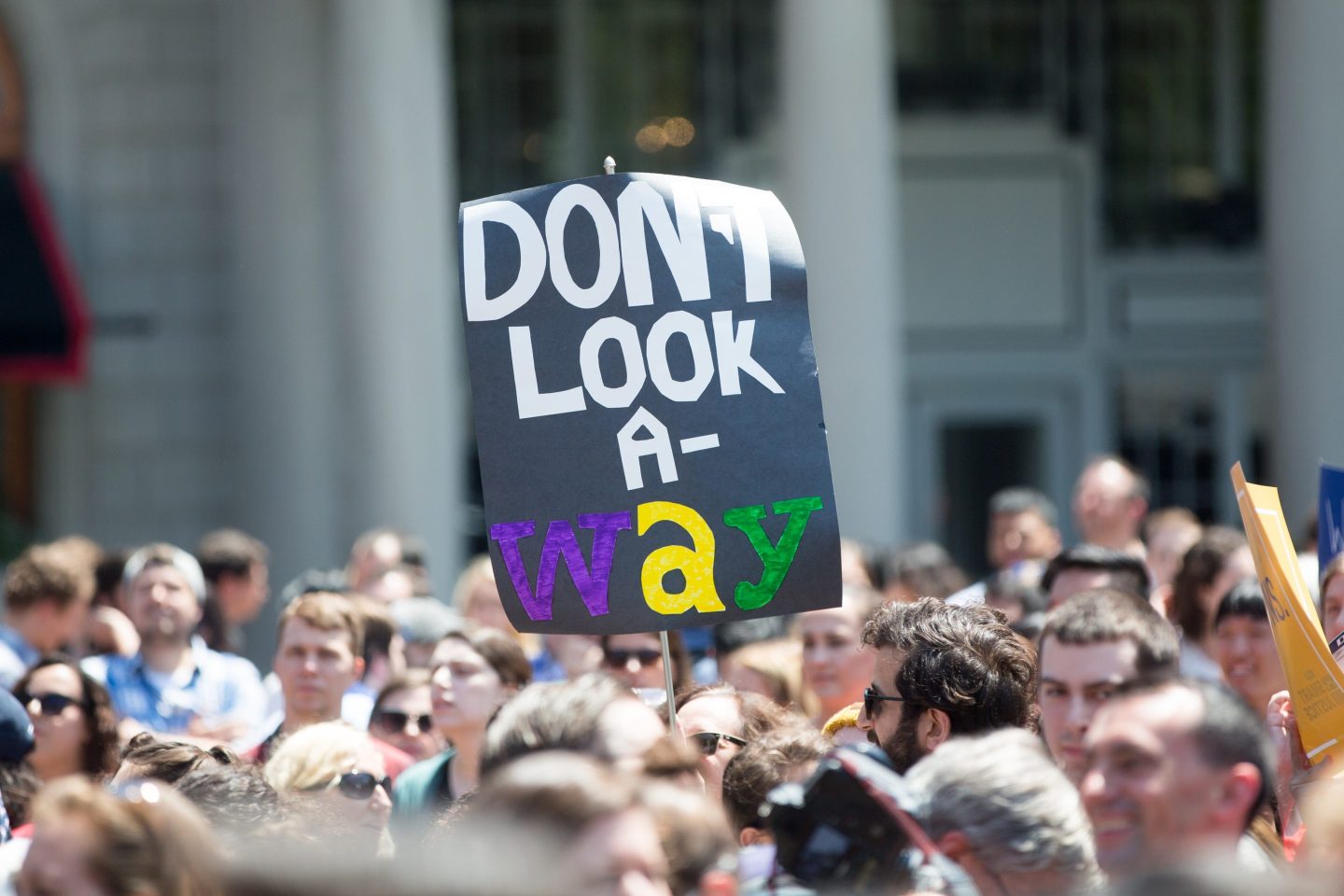
Wayfair recently found itself the subject of unwanted attention when word leaked online that it had received a $200,000 order to supply furniture to one of the detention centers in Texas that have become a flashpoint for American politics amid reports of overcrowding and unhygienic conditions. Wayfair’s CEO, Niraj Shah, was initially caught flat-footed by the criticism, as employees staged a walkout in late June that drew support from Sen. Elizabeth Warren and Rep. Alexandria Ocasio-Cortez.
The walkout hardly received universal approval. “It would be one thing if the protests were against the sale of stun guns and rubber hoses to camp supervisors,” Politico’s Jack Shafer wrote in a representative critique. “But they’re protesting the sale of bedding! Can they really believe that nobody should sell bedding to the camp operators?”
Shafer has a point. But whatever one thinks of the tactical wisdom of the protestors, events like the Wayfair walkout tell us a lot about how capitalism is becoming an accomplice for social change. Consider the various types of commercial demonstrations we’ve seen in the past decade. There are consumers protesting public officials by exerting pressure on private companies, as with the #GrabYourWallet protest that compelled Nordstrom to stop carrying Ivanka Trump’s clothing line. There are corporations pushing back against government policies, such as the boycott threats by major companies in 2015 that forced lawmakers in Indiana to amend a religious liberty law to protect the rights of LGBT Americans. And there are examples of employees attempting to change company policy by withholding work, such as the worldwide walkouts last November by Google workers in protest of the company’s handling of sexual harassment.
In all of these cases, it is the threat of losing money—whether in the form of sales, tax receipts, or lost work—that compels entities to act. Such protests, of course, are nothing new, but what has made them especially attractive in recent years is the indispensable role social media has played in broadcasting and bolstering such efforts.
Consider the timeline of the Wayfair walkout. The first tweet about the leaked contract to supply detention centers was sent at 10:45 a.m. Eastern Time on June 25. By 11:38 a.m., disgruntled employees had set up a @wayfairwalkout account and were promoting a protest for the very next day. The following afternoon, fewer than 27 hours after the original tweet, the walkout was underway in Boston with coverage by a phalanx of major media outlets.
Such efforts have not been without controversy, but whatever one thinks about them in any specific instance probably says more about a person’s political opinions than the phenomenon of activist capitalism, which is a bipartisan affair. Indeed, less than a week after the Wayfair walkout, conservatives were calling for a boycott of Nike for its perceived anti-American bias in suspending production of a line of shoes featuring the 13-star version of the American flag. Right-wing superstars such as Sen. Ted Cruz and Fox News host Laura Ingraham pledged they would no longer buy Nike products.
The message of the boycott was clear: Nike was being a bad citizen, and consumers should use their pocketbooks to teach the company an important lesson in civics.
The rise of social media-amplified efforts to use labor and purchasing power to bring about social change is an extraordinary development in contemporary capitalism. Such initiatives represent more decentralized and thoroughly democratic examples of the kind of exercises in monetary might long employed by wealthy individuals to change the world around them.
If we accept the notion that millionaires and billionaires can use the power of their purses to disproportionately shape society—whether by setting the culture of private companies, establishing philanthropic institutions, or using money as a carrot or cudgel to achieve political aims—the idea that there is anything wrong with small platoons of Americans joining together to work toward their own vision of an ideal world seems unsporting to say the least.
Indeed, the fact that any single individual might ever have so great a say in public affairs has always been the oligarchic defect of meritocratic societies, and the possibility that the mass communication tools freely afforded by social media can rebalance the scales in favor of social change by the many, rather than the few, seems like a shot in the arm for democracy.
Are there dangers posed by the rise of activist capitalism? Sure, but they aren’t altogether different than any other threats posed by allowing the wealth of single individuals to shape the public sphere. We freely allow that private money will embolden social movements, influence institutional decision-making, underwrite the arts and sciences, and, most importantly, help to determine the aim and scope of American politics. Since money can give anyone a megaphone in the public square, the really important question is: Who gets to hold it?
Increasingly, by pooling their labor and purchasing power, a larger number of Americans are claiming their time at that megaphone. They are noisy, to be sure, and taken at once, their messages can be confusing, but if you listen closely you just might hear something extraordinary: the announcement of a new chapter in the history of American capitalism.
John Paul Rollert is an adjunct associate professor at the University of Chicago Booth School of Business. He also writes the In-House Ethicist column for the Chicago Booth Review. You can follow him on Twitter @jprollert.