• Home
  • News
  • Fortune 500
  • Tech
  • Finance
  • Leadership
  • Lifestyle
  • Rankings
  • Multimedia
HealthBrainstorm Health

In Healthcare, the Smart Money Is Focused On Fixing the System

Andrew Nusca
By
Andrew Nusca
Andrew Nusca
Editorial Director, Brainstorm and author of Fortune Tech
Down Arrow Button Icon
Andrew Nusca
By
Andrew Nusca
Andrew Nusca
Editorial Director, Brainstorm and author of Fortune Tech
Down Arrow Button Icon
March 20, 2018, 12:14 PM ET
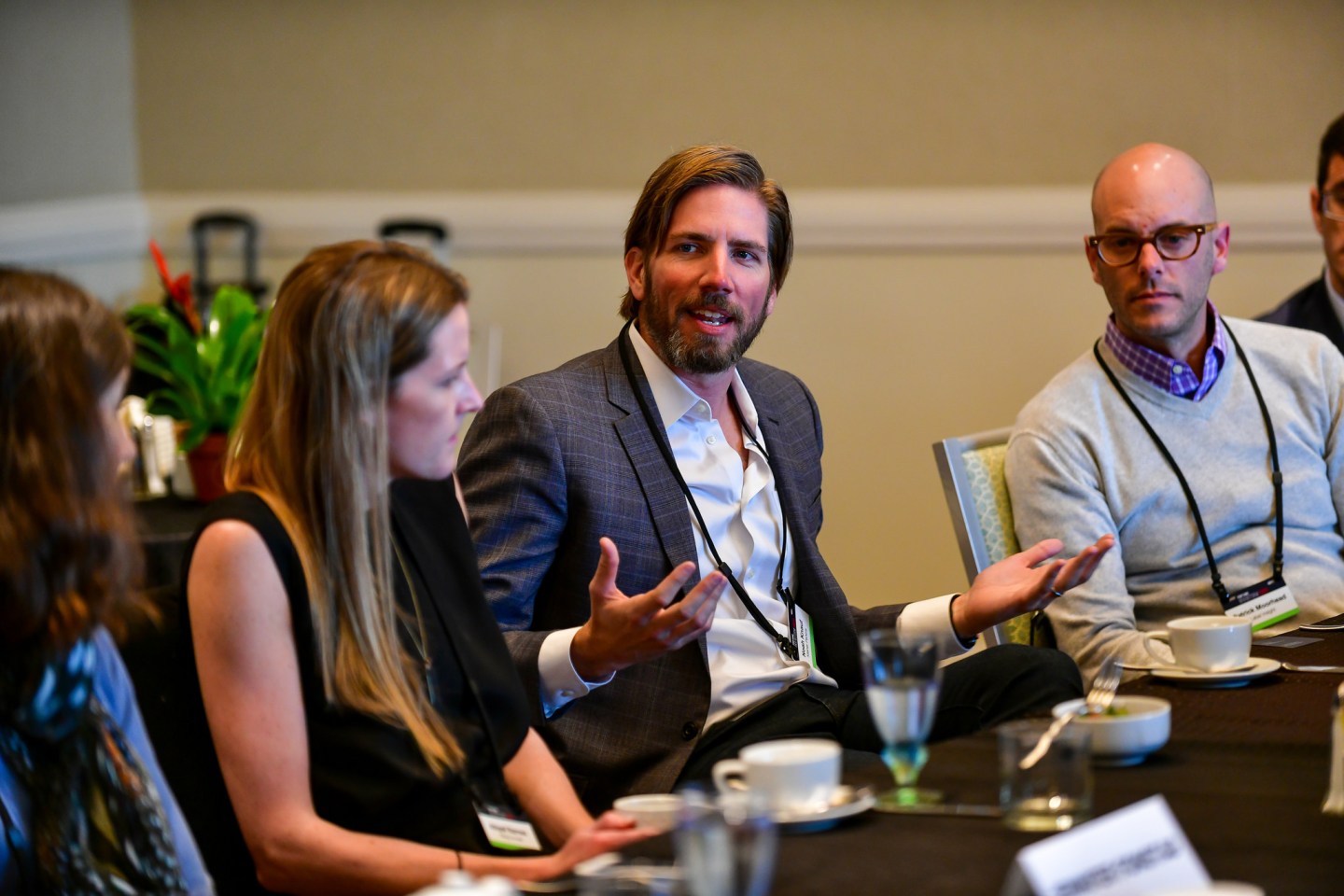
Kleiner Perkins general partner Noah Knauf speaking at the 2018 Fortune Brainstorm Health conference in Laguna Niguel, Calif.
Kleiner Perkins general partner Noah Knauf speaking at the 2018 Fortune Brainstorm Health conference in Laguna Niguel, Calif.Photograph by Stuart Isett/Fortune

LAGUNA NIGUEL, Calif.—Some $5.8 billion poured into digital health care companies in 2017—a record—and yet most signs suggest the revolution is only getting started.

Industry experts gathered here at Fortune’s Brainstorm Health conference to discuss which areas were most ripe for investment. Genome editing? Personalized medicine? New data-driven tools?

Yet over breakfast on Tuesday, it became clear that the biggest value would come from fixing the health system’s fundamental flaws—flaws, they argued, that stymied any glittering tech innovations.

“What do we have to show for all of that investment?” Fortune senior writer Michal Lev-Ram, the moderator, asked the room.

“‘Show for it’ is a tough metric,” acknowledged Brain Capital Ventures managing director Yumin Choi. When he speaks to companies, Choi said, “They’re thirsting for new innovation but also consolidation of technology…people are saying, ‘I want to see real companies. Companies that are going to last.'”

And that’s why “the dollars in is not the best metric to track,” Choi said. “I always look at the customer base and who’s buying what as a leading indicator.”

Besides, “Anytime you have a technology or innovation, it takes awhile to percolate out into the community,” said Aspect Ventures co-founder Jennifer Fonstad. “We’re kind of at 1%, maybe 2%. We’ve got a long way to go.”

There’s room for some optimism, said Kleiner Perkins general partner Noah Knauf. “It’s this moment in time finally when everything’s aligned. The data’s there,” he said. For so long, the industry was working to just collect it. “It’s in the system,” he said. “It’s not a problem anymore. And that’s where interesting businesses emerge.”

David Singer, managing partner at Maverick Ventures, concurred. “You are starting to see companies do things with their employee base that were once unnatural,” he said. “I think it’s super encouraging.”

And it’s the right amount of investment. “Dollars follow opportunity, right?” asked Greycroft co-founder Ian Sigalow. At $5.8 billion, that’s about 25% to 30% of venture capital dollars, and that’s about the right ratio compared to health’s share of overall U.S. GDP. “I don’t think people are overweight with healthcare right now,” he said.

Here’s the frustration, though: The tech adoption curve is not really driven by consumers. That’s starting to change, Choi noted, but it’s still early days. He experienced this himself when he had a blocked tear duct and went to Massachusetts General Hospital in Boston. “It was a horrible experience” with back-office waste that had him shuttling between medical professionals for process reasons instead of getting proper medical attention. “There are a lot of things that we feel we’re paying out of pocket,” he said. “Still, the majority of dollars are not coming from consumers.”

The dollar shift to transparency, and away from fee-for-service, will help change things, Choi added. But innovations tend to be adopted over decades and not days. “I think we’re in the early innings of that happening,” he said.

Sigalow nodded in agreement. “The last 10 years have been light speed compared to the Salk vaccine,” he said.

Singer interjected to ask a question of the room: How many people get their healthcare bills in the mail? Many hands went up.

“It’s really messed up,” he said. “It’s the only category in which the U.S. Postal Service is growing.” The group laughed. It’s not that medical organizations can’t give us a great experience, he said. “It’s just that they can’t. There’s inertia.” We haven’t yet reached a tipping point where data show that rising copays are causing this. “But I think it’s coming,” he added.

In other words, there are broader systemic issues at play here. It’s not the technology that’s lacking—it’s the structure of the system itself. “You would have this consumer conversation with physicians years ago and it was heretical that consumers would have anything to do with their healthcare,” Knauf said with some disbelief.

A male entrepreneur seated across the table agreed with him. The entrepreneur was working in the mobile-consumer category before deciding to move to health. He was overwhelmed by the shift. “The differences are just mind-blowing,” the entrepreneur said. “It is remarkable how systems are built to [destroy] innovation.” It is crazy, for example, that patients don’t pay for their services. “The system is truly messed up,” he said flatly.

“‘System’ is a generous word for it,” a female participant shouted from the other side of the table.

Delos “Toby” Cosgrove, the onetime Cleveland Clinic CEO, leaned forward and rested his elbows on the table. “I think you’ll see things change substantially as incentives move toward value,” he said. And everyone nodded.

For more coverage of Fortune’s Brainstorm Health conference, click here.

About the Author
Andrew Nusca
By Andrew NuscaEditorial Director, Brainstorm and author of Fortune Tech
Instagram iconLinkedIn iconTwitter icon

Andrew Nusca is the editorial director of Brainstorm, Fortune's innovation-obsessed community and event series. He also authors Fortune Tech, Fortune’s flagship tech newsletter.

See full bioRight Arrow Button Icon

Latest in Health

Gen Z
EconomyGen Z
America, meet your alienated youth: ‘Gold standard’ Harvard survey reveals Gen Z’s anxiety and distrust, defined by economic insecurity
By Nick LichtenbergDecember 4, 2025
2 hours ago
Jensen Huang
SuccessBillionaires
Nvidia CEO Jensen Huang admits he works 7 days a week, including holidays, in a constant ‘state of anxiety’ out of fear of going bankrupt
By Jessica CoacciDecember 4, 2025
6 hours ago
Healthmeal delivery
The 6 Best Meal Delivery Services for Singles in 2025
By Christina SnyderDecember 4, 2025
7 hours ago
Healthmeal delivery
The 6 Best Meal Delivery Services for Families (2025)
By Christina SnyderDecember 4, 2025
7 hours ago
Boston Celtics head coach Joe Mazzulla stands on the court with his arms folded
Workplace CultureLeadership
You don’t need to have fun at work—take it from NBA head coach Joe Mazzulla: ‘Fun is a cop-out sometimes when things aren’t going well’
By Dave SmithDecember 4, 2025
11 hours ago
Bill Gates
HealthGates Foundation
Bill Gates decries ‘significant reversal in child deaths’ as nearly 5 million kids will die before they turn 5 this year
By Nick LichtenbergDecember 4, 2025
17 hours ago

Most Popular

placeholder alt text
Economy
Two months into the new fiscal year and the U.S. government is already spending more than $10 billion a week servicing national debt
By Eleanor PringleDecember 4, 2025
11 hours ago
placeholder alt text
North America
Jeff Bezos and Lauren Sánchez Bezos commit $102.5 million to organizations combating homelessness across the U.S.: ‘This is just the beginning’
By Sydney LakeDecember 2, 2025
2 days ago
placeholder alt text
Success
‘Godfather of AI’ says Bill Gates and Elon Musk are right about the future of work—but he predicts mass unemployment is on its way
By Preston ForeDecember 4, 2025
6 hours ago
placeholder alt text
Economy
Ford workers told their CEO 'none of the young people want to work here.' So Jim Farley took a page out of the founder's playbook
By Sasha RogelbergNovember 28, 2025
6 days ago
placeholder alt text
North America
Anonymous $50 million donation helps cover the next 50 years of tuition for medical lab science students at University of Washington
By The Associated PressDecember 2, 2025
2 days ago
placeholder alt text
Health
Bill Gates decries ‘significant reversal in child deaths’ as nearly 5 million kids will die before they turn 5 this year
By Nick LichtenbergDecember 4, 2025
17 hours ago
Rankings
  • 100 Best Companies
  • Fortune 500
  • Global 500
  • Fortune 500 Europe
  • Most Powerful Women
  • Future 50
  • World’s Most Admired Companies
  • See All Rankings
Sections
  • Finance
  • Leadership
  • Success
  • Tech
  • Asia
  • Europe
  • Environment
  • Fortune Crypto
  • Health
  • Retail
  • Lifestyle
  • Politics
  • Newsletters
  • Magazine
  • Features
  • Commentary
  • Mpw
  • CEO Initiative
  • Conferences
  • Personal Finance
  • Education
Customer Support
  • Frequently Asked Questions
  • Customer Service Portal
  • Privacy Policy
  • Terms Of Use
  • Single Issues For Purchase
  • International Print
Commercial Services
  • Advertising
  • Fortune Brand Studio
  • Fortune Analytics
  • Fortune Conferences
  • Business Development
About Us
  • About Us
  • Editorial Calendar
  • Press Center
  • Work At Fortune
  • Diversity And Inclusion
  • Terms And Conditions
  • Site Map

© 2025 Fortune Media IP Limited. All Rights Reserved. Use of this site constitutes acceptance of our Terms of Use and Privacy Policy | CA Notice at Collection and Privacy Notice | Do Not Sell/Share My Personal Information
FORTUNE is a trademark of Fortune Media IP Limited, registered in the U.S. and other countries. FORTUNE may receive compensation for some links to products and services on this website. Offers may be subject to change without notice.