• Home
  • Latest
  • Fortune 500
  • Finance
  • Tech
  • Leadership
  • Lifestyle
  • Rankings
  • Multimedia
CommentaryFlorida school shooting

Commentary: America’s Response to Gun Violence: a Cycle of Mourning and Failure

By
Sandro Galea
Sandro Galea
and
Bethany Cianciolo
Bethany Cianciolo
Down Arrow Button Icon
By
Sandro Galea
Sandro Galea
and
Bethany Cianciolo
Bethany Cianciolo
Down Arrow Button Icon
February 16, 2018, 10:42 AM ET
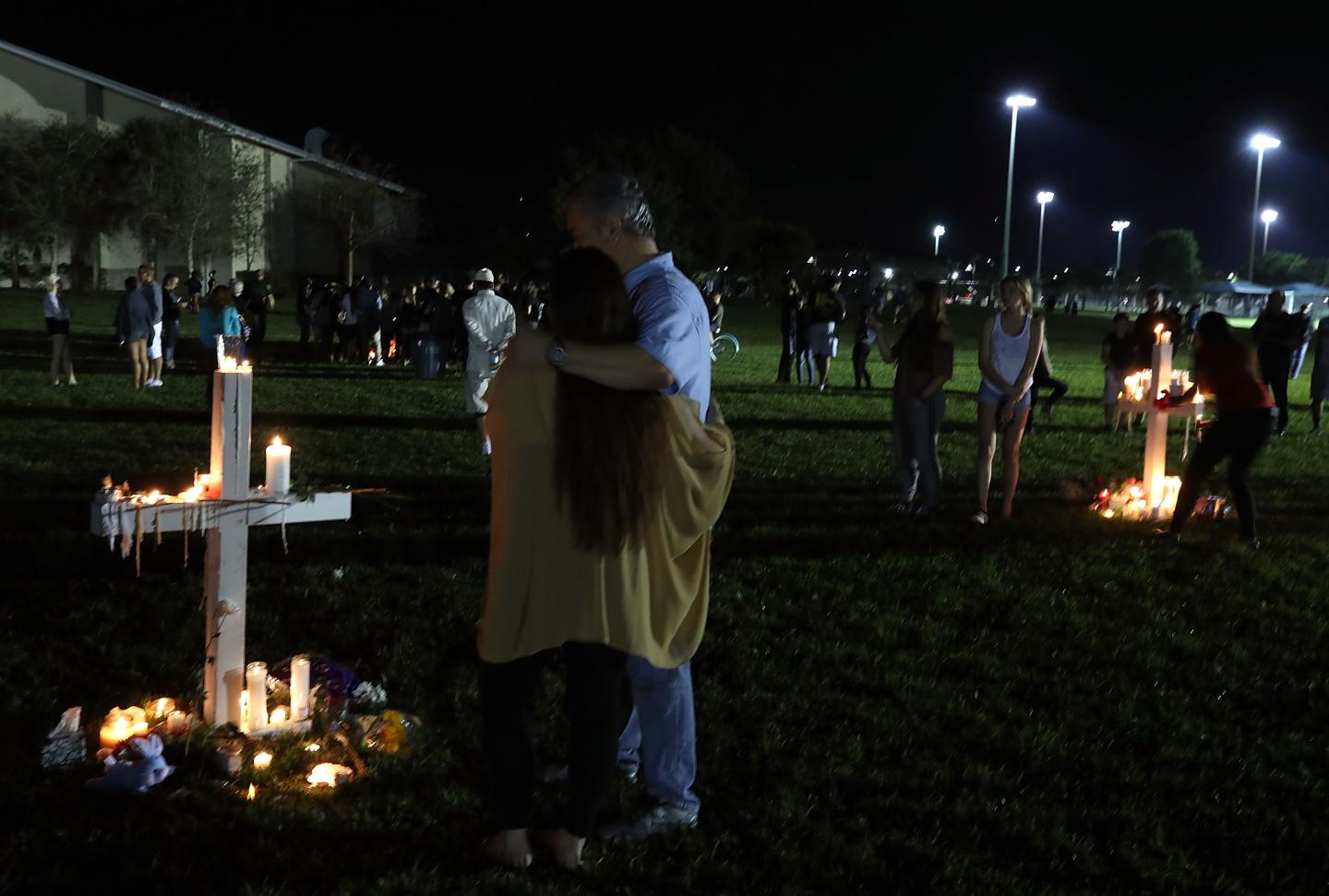
Florida Town Of Parkland In Mourning, After Shooting At Marjory Stoneman Douglas High School Kills 17
PARKLAND, FL - FEBRUARY 15: Students, friends, and family members gather around candlit crosses during vigil for victims of the mass shooting at Marjory Stoneman Douglas High School yesterday, at Pine Trail Park, on February 15, 2018 in Parkland, Florida. Yesterday Police arrested 19 year old former student Nikolas Cruz for killing 17 people at the high school. (Photo by Mark Wilson/Getty Images)Mark Wilson—Getty Images

On Wednesday, a gunman killed 17 people and wounded at least a dozen others at a Parkland, Florida high school. This act was shocking, evil, and, in America, routine. There have been 30 mass shootings in the U.S. so far this year, And just last October, a gunman in Las Vegas killed 58 people and wounded hundreds more, making it the deadliest mass shooting in the country’s modern history.

This cycle of mass shooting after mass shooting, again and again, inevitably pushes us to ask the question: Why? Why does this keep happening? While many answers are proposed, we may perhaps find some insight by considering what we know about human behavior after mass traumatic events.

In 2014, our team studied more than 330 mass traumas worldwide over the past 50 years to better understand the psychology of how populations react to events like gun massacres. We found that human reaction to these events takes the form of roughly five stages.

The first stage is group preservation. This is when those affected seek shelter and information to protect themselves while they are still under threat. In Parkland, we witnessed this in real time in the heartbreaking messages students who were trapped in the school posted to social media. In these messages and videos, we saw the students seek shelter in place, and ask about the safety of others, as they waited for rescue.

The second stage is population preservation. This begins when word of an in-progress traumatic event spreads to the broader community, and the community responds. Parents seek the whereabouts of their children, first responders rush toward the danger to mitigate further harm, and public figures in politics and media make their initial comments on the unfolding events.

Once the immediate physical danger has passed—the shooter subdued, the crime scene secured—the third stage, internalization, begins. Internalization is the long work of collectively processing our emotional response to the event. This stage touches not just the community directly affected by the trauma, but the observers around the country and the world who mourn with each new massacre. We grieve for the loss of life, for the pain endured by the injured and the families of the victims, and for our own shattered sense of normalcy. This process often involves creating memorials for the dead, and working through the narrative of what happened, to trace the magnitude of our loss, and understand how it came to be.

This leads to stage four, the externalizing stage, where we assign blame for the tragedy, and identify the outside causes that have enabled a pattern of mass shootings in the U.S. As we process the aftermath of a mass shooting, we begin to see the institutional failures that made it possible. When it comes to gun violence, this means our country’s lack of commonsense gun safety laws, and the entrenched opposition of the National Rifle Association and Republican lawmakers to even incremental reform.


This awareness should lead to stage five, renormalization, where we correct the underlying issues that lay the groundwork for shootings. This is, after all, what we do after nearly every other mass trauma, aiming to make a healthier world. After the Great Chicago Fire in 1871, for example, the U.S. embraced fire prevention, which has significantly reduced the number of fire deaths over the last century. However, fire never had a powerful organization like the NRA to lobby Congress on its behalf. Guns do.

So, unlike tragedies of the past, the gun violence epidemic has not led to reforms that create a healthier, safer world—we are not at stage five. Instead, we face a world where we accept the regular slaughter of innocents as the price we pay for the right to own assault rifles and bring them wherever we want, no matter how troubled we may be. We remain frozen at stage four, able to see clearly the cause of this sordid status quo—the proliferation of guns in our society. As long as we are unable to muster an effective, humane response at the legislative level, we will never get to stage five. And the killing will continue.

Sandro Galea is a professor and Dean of the Boston University School of Public Health. His book, Healthier: Fifty thoughts on the foundations of population health, was published in June. Follow him on Twitter: @sandrogalea.

About the Authors
By Sandro Galea
See full bioRight Arrow Button Icon
By Bethany Cianciolo
See full bioRight Arrow Button Icon

Latest in Commentary

Finance
Lorem ipsum dolor sit amet, consectetur adipiscing elit, sed do eiusmod tempor incididunt ut labore et dolore magna aliqua. Ut enim ad minim veniam
By Fortune Editors
October 20, 2025
Finance
Lorem ipsum dolor sit amet, consectetur adipiscing elit, sed do eiusmod tempor incididunt ut labore et dolore magna aliqua. Ut enim ad minim veniam
By Fortune Editors
October 20, 2025
Finance
Lorem ipsum dolor sit amet, consectetur adipiscing elit, sed do eiusmod tempor incididunt ut labore et dolore magna aliqua. Ut enim ad minim veniam
By Fortune Editors
October 20, 2025
Finance
Lorem ipsum dolor sit amet, consectetur adipiscing elit, sed do eiusmod tempor incididunt ut labore et dolore magna aliqua. Ut enim ad minim veniam
By Fortune Editors
October 20, 2025
Finance
Lorem ipsum dolor sit amet, consectetur adipiscing elit, sed do eiusmod tempor incididunt ut labore et dolore magna aliqua. Ut enim ad minim veniam
By Fortune Editors
October 20, 2025
Finance
Lorem ipsum dolor sit amet, consectetur adipiscing elit, sed do eiusmod tempor incididunt ut labore et dolore magna aliqua. Ut enim ad minim veniam
By Fortune Editors
October 20, 2025

Most Popular

Finance
Lorem ipsum dolor sit amet, consectetur adipiscing elit, sed do eiusmod tempor incididunt ut labore et dolore magna aliqua. Ut enim ad minim veniam
By Fortune Editors
October 20, 2025
Finance
Lorem ipsum dolor sit amet, consectetur adipiscing elit, sed do eiusmod tempor incididunt ut labore et dolore magna aliqua. Ut enim ad minim veniam
By Fortune Editors
October 20, 2025
Finance
Lorem ipsum dolor sit amet, consectetur adipiscing elit, sed do eiusmod tempor incididunt ut labore et dolore magna aliqua. Ut enim ad minim veniam
By Fortune Editors
October 20, 2025
Finance
Lorem ipsum dolor sit amet, consectetur adipiscing elit, sed do eiusmod tempor incididunt ut labore et dolore magna aliqua. Ut enim ad minim veniam
By Fortune Editors
October 20, 2025
Finance
Lorem ipsum dolor sit amet, consectetur adipiscing elit, sed do eiusmod tempor incididunt ut labore et dolore magna aliqua. Ut enim ad minim veniam
By Fortune Editors
October 20, 2025
Finance
Lorem ipsum dolor sit amet, consectetur adipiscing elit, sed do eiusmod tempor incididunt ut labore et dolore magna aliqua. Ut enim ad minim veniam
By Fortune Editors
October 20, 2025
Fortune Secondary Logo
Rankings
  • 100 Best Companies
  • Fortune 500
  • Global 500
  • Fortune 500 Europe
  • Most Powerful Women
  • World's Most Admired Companies
  • See All Rankings
  • Lists Calendar
Sections
  • Finance
  • Fortune Crypto
  • Features
  • Leadership
  • Health
  • Commentary
  • Success
  • Retail
  • Mpw
  • Tech
  • Lifestyle
  • CEO Initiative
  • Asia
  • Politics
  • Conferences
  • Europe
  • Newsletters
  • Personal Finance
  • Environment
  • Magazine
  • Education
Customer Support
  • Frequently Asked Questions
  • Customer Service Portal
  • Privacy Policy
  • Terms Of Use
  • Single Issues For Purchase
  • International Print
Commercial Services
  • Advertising
  • Fortune Brand Studio
  • Fortune Analytics
  • Fortune Conferences
  • Business Development
  • Group Subscriptions
About Us
  • About Us
  • Press Center
  • Work At Fortune
  • Terms And Conditions
  • Site Map
  • About Us
  • Press Center
  • Work At Fortune
  • Terms And Conditions
  • Site Map
  • Facebook icon
  • Twitter icon
  • LinkedIn icon
  • Instagram icon
  • Pinterest icon

Latest in Commentary

hegseth
CommentaryMilitary
America shot its arsenal empty in 2 wars. Now it needs Beijing’s permission to reload
By Steve H. Hanke and Jeffrey WengApril 30, 2026
6 hours ago
Duncan Tait, CEO of Inchcape
Europecar manufacturing
“Competition is good for the industry”. Inchcape CEO’s case for optimism in automotive’s next chapter
By Duncan TaitApril 30, 2026
9 hours ago
agentic
CommentaryAI agents
Why your data infrastructure — not your AI model — will determine whether Agentic AI scales
By Jeffrey Sonnenfeld, Stephen Henriques, Catherine Dai and Zander JeinthanuttkanontApril 30, 2026
12 hours ago
hoskins
Commentaryoffices
Gensler Co-Chair: Hot-desking was supposed to save money. It may be costing you your culture
By Diane HoskinsApril 30, 2026
13 hours ago
tillis
CommentaryCongress
Thom Tillis: Free markets built American prosperity. Government intervention puts it at risk
By Thom Tillis and John StanfordApril 30, 2026
15 hours ago
iran
CommentaryIran
The Strait of Hormuz is a data problem, not just a military one
By Erik Bethel and Ami DanielApril 30, 2026
15 hours ago

Most Popular

Apple cofounder Ronald Wayne—whose stake would be worth up to $400 billion had he not sold it in 1976—says that at 91, he has no regrets
Success
Apple cofounder Ronald Wayne—whose stake would be worth up to $400 billion had he not sold it in 1976—says that at 91, he has no regrets
By Preston ForeApril 27, 2026
3 days ago
Google Cloud revenue is now 18% of Alphabet's business. Is this the beginning of the end of Google's search identity?
Big Tech
Google Cloud revenue is now 18% of Alphabet's business. Is this the beginning of the end of Google's search identity?
By Alexei OreskovicApril 29, 2026
22 hours ago
‘They left me no choice’: Powell isn’t going anywhere—blocking Trump from another Fed appointee
Banking
‘They left me no choice’: Powell isn’t going anywhere—blocking Trump from another Fed appointee
By Eva RoytburgApril 29, 2026
1 day ago
Jamie Dimon gets candid about national debt: ‘There will be a bond crisis, and then we’ll have to deal with it’
Economy
Jamie Dimon gets candid about national debt: ‘There will be a bond crisis, and then we’ll have to deal with it’
By Eleanor PringleApril 29, 2026
2 days ago
‘The cost of compute is far beyond the costs of the employees’: Nvidia executive says right now AI is more expensive than paying human workers
AI
‘The cost of compute is far beyond the costs of the employees’: Nvidia executive says right now AI is more expensive than paying human workers
By Sasha RogelbergApril 28, 2026
3 days ago
With no end in sight, Trump considers new options in Iran war—including the ‘Dark Eagle’ hypersonic missile
Big Tech
With no end in sight, Trump considers new options in Iran war—including the ‘Dark Eagle’ hypersonic missile
By Jim EdwardsApril 30, 2026
14 hours ago

© 2026 Fortune Media IP Limited. All Rights Reserved. Use of this site constitutes acceptance of our Terms of Use and Privacy Policy | CA Notice at Collection and Privacy Notice | Do Not Sell/Share My Personal Information
FORTUNE is a trademark of Fortune Media IP Limited, registered in the U.S. and other countries. FORTUNE may receive compensation for some links to products and services on this website. Offers may be subject to change without notice.