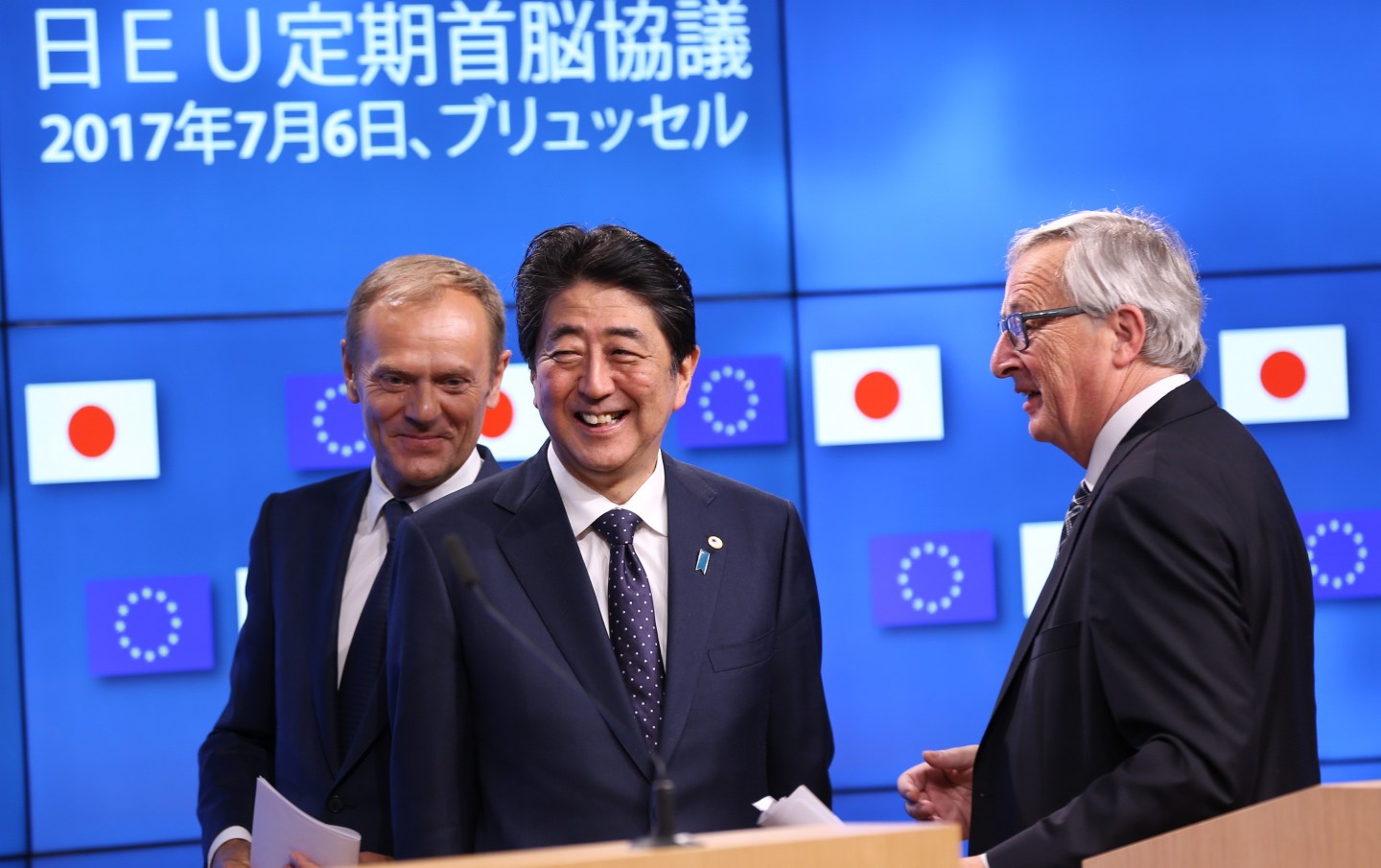
Japanese Prime Minister Shinzo Abe made an unscheduled stop in Brussels Thursday on his way to the G20 Summit in Hamburg, Germany. There, he and European Council President Donald Tusk proudly announced the conclusion of a new EU-Japan trade deal. Their message is simple: As the United States denounces free trade and walks away from the negotiating table, the rest of the world is not standing still.
The EU-Japan trade agreement will provide significant benefits for Japanese and European companies and consumers. Together, Japan and the EU account for about a third of the global economy. The EU is Japan’s third-largest trading partner, and Japan is the EU’s sixth-largest trading partner. If ratified, the accord would be the EU’s largest free trade agreement. And after the Trans-Pacific Partnership (TPP), which Japan is now urging others to bring into effect without the United States, this will be Japan’s largest free trade accord.
The deal is also a major political victory for both sides. For Abe, it shows the world that a once-protective Japan is emerging as a leader in global trade. German Chancellor and G20 host Angela Merkel, in turn, can demonstrate that the EU, after Brexit, is open for business and can lead the quest for open markets among G20 members.
The deal, however, is not such good news for the United States. It will disadvantage U.S. agriculture, manufacturing, and services firms doing business in Europe and Japan. American pork, beef, and dairy producers will be less competitive than their European counterparts, who will be able to sell to Japanese consumers at reduced prices. U.S. beef exporters were already hurting as a result of tariff cuts in the Japan-Australia Economic Partnership Agreement, which benefited Australian beef. Other sectors that would be particularly disadvantaged from the Japan-EU trade deal are chemicals, machinery, and electronics, as well as financial and other service providers.
Some of the details of the deal still need to be ironed out. Based on previous EU agreements, the U.S. could be harmed by regulatory provisions. If Japan agrees to EU auto safety standards that differ from American standards, U.S. auto companies may feel increasing pressure to adopt these new standards, a potentially costly move. Moreover, if Japan agrees to European geographic indications that mandate certain cheeses, for example, may only be sold in Japan if produced in the EU, American dairy producers could lose their ability to sell the same products in Japan. The list does not stop there. As other provisions become public and certain technical and regulatory issues are worked out, there may be additional costs for U.S. companies on the horizon.
From a strategic perspective, the deal is also a blow to the U.S. After its exit from TPP in January, the administration expressed preference for bilateral trade agreements, including with Japan. But the conclusion of the EU deal signals that Japan is hedging its bets and reducing its dependency on the U.S. It also puts Japan in a stronger negotiating position, should bilateral talks with the U.S. commence.
More broadly, the EU-Japan trade deal is the latest in a series of announcements of negotiation launches and agreement conclusions that exclude the U.S. These also include the “TPP 11,” also known as TPP sans U.S.; the Regional Comprehensive Economic Partnership (RCEP) between China, India, and 14 other Asia-Pacific countries; and potential bilateral deals between Canada and China, Australia and Indonesia, and South Korea and Mexico. As these agreements go into effect, they put U.S. exporters at a comparative disadvantage.
By any measure, the conclusion of the EU-Japan trade deal is a wake-up call for the U.S. For me, this feels like a bit of déjà vu. The US-Korea Free Trade Agreement (KORUS), concluded in 2007, sat on the shelf collecting dust for a few years. In the meantime, the EU negotiated a deal with South Korea in 2009, which came into effect in 2011 and gave European companies a competitive edge in the Korean market. Ultimately, this helped drive Congress to ratify KORUS so that American producers would be put on equal footing in Korea with their European competitors.
I hope that the EU-Japan deal will similarly help spur action in Washington and get us back in the business of negotiating fair-market opening agreements. The Trump administration, for instance, should renew its push on the Transatlantic Trade and Investment Partnership (TTIP), the proposed trade agreement between the EU and the U.S. It should also look at the NAFTA renegotiations not as a chance to score points and settle scores, but as an opportunity to strengthen and modernize that deal by adding provisions on intellectual property rights, data flows, and labor standards. And finally, it should reengage with its Asian trading partners on a high-standard deal, Japan included.
Wendy Cutler, former acting deputy U.S. trade representative, is vice president of the Asia Society Policy Institute in Washington, D.C.