• Home
  • Latest
  • Fortune 500
  • Finance
  • Tech
  • Leadership
  • Lifestyle
  • Rankings
  • Multimedia
CommentaryFinance

How President Trump Can Actually Pass Corporate Tax Reform

By
Robert Pozen
Robert Pozen
Down Arrow Button Icon
By
Robert Pozen
Robert Pozen
Down Arrow Button Icon
April 5, 2017, 2:03 PM ET
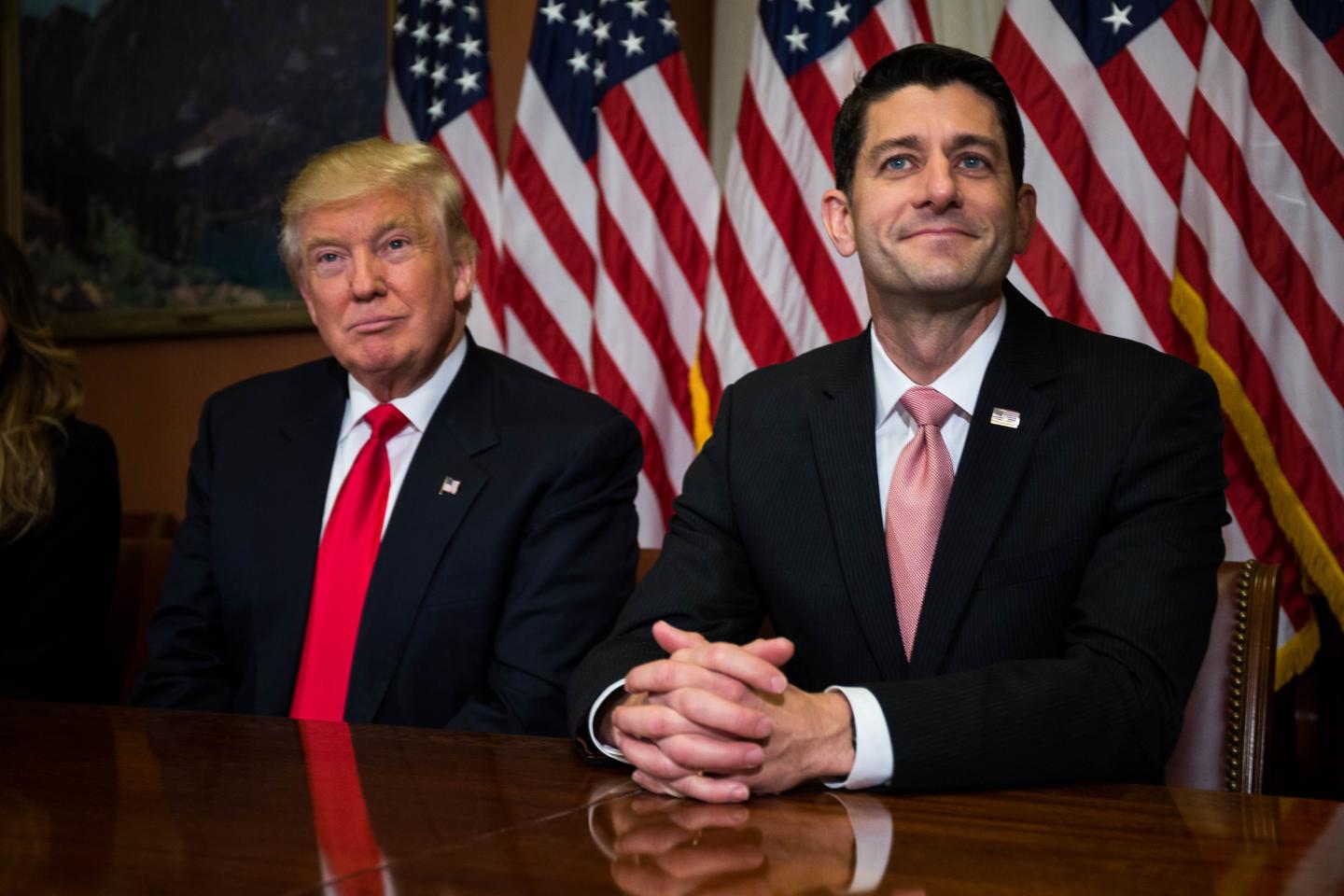
President-Elect Trump And Vice President-Elect Pence Meet With House Speaker Paul Ryan On Capitol Hill
WASHINGTON, D.C. - NOVEMBER 10: President-elect Donald Trump meets with House Speaker Paul Ryan (R-WI) at the U.S. Capitol for a meeting November 10, 2016 in Washington, DC. Earlier in the day president-elect Trump met with U.S. President Barack Obama at the White House. (Photo by Zach Gibson/Getty Images)Photograph by Zach Gibson—Getty Images

While the Congressional efforts to reform America’s health care system fell apart last month, the Trump Administration can learn important lessons for its next legislative battle: corporate tax reform. Here are five key guidelines.

First, don’t trust House Republicans to draft a bill.

House Republicans could not muster a majority of their own party for their healthcare bill, so the White House should draft its own corporate tax bill — without the border adjustment tax (BAT) that House Speaker Paul Ryan has advocated. Although the BAT would exempt from US corporate taxes all exports by US companies, it would be fiercely opposed by US retailers and local manufacturers, since it would end their ability to deduct the cost of imported goods or services from their corporate tax payments. What’s more, these opponents do not believe the economists who claim that the BAT would send the price of imports downward by 20% — because these economists predict the US dollar will appreciate by an equivalent amount.

Moreover, House Republicans have not come to grips with the broader implications of the BAT. If the US dollar appreciates another 20% from its already high level, what would happen to the trillions of dollars of foreign assets held by US investors? And will Congress overcome the strong argument of our foreign allies that the unusual structure of the BAT discriminates against imports and therefore violates the rules of the World Trade Organization?

Second, try to win over moderate Democrats

Given the slim majorities and ideological divisions in the Republican ranks, the White House should not ignore moderate Democrats as it did in healthcare reform. Some Democrats support the repatriation of the more than $2 trillion in past foreign profits of US multinationals held abroad, but they do not want to repeat the tax holiday of 2004. When US multinationals were then allowed to bring back their past foreign profits at a low tax rate, they mainly distributed such profits to their shareholders instead of hiring more US workers.

To attract some Democratic votes, President Trump should link his tax bill to the bipartisan objective of repairing American infrastructure. The Trump campaign proposed a 10% tax on past foreign profits held abroad by US multinationals, which could then at their discretion repatriate the remaining profits (without additional taxes ). Trump could announce that the approximately $150 billion to $200 billion, generated by this tax over 10 years, would be dedicated to government investment in US infrastructure.

Third, don’t leave America much deeper in debt.

A significant block of Republicans in Congress would oppose any major legislation, healthcare or tax reform, if it resulted in a sharp increase in the national debt. Yet the Trump campaign proposed a reduction in the corporate tax rate from 35% to 15%. This 15% rate is a nonstarter, because it would increase the national debt by $2 trillion to $3 trillion over the next decade, and more if that rate were applied to the business income of partnerships.

To be competitive with most industrialized countries, the US needs a corporate tax rate in the range of 20% to 25% — with a US tax credit for corporate taxes paid to a foreign country. Such a lower tax rate would be partly financed by closing and narrowing existing corporate tax preferences. Most importantly, Trump would raise considerable revenue by his campaign proposal to limit corporate deductions for interest – which would also correct the Code’s bias in favor of debt over equity.

Fourth, bite the bullet on the tough issues in tax reform.

In contrast to healthcare reform, some of the toughest issues in tax reform are international — specifically, the billions of foreign profits that have been parked by US multinationals in tax havens. In places like Bermuda or the Cayman Islands, these foreign profits are subject to minimal local taxes, while the US taxes on these foreign profits can be indefinitely deferred. To end these tax avoidance schemes, the original Trump proposal would have abolished tax deferral – in the context of a 15% corporate tax rate.

However, this proposal to abolish tax deferral on foreign profits would come up against heavy lobbying if Congress adopted a corporate tax rate of, say, 23% — the average rate of large industrial countries. So the Trump Administration needs to stand firm on this proposal to abolish tax deferral: It is critical to bringing company facilities back to the US and helping to provide enough new revenues to avoid blowing up the national debt.

Fifth, get the assumptions right in the revenue estimates.

In estimating the revenue lost or gained by any legislative proposal, the Joint Committee on Taxation must start from a baseline of what would happen without any tax reform. Unfortunately, that Committee tends to believe that, absent tax reform, US multinationals would bring back most of their foreign profits over time and pay the 35% corporate tax. Under this assumption, stopping deferral for future foreign profits and lowering the corporate tax rate to 23% would produce a significant revenue loss.

Yet this assumption is unrealistic. US multinationals have announced their intent NOT to repatriate foreign profits – and have actually not done so unless companies were faced with a severe cash shortage or earned profits in countries like Japan with corporate tax rates over 30%. Thus, if the US ended tax deferral and adopted a 23% corporate tax rate, a majority of the taxes on foreign profits subsequently repatriated should be counted as revenues attributable to the new system.

In short, who would have thought that tax reform is so complex? To raise the probabilities of success, the Trump Administrative should own the process and follow the above five guidelines.

Robert C. Pozen is a senior lecturer at MIT Sloan School of Management and former executive chairman of MFS Investment Management.

About the Author
By Robert Pozen
See full bioRight Arrow Button Icon

Latest in Commentary

Finance
Lorem ipsum dolor sit amet, consectetur adipiscing elit, sed do eiusmod tempor incididunt ut labore et dolore magna aliqua. Ut enim ad minim veniam
By Fortune Editors
October 20, 2025
Finance
Lorem ipsum dolor sit amet, consectetur adipiscing elit, sed do eiusmod tempor incididunt ut labore et dolore magna aliqua. Ut enim ad minim veniam
By Fortune Editors
October 20, 2025
Finance
Lorem ipsum dolor sit amet, consectetur adipiscing elit, sed do eiusmod tempor incididunt ut labore et dolore magna aliqua. Ut enim ad minim veniam
By Fortune Editors
October 20, 2025
Finance
Lorem ipsum dolor sit amet, consectetur adipiscing elit, sed do eiusmod tempor incididunt ut labore et dolore magna aliqua. Ut enim ad minim veniam
By Fortune Editors
October 20, 2025
Finance
Lorem ipsum dolor sit amet, consectetur adipiscing elit, sed do eiusmod tempor incididunt ut labore et dolore magna aliqua. Ut enim ad minim veniam
By Fortune Editors
October 20, 2025
Finance
Lorem ipsum dolor sit amet, consectetur adipiscing elit, sed do eiusmod tempor incididunt ut labore et dolore magna aliqua. Ut enim ad minim veniam
By Fortune Editors
October 20, 2025

Most Popular

Finance
Lorem ipsum dolor sit amet, consectetur adipiscing elit, sed do eiusmod tempor incididunt ut labore et dolore magna aliqua. Ut enim ad minim veniam
By Fortune Editors
October 20, 2025
Finance
Lorem ipsum dolor sit amet, consectetur adipiscing elit, sed do eiusmod tempor incididunt ut labore et dolore magna aliqua. Ut enim ad minim veniam
By Fortune Editors
October 20, 2025
Finance
Lorem ipsum dolor sit amet, consectetur adipiscing elit, sed do eiusmod tempor incididunt ut labore et dolore magna aliqua. Ut enim ad minim veniam
By Fortune Editors
October 20, 2025
Finance
Lorem ipsum dolor sit amet, consectetur adipiscing elit, sed do eiusmod tempor incididunt ut labore et dolore magna aliqua. Ut enim ad minim veniam
By Fortune Editors
October 20, 2025
Finance
Lorem ipsum dolor sit amet, consectetur adipiscing elit, sed do eiusmod tempor incididunt ut labore et dolore magna aliqua. Ut enim ad minim veniam
By Fortune Editors
October 20, 2025
Finance
Lorem ipsum dolor sit amet, consectetur adipiscing elit, sed do eiusmod tempor incididunt ut labore et dolore magna aliqua. Ut enim ad minim veniam
By Fortune Editors
October 20, 2025
Fortune Secondary Logo
Rankings
  • 100 Best Companies
  • Fortune 500
  • Global 500
  • Fortune 500 Europe
  • Most Powerful Women
  • World's Most Admired Companies
  • See All Rankings
  • Lists Calendar
Sections
  • Finance
  • Fortune Crypto
  • Features
  • Leadership
  • Health
  • Commentary
  • Success
  • Retail
  • Mpw
  • Tech
  • Lifestyle
  • CEO Initiative
  • Asia
  • Politics
  • Conferences
  • Europe
  • Newsletters
  • Personal Finance
  • Environment
  • Magazine
  • Education
Customer Support
  • Frequently Asked Questions
  • Customer Service Portal
  • Privacy Policy
  • Terms Of Use
  • Single Issues For Purchase
  • International Print
Commercial Services
  • Advertising
  • Fortune Brand Studio
  • Fortune Analytics
  • Fortune Conferences
  • Business Development
  • Group Subscriptions
About Us
  • About Us
  • Press Center
  • Work At Fortune
  • Terms And Conditions
  • Site Map
  • About Us
  • Press Center
  • Work At Fortune
  • Terms And Conditions
  • Site Map
  • Facebook icon
  • Twitter icon
  • LinkedIn icon
  • Instagram icon
  • Pinterest icon

Latest in Commentary

hegseth
CommentaryMilitary
America shot its arsenal empty in 2 wars. Now it needs Beijing’s permission to reload
By Steve H. Hanke and Jeffrey WengApril 30, 2026
53 minutes ago
Duncan Tait, CEO of Inchcape
Europecar manufacturing
“Competition is good for the industry”. Inchcape CEO’s case for optimism in automotive’s next chapter
By Duncan TaitApril 30, 2026
4 hours ago
agentic
CommentaryAI agents
Why your data infrastructure — not your AI model — will determine whether Agentic AI scales
By Jeffrey Sonnenfeld, Stephen Henriques, Catherine Dai and Zander JeinthanuttkanontApril 30, 2026
7 hours ago
hoskins
Commentaryoffices
Gensler Co-Chair: Hot-desking was supposed to save money. It may be costing you your culture
By Diane HoskinsApril 30, 2026
8 hours ago
tillis
CommentaryCongress
Thom Tillis: Free markets built American prosperity. Government intervention puts it at risk
By Thom Tillis and John StanfordApril 30, 2026
10 hours ago
iran
CommentaryIran
The Strait of Hormuz is a data problem, not just a military one
By Erik Bethel and Ami DanielApril 30, 2026
10 hours ago

Most Popular

Apple cofounder Ronald Wayne—whose stake would be worth up to $400 billion had he not sold it in 1976—says that at 91, he has no regrets
Success
Apple cofounder Ronald Wayne—whose stake would be worth up to $400 billion had he not sold it in 1976—says that at 91, he has no regrets
By Preston ForeApril 27, 2026
3 days ago
‘They left me no choice’: Powell isn’t going anywhere—blocking Trump from another Fed appointee
Banking
‘They left me no choice’: Powell isn’t going anywhere—blocking Trump from another Fed appointee
By Eva RoytburgApril 29, 2026
24 hours ago
Jamie Dimon gets candid about national debt: ‘There will be a bond crisis, and then we’ll have to deal with it’
Economy
Jamie Dimon gets candid about national debt: ‘There will be a bond crisis, and then we’ll have to deal with it’
By Eleanor PringleApril 29, 2026
1 day ago
Google Cloud revenue is now 18% of Alphabet's business. Is this the beginning of the end of Google's search identity?
Big Tech
Google Cloud revenue is now 18% of Alphabet's business. Is this the beginning of the end of Google's search identity?
By Alexei OreskovicApril 29, 2026
17 hours ago
‘The cost of compute is far beyond the costs of the employees’: Nvidia executive says right now AI is more expensive than paying human workers
AI
‘The cost of compute is far beyond the costs of the employees’: Nvidia executive says right now AI is more expensive than paying human workers
By Sasha RogelbergApril 28, 2026
2 days ago
Elon Musk says saving for retirement is irrelevant because AI is going to create a world of abundance: 'It won't matter'
Future of Work
Elon Musk says saving for retirement is irrelevant because AI is going to create a world of abundance: 'It won't matter'
By Marco Quiroz-GutierrezApril 26, 2026
4 days ago

© 2026 Fortune Media IP Limited. All Rights Reserved. Use of this site constitutes acceptance of our Terms of Use and Privacy Policy | CA Notice at Collection and Privacy Notice | Do Not Sell/Share My Personal Information
FORTUNE is a trademark of Fortune Media IP Limited, registered in the U.S. and other countries. FORTUNE may receive compensation for some links to products and services on this website. Offers may be subject to change without notice.