• Home
  • Latest
  • Fortune 500
  • Finance
  • Tech
  • Leadership
  • Lifestyle
  • Rankings
  • Multimedia
Commentary

The Dysfunction Behind Trumpcare Explained

By
Sandro Galea
Sandro Galea
Down Arrow Button Icon
By
Sandro Galea
Sandro Galea
Down Arrow Button Icon
March 28, 2017, 11:58 AM ET
TOPSHOT-US-POLITICS-TRUMP-SIGNING
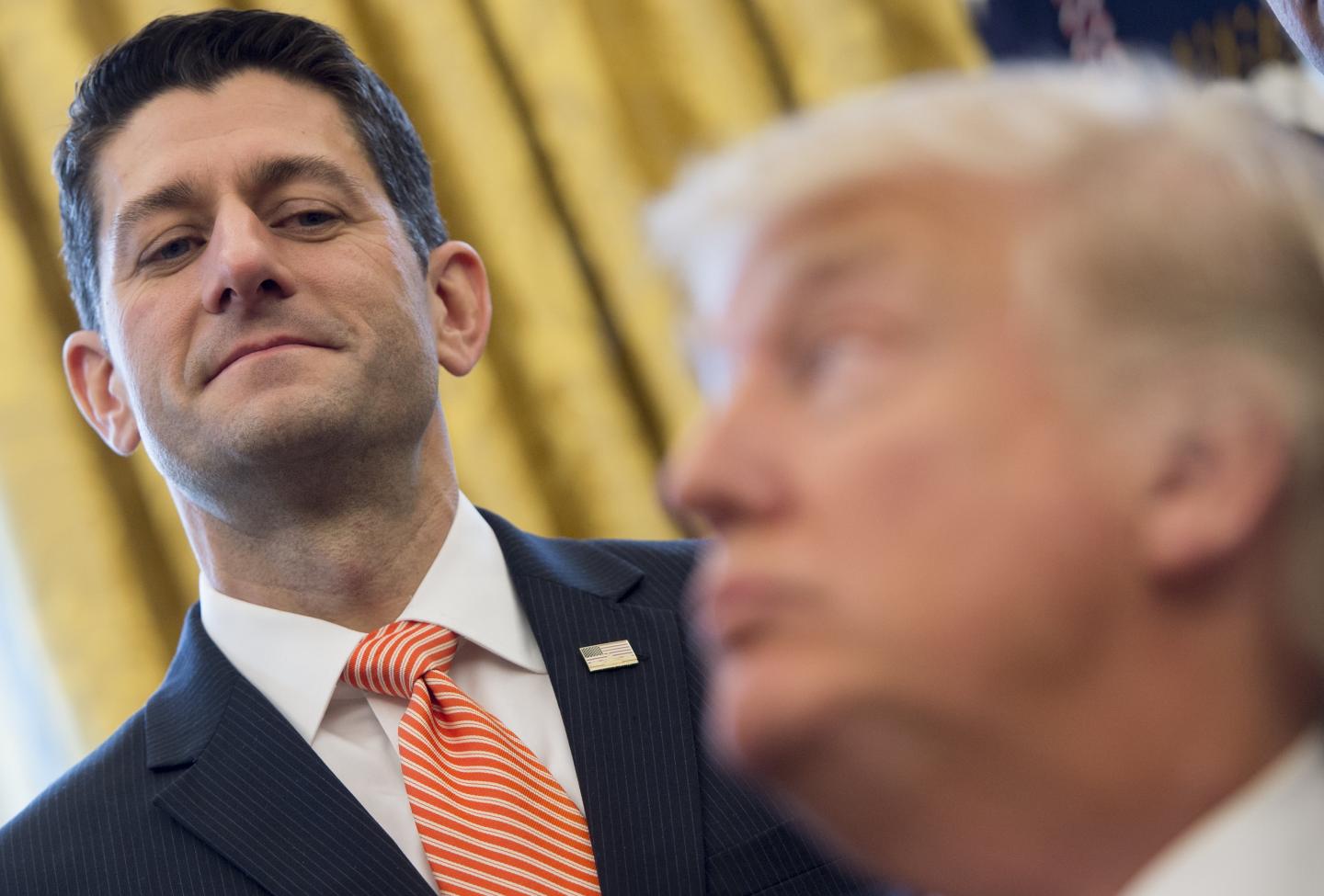
TOPSHOT - US President Donald Trump speaks to Speaker of the House Paul Ryan after signing House Joint Resolution 41, which removes some Dodd-Frank regulations on oil and gas companies, during a bill signing ceremony in the Oval Office of the White House in Washington, DC, February 14, 2017. / AFP / SAUL LOEB (Photo credit should read SAUL LOEB/AFP/Getty Images)SAUL LOEB AFP/Getty Images

The healthcare debate unfolded rapidly last week, with the story changing at a dizzying pace, until it ended with the defeat of the American Health Care Act (AHCA). Ultimately, Congress chose not to vote on “Trumpcare,” due to Republican division over the substance of the widely unpopular bill. As we watched these events play out, traditional forms of commentary often felt a step or two behind the moment. We are, after all, used to seeing situations unfold linearly, with one event leading to another, following the standard pattern of cause and effect. Yet, in the blur of last week, developments emerged almost simultaneously. We saw President Trump lobby for the AHCA, even as Republicans worked to amend the bill to make it more palatable for their caucus prior to a scheduled vote on the legislation. Republicans then delayed the vote, before, ultimately, rescheduling it for Friday, then calling it off. For those of us who are invested in navigating the complex subject of healthcare, these events begged the question: how do we make sense of such wild times?

In my book, Systems Science and Population Health, my co-authors and I discuss how to apply a systems science approach to the work of population health — the study of the conditions that shape health within and across groups of people, and of the mechanisms through which these conditions determine the health of individuals. Systems science is an interdisciplinary field that studies how the interaction of factors produces outcomes—how the causes and consequences of events can, taken together, form the basis for everything from a disease epidemic, to a pattern of human behavior. Complex systems are characterized chiefly by these elements: many interacting components, non-linearities, discontinuities (i.e. the occurrence of something unexpected), and emergent properties, which come about when systems take on a “life of their own” and develop into something that often looks quite different than the original inputs.

With this picture in mind, it is clear that the healthcare debate, particularly as it played out last week, is very much a complex system, and can be constructively viewed through a systems science lens. First, there are multiple components. These include Congress, the President, various outside stakeholders—including insurance companies and the pharmaceutical industry—and the American people.

The question then becomes: which component is key? Each attempted to influence the debate, and at various times eachseemed to be, briefly, in control of the narrative. In the days immediately following the election of President Trump, Republicans appeared to more or less have the upper hand, and the fate of the ACA looked sealed. With Republican majorities in the House and Senate, and GOP control of the Executive Branch, there were few reasons not to think that a swift repeal of the healthcare law was achievable and likely. But as the practical reality of repeal began to sink in for the millions of Americans who stand to lose coverage, the voices of concerned, angry citizens soon took center stage at town halls across the country. The challenge was compounded for proponents of repeal by the release of the AHCA. When the Congressional Budget Office reported that the AHCA stood to strip 24 million people of their health insurance, Congressional Republicans divided into two camps — those who disliked the bill for fear that it would harm their constituents (not to mention their own electoral prospects) and those who did not feel that the bill went far enough in rolling back the “socialism” of the Affordable Care Act (ACA).

It is this Republican division that most clearly illustrated the role of nonlinearity in the healthcare debate. In recent weeks, we have seen how, in politics, X does not always equal Y, but rather some function thereof, as the traditional political pressures that have been brought to bear on the healthcare fight have not yielded simple results. The most obvious example is the singular presence of President Trump, and his attempts to lobby for the AHCA. Last week, he was said to have been in “full arm-twisting mode,” as he tried to leverage his vaunted deal-making ability into the fulfillment of his frequent campaign pledge to “repeal and replace” the ACA. In the past, Presidents have pushed their legislative agendas with varying degrees of success; at present, the commander-in-chief has so far failed to control the chaos of the healthcare debate or channel his considerable electoral advantages into the swift passage of his promised initiative. From a systems perspective, this is clearly because the interplay of factors involved have shaped his input into an unlikely output — in this case, the rush to “repeal and replace” led to a bill that polarized Trump’s caucus. As a consequence, the chief source of political pressure on healthcare became less and less Trump, and more and more the ideological concerns of his fellow Republicans.

A series of discontinuities have further disrupted this debate, creating uncertainty as the process lurches into its own. These events have occurred suddenly — as, for example, when Republicans announced that a repeal vote would be delayed, before reversing course. In systems science, such disruptions give way to emergent properties, whereby a surprise break or resolution leads to an outcome that few could have predicted. In the context of healthcare, this could mean anything from a law that is even more exclusionary than the AHCA, an ACA repeal with no replacement in sight, or even — unthinkable on November 9 — the survival of the ACA in its present form, an outcome which begins to seem ever-more likely.

Looking at the healthcare debate, and the broader activities of the Trump administration, through a systems science lens helps us take perhaps a more dispassionate view — to focus less on trying to predict where each moment will lead, and more on observing the interaction of factors that will, ultimately, determine outcomes. These factors will at times seem tangled; they will proceed in fits and starts, as the ambitions of an untested President interact with the interests of a recalcitrant conservative block, a determined opposition, and the will of a divided public. The utility of a systems science approach is to wean us away from the predictive, “A plus B will likely equal C” focus of most contemporary analysis and help us become more comfortable reading the relationship between a host of factors, in real-time, to better appreciate how complexity shapes our society, and, by extension, our increasingly freewheeling politics.

Sandro Galea is the Robert A Knox Professor and Dean of Boston University School of Public Health. His book, Systems Science and Population Health, was published in February. Follow him on Twitter @sandrogalea.


About the Author
By Sandro Galea
See full bioRight Arrow Button Icon

Latest in Commentary

Finance
Lorem ipsum dolor sit amet, consectetur adipiscing elit, sed do eiusmod tempor incididunt ut labore et dolore magna aliqua. Ut enim ad minim veniam
By Fortune Editors
October 20, 2025
Finance
Lorem ipsum dolor sit amet, consectetur adipiscing elit, sed do eiusmod tempor incididunt ut labore et dolore magna aliqua. Ut enim ad minim veniam
By Fortune Editors
October 20, 2025
Finance
Lorem ipsum dolor sit amet, consectetur adipiscing elit, sed do eiusmod tempor incididunt ut labore et dolore magna aliqua. Ut enim ad minim veniam
By Fortune Editors
October 20, 2025
Finance
Lorem ipsum dolor sit amet, consectetur adipiscing elit, sed do eiusmod tempor incididunt ut labore et dolore magna aliqua. Ut enim ad minim veniam
By Fortune Editors
October 20, 2025
Finance
Lorem ipsum dolor sit amet, consectetur adipiscing elit, sed do eiusmod tempor incididunt ut labore et dolore magna aliqua. Ut enim ad minim veniam
By Fortune Editors
October 20, 2025
Finance
Lorem ipsum dolor sit amet, consectetur adipiscing elit, sed do eiusmod tempor incididunt ut labore et dolore magna aliqua. Ut enim ad minim veniam
By Fortune Editors
October 20, 2025

Most Popular

Finance
Lorem ipsum dolor sit amet, consectetur adipiscing elit, sed do eiusmod tempor incididunt ut labore et dolore magna aliqua. Ut enim ad minim veniam
By Fortune Editors
October 20, 2025
Finance
Lorem ipsum dolor sit amet, consectetur adipiscing elit, sed do eiusmod tempor incididunt ut labore et dolore magna aliqua. Ut enim ad minim veniam
By Fortune Editors
October 20, 2025
Finance
Lorem ipsum dolor sit amet, consectetur adipiscing elit, sed do eiusmod tempor incididunt ut labore et dolore magna aliqua. Ut enim ad minim veniam
By Fortune Editors
October 20, 2025
Finance
Lorem ipsum dolor sit amet, consectetur adipiscing elit, sed do eiusmod tempor incididunt ut labore et dolore magna aliqua. Ut enim ad minim veniam
By Fortune Editors
October 20, 2025
Finance
Lorem ipsum dolor sit amet, consectetur adipiscing elit, sed do eiusmod tempor incididunt ut labore et dolore magna aliqua. Ut enim ad minim veniam
By Fortune Editors
October 20, 2025
Finance
Lorem ipsum dolor sit amet, consectetur adipiscing elit, sed do eiusmod tempor incididunt ut labore et dolore magna aliqua. Ut enim ad minim veniam
By Fortune Editors
October 20, 2025
Fortune Secondary Logo
Rankings
  • 100 Best Companies
  • Fortune 500
  • Global 500
  • Fortune 500 Europe
  • Most Powerful Women
  • Future 50
  • World’s Most Admired Companies
  • See All Rankings
Sections
  • Finance
  • Fortune Crypto
  • Features
  • Leadership
  • Health
  • Commentary
  • Success
  • Retail
  • Mpw
  • Tech
  • Lifestyle
  • CEO Initiative
  • Asia
  • Politics
  • Conferences
  • Europe
  • Newsletters
  • Personal Finance
  • Environment
  • Magazine
  • Education
Customer Support
  • Frequently Asked Questions
  • Customer Service Portal
  • Privacy Policy
  • Terms Of Use
  • Single Issues For Purchase
  • International Print
Commercial Services
  • Advertising
  • Fortune Brand Studio
  • Fortune Analytics
  • Fortune Conferences
  • Business Development
  • Group Subscriptions
About Us
  • About Us
  • Editorial Calendar
  • Press Center
  • Work At Fortune
  • Diversity And Inclusion
  • Terms And Conditions
  • Site Map
  • About Us
  • Editorial Calendar
  • Press Center
  • Work At Fortune
  • Diversity And Inclusion
  • Terms And Conditions
  • Site Map
  • Facebook icon
  • Twitter icon
  • LinkedIn icon
  • Instagram icon
  • Pinterest icon

Latest in Commentary

clinton
Commentarydisruption
I was a government official in the 1990s and watched the economy get turned upside-down. It’s happening again
By Maria FlynnApril 15, 2026
40 minutes ago
dees
CommentaryNational Security
A retired general’s warning: America can’t fight the AI arms race on tech it doesn’t control
By Robert F. DeesApril 15, 2026
40 minutes ago
fudd
CommentarySports
Azzi Fudd: how I learned to use NIL for transformation, not just transactions
By Azzi FuddApril 15, 2026
2 hours ago
crowell
CommentaryRetirement
Retirees are facing a $345,000 bill they never saw coming — and most aren’t prepared
By Andrew CrowellApril 14, 2026
1 day ago
AI agents are acting like employees, but company structures still treat them like software
CommentaryOkta
AI agents are acting like employees, but company structures still treat them like software
By Dan MountstephenApril 13, 2026
2 days ago
trump
CommentaryWhite House
The futility of Trump’s grandiose personal branding of public assets, from ballrooms and bills to ships and planes
By Jeffrey Sonnenfeld and Steven TianApril 13, 2026
2 days ago

Most Popular

Billionaire philanthropist MacKenzie Scott has donated again—a week after gifting millions to a college, she's just given $70 million to Meals on Wheels America
Success
Billionaire philanthropist MacKenzie Scott has donated again—a week after gifting millions to a college, she's just given $70 million to Meals on Wheels America
By Fortune EditorsApril 13, 2026
2 days ago
Retirees are facing a $345,000 bill they never saw coming — and most aren't prepared
Commentary
Retirees are facing a $345,000 bill they never saw coming — and most aren't prepared
By Fortune EditorsApril 14, 2026
1 day ago
He was coding at 12 like Elon Musk and became one of Google’s youngest-ever CMOs—but now says Gen Z is better off ice skating than learning to code
Success
He was coding at 12 like Elon Musk and became one of Google’s youngest-ever CMOs—but now says Gen Z is better off ice skating than learning to code
By Fortune EditorsApril 14, 2026
1 day ago
Anthropic is facing a wave of user backlash over reports of performance issues with its Claude AI chatbot
AI
Anthropic is facing a wave of user backlash over reports of performance issues with its Claude AI chatbot
By Fortune EditorsApril 14, 2026
1 day ago
Palantir CEO says working at his $316 billion software company is better than a degree from Harvard or Yale: ‘No one cares about the other stuff’
Success
Palantir CEO says working at his $316 billion software company is better than a degree from Harvard or Yale: ‘No one cares about the other stuff’
By Fortune EditorsApril 14, 2026
24 hours ago
Current price of oil as of April 14, 2026
Personal Finance
Current price of oil as of April 14, 2026
By Fortune EditorsApril 14, 2026
1 day ago

© 2026 Fortune Media IP Limited. All Rights Reserved. Use of this site constitutes acceptance of our Terms of Use and Privacy Policy | CA Notice at Collection and Privacy Notice | Do Not Sell/Share My Personal Information
FORTUNE is a trademark of Fortune Media IP Limited, registered in the U.S. and other countries. FORTUNE may receive compensation for some links to products and services on this website. Offers may be subject to change without notice.