• Home
  • Latest
  • Fortune 500
  • Finance
  • Tech
  • Leadership
  • Lifestyle
  • Rankings
  • Multimedia
CommentaryLeadership

America Should Question Neil Gorsuch’s Willingness To Stand Up To Trump’s Travel Ban

By
Faiza Patel
Faiza Patel
Down Arrow Button Icon
By
Faiza Patel
Faiza Patel
Down Arrow Button Icon
March 23, 2017, 4:55 PM ET
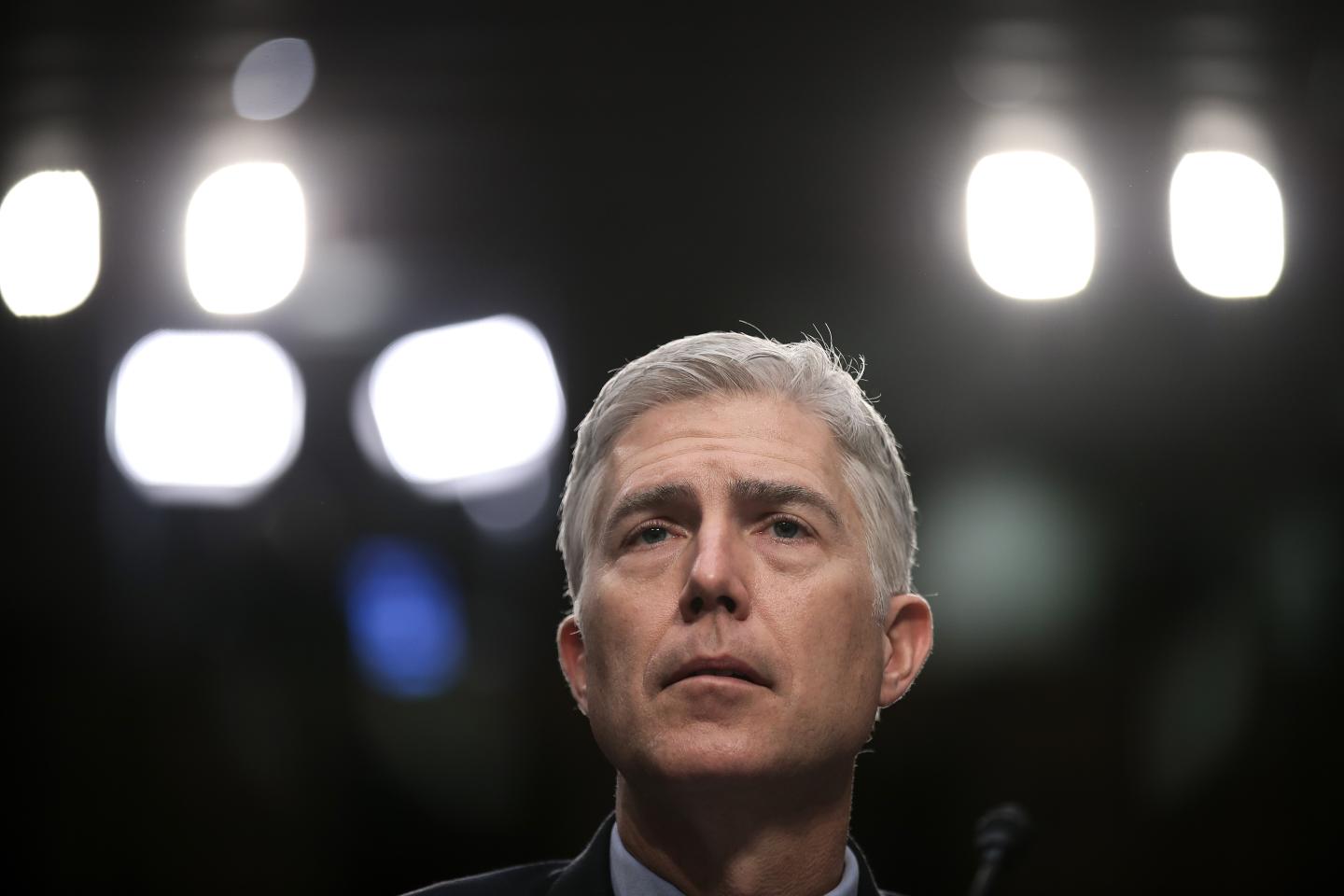
Senate Holds Confirmation Hearing For Supreme Court Nominee Neil Gorsuch
Drew Angerer—Getty Images

During Judge Gorsuch’s nomination hearing this week, senators pressed him on his views on issues relevant to President Trump’s ban on travel from six Muslim countries, which has thus far been blocked by courts. Gorsuch rightly declined to say what he thought about the pending litigation, which seems destined to come before the Supreme Court. When questioned on principles that might be relevant to the case, he replied in ways that seem facially reassuring, but avoided giving anything away – although his record as a Bush administration lawyer rings plenty of alarm bells.

Senator Patrick Leahy attempted to get at the nominee’s thoughts about the First Amendment’s religion clauses, which both forbid the government from preferring one faith over another and guarantee the right to freely practice one’s faith. Asked whether the First Amendment allowed a “religious litmus test,” Gorsuch replied that the issue was “currently being litigated” – obviously referring to the travel ban cases. An explicit religious litmus test would undoubtedly be unconstitutional and Gorsuch should have had no qualms about saying so. The issue being litigated is whether the travel ban is a religious test disguised as a national security measure. He was similarly cautious when asked whether the president could ban all Jews, simply referencing the constitutional guarantees of religious freedom and equal protection. Senator Leahy was able to get Gorsuch to concede that a religious test to serve in the military would be against the law, but not much more.

“No man is above the law,” Gorsuch declared in response to Senator Leahy’s query about whether the president’s national security determinations can be reviewed by the Supreme Court. Pressed on his willingness to stand up to Trump, Gorsuch explained that the hallmark of the rule of law was whether “the government can lose in its own court.”

It is hard to imagine a judicial nominee saying anything different. However, Gorsuch’s testimony gave little insight into how robustly he would review presidential decisions, a central issue in the Muslim ban lawsuits. When the first version of the ban came before the courts, Trump’s lawyers made a sweeping claim: not only was the president entitled to great deference in his national security judgments, his actions were “unreviewable.” It was easy enough for the court to smack down this argument, relying on a long line of cases in which the courts had reviewed, and even struck down, executive action on immigration and national security. When the next version of the ban was challenged, the administration made a narrower claim: that the president’s actions on immigration could only be reviewed to determine that they were “facially legitimate.” The president didn’t want the court looking at the motivation behind the order. That argument didn’t work either. Using the framework set out by the Supreme Court for cases challenging governmental expressions of religious preferences, the court looked at the context in which the order was issued finding “significant and unrebutted evidence of religious animus” towards Muslims and a “dearth of evidence indicating a national security purpose” and halted implementation.

In fact, we can glean greater insight into Gorsuch’s views on executive power from his record as a high-level political appointee in the Justice Department from 2005-2006 – a time when the Bush administration was advancing extremely broad claims of executive power to justify warrantless surveillance, torture, and Guantanamo. His involvement in crafting and defending these policies was disclosed in a number of documents relating to his tenure obtained by Senator Diane Feinstein. When questioned about his involvement in these matters, Gorsuch downplayed his role, suggesting that he was merely acting as a speechwriter. But today’s witnesses, many of of whom were central figures in the fights against these policies, detailed Gorsuch’s role in advancing them. Jameel Jaffer, who headed up the ACLU’s national security work during the time, raised an important point: “Judge Gorsuch appears not to have registered any disagreement with any of the policies he defended—though other officials did. Nor is there evidence that he registered discomfort with any of the broad arguments that the Justice Department advanced in support of those policies—though, again, others did.”

While it is difficult to read too much into Gorsuch’s fairly traditional and vague answers affirming courts’ role in serving as a check on the president and recognizing fundamental guarantees of religious freedom and due process, his work defending the worst of the Bush administration’s excesses raises serious questions about whether he would stand up to President Trump.

By Faiza Patel is co-director of the Liberty & National Security Program at the Brennan Center for Justice at NYU School of Law.

About the Author
By Faiza Patel
See full bioRight Arrow Button Icon

Latest in Commentary

Finance
Lorem ipsum dolor sit amet, consectetur adipiscing elit, sed do eiusmod tempor incididunt ut labore et dolore magna aliqua. Ut enim ad minim veniam
By Fortune Editors
October 20, 2025
Finance
Lorem ipsum dolor sit amet, consectetur adipiscing elit, sed do eiusmod tempor incididunt ut labore et dolore magna aliqua. Ut enim ad minim veniam
By Fortune Editors
October 20, 2025
Finance
Lorem ipsum dolor sit amet, consectetur adipiscing elit, sed do eiusmod tempor incididunt ut labore et dolore magna aliqua. Ut enim ad minim veniam
By Fortune Editors
October 20, 2025
Finance
Lorem ipsum dolor sit amet, consectetur adipiscing elit, sed do eiusmod tempor incididunt ut labore et dolore magna aliqua. Ut enim ad minim veniam
By Fortune Editors
October 20, 2025
Finance
Lorem ipsum dolor sit amet, consectetur adipiscing elit, sed do eiusmod tempor incididunt ut labore et dolore magna aliqua. Ut enim ad minim veniam
By Fortune Editors
October 20, 2025
Finance
Lorem ipsum dolor sit amet, consectetur adipiscing elit, sed do eiusmod tempor incididunt ut labore et dolore magna aliqua. Ut enim ad minim veniam
By Fortune Editors
October 20, 2025

Most Popular

Finance
Lorem ipsum dolor sit amet, consectetur adipiscing elit, sed do eiusmod tempor incididunt ut labore et dolore magna aliqua. Ut enim ad minim veniam
By Fortune Editors
October 20, 2025
Finance
Lorem ipsum dolor sit amet, consectetur adipiscing elit, sed do eiusmod tempor incididunt ut labore et dolore magna aliqua. Ut enim ad minim veniam
By Fortune Editors
October 20, 2025
Finance
Lorem ipsum dolor sit amet, consectetur adipiscing elit, sed do eiusmod tempor incididunt ut labore et dolore magna aliqua. Ut enim ad minim veniam
By Fortune Editors
October 20, 2025
Finance
Lorem ipsum dolor sit amet, consectetur adipiscing elit, sed do eiusmod tempor incididunt ut labore et dolore magna aliqua. Ut enim ad minim veniam
By Fortune Editors
October 20, 2025
Finance
Lorem ipsum dolor sit amet, consectetur adipiscing elit, sed do eiusmod tempor incididunt ut labore et dolore magna aliqua. Ut enim ad minim veniam
By Fortune Editors
October 20, 2025
Finance
Lorem ipsum dolor sit amet, consectetur adipiscing elit, sed do eiusmod tempor incididunt ut labore et dolore magna aliqua. Ut enim ad minim veniam
By Fortune Editors
October 20, 2025
Fortune Secondary Logo
Rankings
  • 100 Best Companies
  • Fortune 500
  • Global 500
  • Fortune 500 Europe
  • Most Powerful Women
  • World's Most Admired Companies
  • See All Rankings
  • Lists Calendar
Sections
  • Finance
  • Fortune Crypto
  • Features
  • Leadership
  • Health
  • Commentary
  • Success
  • Retail
  • Mpw
  • Tech
  • Lifestyle
  • CEO Initiative
  • Asia
  • Politics
  • Conferences
  • Europe
  • Newsletters
  • Personal Finance
  • Environment
  • Magazine
  • Education
Customer Support
  • Frequently Asked Questions
  • Customer Service Portal
  • Privacy Policy
  • Terms Of Use
  • Single Issues For Purchase
  • International Print
Commercial Services
  • Advertising
  • Fortune Brand Studio
  • Fortune Analytics
  • Fortune Conferences
  • Business Development
  • Group Subscriptions
About Us
  • About Us
  • Press Center
  • Work At Fortune
  • Terms And Conditions
  • Site Map
  • About Us
  • Press Center
  • Work At Fortune
  • Terms And Conditions
  • Site Map
  • Facebook icon
  • Twitter icon
  • LinkedIn icon
  • Instagram icon
  • Pinterest icon

Latest in Commentary

hegseth
CommentaryMilitary
America shot its arsenal empty in 2 wars. Now it needs Beijing’s permission to reload
By Steve H. Hanke and Jeffrey WengApril 30, 2026
11 hours ago
Duncan Tait, CEO of Inchcape
Europecar manufacturing
“Competition is good for the industry”. Inchcape CEO’s case for optimism in automotive’s next chapter
By Duncan TaitApril 30, 2026
14 hours ago
agentic
CommentaryAI agents
Why your data infrastructure — not your AI model — will determine whether Agentic AI scales
By Jeffrey Sonnenfeld, Stephen Henriques, Catherine Dai and Zander JeinthanuttkanontApril 30, 2026
17 hours ago
hoskins
Commentaryoffices
Gensler Co-Chair: Hot-desking was supposed to save money. It may be costing you your culture
By Diane HoskinsApril 30, 2026
18 hours ago
tillis
CommentaryCongress
Thom Tillis: Free markets built American prosperity. Government intervention puts it at risk
By Thom Tillis and John StanfordApril 30, 2026
20 hours ago
iran
CommentaryIran
The Strait of Hormuz is a data problem, not just a military one
By Erik Bethel and Ami DanielApril 30, 2026
20 hours ago

Most Popular

Apple cofounder Ronald Wayne—whose stake would be worth up to $400 billion had he not sold it in 1976—says that at 91, he has no regrets
Success
Apple cofounder Ronald Wayne—whose stake would be worth up to $400 billion had he not sold it in 1976—says that at 91, he has no regrets
By Preston ForeApril 27, 2026
4 days ago
Google Cloud revenue is now 18% of Alphabet's business. Is this the beginning of the end of Google's search identity?
Big Tech
Google Cloud revenue is now 18% of Alphabet's business. Is this the beginning of the end of Google's search identity?
By Alexei OreskovicApril 29, 2026
1 day ago
China dominates the world's lithium supply. The U.S. just found 328 years' worth in its own backyard
North America
China dominates the world's lithium supply. The U.S. just found 328 years' worth in its own backyard
By Jake AngeloApril 30, 2026
10 hours ago
‘The cost of compute is far beyond the costs of the employees’: Nvidia executive says right now AI is more expensive than paying human workers
AI
‘The cost of compute is far beyond the costs of the employees’: Nvidia executive says right now AI is more expensive than paying human workers
By Sasha RogelbergApril 28, 2026
3 days ago
With no end in sight, Trump considers new options in Iran war—including the ‘Dark Eagle’ hypersonic missile
Big Tech
With no end in sight, Trump considers new options in Iran war—including the ‘Dark Eagle’ hypersonic missile
By Jim EdwardsApril 30, 2026
18 hours ago
No, tariffs are not strengthening the economy
Commentary
No, tariffs are not strengthening the economy
By Alex DuranteApril 29, 2026
2 days ago

© 2026 Fortune Media IP Limited. All Rights Reserved. Use of this site constitutes acceptance of our Terms of Use and Privacy Policy | CA Notice at Collection and Privacy Notice | Do Not Sell/Share My Personal Information
FORTUNE is a trademark of Fortune Media IP Limited, registered in the U.S. and other countries. FORTUNE may receive compensation for some links to products and services on this website. Offers may be subject to change without notice.