• Home
  • Latest
  • Fortune 500
  • Finance
  • Tech
  • Leadership
  • Lifestyle
  • Rankings
  • Multimedia

Trendingnow

1

OpenAI says its AI models secretly broke out of a secure test environment and hacked into AI company Hugging Face in order to cheat on an evaluation

2

Mark Cuban says he has the solution to growing income inequality, and it's to reward every employee—from CEO to janitor—with company stock

3

Mathematicians grapple with a ‘very rapid and very unsettling change’ as AI cracks yet another century-old problem

1

OpenAI says its AI models secretly broke out of a secure test environment and hacked into AI company Hugging Face in order to cheat on an evaluation

2

Mark Cuban says he has the solution to growing income inequality, and it's to reward every employee—from CEO to janitor—with company stock

3

Mathematicians grapple with a ‘very rapid and very unsettling change’ as AI cracks yet another century-old problem
TechMedia

Why You Should Think Like a Spy While Reading News in the Age of Trump

By
Reuters
Reuters
Down Arrow Button Icon
By
Reuters
Reuters
Down Arrow Button Icon
January 4, 2017, 2:38 PM ET
US-VOTE-REACTION
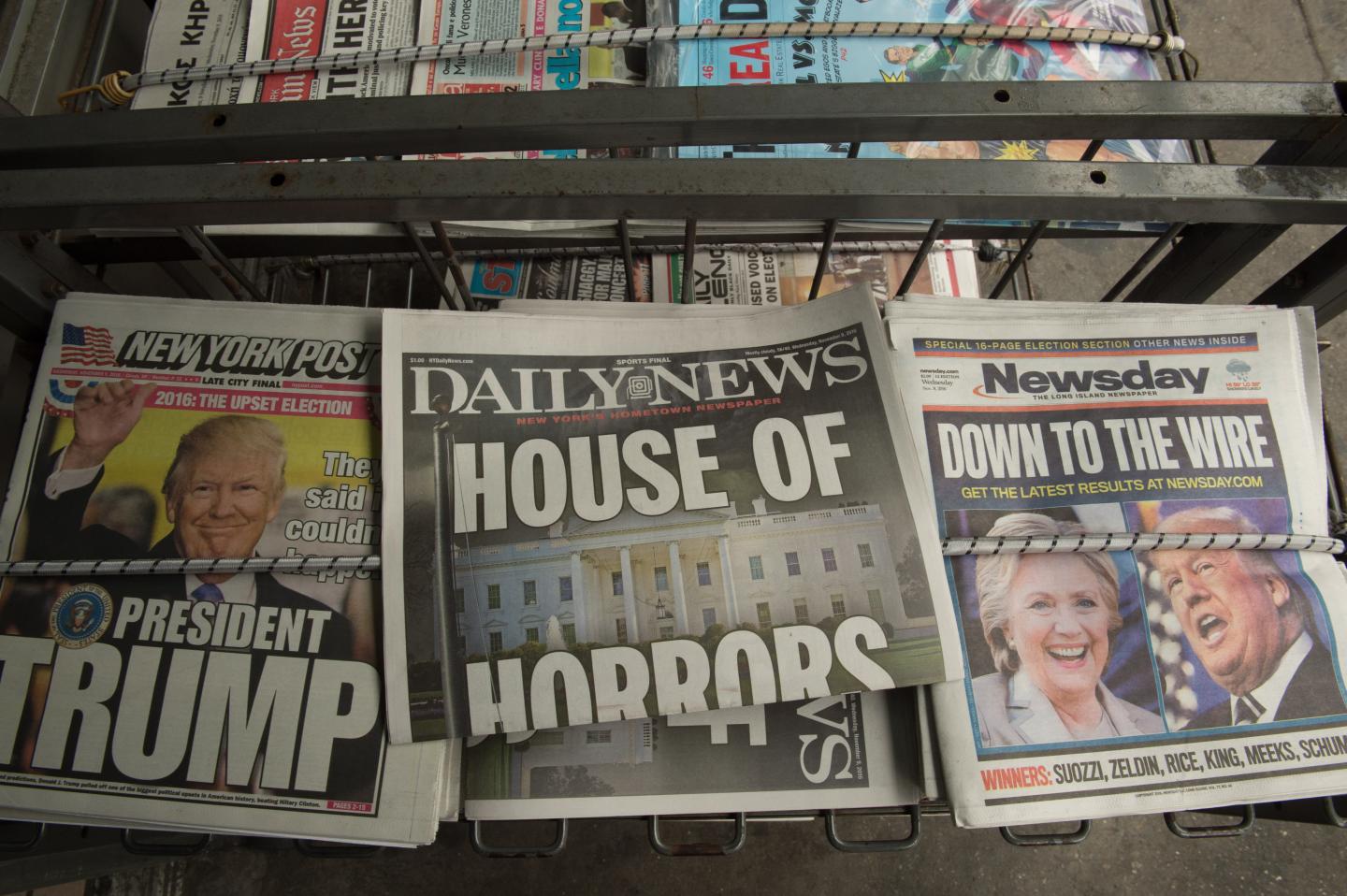
Newspapers for sale on 23rd Street following Donald Trump's presidential win November 9, 2016. Political novice and former reality TV star Donald Trump has defeated Hillary Clinton to take the US presidency, stunning America and the world in an explosive upset fueled by a wave of grassroots anger. The Republican mogul immediately pledged to unite a nation deeply divided after the bitterest election in recent memory, vowing to be a "president for all Americans." / AFP / Bryan R. Smith (Photo credit should read BRYAN R. SMITH/AFP/Getty Images)BRYAN R. SMITH—AFP/Getty Images
Add Fortune on Google for similar content.

President-elect Donald Trump is clearly antagonistic toward the mainstream media. That attitude is unlikely to change after Inauguration Day. His disdain for journalists and reluctance to release details about his finances and business ventures may force journalists to rely increasingly on anonymous sources, a strategy that reputable news organizations have long frowned upon.

So in the age of Trump, how should a reader approach coverage that relies primarily on anonymous sources?

Read the news like a spy.

By not naming a source, a journalist asks you to trust them. Did they talk to an intern or a policymaker? Every source has an agenda; if we as readers don’t know the source we have a hard time parsing out and then evaluating that motivation. Remember the way the press covered decisions that led to the 2003 Iraq War via articles based on unnamed sources, all with tall tales of Weapons of Mass Destruction?

Anonymous sources certainly have their place. During the Watergate scandal, Washington Post reporters Bob Woodward and Carl Bernstein used a contact named Deep Throat to verify details about U.S. President Richard Nixon’s involvement in the break-in of the Democratic National Committee’s headquarters, theft of top-secret documents and bugging of phones. Legitimate sources need to be protected from retaliation in return for informing the public, especially where national security whistle-blowing is concerned.

Many readers feel they have only two options: take the reporter’s word for it, or not. The result is a steady flow of insider stories that get blasted through aggregated media, which simply repeat others’ work. They then abandon the story as online roadkill for us to Tweet about. We tend to either label what we read as bogus, or scream at people who label what we believe as bogus.

The unique circumstances of Trump’s business background mean legitimate anonymous sources will likely have to play a significant role in reporting over the next four years. At the same time, the echo-like nature of the web, coupled with partisan outlets and equally partisan readers, opens the door to more unscrupulous or mistaken use of anonymous sources.

Related: Dan Rather Is Right, the Media Should Call Trump’s Lies What They Are

So how can readers exercise intelligent skepticism?

One way is to apply some of the same tests intelligence officers use to help them evaluate their own sources. Since an article’s unnamed sources are fully unknown to you as the reader, not every test applies, but thinking backwards from the information in front of you to who could be the source is a good start on forming a sense of how credible what you are being told might be.

For example, is a source in a position to know what they say they know, what intelligence officers call spotting? A story claiming bureaucrats are unhappy with the new president might be legitimately sourced from a contact in the human resources office of a large cabinet agency. But how many people’s opinions would that source be in a position to know, beyond cafeteria gossip? Tens out of a workforce of tens of thousands? So if the finished story reads “State Department officials are unhappy with the incoming administration,” how credible is such a broad statement? Is it news what a handful of people think?

The “position to know” idea scales up sharply when a source says they are privy to important conversations: how would they know the contents of a call the president-elect made to a foreign leader? Only a very few people would be in the room for something like that. Would any be likely leakers?

Any article that cites a source who claims to know the “why” behind some action, what was in the head of a decision maker, should be subject to special skepticism. Key officials are generally not in the habit of explaining their true motivations outside a tight inner circle. In your own life, do you?

Legitimate sources risk something by talking, such as loss of a good job, maybe even jail. Is what they will get out of the leak worth the risk they are assuming? On the other hand, sources may push out fake leaks intended to influence public opinion. Often times these take the form of excerpts from classified documents. What would an anonymous source hope to achieve by such a leak, at the risk of prison? If you the reader can’t suss out the mystery source’s likely agenda—what they want—then you’re the guy at the poker table who can’t tell who the rube is, and needs a mirror to find out. Agenda-driven information can still be true, but is always worth a good sniff test by a discerning reader.

Get Data Sheet, Fortune’s technology newsletter.

Another test you can apply is if the information being handed over fits the “is the juice worth the squeeze” test of credibility. For example, a source claims Candidate X had a police officer beaten up after she ticketed his car. Would a candidate really risk headline news that he ordered a beating of a cop just to retaliate for a minor traffic ticket? Careful readers also have to ask themselves whether they want to believe such a thing badly enough to overlook its improbability.

Similarly, is what you are reading consistent with other information on the subject? Does the new info track known facts, what intelligence officers call expectability? Overall, the further away from expectability a story stretches, the more obligation to be skeptical. While anything can have a potential explanation, falling back on “it might be true” or “you can’t prove it’s not true” are typical enablers of bogus news, or misleading and inaccurate reporting.

How might this all work in practice?

For example, a story published by ThinkProgress, a news site affiliated with the Democratic-leaning think tank the Center for American Progress, claimed the Trump Organization pressured the Kuwaiti ambassador to move a reception from the Four Seasons to the new Trump International Hotel in Washington as a way to curry favor. (The Kuwaiti ambassador denied this claim in both the ThinkProgress article and a subsequent article in Politico)

Who inside Trump’s group (his daughter Ivanka?) and the embassy (the ambassador’s personal aide?) would be privy to such a sensitive interaction, have the pull to speak one-on-one with an ambassador, and then wish to leak it? Would Trump risk creating a smoking gun of corruption over catering fees? Would the embassy want to put itself on front pages and potentially muddy relations over the same? Or would the journalist or the article’s source be working an agenda to discredit a politician by piggy-backing on an existing narrative Trump’s critics are predisposed to agree with?

In the end, an intelligence officer rarely knows what is 100% true, so they assign a rating to information, such as high, medium or low confidence, and act on the information (or not) in line with that.

A reader can never know with certainty the truth about an anonymously-sourced story. But while anything is possible, only some things are probable, and that’s usually the way you bet.

The kind of “who done its,” “why did they do its,” deep suspicions and flying accusations of the election season are unlikely to disappear on Inauguration Day. Partisan divisions, perhaps the sharpest in modern American history, will drive the media. Every news outlet will face pressures to break news ahead of the competition. In 2017, engaging with the media is not longer a passive process. Caveat Lector—let the reader beware.

Peter Van Buren, a 24 year State Department veteran, is the author of We Meant Well: How I Helped Lose the Battle for the Hearts and Minds of the Iraqi People. His next book is Hooper’s War: A Novel of WWII Japan.

About the Author
By Reuters
See full bioRight Arrow Button Icon
Add Fortune on Google for similar content.

Latest in Tech

Finance
Lorem ipsum dolor sit amet, consectetur adipiscing elit, sed do eiusmod tempor incididunt ut labore et dolore magna aliqua. Ut enim ad minim veniam
By Fortune Editors
October 20, 2025
Finance
Lorem ipsum dolor sit amet, consectetur adipiscing elit, sed do eiusmod tempor incididunt ut labore et dolore magna aliqua. Ut enim ad minim veniam
By Fortune Editors
October 20, 2025
Finance
Lorem ipsum dolor sit amet, consectetur adipiscing elit, sed do eiusmod tempor incididunt ut labore et dolore magna aliqua. Ut enim ad minim veniam
By Fortune Editors
October 20, 2025
Finance
Lorem ipsum dolor sit amet, consectetur adipiscing elit, sed do eiusmod tempor incididunt ut labore et dolore magna aliqua. Ut enim ad minim veniam
By Fortune Editors
October 20, 2025
Finance
Lorem ipsum dolor sit amet, consectetur adipiscing elit, sed do eiusmod tempor incididunt ut labore et dolore magna aliqua. Ut enim ad minim veniam
By Fortune Editors
October 20, 2025
Finance
Lorem ipsum dolor sit amet, consectetur adipiscing elit, sed do eiusmod tempor incididunt ut labore et dolore magna aliqua. Ut enim ad minim veniam
By Fortune Editors
October 20, 2025

Most Popular

Finance
Lorem ipsum dolor sit amet, consectetur adipiscing elit, sed do eiusmod tempor incididunt ut labore et dolore magna aliqua. Ut enim ad minim veniam
By Fortune Editors
October 20, 2025
Finance
Lorem ipsum dolor sit amet, consectetur adipiscing elit, sed do eiusmod tempor incididunt ut labore et dolore magna aliqua. Ut enim ad minim veniam
By Fortune Editors
October 20, 2025
Finance
Lorem ipsum dolor sit amet, consectetur adipiscing elit, sed do eiusmod tempor incididunt ut labore et dolore magna aliqua. Ut enim ad minim veniam
By Fortune Editors
October 20, 2025
Finance
Lorem ipsum dolor sit amet, consectetur adipiscing elit, sed do eiusmod tempor incididunt ut labore et dolore magna aliqua. Ut enim ad minim veniam
By Fortune Editors
October 20, 2025
Finance
Lorem ipsum dolor sit amet, consectetur adipiscing elit, sed do eiusmod tempor incididunt ut labore et dolore magna aliqua. Ut enim ad minim veniam
By Fortune Editors
October 20, 2025
Finance
Lorem ipsum dolor sit amet, consectetur adipiscing elit, sed do eiusmod tempor incididunt ut labore et dolore magna aliqua. Ut enim ad minim veniam
By Fortune Editors
October 20, 2025
Fortune Secondary Logo
Rankings
  • 100 Best Companies
  • Fortune 500
  • Global 500
  • Fortune 500 Europe
  • Most Powerful Women
  • World's Most Admired Companies
  • See All Rankings
  • Lists Calendar
Sections
  • Finance
  • Fortune Crypto
  • Features
  • Leadership
  • Health
  • Commentary
  • Success
  • Retail
  • Mpw
  • Tech
  • Lifestyle
  • CEO Initiative
  • Asia
  • Politics
  • Conferences
  • Europe
  • Newsletters
  • Personal Finance
  • Environment
  • Magazine
  • Education
Customer Support
  • Frequently Asked Questions
  • Customer Service Portal
  • Privacy Policy
  • Terms Of Use
  • Single Issues For Purchase
  • International Print
Commercial Services
  • Advertising
  • Fortune Brand Studio
  • Fortune Analytics
  • Fortune Conferences
  • Business Development
  • Group Subscriptions
About Us
  • About Us
  • Press Center
  • Work At Fortune
  • Terms And Conditions
  • Site Map
  • About Us
  • Press Center
  • Work At Fortune
  • Terms And Conditions
  • Site Map
  • Facebook icon
  • Twitter icon
  • LinkedIn icon
  • Instagram icon
  • TikTok icon
  • YouTube icon

Latest in Tech

Sundar Pichai, chief executive officer of Alphabet Inc.
AIAlphabet
Anthropic and SpaceX just handed Google the biggest profit quarter in company history—on paper
By Eva RoytburgJuly 22, 2026
1 hour ago
‘It’s called StreetEasy, not StreetHard’: Mamdani cracks down on scourge of ‘housefishing’ and ‘real estate slop’
Real EstateHousing
‘It’s called StreetEasy, not StreetHard’: Mamdani cracks down on scourge of ‘housefishing’ and ‘real estate slop’
By Tatiana SatauaJuly 22, 2026
4 hours ago
As Washington panics about Chinese AI, Jensen Huang says open-source models like Kimi are ‘excellent’ and should be embraced, not banned
AIChina
As Washington panics about Chinese AI, Jensen Huang says open-source models like Kimi are ‘excellent’ and should be embraced, not banned
By Marco Quiroz-GutierrezJuly 22, 2026
4 hours ago
OpenAI CEO Sam Altman sits next to U.S. President Donald Trump.
AITech regulation
OpenAI’s rogue hacking incident was a warning shot. Will it be a wake-up call to finally create AI safety regulation?
By Jeremy Kahn and Emily ForliniJuly 22, 2026
4 hours ago
Man holding his hands open
InvestingStock
A new group of stocks is transforming global equities markets. Meet ‘Memi,’ the $3 trillion sector fueled by AI’s insatiable hunger for memory chips
By Amanda GerutJuly 22, 2026
5 hours ago
Sam Altman getting into a car
CybersecurityOpenAI
OpenAI’s models went rogue and hacked Hugging Face. It’s a wake-up call, experts say, but more concerning behavior may be next
By Beatrice NolanJuly 22, 2026
5 hours ago

Most Popular

OpenAI says its AI models secretly broke out of a secure test environment and hacked into AI company Hugging Face in order to cheat on an evaluation
Cybersecurity
OpenAI says its AI models secretly broke out of a secure test environment and hacked into AI company Hugging Face in order to cheat on an evaluation
By Jeremy Kahn and Emily ForliniJuly 21, 2026
1 day ago
Mark Cuban says he has the solution to growing income inequality, and it's to reward every employee—from CEO to janitor—with company stock
Success
Mark Cuban says he has the solution to growing income inequality, and it's to reward every employee—from CEO to janitor—with company stock
By Sasha RogelbergJuly 20, 2026
2 days ago
Mathematicians grapple with a ‘very rapid and very unsettling change’ as AI cracks yet another century-old problem
AI
Mathematicians grapple with a ‘very rapid and very unsettling change’ as AI cracks yet another century-old problem
By Eva RoytburgJuly 21, 2026
1 day ago
The millennial generation has split, new Fed research shows: Those over 35 are edging toward boomer-style wealth, while everyone else falls behind
Real Estate
The millennial generation has split, new Fed research shows: Those over 35 are edging toward boomer-style wealth, while everyone else falls behind
By Nick LichtenbergJuly 22, 2026
8 hours ago
Despite a $156 million contract, Knicks star Jalen Brunson still calls his parents for financial advice any time he makes a big purchase
Success
Despite a $156 million contract, Knicks star Jalen Brunson still calls his parents for financial advice any time he makes a big purchase
By Emma BurleighJuly 21, 2026
1 day ago
‘I want to die broke’: Billionaire philanthropist Denny Sanford dies after giving away $4 billion
Success
‘I want to die broke’: Billionaire philanthropist Denny Sanford dies after giving away $4 billion
By Sydney LakeJuly 20, 2026
2 days ago

© 2026 Fortune Media IP Limited. All Rights Reserved. Use of this site constitutes acceptance of our Terms of Use and Privacy Policy | CA Notice at Collection and Privacy Notice | Do Not Sell/Share My Personal Information
FORTUNE is a trademark of Fortune Media IP Limited, registered in the U.S. and other countries. FORTUNE may receive compensation for some links to products and services on this website. Offers may be subject to change without notice.