
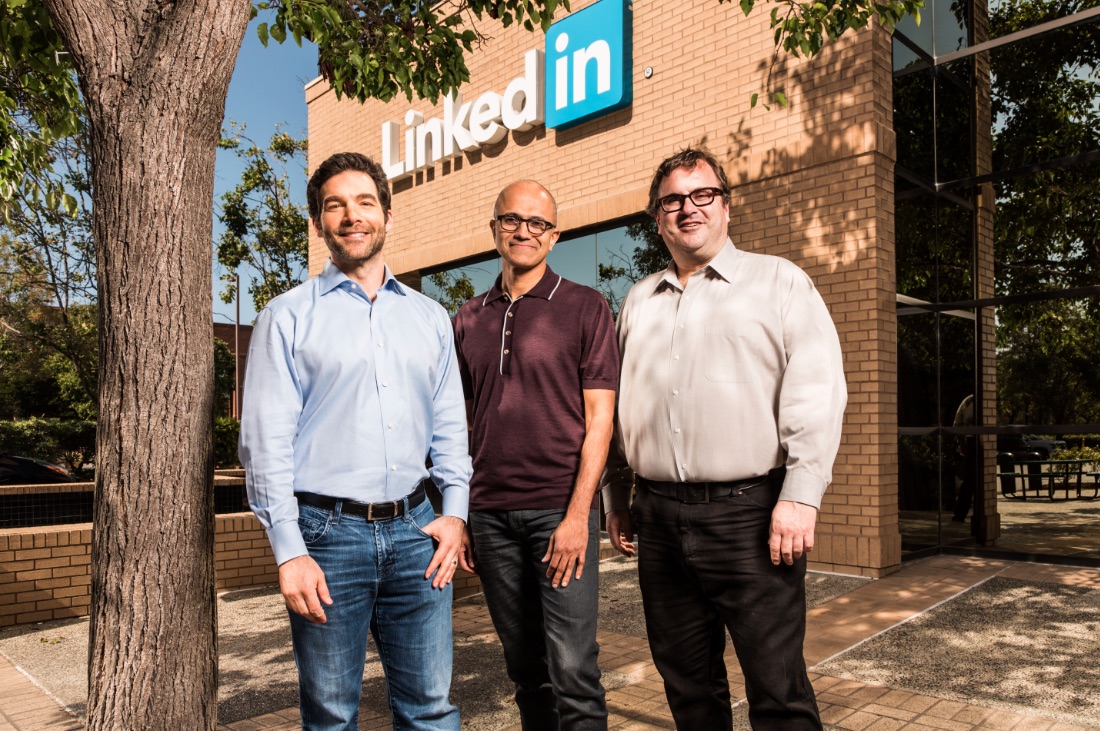
Now that Microsoft’s $26 billion purchase of LinkedIn is final, here are some suggestions for things that Microsoft chief executive officer Satya Nadella could do to improve the huge—but sometimes annoying—business network.
Based on a very informal poll of about two dozen colleagues and friends, nearly everyone agrees that that LinkedIn’s database is an incredible trove of information about current or prospective employees or employers. It’s useful for finding and keeping in touch with long-lost colleagues, or finding potential new job or filling job openings. LinkedIn claims 467 million registered users, with two new people joining every second, although it does not disclose how many pay.
Only one of the respondents says she’s quit the business-focused social network, deleting her account. Other than that, here are some suggestions.
Fix the Interface
There were lots of complaints about the user interface, which is clumsy and seems in a constant state of flux.
“They keep changing it,” says Catherine Marenghi, a Boston area public relations executive and author. It is very hard to find things—like support, she adds.
To be fair, LinkedIn is already on this. In September, the company outlined plans for a desktop redesign, due early next year.
Go Easy on the Spam
The biggest complaint seems to be LinkedIn’s propensity to “spam” users, requesting more contacts—a feature that thankfully can now be turned off—and reminding them to send birthday wishes or holiday greetings to long-lost colleagues.
Jeff Shuey, a former executive at Eastman Kodak (KODK) and K2 Software, likes finding and keeping in touch with former colleagues with LinkedIn. What he doesn’t like? “Birthday wishes. This is not Facebook (FB) people!”
Kill Endorsements
The myriad of requests to “endorse” contacts is a source of chagrin. No one said they pay any attention to these endorsements.
“The endorsements are absolute crap,” says Yuval Shavit, a Boston-area software engineer via email. “I’ve been endorsed for technologies that I have no experience in. For instance, languages that I have literally never written a single line in. LinkedIn does a bad job curating the info about its users.”
Said another wag: “I love getting endorsements on skills I don’t have from people I don’t know.”
You can kill endorsements, although it’s not intuitive how to do so, and you have to wonder if the random endorsements have value.
Beef up the Mobile App
A vice president of a global healthcare organization based on the East Coast finds LinkedIn’s mobile app less than inspiring.
“The most annoying bug is when you get a notification in mobile email and click the link to take whatever action, the mobile app opens and takes you to your home page. It should behave like the desktop browser app and let you complete whatever the action is,” he said. (This executive requested anonymity because he is not authorized to speak about the company’s IT use.)
Now the Good News
The social network also got some rave reviews, mostly from people who pay for advanced versions for recruitment or marketing
Dee Dee Walsh, vice president of marketing for Mobilize.net, a Bellevue, Wash. company that helps migrate older software to the Web, uses LinkedIn all the time both to recruit new employees and for marketing.
“When I place an ad, it’s really effective especially for non-technical jobs. I get a lot of really great candidates because I can target by title, by keyword, by group,” she noted. It’s less effective than Stackoverflow for technical or engineering candidates, but she thinks Microsoft (MSFT) ownership could help there.
Get Data Sheet, Fortune’s technology newsletter.
Google’s (GOOGL) advertising products let companies buy keywords, but doesn’t allow targeting to this degree, Walsh continues. She also looked at Rainking and DiscoverOrg databases of prospective IT buyers within companies, but they don’t let her fine tune her searches the way LinkedIn does, she says.
For marketing, sales, and recruiting, the ability to really pinpoint searches is critical. “I don’t want to be a pest to people, although I know I am. LinkedIn helps me be a pest to the right people,” Walsh tells Fortune.
Marketers can embed LinkedIn code on their websites which then provides them with the LinkedIn profile of any visitor, a very common usage of the product. The reports on web site visitors that LinkedIn provides are very useful, several marketing executives said.
For more on Microsoft-LinkedIn, watch:
The thing about LinkedIn for many users is that it cuts both ways.
“I don’t like that LinkedIn will tell people when I’ve stalked them. Though, I do like knowing who is stalking me,” says Jennifer Cloer, founder of reTHINKit PR in Portland Oregon. She got back to Fortune later to note that she learned how to switch her privacy settings to incognito, so she can stalk people surreptitiously going forward.
LinkedIn’s strength lies in the data it holds on millions of people. But that can lead to problems: How does it surface the most relevant stuff and promote interaction without bombarding people with minutia?
And now that Microsoft plans to integrate LinkedIn with Office, Outlook and other tentpole products, as noted by LinkedIn chief executive Jeff Weiner, it must also weigh concerns of users about exposing so much of their information to a broader audience. It may be great for Microsoft Dynamics CRM users who want to pump possible leads into their sales application, but may also turn off users who can vote with their feet to turn off the network if it gets too obtrusive.
If you love the sponsored content you now see in LinkedIn, you may rejoice that you’ll soon see it across Microsoft properties going forward. But, if you find it pointless, you may not be happy.
And finally, while no one brought this up, given that LinkedIn had to reset 55,000 passwords for users of its Lynda.com online education site early this week, it seems the company and its new parent have work to do on the security front.
But then again, who doesn’t?