• Home
  • Latest
  • Fortune 500
  • Finance
  • Tech
  • Leadership
  • Lifestyle
  • Rankings
  • Multimedia
Finance

Here’s Why Good Economic Data Won’t Help the Hillary Clinton Campaign

By
Chris Matthews
Chris Matthews
Down Arrow Button Icon
By
Chris Matthews
Chris Matthews
Down Arrow Button Icon
September 14, 2016, 3:11 PM ET
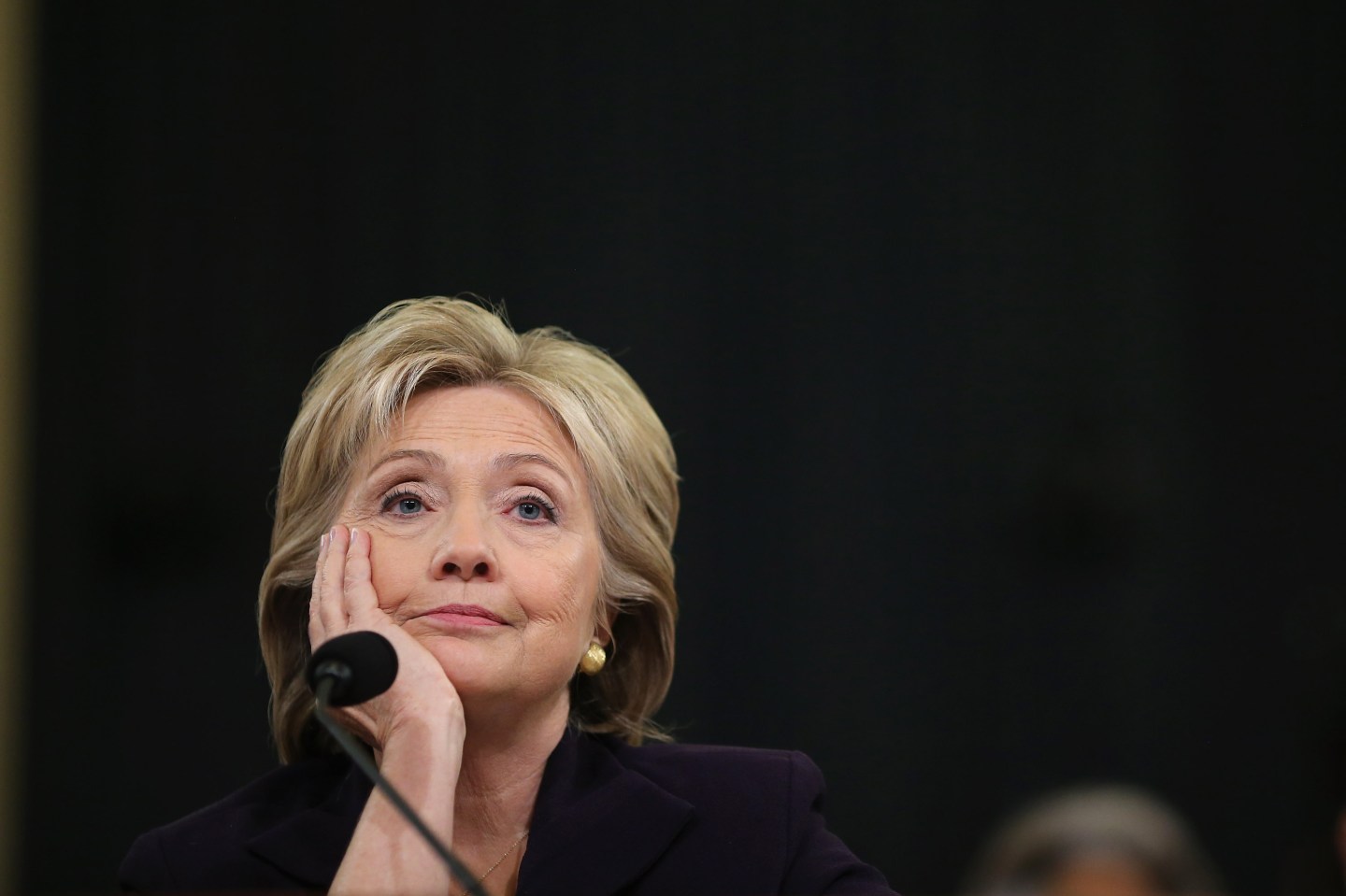
Hillary Clinton Testifies Before House Select Committee On Benghazi Attacks
Photograph by Chip Somodevilla — Getty Images

It was during Bill Clinton’s successful 1992 presidential campaign that the phrase “It’s the economy, stupid” entered the popular political lexicon.

The saying was coined by Clinton advisor James Carville, who argued that the ’92 campaign should simply focus on the problem of rising unemployment, as Americans’ basic economic situations would drive their perceptions of the state of the country and the quality of leadership provided by President George H.W. Bush, Clinton’s opponent.

Since that time it’s been taken as an article of faith that one of the most important drivers of voters’ perception is economic conditions on the ground. But this election cycle may bring this belief into question.

According to Peter Atwater, socionomist and president of the research and analysis firm Financial Insyghts, this is because the correlation between actual economic conditions and people’s perception of the economy is breaking down, and perhaps wasn’t all that strong to begin with. “The transmission of our economic reality into our economic perception is not straightforward,” Atwater wrote in a recent blog post. He points out that there is a strong correlation overall between the economic confidence index compiled by polling firm Gallup and the unemployment rate. But when you dig deeper into the data, the relationship looks much weaker.

Atwater decided to analyze the relationship between confidence and the unemployment rate on a year-by-year basis. He found that the “relationship between ECI and Unemployment appears to change year to year—sometimes dramatically.” The following chart illustrates this fact, with each line representing another year of the recent economic recovery. As you can see, sometimes economic confidence goes up when unemployment goes down (as represented by the lines that slope downward from left to right), but sometimes just the opposite happens (as represented by the upward-slopers).
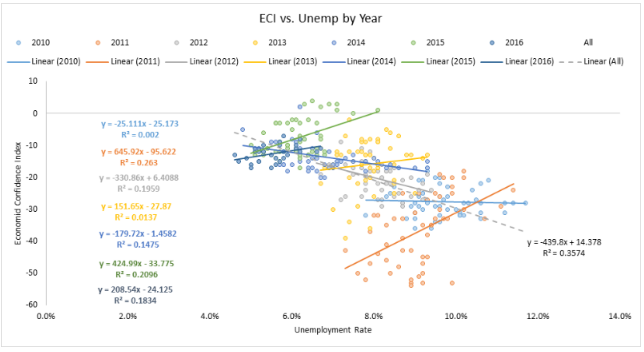
screen-shot-2016-09-14-at-12-45-13-pm

Atwater talked to an analyst at Gallup who tried to chalk these strange relationships to unusual events, like the debt ceiling crisis of 2011 and the government shutdown of 2013. Another theory, posited for the negative relationship between confidence and unemployment last year, was slowing growth, because Americans may take economic facts other than the jobless rate into consideration when deciding how they feel. But what about the fact that average wages rose faster last year than any year since 1967, when the Census Department began measuring the statistic? Surely rising pay should increase economic confidence, but according to Gallup it didn’t.

This research should worry Hillary Clinton, if you believe that voters’ perceptions of the economy drive their decision whether or not to support the incumbent party. And Atwater gives some reasons why Clinton supporters might latch on to this disconnect as reason to worry that positive economic data will not help her. He writes:

I would also caution against viewing specific events as contributors to our level of confidence . . . While [it] may seem intuitive that the Debt Ceiling Crisis and the Government Shutdown negatively impacted confidence in 2011 and 2013, respectively – it is far more likely that both events were in fact symptoms, if not outright consequences of falling confidence. When confidence is weak, zero sum thinking naturally takes hold and reaching a political compromise is especially difficult . . .

Many events that would intuitively suggest even weaker confidence levels to come frequently mark THE low in confidence. Rather than causing confidence to fall further, these events instead mark the bottom. For example, as [the following] chart shows, the 2008 banking crisis didn’t cause American confidence to fall further; it reflected that confidence had fallen already to an extreme. The collapse of Lehman Brothers – not to mention the “spontaneous” formation of the Tea Party – was a symptom of exceptionally weak social mood.

screen-shot-2016-09-14-at-12-57-19-pm

Atwater, then, is pretty sure that it’s not events that are causing changes in confidence, but changes in confidence that are driving events. But what actually causes waves of optimism and pessimism in people is much harder to understand. This thought, Atwater argues, can be unsettling, because people like to know why things are they way they are. But Atwater’s research has led him to believe that these changes, while mysterious, are real and important. They cannot be argued away by pointing to reality, because human beings aren’t necessarily convinced by objective facts. And that could spell bad news for the Clinton campaign come November.


About the Author
By Chris Matthews
See full bioRight Arrow Button Icon

Latest in Finance

Finance
Lorem ipsum dolor sit amet, consectetur adipiscing elit, sed do eiusmod tempor incididunt ut labore et dolore magna aliqua. Ut enim ad minim veniam
By Fortune Editors
October 20, 2025
Finance
Lorem ipsum dolor sit amet, consectetur adipiscing elit, sed do eiusmod tempor incididunt ut labore et dolore magna aliqua. Ut enim ad minim veniam
By Fortune Editors
October 20, 2025
Finance
Lorem ipsum dolor sit amet, consectetur adipiscing elit, sed do eiusmod tempor incididunt ut labore et dolore magna aliqua. Ut enim ad minim veniam
By Fortune Editors
October 20, 2025
Finance
Lorem ipsum dolor sit amet, consectetur adipiscing elit, sed do eiusmod tempor incididunt ut labore et dolore magna aliqua. Ut enim ad minim veniam
By Fortune Editors
October 20, 2025
Finance
Lorem ipsum dolor sit amet, consectetur adipiscing elit, sed do eiusmod tempor incididunt ut labore et dolore magna aliqua. Ut enim ad minim veniam
By Fortune Editors
October 20, 2025
Finance
Lorem ipsum dolor sit amet, consectetur adipiscing elit, sed do eiusmod tempor incididunt ut labore et dolore magna aliqua. Ut enim ad minim veniam
By Fortune Editors
October 20, 2025

Most Popular

Finance
Lorem ipsum dolor sit amet, consectetur adipiscing elit, sed do eiusmod tempor incididunt ut labore et dolore magna aliqua. Ut enim ad minim veniam
By Fortune Editors
October 20, 2025
Finance
Lorem ipsum dolor sit amet, consectetur adipiscing elit, sed do eiusmod tempor incididunt ut labore et dolore magna aliqua. Ut enim ad minim veniam
By Fortune Editors
October 20, 2025
Finance
Lorem ipsum dolor sit amet, consectetur adipiscing elit, sed do eiusmod tempor incididunt ut labore et dolore magna aliqua. Ut enim ad minim veniam
By Fortune Editors
October 20, 2025
Finance
Lorem ipsum dolor sit amet, consectetur adipiscing elit, sed do eiusmod tempor incididunt ut labore et dolore magna aliqua. Ut enim ad minim veniam
By Fortune Editors
October 20, 2025
Finance
Lorem ipsum dolor sit amet, consectetur adipiscing elit, sed do eiusmod tempor incididunt ut labore et dolore magna aliqua. Ut enim ad minim veniam
By Fortune Editors
October 20, 2025
Finance
Lorem ipsum dolor sit amet, consectetur adipiscing elit, sed do eiusmod tempor incididunt ut labore et dolore magna aliqua. Ut enim ad minim veniam
By Fortune Editors
October 20, 2025
Fortune Secondary Logo
Rankings
  • 100 Best Companies
  • Fortune 500
  • Global 500
  • Fortune 500 Europe
  • Most Powerful Women
  • Future 50
  • World’s Most Admired Companies
  • See All Rankings
Sections
  • Finance
  • Fortune Crypto
  • Features
  • Leadership
  • Health
  • Commentary
  • Success
  • Retail
  • Mpw
  • Tech
  • Lifestyle
  • CEO Initiative
  • Asia
  • Politics
  • Conferences
  • Europe
  • Newsletters
  • Personal Finance
  • Environment
  • Magazine
  • Education
Customer Support
  • Frequently Asked Questions
  • Customer Service Portal
  • Privacy Policy
  • Terms Of Use
  • Single Issues For Purchase
  • International Print
Commercial Services
  • Advertising
  • Fortune Brand Studio
  • Fortune Analytics
  • Fortune Conferences
  • Business Development
  • Group Subscriptions
About Us
  • About Us
  • Editorial Calendar
  • Press Center
  • Work At Fortune
  • Diversity And Inclusion
  • Terms And Conditions
  • Site Map
  • About Us
  • Editorial Calendar
  • Press Center
  • Work At Fortune
  • Diversity And Inclusion
  • Terms And Conditions
  • Site Map
  • Facebook icon
  • Twitter icon
  • LinkedIn icon
  • Instagram icon
  • Pinterest icon

Latest in Finance

Personal Financechecking accounts
Best banks for early direct deposit of March 2026
By Glen Luke FlanaganMarch 24, 2026
25 minutes ago
Personal FinanceSavings
Best money market accounts of March 2026
By Glen Luke FlanaganMarch 24, 2026
31 minutes ago
Personal Financemoney management
How premiums impact the price you pay for gold and silver
By Joseph HostetlerMarch 24, 2026
48 minutes ago
Farmer standing in front a soybean farm
Economyfertilizer
Soaring fertilizer prices could pressure a U.S. agricultural industry that supports 50 million jobs and over $10 trillion in output
By Tristan BoveMarch 24, 2026
51 minutes ago
gen z
Real EstateInflation
Gen Z finally had room to breathe. Now Trump’s 26% gas price hike has them suffocating
By Nick LichtenbergMarch 24, 2026
1 hour ago
Two People Faces Talking Discussion Communication Stock Market Insider 3d Illustration
EnergyIran
Nobel laureate Paul Krugman calls it ‘treason’: $580 million in suspicious oil futures traded minutes before Trump’s Iran reversal
By Eva RoytburgMarch 24, 2026
1 hour ago

Most Popular

Commentary
The Treasury just declared the U.S. insolvent. The media missed it
By Fortune EditorsMarch 23, 2026
1 day ago
Personal Finance
Current price of gold as of March 23, 2026
By Fortune EditorsMarch 23, 2026
1 day ago
Economy
It took 200 years for national debt to hit $1 trillion. Annual interest alone now exceeds that—a 'crushing legacy we must reverse,' says budget chair
By Fortune EditorsMarch 23, 2026
1 day ago
Economy
Larry Fink says today's economic anxiety stems from people increasingly feeling like capitalism isn't working for them
By Fortune EditorsMarch 23, 2026
1 day ago
Personal Finance
Current price of oil as of March 23, 2026
By Fortune EditorsMarch 23, 2026
1 day ago
Health
Trump has TACO'd again, this time in Iran, sparking a $1.7 trillion stock market rally in minutes, even as peace talks are in question
By Fortune EditorsMarch 23, 2026
1 day ago

© 2026 Fortune Media IP Limited. All Rights Reserved. Use of this site constitutes acceptance of our Terms of Use and Privacy Policy | CA Notice at Collection and Privacy Notice | Do Not Sell/Share My Personal Information
FORTUNE is a trademark of Fortune Media IP Limited, registered in the U.S. and other countries. FORTUNE may receive compensation for some links to products and services on this website. Offers may be subject to change without notice.