• Home
  • News
  • Fortune 500
  • Tech
  • Finance
  • Leadership
  • Lifestyle
  • Rankings
  • Multimedia
MPW

Here’s Why Economists Still Can’t Fully Explain the Gender Pay Gap

By
Valentina Zarya
Valentina Zarya
Down Arrow Button Icon
By
Valentina Zarya
Valentina Zarya
Down Arrow Button Icon
March 23, 2016, 7:00 AM ET
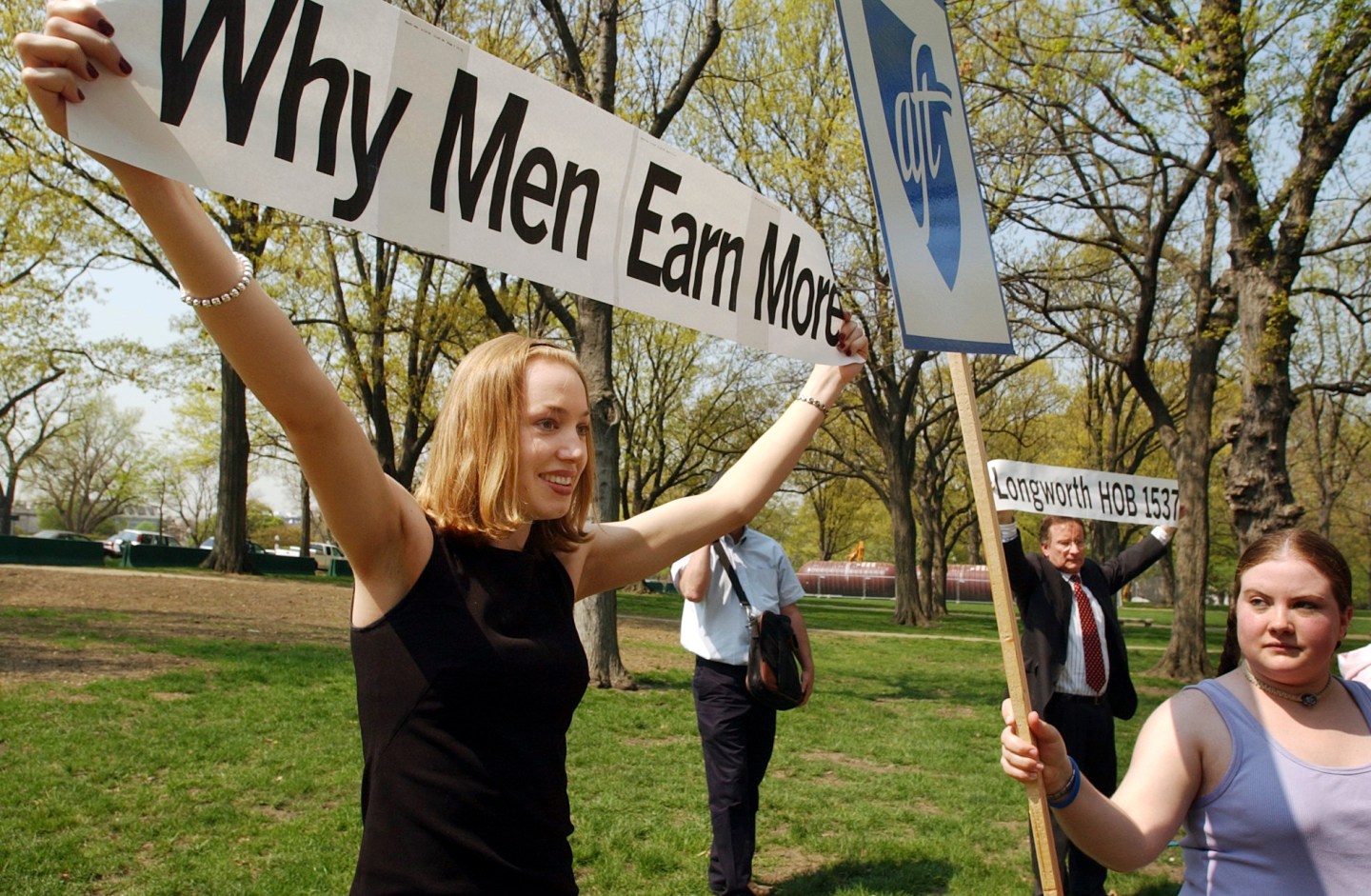
Womens Rights Rally
Photograph by Tom Williams—CQ-Roll Call, Inc.

Women in the U.S. make 76 cents for every dollar a man makes, right?

Well, yes and no. In reality, that pay gap narrows when you start to account for variables like age, education, and experience. A study released today by career review site Glassdoor finds that when you control for those factors—as well as company, industry, geography, firm size, and job title—two thirds of the pay gap disappears.

Here’s a closer look at how each set of variables impacts the gap. The chart below shows how, as you factor adding in more variables, the average pay gap keeps shrinking, going from 24% down to just 5.4%. Translation: When a man and a woman work in the same type of job, in the same city, and have the same levels of experience, the difference in pay is only about 5 cents.

Fig2_US_Gender Pay Gap Bar Chart

However, before we start jumping for joy, let’s look at the data in another way. Those five cents represent how much more money men make for no reason at all—or at least no reason economists can find. In fact, about a third of the overall U.S. pay gap is “unexplained.” This difference has typically been attributed to gender bias, says Glassdoor chief economist Andrew Chamberlain.

“If you asked an economist 25 years ago, he or she would say [those five cents represent] discrimination. Today, we have a more nuanced view. It could be workplace bias, but it could also be workplace data that we don’t see: race and ethnicity, kids, an elderly parent.”

US_FactorsofGenderPayGap_PieChart

To make matters even more complicated, while the “unexplained” part of the pay gap isn’t necessarily caused by bias, the “explained” portion—the two-thirds of the pay gap that economists can account for by looking at things like industry and education—very well could be.

“Just because we can explain why there’s a gap it doesn’t mean that this is due to [women’s] choice,” says Chamberlain. In other words, there may be larger reasons why a woman has a lower level of education or works in lower paying field than her male cohorts. Perhaps she was steered away from certain majors when she was in school, or can’t work in an industry like law or finance because of care-taking responsibilities.

“If you think about it for five minutes, it’s clear that most of these things aren’t choice but systemic,” says Chamberlain, a former economics instructor at U.C. San Diego.

Chamberlain is the first to admit that there are limits to what we can learn from sweeping studies like this one (Glassdoor looked at the salaries of 505,000 U.S. employees). Researchers are all “walking around an elephant in the room and measuring it differently, and it’s never zero,” he says. In other words, there will always be a part of the gap that cannot be accounted for statistically.

So if stats don’t cut it, how do we figure out what’s causing that gap? One answer is experimentation, says Emilio Castilla, a professor at the MIT Sloan School of Management. “The beauty of experiments is that you can establish a causal link” between people’s work and how they are rewarded.

In one study, Castilla ran an experiment in which he randomly assigned managers fictional profiles of male and female employees— with the same exact backgrounds and levels of performance—and asked them to allocate bonuses. What he found was that women were systematically awarded lower bonuses, even though managers were told to only look at an employee’s merit.

Because these are fictional scenarios, we can’t blame the lower pay the woman received on her desire for flexibility, her poor negotiation skills, or her need to take care of the kids. The answer here can only be bias.

Now let’s try and explain that.

About the Author
By Valentina Zarya
See full bioRight Arrow Button Icon

Latest in MPW

Workplace CultureSports
Exclusive: Billionaire Michele Kang launches $25 million U.S. Soccer institute that promises to transform the future of women’s sports
By Emma HinchliffeDecember 2, 2025
10 hours ago
C-SuiteLeadership Next
Ulta Beauty CEO Kecia Steelman says she has the best job ever: ‘My job is to help make people feel really good about themselves’
By Fortune EditorsNovember 5, 2025
27 days ago
ConferencesMPW Summit
Executives at DoorDash, Airbnb, Sephora and ServiceNow agree: leaders need to be agile—and be a ‘swan’ on the pond
By Preston ForeOctober 21, 2025
1 month ago
Jessica Wu, co-founder and CEO of Sola, at Fortune MPW 2025
MPW
Experts say the high failure rate in AI adoption isn’t a bug, but a feature: ‘Has anybody ever started to ride a bike on the first try?’
By Dave SmithOctober 21, 2025
1 month ago
Jamie Dimon with his hand up at Fortune's Most Powerful Women Summit
SuccessProductivity
JPMorgan CEO Jamie Dimon says if you check your email in meetings, he’ll tell you to close it: ’it’s disrespectful’
By Preston ForeOctober 17, 2025
2 months ago
Pam Catlett
ConferencesMPW Summit
This exec says resisting FOMO is a major challenge in the AI age: ‘Stay focused on the human being’
By Preston ForeOctober 16, 2025
2 months ago

Most Popular

placeholder alt text
Economy
Ford workers told their CEO 'none of the young people want to work here.' So Jim Farley took a page out of the founder's playbook
By Sasha RogelbergNovember 28, 2025
4 days ago
placeholder alt text
Success
Warren Buffett used to give his family $10,000 each at Christmas—but when he saw how fast they were spending it, he started buying them shares instead
By Eleanor PringleDecember 2, 2025
18 hours ago
placeholder alt text
Economy
Elon Musk says he warned Trump against tariffs, which U.S. manufacturers blame for a turn to more offshoring and diminishing American factory jobs
By Sasha RogelbergDecember 2, 2025
12 hours ago
placeholder alt text
C-Suite
MacKenzie Scott's $19 billion donations have turned philanthropy on its head—why her style of giving actually works
By Sydney LakeDecember 2, 2025
19 hours ago
placeholder alt text
Success
Forget the four-day workweek, Elon Musk predicts you won't have to work at all in ‘less than 20 years'
By Jessica CoacciDecember 1, 2025
1 day ago
placeholder alt text
AI
More than 1,000 Amazon employees sign open letter warning the company's AI 'will do staggering damage to democracy, our jobs, and the earth’
By Nino PaoliDecember 2, 2025
20 hours ago
Rankings
  • 100 Best Companies
  • Fortune 500
  • Global 500
  • Fortune 500 Europe
  • Most Powerful Women
  • Future 50
  • World’s Most Admired Companies
  • See All Rankings
Sections
  • Finance
  • Leadership
  • Success
  • Tech
  • Asia
  • Europe
  • Environment
  • Fortune Crypto
  • Health
  • Retail
  • Lifestyle
  • Politics
  • Newsletters
  • Magazine
  • Features
  • Commentary
  • Mpw
  • CEO Initiative
  • Conferences
  • Personal Finance
  • Education
Customer Support
  • Frequently Asked Questions
  • Customer Service Portal
  • Privacy Policy
  • Terms Of Use
  • Single Issues For Purchase
  • International Print
Commercial Services
  • Advertising
  • Fortune Brand Studio
  • Fortune Analytics
  • Fortune Conferences
  • Business Development
About Us
  • About Us
  • Editorial Calendar
  • Press Center
  • Work At Fortune
  • Diversity And Inclusion
  • Terms And Conditions
  • Site Map

© 2025 Fortune Media IP Limited. All Rights Reserved. Use of this site constitutes acceptance of our Terms of Use and Privacy Policy | CA Notice at Collection and Privacy Notice | Do Not Sell/Share My Personal Information
FORTUNE is a trademark of Fortune Media IP Limited, registered in the U.S. and other countries. FORTUNE may receive compensation for some links to products and services on this website. Offers may be subject to change without notice.