Much that is written about leaders these days seems to be negative: they are incompetent, arrogant, unethical, greedy, the list goes on and on.
No doubt, there is a great deal of anger and cynicism from employees, shareholders, and voters. When things go wrong in our lives, we are quick to place the blame for our ills on our leaders, and we often expect our leaders to fix things.
Are we justified in doing so? Or are we externalizing our problems by blaming those in charge? Is it time to accept responsibility for our lives and take action to make things better?
We live in an imperfect world, filled with violence, income inequality, a lack of jobs, corruption, ill health, and defective products. As much as we would like to eradicate these ills, there are no easy solutions that leaders can apply to make such problems disappear.
Meanwhile, political leaders are fanning the flames of anger and distrust in order to gain popular support. Their words are intensified by the 24-hour news cycle, with every outlet looking to gain viewers by highlighting the urgency of these ills.
This atmosphere brings out the worst in us. All we are doing is further dividing the country between rich and poor, conservatives and liberals, free traders and protectionists, hawks and doves. The next American president will be no more able to eliminate these problems than the last two have been. And blaming the media doesn’t solve anything because their incentive structure is built on giving people stories they want to grow the size of their audience.
In business, activist investors assault corporate boards with simplistic, short-term solutions to break up companies, leverage their balance sheets, or buy back stock by cutting investment required for their strategic success. These investors can find something to criticize at every company. And shareholders often give them the benefit of the doubt in order to see near-term bumps in stock prices.
But toxic leadership comes at a great cost. Such leaders create environments that bring out the worst in people and drag everyone down. Like malignant tumors, negative attitudes spread throughout organizations until everyone is playing “the blame game” and avoiding responsibility for the problems they create. Once this happens, organizations are on a path to self-destruction, creating in their wake enormous harm for employees and shareholders alike. At this point, the organization is no longer able to sustain itself and begins to unravel. That’s what happened to Sears, General Motors, Lehman Brothers, Kodak, and other victims of politics, cynicism, and short-term thinking.
Enter Positive Leadership
Authentic leaders, by contrast, try to bring out the best in people. They aim to see others’ potential, to empower people to take responsibility for their actions, and to work together to make things better for all people. That’s what great political leaders like Ronald Reagan, Franklin D. Roosevelt, and Nelson Mandela have done in years past. It is what today’s leaders in business, health care, nonprofits, academia, and yes – in politics – need to do to bring us together to make life better for all people and to ameliorate our ills.
Sustainable, meaningful progress of any kind comes with a multitude of trials and tribulations. Yet the best leaders find ways to celebrate the incremental victories. As I highlight in my latest book, Discover Your True North, recent scientific research shows that positive approaches to empower people is a must-have leadership trait. By and large, the leaders I know are doing just that. They are doing their best to encourage people to grow, contribute, and live happy and meaningful lives. To use the words of author Adam Grant, they are “givers,” not “takers.”
This approach is consistent with the positive psychology movement pioneered by psychologist Martin Seligman. The three aims of positive psychology are:
- Building human strength
- Making the lives of people fulfilling
- Nurturing the talent that resides in all of us
In his book Focus, Daniel Goleman describes multiple experiments that demonstrate the impact of positive interactions with employees. One experiment showed employees perceived negative feedback more favorably when it was delivered in warm, supportive tones. When good news or positive feedback was delivered in negative tones, employees left the discussions feeling poorly, instead of feeling elated by their successes. Seligman’s research shows a 3:1 “positive-to-negative” statements ratio is necessary for healthy professional relationships.
When organizations hit roadblocks, people naturally get upset, and often their anger shows, but that doesn’t resolve anything. As Positive Intelligence author Shirzad Chamine says, there is an inner, often unconscious dialogue going on between your “sage” and your “saboteurs.” As leaders recognize this dialogue, they will be alert to avoiding negative responses that sabotage healthy relationships. By inquiring rather than directing, leaders can find opportunities within the challenges their organizations face. They also can build better relationships with colleagues who count on them to help solve problems.
Alan Mulally’s Positive Transformation at Ford
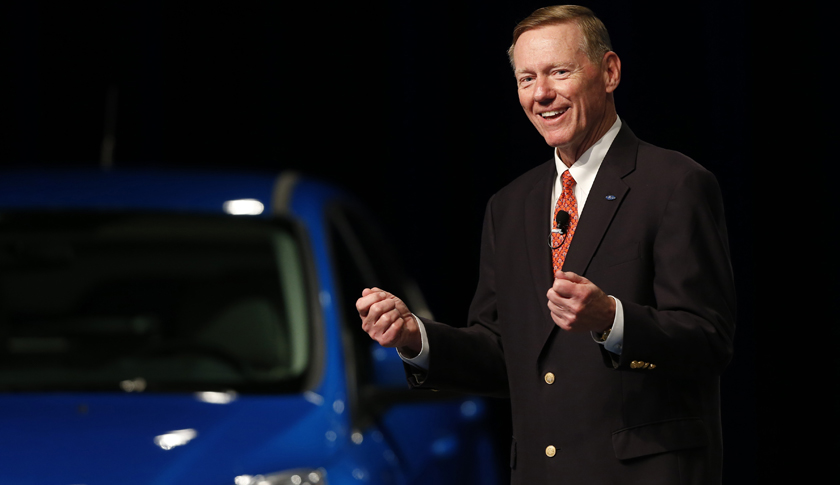
Navigating severe challenges requires strong, courageous, and authentic leaders. That’s what Alan Mulally offered at Ford Motor (F).
On his first day as Ford’s CEO in 2006, Mulally asked to tour Ford’s famous Rouge plant where Henry Ford created the Model T. Mulally was informed by one of his top executives, “Our leaders don’t talk directly to factory employees.” Ignoring that advice, he went to the plant immediately to talk to front-line workers.
Mullaly also set up mandatory weekly management meetings he called the business process review (BPR) for his top executives to get to the root cause of Ford’s long-standing problems. He quickly discovered that Ford’s challenges went way beyond financial losses: the culture at Ford was broken and in need of massive transformation. He observed, “Ford had been going out of business for 40 years, and no one would face that reality.”
In response, Mulally developed One Ford, an initiative based on “focus, teamwork and a single global approach, aligning employee efforts toward a common definition of success.” He started by redesigning internal meetings. As described in Bryce Hoffman’s American Icon, meetings had become “arenas for mortal combat” in which employees practiced self-preservation, trying to identify flaws in each other’s plans instead of recommending solutions to their problems.
Mulally reframed these meetings from negative to positive, fostering a safe environment where people had open and honest discussions without fear of blame. Instead of attacking executives for the issues they brought to the table, Mulally encouraged collaborative approaches to problem solving. He noted, “If you have a common purpose and an environment in which people want to help others succeed, the problems will be fixed quickly.”
Mulally introduced a “traffic light” system to weekly BPRs in which executives indicated progress on key initiatives as green, yellow, or red. After four meetings in which all programs were labelled green, Mulally confronted his team, “We are going to lose $18 billion this year, so is there anything that’s not going well?” His question was met with stony silence.
The following week, Ford’s North American President, Mark Fields, showed a red indicator that a new vehicle launch would be delayed. Other executives assumed Fields would be fired over the bad news. Instead, Mulally began clapping and said, “Mark, that is great visibility.” He asked the group, “What can we do to help Mark out?” As he frequently told his leaders, “You have a problem; you are not the problem.”
Mulally describes his leadership style as “positive leadership—conveying the idea that there is always a way forward.” He says a critical part of positive leadership is “reinforcing the idea that everyone is included. When people feel accountable and included, it is more fun. It is just more rewarding to do things in a supportive environment.”
With determination and positive leadership, Mulally created a culture of effective problem solving and teamwork. As a result, his team kept Ford out of bankruptcy, reversed market share losses with improved auto designs and quality, brought jobs back to the U.S. from overseas plants, and restored the company’s profitability by becoming cost competitive with foreign producers.
Weak leaders focus on all the things that are going wrong. Great leaders like Mulally bring out the best in us. The most effective leaders apply the principles of positive psychology, ensuring their interactions with employees contain a healthy balance of positive and constructive feedback. They maintain an optimistic outlook despite the setbacks, reinforcing that there is a hopeful way forward.
Bill George is Senior Fellow at Harvard Business School, former Chairman & CEO of Medtronic, and author of Discover Your True North.