In the 1960s classic film, The Graduate, a man barks advice to a young Dustin Hoffmann about his future: “I just want to say one word to you. Just one word. Plastics.” For the renewable energy industry these days, its future can also be summed up in one word: storage.
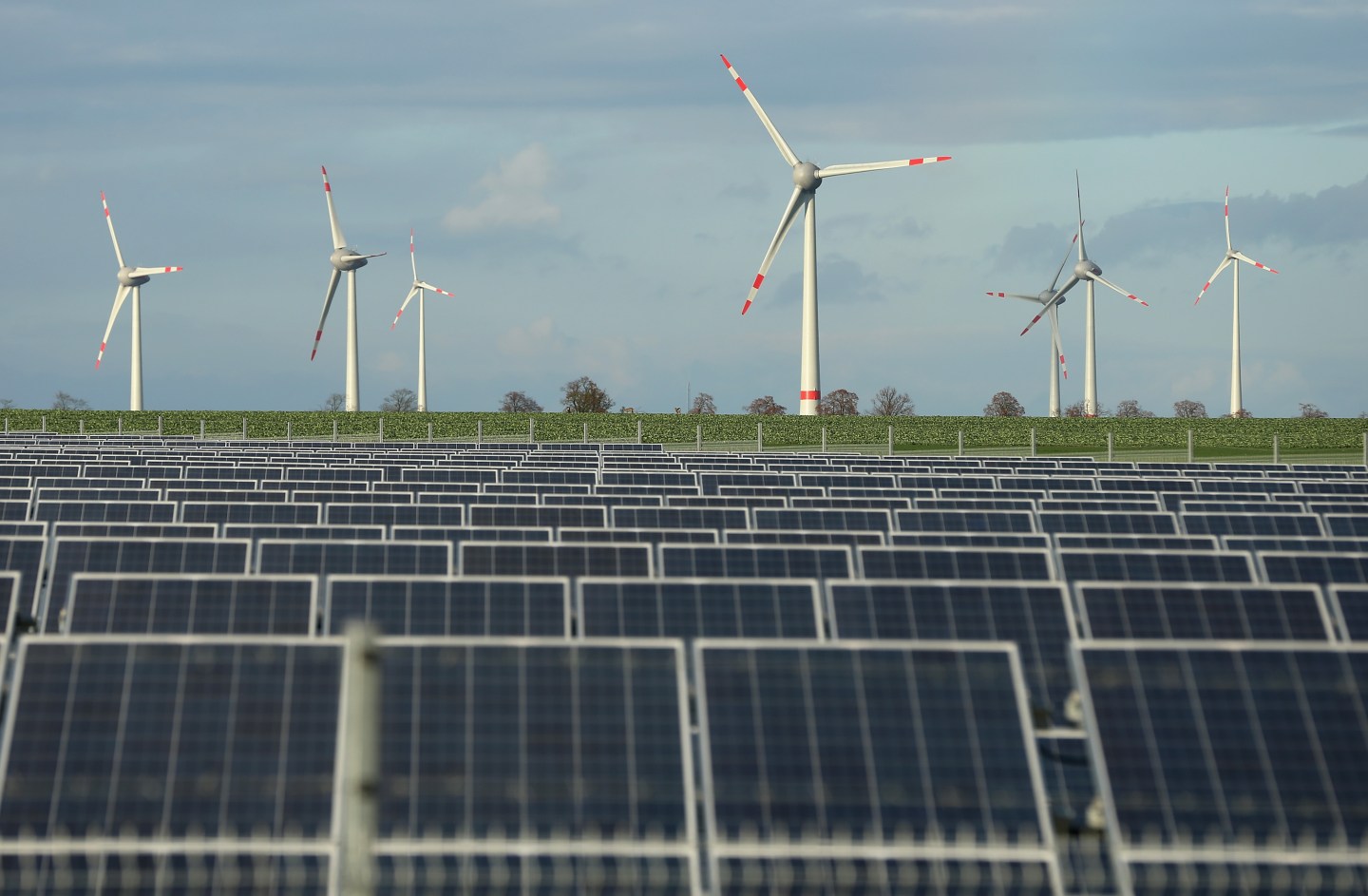
Renewables are growing. Even many of my friends in the oil and gas industry concede that the energy mix of the future is going to look a lot different from the one we have now—and renewables will be a much bigger part of the picture. The real question is how close (or distant) that future is.
Based on current technologies, the conclusion of the fossil fuel industry is—pretty darn far. In its 2015 Outlook on Energy, for example, Exxon (XOM) projects that solar will grow by a factor of 20 and wind by five—but that by 2040 all renewables will still make up less than 10 percent of the global power supply. In its projections to 2035, BP (BP) ends up in the same neighborhood.
The reason is that people really do want to be able to flip a switch and see the lights come on. Renewables (other than hydro, which has had its day) cannot deliver that; there always needs to be another source of backup power, which means fossil fuels or nuclear. Consider Germany. Even though it is investing heavily in renewables, it “will continue to need almost as many conventional power stations as before,” noted technology minister, Philipp Rosler. “When there is no wind, or it is cloudy, conventional power stations need to jump in and cover the bulk of energy consumption so that the electricity supply can be maintained securely. …At present, only flexible conventional power stations can do this.”
What renewables need to scale up to the very big time, then, is a game-changer (to use some consultant-speak). If solar or wind power could be economically stored, then released on command, that could fundamentally change the world’s power dynamics.
This idea is neither new nor fantastic. Hydro has used pumped storage systems for decades; your cellphone’s battery is a form of storage. But the technology basically doesn’t exist for wind or solar. That could be changing. IHS, the respected energy consultancy, projects that energy storage will grow from a one-third of a gigawatt in 2013 to 6 GW by 2017 and more than 40 GW by 2022. In 2013, McKinsey estimated that the economic impact of energy storage would be at least $90 billion a year by 2025, and possibly much more (up to $635 billion) depending on how fast it is applied to cars. This is a drop in the bucket that is the $6 trillion global energy market—but it is a drop that is getting bigger.
In fact, as we have seen with both shale and solar over the last decade, decades of work and dozens of innovations can come together and create a tipping point where use dramatically increases. I think that could happen with storage. We are seeing many of the same dynamics.
Specifically, there are tons of experiments going on, ranging from a system that supports a 153-megawatt wind farm in Texas to one in midtown Manhattan that keeps a skyscraper cool, warm, and lit to one that provides backup support for isolated utilities in Alaska. Not all of these will work, or work well enough, cheaply enough to scale up. But that is true of any innovation; what matters is that lots of ideas are being tried. Some of them will succeed.
It’s worth noting, too, that the storage technologies that do exist are getting cheaper. In 2007, the cost of large-format lithium-ion storage was about $900 per kilowatt-hour; that is down to about $380, and could drop below $200 by 2020. There are other promising battery technologies that could leapfrog or at least complement li-ion, such as liquid metal, lithium-air, lithium-sulfur, sodium-ion, nano-based supercapacitors, and energy cache technology.
Finally, this is one area concerning renewables that the utilities are not fighting; in fact, they are investing. That matters, because we need the grid, and storage could actually strengthen it. Right now, utilities have to build extra capacity just to meet occasional peaks; the US typically uses less than 30 percent of capacity. If utilities could store power during periods of low demand, then release it during peaks, that would save a ton of money on capital costs, while also smoothing out frequency variations and providing voltage support. To venture into consultant speak again, that’s a win-win.
I am not a green-tinted Pollyanna. I know that there are lots of hurdles before storage becomes mainstream. As the hard-headed environmentalists at the Rocky Mountain Institute put it recently, there is no energy-storage business model at the moment that “offers anything close to a cash-positive scenario.” The McKinsey Global Institute cautions that there are many big issues that need to be addressed.
But the big picture is this. There are many smart people, all over the world, working on energy storage. Investment in their research is growing. Costs are falling. Technologies are proliferating. And people want it. There is one word that sums up the likely consequence of those trends: progress.
Scott Nyquist is a global leader in McKinsey’s oil & gas practice and also its Sustainability & Resource Productivity Network. He writes a column for LinkedIn on energy and environmental issues.