One spring day I was riding my bicycle in Death Valley when I came upon an astonishing sight. A section of the roadway was covered with thousands of dead caterpillars squashed flat by cars as they attempted to cross the road. Looking more closely, I could see masses of caterpillars on each side slowly making their way toward the road. There were as many on the left side of the road headed to the right side as there were on the right side headed toward the left.
This was barren country, and as far as I could make out, the landscape was identically empty on both sides of the road. What motivated the caterpillars to cross? I have no idea! Probably entomologists have a goooood reason. Yet the memory has stayed with me as a constant reminder of analogous, meaningless dysfunctional behaviors in my life. How many times have I crossed a road pointlessly when staying where I was would have been fine?
Like those caterpillars, we are often more interested in what we do not have than in what we have. We may strive for something, and the effort may consume us. Once we have obtained our goal, it tends to lose its hold on us, and we are off to the next pursuit. Currently in America, approximately 50 percent of marriages end in divorce. Many of these are followed by remarriages. We are always looking for something different, something better.
People change jobs because they get bored. They travel not for the joy of traveling but simply to get away. It is common for people traveling to other cities and countries to visit museums, even though they never bother to go to the ones in their own hometowns. In some people’s lives there is constant change for change’s sake, like the caterpillars crossing the road to reach an identical piece of Death Valley real estate. Maybe going from one place to another does no harm, or maybe you get flattened while you are crossing the road.
Some professions have motivation for road-crossing behavior built in. In sports there is always the next game and the next season to work toward. In research there is the next project and the next paper, always more knowledge to achieve. In school, there is always the next exam, class, and term. Then there are the various levels to graduate from: grade school, junior high school, high school, college, and graduate school. In jobs we work our way up the ladder, always looking ahead. In these examples, at least, there seems to be something bigger and better on the other side of the road.
In all these examples you will see that what has been left behind was at one point something you desired most in life. Yet now it hardly matters to you. There is nothing wrong with change and moving forward in life if it gets you to a better spot. Unfortunately, all too often in our search for the next big thing we don’t take the time to appreciate the satisfaction of achieving a goal, or the process itself. We are so busy being enticed by our next endeavor that we forget to savor what is already there and could be deeply meaningful. It is useful to remember the adage “The more things change, the more they remain the same.”
A good case in point comes from a colleague of mine who made some important discoveries and became very prominent in the area of applied mathematics. Periodically he would win some award or receive an honorary degree. Invariably he would tell me about the next honor he was hoping for. Then, when he got it, he would tell me he was pleased because he could use it to get a pay raise in the coming year. In fact, he was unmarried, very well paid, and had no need of extra income. In spite of his many successes and his many raises, he was basically an unhappy person. Sadly, he reminded me of the caterpillars, always hoping to find something on the other side of the road, although it was all around him already on his side of the road.
Often the things we strive for only represent more of something we already have: money, fame, appreciation, love. It’s an endless chase; as the saying goes, You can’t get enough from more. For some people it’s the thrill of the chase that they really enjoy, so once they get what they have been seeking, it becomes irrelevant. There’s nothing inherently wrong with this, as long as you are honest with yourself about your goals. Otherwise you are bound to spend your life frustrated and unhappy, like my friend.
There is an ethos regarding change in Silicon Valley. Within many companies there is always a fierce struggle to develop something new in an effort to stay ahead of competitors. Silicon Valley people believe their companies will stagnate and die without continual innovation: it’s the ultimate what-have-you-done-lately? culture. To maintain status in such a culture, people always need a new and evolving story. If they don’t deliver, they feel they lose face. These people are under a lot of pressure, and in their desperation they sometimes act like those caterpillars, taking their organizations on meaningless road-crossing journeys in pursuit of a new story to tell their friends.
The moral is that change for change’s sake is not necessarily good. Sometimes it is okay to fail in the pursuit of a meaningful goal. But it is never okay to commit organizational suicide just to save face with your friends or impress your latest love interest.
Bernard Roth is the Rodney H. Adams Professor of Engineering and the academic director of the Hasso Plattner Institute of Design (the d.school) at Stanford University.
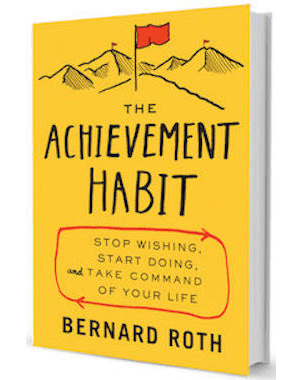
THE ACHIEVEMENT HABIT. Copyright © 2015 by Bernard Roth. Excerpt reprinted with permission from HarperBusiness, an imprint of HarperCollins Publishers.