• Home
  • Latest
  • Fortune 500
  • Finance
  • Tech
  • Leadership
  • Lifestyle
  • Rankings
  • Multimedia
FinanceInvesting

Treasury traders will trade with themselves, when no one else will

By
Stephen Gandel
Stephen Gandel
Down Arrow Button Icon
By
Stephen Gandel
Stephen Gandel
Down Arrow Button Icon
July 14, 2015, 7:05 AM ET
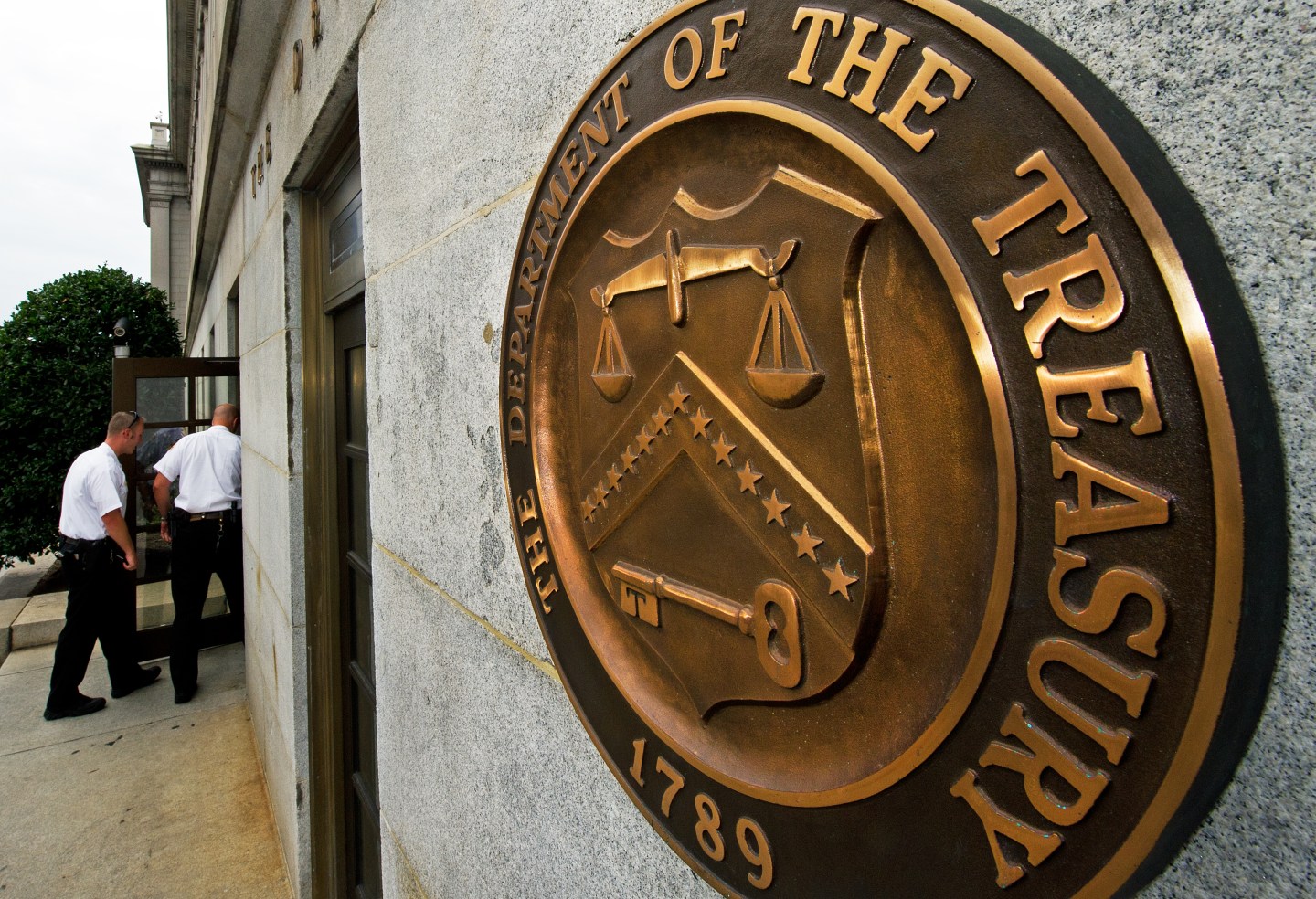
US Secret Service Uniform Division offic
US Secret Service Uniform Division officers walk in the door near the seal on the US Treasury building August 9, 2011, in Washington, DC. AFP Photo/Paul J. Richards (Photo credit should read PAUL J. RICHARDS/AFP/Getty Images)Photograph by Paul J. Richards — AFP/Getty Images

The Treasury market, officially, had its own flash crash.

On October 15, the yield on Treasury bonds dropped 8% in roughly six minutes. They quickly rebounded, erasing all the gains that bond traders quickly achieved. (Remember, yields move in the opposite direction of bond prices.)

Moves like that don’t happen very often in the low-volatility Treasury market. So, since then, bond market participants have been scratching their heads trying to figure out what happened. And a lot of people have used that unusual day in the bond market to complain about things they don’t like. For Wall Streeters, that has been the Volcker Rule, and liquidity and capital rules, which they say makes it impossible for the big banks to commit a lot of resources to helping their clients trade bonds.

On Monday, nearly nine months later, several regulators published a deep dive on what happened on October 15. Shortly after the bond flash crash, I wrote that there was little evidence that regulators and financial reforms put in place after the financial crisis had broken the bond market. Monday’s report backs that up. Although, just to reiterate, the report was written by regulators, so there probably was some bias there. The report says, “By many metrics, the liquidity and efficiency of trading in the Treasury market are as robust as they have ever been.”

Nevertheless, the report also says that much of the liquidity in the Treasury market has switched from the banks and brokers to “principal trading firms,” which sounds a lot like high frequency trading firms but just by another, less controversial, name.

The report did find that there was an unusual amount of “self-trading” going on during the period in which Treasury yields rose and then fell quickly. Self-trading is when one firm sells a bunch of Treasury bonds to itself. In the stock market, where high frequency trading is much more controversial, it’s wash-trading and is generally illegal. Buying and selling a stock to yourself at ever higher prices is a pretty good way to make a stock price look like it is going up and thus manipulate the market.

But in the Treasury market, self-trading happens all the time and, at least to some extent, is, oddly, allowed. The firms are supposed to have some sort of software, or mechanism, in place, to prevent self-trading, but it appears those mechanisms are optional. Although, last year, high frequency trading firm Tower Research Capital was fined $65,000 for not implementing measures that would limit self-trading.

Despite discouragements, self-trading represents about 5.6% of the Treasury market, according to Monday’s report. But during the bond market flash crash, it reached nearly 15%. That sounds bad.

But Monday’s report makes no judgement on whether all of this self-trading constituted market manipulation or illegal activity. And there is a little bit of a chicken and egg problem. There was a jump in the number of trades placed by high frequency trading firms on October 15. And there was a jump in self-trading during the period in which Treasury yields dove and rebounded. And the high frequency trading firms were the source of the bulk of the self-trades. But it’s unclear whether self-trading moved the market, or if the fact that more of the market was driven by high frequency trading created more self-trading.

What appears to have happened is that, sometime on the morning of October 15, a bunch of computer systems at trading firms anticipated a spike in trading and started to ramp up their activity, as any good market maker should, anticipating the need for higher liquidity. The problem was no actual investors were looking to trade. Monday’s report stated that long-term traders didn’t appear to shift their positions much. When no one else showed up, that didn’t stop the computers. They just traded with themselves, which is sort of allowed. Until they realized this was a little silly and stopped, and Treasury prices went back to normal.

That left the rest of us wondering what the heck happened for nine months. Perhaps. The report does not definitively say that high frequency trading caused the Treasury market flash crash, but it says it’s something to look into.

The Treasury market is more volatile than it used to be. And that’s not great. But if it’s because high frequency trading firms have taken over doing the silly, and riskier, trades banks once did, a higher volatility Treasury market may not be such a bad thing.

About the Author
By Stephen Gandel
See full bioRight Arrow Button Icon

Latest in Finance

Finance
Lorem ipsum dolor sit amet, consectetur adipiscing elit, sed do eiusmod tempor incididunt ut labore et dolore magna aliqua. Ut enim ad minim veniam
By Fortune Editors
October 20, 2025
Finance
Lorem ipsum dolor sit amet, consectetur adipiscing elit, sed do eiusmod tempor incididunt ut labore et dolore magna aliqua. Ut enim ad minim veniam
By Fortune Editors
October 20, 2025
Finance
Lorem ipsum dolor sit amet, consectetur adipiscing elit, sed do eiusmod tempor incididunt ut labore et dolore magna aliqua. Ut enim ad minim veniam
By Fortune Editors
October 20, 2025
Finance
Lorem ipsum dolor sit amet, consectetur adipiscing elit, sed do eiusmod tempor incididunt ut labore et dolore magna aliqua. Ut enim ad minim veniam
By Fortune Editors
October 20, 2025
Finance
Lorem ipsum dolor sit amet, consectetur adipiscing elit, sed do eiusmod tempor incididunt ut labore et dolore magna aliqua. Ut enim ad minim veniam
By Fortune Editors
October 20, 2025
Finance
Lorem ipsum dolor sit amet, consectetur adipiscing elit, sed do eiusmod tempor incididunt ut labore et dolore magna aliqua. Ut enim ad minim veniam
By Fortune Editors
October 20, 2025

Most Popular

Finance
Lorem ipsum dolor sit amet, consectetur adipiscing elit, sed do eiusmod tempor incididunt ut labore et dolore magna aliqua. Ut enim ad minim veniam
By Fortune Editors
October 20, 2025
Finance
Lorem ipsum dolor sit amet, consectetur adipiscing elit, sed do eiusmod tempor incididunt ut labore et dolore magna aliqua. Ut enim ad minim veniam
By Fortune Editors
October 20, 2025
Finance
Lorem ipsum dolor sit amet, consectetur adipiscing elit, sed do eiusmod tempor incididunt ut labore et dolore magna aliqua. Ut enim ad minim veniam
By Fortune Editors
October 20, 2025
Finance
Lorem ipsum dolor sit amet, consectetur adipiscing elit, sed do eiusmod tempor incididunt ut labore et dolore magna aliqua. Ut enim ad minim veniam
By Fortune Editors
October 20, 2025
Finance
Lorem ipsum dolor sit amet, consectetur adipiscing elit, sed do eiusmod tempor incididunt ut labore et dolore magna aliqua. Ut enim ad minim veniam
By Fortune Editors
October 20, 2025
Finance
Lorem ipsum dolor sit amet, consectetur adipiscing elit, sed do eiusmod tempor incididunt ut labore et dolore magna aliqua. Ut enim ad minim veniam
By Fortune Editors
October 20, 2025
Fortune Secondary Logo
Rankings
  • 100 Best Companies
  • Fortune 500
  • Global 500
  • Fortune 500 Europe
  • Most Powerful Women
  • Future 50
  • World’s Most Admired Companies
  • See All Rankings
Sections
  • Finance
  • Fortune Crypto
  • Features
  • Leadership
  • Health
  • Commentary
  • Success
  • Retail
  • Mpw
  • Tech
  • Lifestyle
  • CEO Initiative
  • Asia
  • Politics
  • Conferences
  • Europe
  • Newsletters
  • Personal Finance
  • Environment
  • Magazine
  • Education
Customer Support
  • Frequently Asked Questions
  • Customer Service Portal
  • Privacy Policy
  • Terms Of Use
  • Single Issues For Purchase
  • International Print
Commercial Services
  • Advertising
  • Fortune Brand Studio
  • Fortune Analytics
  • Fortune Conferences
  • Business Development
About Us
  • About Us
  • Editorial Calendar
  • Press Center
  • Work At Fortune
  • Diversity And Inclusion
  • Terms And Conditions
  • Site Map
Fortune Secondary Logo
  • About Us
  • Editorial Calendar
  • Press Center
  • Work At Fortune
  • Diversity And Inclusion
  • Terms And Conditions
  • Site Map
  • Facebook icon
  • Twitter icon
  • LinkedIn icon
  • Instagram icon
  • Pinterest icon

Latest in Finance

EnergyOil
Dow futures fall 350 points on U.S.-Iran conflict, but oil prices pare gains as Trump hints at sanctions relief for new leadership
By Jason Ma and Amanda GerutMarch 1, 2026
2 hours ago
AsiaIran
Asian aviation stocks plunge as Iran conflict forces airlines to cancel flights over Middle Eastern airspace
By Angelica AngMarch 1, 2026
2 hours ago
Middle EastDubai
This American tourist stranded in Dubai due to Iran’s bombardment doesn’t think she’ll be back — ‘the universe was trying to tell us something’
By Brian Melley and The Associated PressMarch 1, 2026
6 hours ago
AsiaPakistan
At least 22 people killed and more than 120 injured in Pakistan after Iran supporters try to storm U.S. Consulate
By The Associated PressMarch 1, 2026
6 hours ago
Middle EastUAE
UAE stock markets to close for two days amid Iran strikes
By Sherif Tarek, Omar Tamo, Farah Elbahrawy and BloombergMarch 1, 2026
7 hours ago
basketball player celebrates on the court
EconomyNBA
NBA star’s partnership with a prediction market raises new questions for a troubled sports betting landscape
By Carlos GarciaMarch 1, 2026
9 hours ago

Most Popular

placeholder alt text
Economy
Your grandparents are the reason the U.S. isn't in a recession right now. That won't last forever
By Eleanor PringleMarch 1, 2026
20 hours ago
placeholder alt text
Success
MacKenzie Scott's close relationship with Toni Morrison long before Amazon put her on the path give more than $1 billion to HBCUs
By Sasha RogelbergMarch 1, 2026
14 hours ago
placeholder alt text
Middle East
As Iran attacks Dubai, the tax-free haven for the global elite could see 'catastrophic' fallout — 'this can also send shockwaves globally'
By Jason MaMarch 1, 2026
12 hours ago
placeholder alt text
Personal Finance
Trump's universal 401(k) architect on why lower-income people distrust retirement accounts: 'they want to know what the catch is'
By Jacqueline MunisFebruary 28, 2026
2 days ago
placeholder alt text
Health
Gen Z men are eating ‘boy kibble,’ the human equivalent to dog food, to load up on protein cheaply
By Jake AngeloMarch 1, 2026
17 hours ago
placeholder alt text
AI
The week the AI scare turned real and America realized maybe it isn't ready for what's coming
By Nick LichtenbergFebruary 28, 2026
2 days ago

© 2026 Fortune Media IP Limited. All Rights Reserved. Use of this site constitutes acceptance of our Terms of Use and Privacy Policy | CA Notice at Collection and Privacy Notice | Do Not Sell/Share My Personal Information
FORTUNE is a trademark of Fortune Media IP Limited, registered in the U.S. and other countries. FORTUNE may receive compensation for some links to products and services on this website. Offers may be subject to change without notice.