• Home
  • News
  • Fortune 500
  • Tech
  • Finance
  • Leadership
  • Lifestyle
  • Rankings
  • Multimedia
Airline industry

This airline is getting bigger seats — in economy

By
Brad Tuttle
Brad Tuttle
Down Arrow Button Icon
By
Brad Tuttle
Brad Tuttle
Down Arrow Button Icon
April 15, 2015, 3:46 PM ET
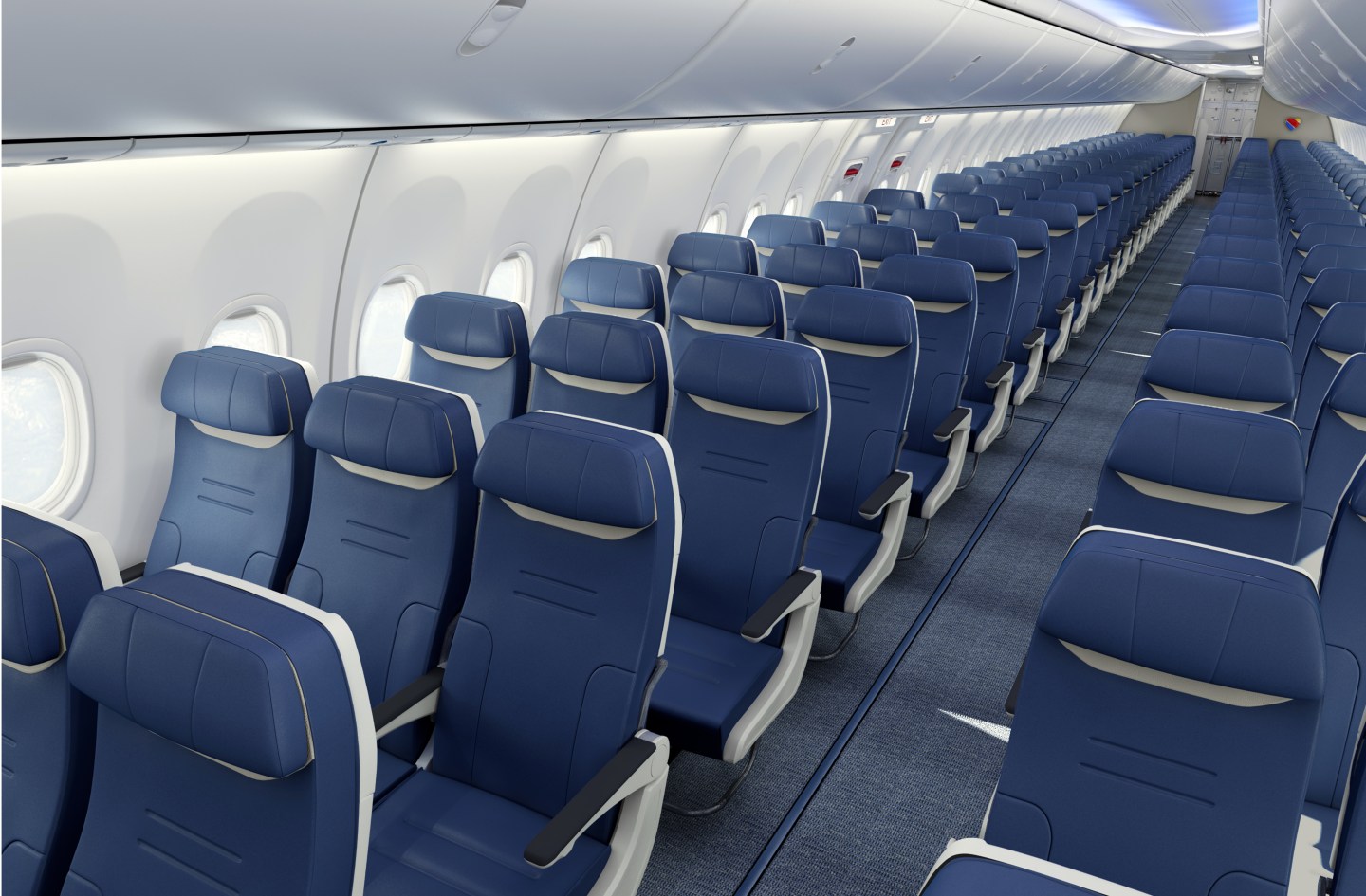
Southwest Airlines’ new aircraft seat
Southwest is the launch Customer for the new seats represented here on the new Boeing 737 MAX aircraft.Courtesy of Southwest Airlines

This article was originally published on Money.com

This week, Southwest Airlines announced that its new 737 airplanes will boast seats with a rare commodity: a little extra room for your butt. The bottom seat cushions will be 17.8 inches across, whereas the typical seat width on 737s is 17 to 17.3 inches.

“The new aircraft seats are the widest economy seats available in the single-aisle 737 market, and offer a unique design that gives our customers what they asked for: more space,” Bob Jordan, Southwest’s executive vice president and chief commercial officer, said in a press release announcing the new seats.

Passengers won’t get to enjoy the extra seat width until mid-2016 at the earliest. That’s when Southwest’s forthcoming 737-800s will first hit the runway and begin accepting passengers.

Will the new seats transform the flying experience of passengers? Honestly, probably not. An extra half-inch or so of space is nice, but for most travelers it won’t feel like a true game changer. Besides, the seats in some other airlines’ economy sections are already wider than Southwest’s new seats. According to SeatGuru, carriers that commonly use 737s, such as Alaska Airlines and Southwest, currently have seat widths of 17 to 17.1 inches. But on JetBlue, which prefers different aircraft (Airbus, Embraer E-190), the seat widths range from 17.8 to 18.25 inches.

Meanwhile, Airbus has argued that airline seats should be at least 18 inches wide, pointing to studies that show sleep quality is 53% better on 18-inch seats compared with 17-inchers. Airbus also pointed out that human beings today tend to simply be larger and heavier than prior generations, and that other industries are more accommodating. The typical modern American movie theater seat, for instance, is 22 inches wide, one inch more than the average of a decade ago.

Nonetheless, Southwest’s move is a welcome change, if for no other reason than that it goes against the trend of airlines cramming in more and more seats and scaling back passengers’ personal space in economy sections, with the hopes of boosting profits—which are already at record highs thanks to high airfares and low fuel prices. Southwest remains an anomaly in the industry for maintaining its free checked baggage policy. Slightly wider seats could prove to be another way the airline can differentiate itself from the pack in a passenger-friendly way.


About the Author
By Brad Tuttle
See full bioRight Arrow Button Icon
0

Most Popular

placeholder alt text
North America
Jeff Bezos and Lauren Sánchez Bezos commit $102.5 million to organizations combating homelessness across the U.S.: ‘This is just the beginning’
By Sydney LakeDecember 2, 2025
1 day ago
placeholder alt text
Economy
Ford workers told their CEO 'none of the young people want to work here.' So Jim Farley took a page out of the founder's playbook
By Sasha RogelbergNovember 28, 2025
5 days ago
placeholder alt text
North America
Anonymous $50 million donation helps cover the next 50 years of tuition for medical lab science students at University of Washington
By The Associated PressDecember 2, 2025
1 day ago
placeholder alt text
C-Suite
MacKenzie Scott's $19 billion donations have turned philanthropy on its head—why her style of giving actually works
By Sydney LakeDecember 2, 2025
1 day ago
placeholder alt text
Success
Warren Buffett used to give his family $10,000 each at Christmas—but when he saw how fast they were spending it, he started buying them shares instead
By Eleanor PringleDecember 2, 2025
1 day ago
placeholder alt text
Economy
Elon Musk says he warned Trump against tariffs, which U.S. manufacturers blame for a turn to more offshoring and diminishing American factory jobs
By Sasha RogelbergDecember 2, 2025
1 day ago
Rankings
  • 100 Best Companies
  • Fortune 500
  • Global 500
  • Fortune 500 Europe
  • Most Powerful Women
  • Future 50
  • World’s Most Admired Companies
  • See All Rankings
Sections
  • Finance
  • Leadership
  • Success
  • Tech
  • Asia
  • Europe
  • Environment
  • Fortune Crypto
  • Health
  • Retail
  • Lifestyle
  • Politics
  • Newsletters
  • Magazine
  • Features
  • Commentary
  • Mpw
  • CEO Initiative
  • Conferences
  • Personal Finance
  • Education
Customer Support
  • Frequently Asked Questions
  • Customer Service Portal
  • Privacy Policy
  • Terms Of Use
  • Single Issues For Purchase
  • International Print
Commercial Services
  • Advertising
  • Fortune Brand Studio
  • Fortune Analytics
  • Fortune Conferences
  • Business Development
About Us
  • About Us
  • Editorial Calendar
  • Press Center
  • Work At Fortune
  • Diversity And Inclusion
  • Terms And Conditions
  • Site Map

© 2025 Fortune Media IP Limited. All Rights Reserved. Use of this site constitutes acceptance of our Terms of Use and Privacy Policy | CA Notice at Collection and Privacy Notice | Do Not Sell/Share My Personal Information
FORTUNE is a trademark of Fortune Media IP Limited, registered in the U.S. and other countries. FORTUNE may receive compensation for some links to products and services on this website. Offers may be subject to change without notice.