• Home
  • Latest
  • Fortune 500
  • Finance
  • Tech
  • Leadership
  • Lifestyle
  • Rankings
  • Multimedia
FinanceCommentary

For-profit schools are a bad deal for both investors and taxpayers

By
Sheila Bair
Sheila Bair
Down Arrow Button Icon
By
Sheila Bair
Sheila Bair
Down Arrow Button Icon
December 29, 2014, 7:02 AM ET

In Imperial China, convicted criminals were subjected to a particularly unpleasant form of execution called lingchi, which involved slicing a condemned man’s flesh multiple times until he was dead. This horrific form of old Asian justice gave rise to a commonly used Western phrase: death by a thousand cuts.

Publicly traded for-profit colleges, a group that includes ITT (ESI) and Corinthian (COCO), are suffering a form of lingchi these days. If their critics are right, they deserve it. Once darlings of Wall Street, they have underperformed this year as they have endured repeated slashings by the media, academics, consumer advocates, and federal and state law-enforcement agencies who say that they are cheating both students and taxpayers. At the end of the third quarter, their shares were down 20% compared with the S&P 500 index, which was up 7% for the year.

Studies show that students who have attended such schools have higher unemployment rates, lower earnings, and greater student debt loads and default rates than do students at comparable public and nonprofit private schools. Studies have also found that many for-profit schools spend more on marketing, multimillion-dollar compensation packages, and shareholder payouts than they do on actually educating their students. Government investigations have uncovered multiple instances of misleading recruitment tactics. Because enrollment numbers drive profits, the game is to attract as many new students as possible. One school, for example, was inflating its job-placement stats by paying employers to hire their graduates temporarily and counting as a “placement” jobs that lasted only one day.

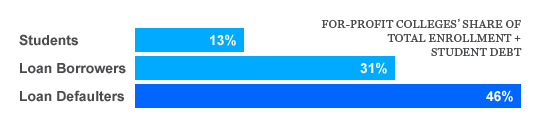
Parents and students should be concerned, but so should taxpayers, since the schools’ revenues are financed almost exclusively by federal grants and loan guarantees. Indeed, while for-profit schools account for only about 12% of all U.S. college students, they account for 32% of federally backed loan borrowers and a whopping 44% of student-loan defaults. In the 1990s, Congress tried to place limits on their ability to milk Uncle Sam by requiring that they derive at least 10% of their revenues from sources other than federal student aid. However, these schools have found ways around this by, say, targeting veterans using GI benefits to pay for their education. (Because of a loophole, the GI Bill doesn’t count as federal student aid.)

Defenders of for-profits protest that they are providing opportunities to disadvantaged students that would not otherwise be available. To be sure, these schools target low-income and minority students, but what kind of “opportunity” are they providing by loading these kids up with debt they can never escape—student debt is not dischargeable in bankruptcy—to pay for an educational experience that does little to improve their job prospects?

The Education Department recently finalized rules tightening federal student-aid eligibility for for-profits and other schools that offer vocational degrees. But the rules do not attack the core problem, which is misaligned economic incentives. Like any crony capitalist, they privatize profits and socialize losses, making money by gaming the government instead of providing a service the market values. We need to close loopholes in the 10% test and require the schools to cover 20% of a defaulting student’s loan out of their own pockets. This would give the schools stronger incentives to make sure their students graduate and find jobs.

The Chinese administered lingchi when they believed there was no possibility of redemption for the victim. But for-profit colleges and their investors can be saved. They need to fundamentally change their business model from one based on taxpayer subsidies and cynical exploitation of students’ dreams to one based on providing valuable degrees that are responsive to the labor market. By doing that, they would help both students and our economy and perhaps justify their taxpayer support. 

Fortune contributor Sheila Bair is former chair of the FDIC.

This story is from the January 2015 issue of Fortune.

About the Author
By Sheila Bair
See full bioRight Arrow Button Icon

Latest in Finance

Finance
Lorem ipsum dolor sit amet, consectetur adipiscing elit, sed do eiusmod tempor incididunt ut labore et dolore magna aliqua. Ut enim ad minim veniam
By Fortune Editors
October 20, 2025
Finance
Lorem ipsum dolor sit amet, consectetur adipiscing elit, sed do eiusmod tempor incididunt ut labore et dolore magna aliqua. Ut enim ad minim veniam
By Fortune Editors
October 20, 2025
Finance
Lorem ipsum dolor sit amet, consectetur adipiscing elit, sed do eiusmod tempor incididunt ut labore et dolore magna aliqua. Ut enim ad minim veniam
By Fortune Editors
October 20, 2025
Finance
Lorem ipsum dolor sit amet, consectetur adipiscing elit, sed do eiusmod tempor incididunt ut labore et dolore magna aliqua. Ut enim ad minim veniam
By Fortune Editors
October 20, 2025
Finance
Lorem ipsum dolor sit amet, consectetur adipiscing elit, sed do eiusmod tempor incididunt ut labore et dolore magna aliqua. Ut enim ad minim veniam
By Fortune Editors
October 20, 2025
Finance
Lorem ipsum dolor sit amet, consectetur adipiscing elit, sed do eiusmod tempor incididunt ut labore et dolore magna aliqua. Ut enim ad minim veniam
By Fortune Editors
October 20, 2025

Most Popular

Finance
Lorem ipsum dolor sit amet, consectetur adipiscing elit, sed do eiusmod tempor incididunt ut labore et dolore magna aliqua. Ut enim ad minim veniam
By Fortune Editors
October 20, 2025
Finance
Lorem ipsum dolor sit amet, consectetur adipiscing elit, sed do eiusmod tempor incididunt ut labore et dolore magna aliqua. Ut enim ad minim veniam
By Fortune Editors
October 20, 2025
Finance
Lorem ipsum dolor sit amet, consectetur adipiscing elit, sed do eiusmod tempor incididunt ut labore et dolore magna aliqua. Ut enim ad minim veniam
By Fortune Editors
October 20, 2025
Finance
Lorem ipsum dolor sit amet, consectetur adipiscing elit, sed do eiusmod tempor incididunt ut labore et dolore magna aliqua. Ut enim ad minim veniam
By Fortune Editors
October 20, 2025
Finance
Lorem ipsum dolor sit amet, consectetur adipiscing elit, sed do eiusmod tempor incididunt ut labore et dolore magna aliqua. Ut enim ad minim veniam
By Fortune Editors
October 20, 2025
Finance
Lorem ipsum dolor sit amet, consectetur adipiscing elit, sed do eiusmod tempor incididunt ut labore et dolore magna aliqua. Ut enim ad minim veniam
By Fortune Editors
October 20, 2025
Rankings
  • 100 Best Companies
  • Fortune 500
  • Global 500
  • Fortune 500 Europe
  • Most Powerful Women
  • Future 50
  • World’s Most Admired Companies
  • See All Rankings
Sections
  • Finance
  • Leadership
  • Success
  • Tech
  • Asia
  • Europe
  • Environment
  • Fortune Crypto
  • Health
  • Retail
  • Lifestyle
  • Politics
  • Newsletters
  • Magazine
  • Features
  • Commentary
  • Mpw
  • CEO Initiative
  • Conferences
  • Personal Finance
  • Education
Customer Support
  • Frequently Asked Questions
  • Customer Service Portal
  • Privacy Policy
  • Terms Of Use
  • Single Issues For Purchase
  • International Print
Commercial Services
  • Advertising
  • Fortune Brand Studio
  • Fortune Analytics
  • Fortune Conferences
  • Business Development
About Us
  • About Us
  • Editorial Calendar
  • Press Center
  • Work At Fortune
  • Diversity And Inclusion
  • Terms And Conditions
  • Site Map
  • Facebook icon
  • Twitter icon
  • LinkedIn icon
  • Instagram icon
  • Pinterest icon

Latest in Finance

wealth
Personal FinanceTaxes
The ultrawealthy have 3 big secrets on reducing taxes including the way they die
By Matt Sedensky and The Associated PressFebruary 16, 2026
8 hours ago
wendy's
BankingRestaurants
Wendy’s closes hundreds of restaurants after plunge in same-store sales worse than Wall Street expected
By Dee-Ann Durbin and The Associated PressFebruary 16, 2026
9 hours ago
Brian Moynihan, chief executive officer of Bank of America Corp.
EconomyJobs
Brian Moynihan isn’t so worried about an AI jobs bloodbath, pointing to a 1960s theory that computers would end all management roles
By Eleanor PringleFebruary 16, 2026
10 hours ago
manyika
CommentaryScience
AI is transforming science – more researchers need access to these powerful tools for discovery  
By James Manyika and Demis HassabisFebruary 16, 2026
12 hours ago
An older person looking at a computer screen
SuccessRetirement
As baby boomers are forced to ‘unretire’ because they’ve not saved enough, 6-year-olds in Germany will soon have retirement accounts
By Orianna Rosa RoyleFebruary 16, 2026
13 hours ago
Personal FinanceBanks
Top CD rates today, Feb. 16, 2026: Lock in up to up to 4.15%
By Glen Luke FlanaganFebruary 16, 2026
14 hours ago

Most Popular

placeholder alt text
Economy
Social Security's trust fund is nearing insolvency, and the borrowing binge that may follow will rip through debt markets, economist warns
By Jason MaFebruary 15, 2026
1 day ago
placeholder alt text
Future of Work
Malcolm Gladwell tells young people if they want a STEM degree, 'don’t go to Harvard.' You may end up at the bottom of your class and drop out
By Sasha RogelbergFebruary 14, 2026
3 days ago
placeholder alt text
Real Estate
A billionaire and an A-list actor found refuge in a 37-home Florida neighborhood with armed guards—proof that privacy is now the ultimate luxury
By Marco Quiroz-GutierrezFebruary 15, 2026
2 days ago
placeholder alt text
Success
Meet the grandmother living out of a 400-ft ‘granny pod’ to save money and help with child care—it’s become an American ‘economic necessity’
By Emma BurleighFebruary 15, 2026
2 days ago
placeholder alt text
Economy
A U.S. 'debt spiral' could start soon as the interest rate on government borrowing is poised to exceed economic growth, budget watchdog says
By Jason MaFebruary 14, 2026
2 days ago
placeholder alt text
Commentary
Something big is happening in AI — and most people will be blindsided
By Matt ShumerFebruary 11, 2026
5 days ago

© 2026 Fortune Media IP Limited. All Rights Reserved. Use of this site constitutes acceptance of our Terms of Use and Privacy Policy | CA Notice at Collection and Privacy Notice | Do Not Sell/Share My Personal Information
FORTUNE is a trademark of Fortune Media IP Limited, registered in the U.S. and other countries. FORTUNE may receive compensation for some links to products and services on this website. Offers may be subject to change without notice.