• Home
  • Latest
  • Fortune 500
  • Finance
  • Tech
  • Leadership
  • Lifestyle
  • Rankings
  • Multimedia
FinanceCommentary

Why Elizabeth Warren is wrong about Wall Street insiders

By
Roger Lowenstein
Roger Lowenstein
Down Arrow Button Icon
By
Roger Lowenstein
Roger Lowenstein
Down Arrow Button Icon
December 3, 2014, 7:00 AM ET
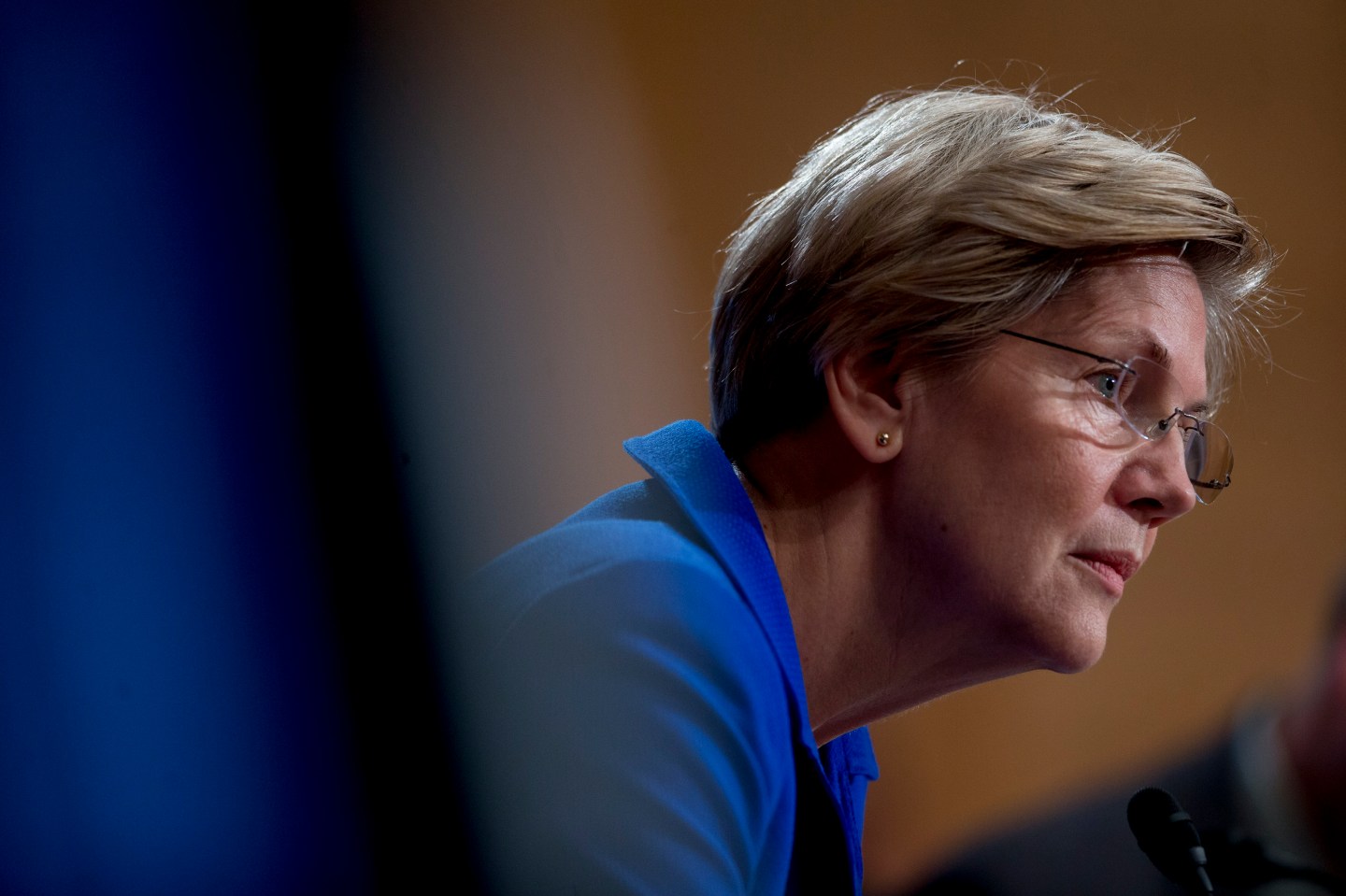
Photograph by Bloomberg/Getty Images

Twice last month, U.S. Sen. Elizabeth Warren (D-MA) called for the White House to back away from, or rule out considering, nominating Wall Street insiders for senior regulatory positions. If this is the start of a crusade, it’s a very bad idea.

The greatest challenge facing financial regulators is the mind-numbing complexity of financial instruments. One big reason Wall Street has gotten away with so many shenanigans is that too few regulators understand what banks are up to.

Although the public hears a lot about the revolving door between Wall Street and Washington—and though it surely poses concerns—the senior positions at the top regulatory institutions are filled with people from public service backgrounds, with academics, and with economists who, in their prior jobs, were not primarily engaged in trading, or reading balance sheets, or evaluating financial risks.

And for the most part, when Wall Street was piling into mortgage securities, these regulators did not understand the risks. They may not understand the next time either.

If Washington is going to be effective at policing Wall Street, it needs to understand what Wall Street does. Franklin D. Roosevelt appreciated this—in a far less complex age—when he nominated Joseph P. Kennedy, a one-time stock market “pool” operator (basically a manipulator) to be the first chairman of the Securities and Exchange Commission. Blunting criticism that he was putting a fox in charge of the henhouse, FDR reportedly said, “set a thief to catch a thief.” Kennedy got the message. He was a resolute chairman and established a solid reputation for the SEC that endured for decades.

Kennedy was not an aberration. His most illustrious successor may have been Arthur Levitt, a one-time stockbroker and stock exchange chairman who was wise to the canny ways of his profession. Levitt sniffed out the simmering potential for conflicts of interest between auditors and public companies—though Congress wouldn’t listen—and was ultimately proven right by the 2002 Arthur Andersen scandal.

By contrast, Christopher Cox, a lawyer and later a congressman, was an ineffective SEC chair. He was blindsided by the 2007 mortgage crisis and it was under his watch that the agency missed the Bernie Madoff scandal. One of the toughest regulators was Nicholas Brady, the head of a presidential commission and soon to be Secretary of Treasury, who courageously identified “portfolio insurance,” then a hot Wall Street product, for stoking the panic in the 1987 stock market crash. Also at the Treasury, I would argue that Hank Paulson, formerly head of Goldman Sachs (GS), responded swiftly and effectively to the 2008 meltdown; he was more forceful than either of his two immediate predecessors, who hailed from the aluminum and railroad industries.

Perhaps a couple of practiced lenders would have been useful at the Federal Reserve—which utterly failed to appreciate the risks in the sub-prime mortgage bubble. Indeed, it seems incredible that during the run-up to the mortgage crisis, among the Fed’s seven governors, only one had a background in private sector banking. (Another, Keven Warsh, had worked at Morgan Stanley (MS), but by the time he joined the Board the bubble was ready to burst.)

This is not to urge a blanket ban on industry outsiders. The lone Fed governor who sounded early alarms about the mortgage crisis was Edward Gramlich, a former economics professor. Nor is it to suggest (obviously) that bankers never get it wrong. But finance cannot be regulated without expertise. To blackball professionals seems dangerously naïve. We should not forget that Paul Volcker, one of the best, and an impeccably ethical, Fed chief, was groomed at Chase Manhattan Bank.

Warren is fighting to block Antonio F. Weiss, who has been nominated by President Obama to be the next Treasury under secretary for domestic finance. Though an important post, it’s an obscure one to be the focus of a Congressional intervention—especially from a Senator of the President’s own party. But Warren has made clear that one of her main objections is that Weiss works at Lazard, a Wall Street investment bank. She wrote in the Huffington Post that Obama should “loosen the hold that Wall Street banks have over economic policy-making.”

That article followed closely a Wall Street Journal op-ed, in which Warren and a fellow Democratic Senator called on President Obama to “move in a new direction” by filling the two vacancies on the Federal Reserve Board with nominees who will “look out for Main Street, not the big banks.”

To maintain, as Warren did, that Wall Street has a “hold” over the Treasury is a curious reading of recent history. Of the eight U.S. Treasury secretaries since the beginning of the Clinton Administration, only three have come from Wall Street.

And if Warren thinks nominating Fed governors sensitive to Main Street represents a “new direction,” she is dead wrong. Only one of the five Fed governors worked as private sector bankers. All of the rest are from public service or academia. Even among the Federal Reserve Banks, the level at which most of the supervision occurs, only three of the 12 have presidents who worked in private sector finance.

Given Warren’s objections, it’s perhaps surprising that, last year, she voted to approve Jack Lew as Treasury Secretary (Lew was at Citigroup (C) when the bank collapsed and required a bailout). But that’s the point: Wall Street-ers should be evaluated on their merits, just like others. Wall Street experience is certainly not a qualification in itself—nominees must demonstrate that they can separate from their employers, intellectually as well as financially. But nor should it be a disqualification. It wouldn’t hurt to have a few foxes on the lookout.

Roger Lowenstein is the author, most recently, of The End of Wall Street. He is writing a book on the origins of the U.S. Federal Reserve.

Correction: An earlier version of this article misstated that none of the five U.S. Fed governors worked as private sector bankers. Jerome H. Powell was a partner at The Carlyle Group from 1997 to 2005.

About the Author
By Roger Lowenstein
See full bioRight Arrow Button Icon

Latest in Finance

Finance
Lorem ipsum dolor sit amet, consectetur adipiscing elit, sed do eiusmod tempor incididunt ut labore et dolore magna aliqua. Ut enim ad minim veniam
By Fortune Editors
October 20, 2025
Finance
Lorem ipsum dolor sit amet, consectetur adipiscing elit, sed do eiusmod tempor incididunt ut labore et dolore magna aliqua. Ut enim ad minim veniam
By Fortune Editors
October 20, 2025
Finance
Lorem ipsum dolor sit amet, consectetur adipiscing elit, sed do eiusmod tempor incididunt ut labore et dolore magna aliqua. Ut enim ad minim veniam
By Fortune Editors
October 20, 2025
Finance
Lorem ipsum dolor sit amet, consectetur adipiscing elit, sed do eiusmod tempor incididunt ut labore et dolore magna aliqua. Ut enim ad minim veniam
By Fortune Editors
October 20, 2025
Finance
Lorem ipsum dolor sit amet, consectetur adipiscing elit, sed do eiusmod tempor incididunt ut labore et dolore magna aliqua. Ut enim ad minim veniam
By Fortune Editors
October 20, 2025
Finance
Lorem ipsum dolor sit amet, consectetur adipiscing elit, sed do eiusmod tempor incididunt ut labore et dolore magna aliqua. Ut enim ad minim veniam
By Fortune Editors
October 20, 2025

Most Popular

Finance
Lorem ipsum dolor sit amet, consectetur adipiscing elit, sed do eiusmod tempor incididunt ut labore et dolore magna aliqua. Ut enim ad minim veniam
By Fortune Editors
October 20, 2025
Finance
Lorem ipsum dolor sit amet, consectetur adipiscing elit, sed do eiusmod tempor incididunt ut labore et dolore magna aliqua. Ut enim ad minim veniam
By Fortune Editors
October 20, 2025
Finance
Lorem ipsum dolor sit amet, consectetur adipiscing elit, sed do eiusmod tempor incididunt ut labore et dolore magna aliqua. Ut enim ad minim veniam
By Fortune Editors
October 20, 2025
Finance
Lorem ipsum dolor sit amet, consectetur adipiscing elit, sed do eiusmod tempor incididunt ut labore et dolore magna aliqua. Ut enim ad minim veniam
By Fortune Editors
October 20, 2025
Finance
Lorem ipsum dolor sit amet, consectetur adipiscing elit, sed do eiusmod tempor incididunt ut labore et dolore magna aliqua. Ut enim ad minim veniam
By Fortune Editors
October 20, 2025
Finance
Lorem ipsum dolor sit amet, consectetur adipiscing elit, sed do eiusmod tempor incididunt ut labore et dolore magna aliqua. Ut enim ad minim veniam
By Fortune Editors
October 20, 2025
Fortune Secondary Logo
Rankings
  • 100 Best Companies
  • Fortune 500
  • Global 500
  • Fortune 500 Europe
  • Most Powerful Women
  • World's Most Admired Companies
  • See All Rankings
  • Lists Calendar
Sections
  • Finance
  • Fortune Crypto
  • Features
  • Leadership
  • Health
  • Commentary
  • Success
  • Retail
  • Mpw
  • Tech
  • Lifestyle
  • CEO Initiative
  • Asia
  • Politics
  • Conferences
  • Europe
  • Newsletters
  • Personal Finance
  • Environment
  • Magazine
  • Education
Customer Support
  • Frequently Asked Questions
  • Customer Service Portal
  • Privacy Policy
  • Terms Of Use
  • Single Issues For Purchase
  • International Print
Commercial Services
  • Advertising
  • Fortune Brand Studio
  • Fortune Analytics
  • Fortune Conferences
  • Business Development
  • Group Subscriptions
About Us
  • About Us
  • Press Center
  • Work At Fortune
  • Terms And Conditions
  • Site Map
  • About Us
  • Press Center
  • Work At Fortune
  • Terms And Conditions
  • Site Map
  • Facebook icon
  • Twitter icon
  • LinkedIn icon
  • Instagram icon
  • Pinterest icon

Latest in Finance

Man wearing a suit and tie and glasses
Big TechTech
Microsoft, Meta, and Google just announced billions more in AI spending. Only Google convinced investors it’s paying off
By Amanda GerutApril 29, 2026
2 hours ago
A man in a suit and tie
InvestingMeta
Meta just bumped its 2026 capex forecast up to as much as $145 billion for the AI boom—and investors flinched
By Amanda GerutApril 29, 2026
4 hours ago
teri
BankingBanks
Exclusive: America’s largest Black-owned bank launches podcast with mission to unlock hidden shame holding back generational wealth
By Nick LichtenbergApril 29, 2026
4 hours ago
A broken grounded plane sits on the tarmac surrounded by machinery
North AmericaAirports
Trackers will be added to emergency vehicles at LaGuardia following deadly March collision
By Bruce Shipkowski and The Associated PressApril 29, 2026
7 hours ago
People wait in long lines at the airport.
PoliticsWhite House
More airport disruptions may be coming as White House warns pay for TSA workers will ‘soon run out’
By Lisa Mascaro and The Associated PressApril 29, 2026
7 hours ago
trump
Energywind energy
Trump spent nearly $2 billion of taxpayer money to undo wind projects already underway. Dems demand answers
By Jennifer McDermott and The Associated PressApril 29, 2026
7 hours ago

Most Popular

Apple cofounder Ronald Wayne—whose stake would be worth up to $400 billion had he not sold it in 1976—says that at 91, he has no regrets
Success
Apple cofounder Ronald Wayne—whose stake would be worth up to $400 billion had he not sold it in 1976—says that at 91, he has no regrets
By Preston ForeApril 27, 2026
2 days ago
‘Take the money and run’: Johns Hopkins economist Steve Hanke on why the UAE quit OPEC
Energy
‘Take the money and run’: Johns Hopkins economist Steve Hanke on why the UAE quit OPEC
By Shawn TullyApril 29, 2026
20 hours ago
‘The cost of compute is far beyond the costs of the employees’: Nvidia executive says right now AI is more expensive than paying human workers
AI
‘The cost of compute is far beyond the costs of the employees’: Nvidia executive says right now AI is more expensive than paying human workers
By Sasha RogelbergApril 28, 2026
2 days ago
Jamie Dimon gets candid about national debt: ‘There will be a bond crisis, and then we’ll have to deal with it’
Economy
Jamie Dimon gets candid about national debt: ‘There will be a bond crisis, and then we’ll have to deal with it’
By Eleanor PringleApril 29, 2026
16 hours ago
More than two-thirds of U.S. schools say they’re unable to afford the cost of student free lunch—and MAHA’s dietary guidelines may make it worse
Economy
More than two-thirds of U.S. schools say they’re unable to afford the cost of student free lunch—and MAHA’s dietary guidelines may make it worse
By Sasha RogelbergApril 29, 2026
18 hours ago
Current price of gold as of April 28, 2026
Personal Finance
Current price of gold as of April 28, 2026
By Danny BakstApril 28, 2026
2 days ago

© 2026 Fortune Media IP Limited. All Rights Reserved. Use of this site constitutes acceptance of our Terms of Use and Privacy Policy | CA Notice at Collection and Privacy Notice | Do Not Sell/Share My Personal Information
FORTUNE is a trademark of Fortune Media IP Limited, registered in the U.S. and other countries. FORTUNE may receive compensation for some links to products and services on this website. Offers may be subject to change without notice.