• Home
  • Latest
  • Fortune 500
  • Finance
  • Tech
  • Leadership
  • Lifestyle
  • Rankings
  • Multimedia
CommentaryCommentary

How to stop robots from taking your job

By
Ryan Feit
Ryan Feit
Down Arrow Button Icon
By
Ryan Feit
Ryan Feit
Down Arrow Button Icon
December 1, 2014, 10:26 AM ET
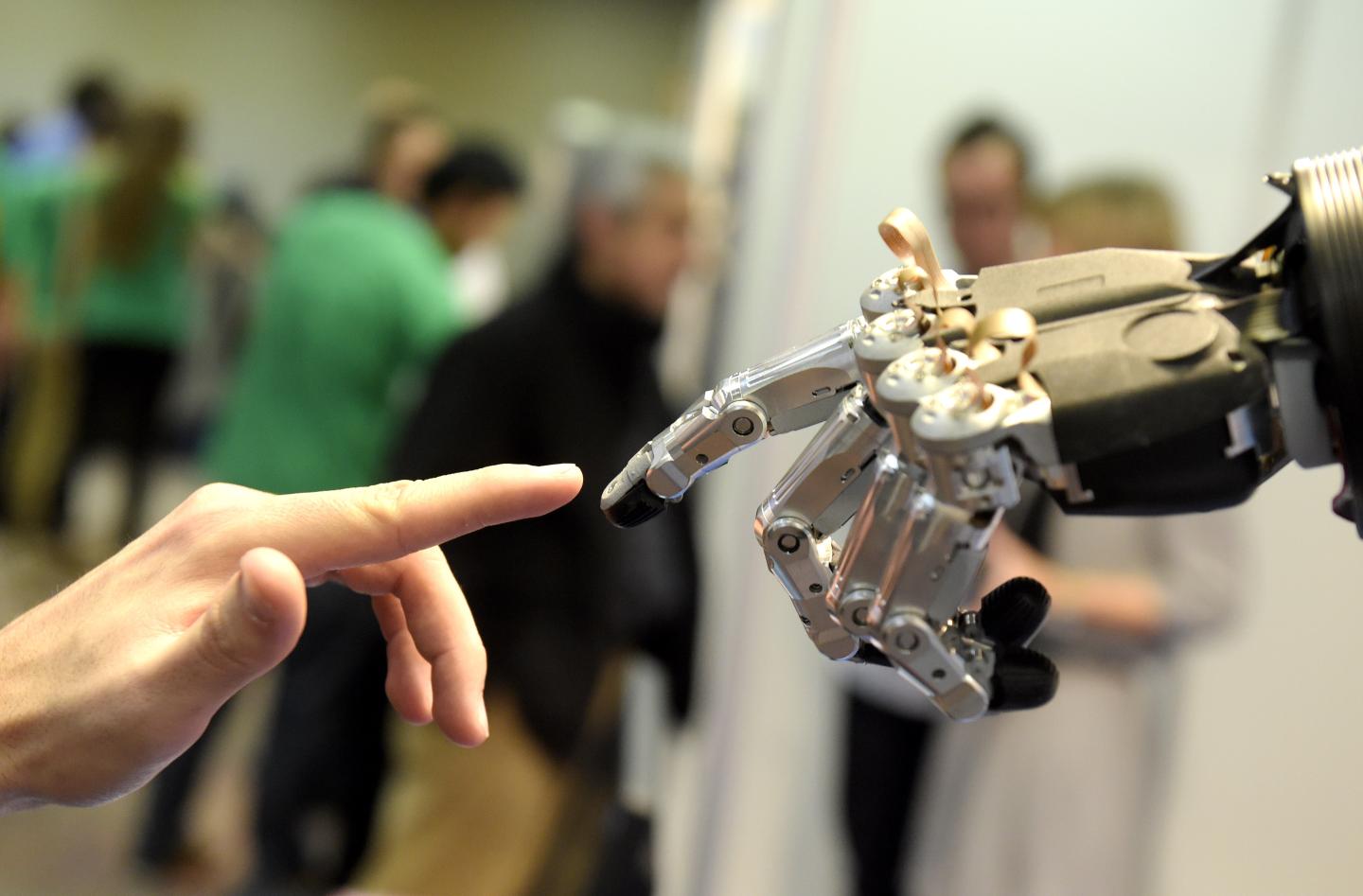
A man moves his finger toward SVH (Servo Electric 5 Finger Gripping Hand) automated hand made by Schunk during the 2014 IEEE-RAS International Conference on Humanoid Robots in Madrid on November 19, 2014.
A man moves his finger toward SVH (Servo Electric 5 Finger Gripping Hand) automated hand made by Schunk during the 2014 IEEE-RAS International Conference on Humanoid Robots in Madrid on November 19, 2014. Photograph by Gerard Julien — AFP/Getty Images

The robots are coming and they want your job. Savioke recently developed a three-foot tall SaviOne robot that replaces the human delivery of snacks and amenities to your hotel room. The robotic butler can navigate your room, make deliveries and even ride the elevator — all without sleeping or going to the bathroom. In addition, robots don’t quit their jobs, whereas the hotel industry, according to the American Hotel & Lodging Association, experiences staff turnover of around 50% in non-management staff.

Moving beyond the hotel industry, Momentum Machines invented a burger-flipping robot that can produce a burger every 10 seconds. This robot replaces three full-time kitchen staff and takes up far less space, potentially able to reduce costs. Momentum Machines Co-Founder Alexandros Vardakostas recently said in an interview at Lemnos Labs that his robot “isn’t meant to make employees more efficient. It’s meant to completely obviate them.”

Both Savioke and Momentum Machines are early signs of the upcoming Technology Revolution. Spawned by advances in robotics, big data, cloud computing and mobile, the revolution could replace millions of jobs. If you recall, the Industrial Revolution was no different than what we will likely see in the future. In 1820, the UK employed approximately 240,000 cotton hand weavers. Within 40 years, 99% of those jobs vanished as a result of the mechanical loom.

About half, 47%, of today’s jobs could be automated away over the next 20 years, according to a recent study by Oxford University. Following the Industrial Revolution during the early 1800s, new inventions created more than enough new work to replace the jobs that were dislocated. But given the ability of today’s technology startups to reach massive scale with minimal headcount, things very well might be different this time around. In 2012, Instagram reached 30 million users and was acquired by Facebook (FB) for $1 billion — all with just 13 employees. By contrast, Kodak filed for bankruptcy in 2012 and employed 145,000 people during its peak.

Indeed, disruption is coming. So what should we do about it?

If history is any indication, some will push for protectionism, shielding certain jobs in order to preserve employment levels in the short-term. Over the next decade, 233,000 taxi drivers and 1.7 million truck drivers in the U.S. could be at risk of having their jobs automated away by driverless vehicles. Given that many cities have already attempted to block the expansion of Uber, we could experience similar tensions when driverless cars arrive. However, in the long-term, attempting to block innovation is short-sighted and makes countries less competitive relative to others who are willing to accept new, more efficient technologies.

Over the next two decades, the most pain will be felt by lesser-skilled workers most likely to lose their jobs to automation. As a result, the gap between the “haves and the have-nots” will widen. This could potentially create tension and fuel lobbying to increase the minimum wage. But like protectionism, raising the minimum wage could ultimately be counter-productive. Increasing minimum wage for hotel or fast-food employees, for example, could actually make companies more interested in automating away those positions if it actually saves companies more money.

Instead of protecting jobs or increasing the minimum wage, we should seriously consider improving America’s antiquated education system. Education is what saved the nation during the 19th century and it could be critical this time as well.

According to MIT Economist David Autor, “By the late 19th century … many Americans recognized that farm employment was declining, industry was rising and their children would need additional education to earn a living.” The World Bank notes that between 1900 and 1940, the percentage of 14- to 17-year-olds enrolled in high school in the U.S. increased from 10% to 75%. As a result, millions of workers left farms and were able to obtain higher-paying jobs as the economy matured.

But this time, we don’t need more schools, we need different schools. Schools will need to place a greater focus on skills that will enable the next generation to benefit from the upcoming technological wave instead of merely getting swept aside. In particular, robots are still horrible communicators and problem solvers. So schools should evolve to emphasize critical thinking and social skills. It is also highly unlikely that during the next couple decades robots will learn how to design and manage themselves, so schools should stress creativity and management skills.

In addition to focusing on different skill sets, schools will need to teach students how to work with machines and other emerging technologies. Today, those who have conquered computers have given themselves a much greater chance of succeeding. Tomorrow, the same will be true as it pertains to robots and big data. In a recent paper, Autor observed that people often “overstate the extent of machine substitution for human labor and ignore the strong complementarities.” In 20 years, our success will not necessarily be driven by our quantitative skills or our work effort, but by how well we collaborate with robots.

Two years ago, a relative of mine was diagnosed with prostate cancer. Ironically, he is a talented urologist who has performed over 3,000 prostate cancer surgeries, but couldn’t operate on himself. When it came to choosing a doctor, he selected a surgeon who was arguably the best in the world at operating with the da Vinci Surgical System, a robotic surgical system. His physician’s skills were still as important as ever but the robot enabled his doctor to translate his hand movements into smaller, more precise incisions. Although the Technology Revolution will come with its share of challenges, like the Industrial Revolution, it will ultimately enable us to do our jobs better than before and solve problems that we can’t even fathom solving today.

Ryan Feit is CEO and co-founder of SeedInvest, a New York City-based equity crowdfunding platform that connects investors with startups.

About the Author
By Ryan Feit
See full bioRight Arrow Button Icon

Latest in Commentary

Finance
Lorem ipsum dolor sit amet, consectetur adipiscing elit, sed do eiusmod tempor incididunt ut labore et dolore magna aliqua. Ut enim ad minim veniam
By Fortune Editors
October 20, 2025
Finance
Lorem ipsum dolor sit amet, consectetur adipiscing elit, sed do eiusmod tempor incididunt ut labore et dolore magna aliqua. Ut enim ad minim veniam
By Fortune Editors
October 20, 2025
Finance
Lorem ipsum dolor sit amet, consectetur adipiscing elit, sed do eiusmod tempor incididunt ut labore et dolore magna aliqua. Ut enim ad minim veniam
By Fortune Editors
October 20, 2025
Finance
Lorem ipsum dolor sit amet, consectetur adipiscing elit, sed do eiusmod tempor incididunt ut labore et dolore magna aliqua. Ut enim ad minim veniam
By Fortune Editors
October 20, 2025
Finance
Lorem ipsum dolor sit amet, consectetur adipiscing elit, sed do eiusmod tempor incididunt ut labore et dolore magna aliqua. Ut enim ad minim veniam
By Fortune Editors
October 20, 2025
Finance
Lorem ipsum dolor sit amet, consectetur adipiscing elit, sed do eiusmod tempor incididunt ut labore et dolore magna aliqua. Ut enim ad minim veniam
By Fortune Editors
October 20, 2025

Most Popular

Finance
Lorem ipsum dolor sit amet, consectetur adipiscing elit, sed do eiusmod tempor incididunt ut labore et dolore magna aliqua. Ut enim ad minim veniam
By Fortune Editors
October 20, 2025
Finance
Lorem ipsum dolor sit amet, consectetur adipiscing elit, sed do eiusmod tempor incididunt ut labore et dolore magna aliqua. Ut enim ad minim veniam
By Fortune Editors
October 20, 2025
Finance
Lorem ipsum dolor sit amet, consectetur adipiscing elit, sed do eiusmod tempor incididunt ut labore et dolore magna aliqua. Ut enim ad minim veniam
By Fortune Editors
October 20, 2025
Finance
Lorem ipsum dolor sit amet, consectetur adipiscing elit, sed do eiusmod tempor incididunt ut labore et dolore magna aliqua. Ut enim ad minim veniam
By Fortune Editors
October 20, 2025
Finance
Lorem ipsum dolor sit amet, consectetur adipiscing elit, sed do eiusmod tempor incididunt ut labore et dolore magna aliqua. Ut enim ad minim veniam
By Fortune Editors
October 20, 2025
Finance
Lorem ipsum dolor sit amet, consectetur adipiscing elit, sed do eiusmod tempor incididunt ut labore et dolore magna aliqua. Ut enim ad minim veniam
By Fortune Editors
October 20, 2025
Fortune Secondary Logo
Rankings
  • 100 Best Companies
  • Fortune 500
  • Global 500
  • Fortune 500 Europe
  • Most Powerful Women
  • World's Most Admired Companies
  • See All Rankings
  • Lists Calendar
Sections
  • Finance
  • Fortune Crypto
  • Features
  • Leadership
  • Health
  • Commentary
  • Success
  • Retail
  • Mpw
  • Tech
  • Lifestyle
  • CEO Initiative
  • Asia
  • Politics
  • Conferences
  • Europe
  • Newsletters
  • Personal Finance
  • Environment
  • Magazine
  • Education
Customer Support
  • Frequently Asked Questions
  • Customer Service Portal
  • Privacy Policy
  • Terms Of Use
  • Single Issues For Purchase
  • International Print
Commercial Services
  • Advertising
  • Fortune Brand Studio
  • Fortune Analytics
  • Fortune Conferences
  • Business Development
  • Group Subscriptions
About Us
  • About Us
  • Press Center
  • Work At Fortune
  • Terms And Conditions
  • Site Map
  • About Us
  • Press Center
  • Work At Fortune
  • Terms And Conditions
  • Site Map
  • Facebook icon
  • Twitter icon
  • LinkedIn icon
  • Instagram icon
  • Pinterest icon

Latest in Commentary

sundar
Commentary250 Years of Innovation
America at 250: immigration and the making of an innovative nation
By Nasser KazeminyMay 1, 2026
38 seconds ago
hegseth
CommentaryMilitary
America shot its arsenal empty in 2 wars. Now it needs Beijing’s permission to reload
By Steve H. Hanke and Jeffrey WengApril 30, 2026
15 hours ago
Duncan Tait, CEO of Inchcape
Europecar manufacturing
“Competition is good for the industry”. Inchcape CEO’s case for optimism in automotive’s next chapter
By Duncan TaitApril 30, 2026
18 hours ago
agentic
CommentaryAI agents
Why your data infrastructure — not your AI model — will determine whether Agentic AI scales
By Jeffrey Sonnenfeld, Stephen Henriques, Catherine Dai and Zander JeinthanuttkanontApril 30, 2026
21 hours ago
hoskins
Commentaryoffices
Gensler Co-Chair: Hot-desking was supposed to save money. It may be costing you your culture
By Diane HoskinsApril 30, 2026
23 hours ago
tillis
CommentaryCongress
Thom Tillis: Free markets built American prosperity. Government intervention puts it at risk
By Thom Tillis and John StanfordApril 30, 2026
1 day ago

Most Popular

Apple cofounder Ronald Wayne—whose stake would be worth up to $400 billion had he not sold it in 1976—says that at 91, he has no regrets
Success
Apple cofounder Ronald Wayne—whose stake would be worth up to $400 billion had he not sold it in 1976—says that at 91, he has no regrets
By Preston ForeApril 27, 2026
4 days ago
China dominates the world's lithium supply. The U.S. just found 328 years' worth in its own backyard
North America
China dominates the world's lithium supply. The U.S. just found 328 years' worth in its own backyard
By Jake AngeloApril 30, 2026
15 hours ago
Google Cloud revenue is now 18% of Alphabet's business. Is this the beginning of the end of Google's search identity?
Big Tech
Google Cloud revenue is now 18% of Alphabet's business. Is this the beginning of the end of Google's search identity?
By Alexei OreskovicApril 29, 2026
1 day ago
Accenture's Julie Sweet blew up 50 years of company history. She says the hardest part is still ahead
Conferences
Accenture's Julie Sweet blew up 50 years of company history. She says the hardest part is still ahead
By Nick LichtenbergApril 29, 2026
2 days ago
With no end in sight, Trump considers new options in Iran war—including the ‘Dark Eagle’ hypersonic missile
Big Tech
With no end in sight, Trump considers new options in Iran war—including the ‘Dark Eagle’ hypersonic missile
By Jim EdwardsApril 30, 2026
23 hours ago
‘The cost of compute is far beyond the costs of the employees’: Nvidia executive says right now AI is more expensive than paying human workers
AI
‘The cost of compute is far beyond the costs of the employees’: Nvidia executive says right now AI is more expensive than paying human workers
By Sasha RogelbergApril 28, 2026
3 days ago

© 2026 Fortune Media IP Limited. All Rights Reserved. Use of this site constitutes acceptance of our Terms of Use and Privacy Policy | CA Notice at Collection and Privacy Notice | Do Not Sell/Share My Personal Information
FORTUNE is a trademark of Fortune Media IP Limited, registered in the U.S. and other countries. FORTUNE may receive compensation for some links to products and services on this website. Offers may be subject to change without notice.