• Home
  • Latest
  • Fortune 500
  • Finance
  • Tech
  • Leadership
  • Lifestyle
  • Rankings
  • Multimedia
Finance

Did Yellen slay the ‘tech bubble’ dragon?

By
Dean Baker
Dean Baker
Down Arrow Button Icon
By
Dean Baker
Dean Baker
Down Arrow Button Icon
July 29, 2014, 1:19 PM ET
Photograph by Bloomberg/Getty Images

Just over a decade ago, then U.S. Federal Reserve Board Chair Alan Greenspan told an adoring audience at the American Economic Association that the best way to deal with asset bubbles is to ignore them. Greenspan was relating what he considered to be his success with the 1990s stock bubble. Rather than trying to take steps to keep prices from moving higher before the bubble grew large enough to pose a danger to the economy, he and his colleagues at the Fed decided that the best option was to let it run its course and then pick up the pieces after the bubble burst.

Even back in 2004, there were good reasons to question the wisdom of this approach. The country was enduring what was at the time its longest stretch without net job growth since the Great Depression. This was the reason the Fed was holding the federal funds rate at the extraordinarily low rate of 1.0% more than two years after the 2001 recession had officially ended. But those of us who thought asset bubbles were something the Fed should concern itself with were just a tiny minority of the economics profession.

That changed with the collapse of the housing bubble in 2008. The financial crisis and Great Recession have convinced most economists, including those in top positions at the Fed, that asset bubbles must be taken seriously. This still leaves the question of how best to rein in bubbles.

There are two basic schools of thought. One of these schools believes that the Fed should directly use monetary policy to stem the growth of bubbles. This would mean raising interest rates to bring down asset prices.

While there is little doubt that higher interest rates will eventually quell the growth of a bubble, high interest rates will also slow the economy. In a situation like the present, where the economy needs all the support it can get, using interest rates to stem the growth of a bubble would mean a big loss of jobs output.

The other approach is the use of the Fed’s regulatory powers and its ability to warn the public about the dangers of a bubble. In other words: talk. The use of regulatory authority is straightforward. The Fed can try to restrict the flows of credit that are spurring the growth of a bubble. For example in the case of the housing bubble, publishing mortgage guidelines that would have excluded the worst loans (which it did in the summer of 2008) might have prevented the proliferation of subprime lending.

The talk approach is also fairly simple. The Federal Reserve Board has an enormous megaphone. When the Fed chair testifies before Congress or gives a public address in another forum, the financial sector has to pay attention. If the Fed chair uses this platform to call attention to a bubble, it is likely to have an impact on investor behavior.

This is not a story of having the Fed chair mumble “irrational exuberance,” while giving his or her subjective assessment on asset prices; it is about having the Fed warn of asset prices being out of line with the fundamentals of the market and historical experience, and presenting the evidence to back up this case.

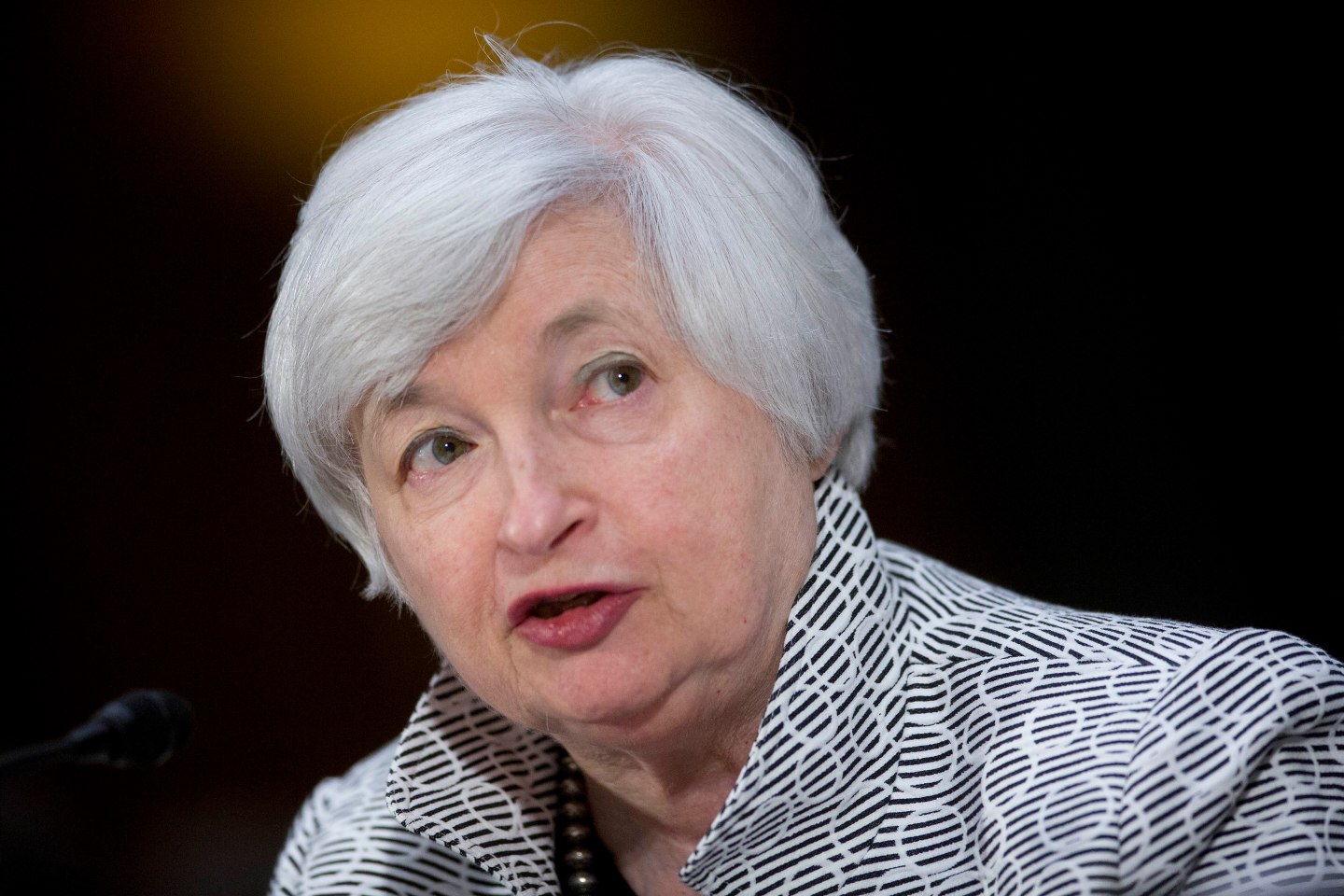
This is exactly what Federal Reserve Board Chair Janet Yellen did in her congressional testimony earlier this month. She warned that the prices of some social media and biotech stocks appeared to be out of line with their earnings potential. She also noted that junk bonds seemed to be over-priced given their inherent riskiness. Her written statement included the evidence to back up these assertions.

No one expects that every investor and fund manager will dump their holdings of these assets based on Yellen’s comments. However they will take the evidence she presents seriously. Any fund manager with a heavy stake in these assets will be looking for a new job if their price subsequently plunges. Unlike with the housing bubble, “who could have known?” will not be an acceptable excuse.

The evidence to date is that Yellen’s warnings had the intended effect. The price of these assets has fallen considerably, although we will need a longer period of time to ensure that the effect is not temporary.

It is certainly encouraging to see Yellen experiment with this approach. It’s good the Fed recognizes its need to prevent the excessive growth of asset bubbles, but it is also important that the Fed carry through this task in a way that doesn’t itself cause serious economic damage. Providing information to financial markets is the lowest cost path imaginable to bubble containment. We should all hope that it works.

Dean Baker is a macroeconomist and co-director of the Center for Economic and Policy Research in Washington, DC. He previously worked as a senior economist at the Economic Policy Institute and an assistant professor at Bucknell University.


About the Author
By Dean Baker
See full bioRight Arrow Button Icon

Latest in Finance

Finance
Lorem ipsum dolor sit amet, consectetur adipiscing elit, sed do eiusmod tempor incididunt ut labore et dolore magna aliqua. Ut enim ad minim veniam
By Fortune Editors
October 20, 2025
Finance
Lorem ipsum dolor sit amet, consectetur adipiscing elit, sed do eiusmod tempor incididunt ut labore et dolore magna aliqua. Ut enim ad minim veniam
By Fortune Editors
October 20, 2025
Finance
Lorem ipsum dolor sit amet, consectetur adipiscing elit, sed do eiusmod tempor incididunt ut labore et dolore magna aliqua. Ut enim ad minim veniam
By Fortune Editors
October 20, 2025
Finance
Lorem ipsum dolor sit amet, consectetur adipiscing elit, sed do eiusmod tempor incididunt ut labore et dolore magna aliqua. Ut enim ad minim veniam
By Fortune Editors
October 20, 2025
Finance
Lorem ipsum dolor sit amet, consectetur adipiscing elit, sed do eiusmod tempor incididunt ut labore et dolore magna aliqua. Ut enim ad minim veniam
By Fortune Editors
October 20, 2025
Finance
Lorem ipsum dolor sit amet, consectetur adipiscing elit, sed do eiusmod tempor incididunt ut labore et dolore magna aliqua. Ut enim ad minim veniam
By Fortune Editors
October 20, 2025

Most Popular

Finance
Lorem ipsum dolor sit amet, consectetur adipiscing elit, sed do eiusmod tempor incididunt ut labore et dolore magna aliqua. Ut enim ad minim veniam
By Fortune Editors
October 20, 2025
Finance
Lorem ipsum dolor sit amet, consectetur adipiscing elit, sed do eiusmod tempor incididunt ut labore et dolore magna aliqua. Ut enim ad minim veniam
By Fortune Editors
October 20, 2025
Finance
Lorem ipsum dolor sit amet, consectetur adipiscing elit, sed do eiusmod tempor incididunt ut labore et dolore magna aliqua. Ut enim ad minim veniam
By Fortune Editors
October 20, 2025
Finance
Lorem ipsum dolor sit amet, consectetur adipiscing elit, sed do eiusmod tempor incididunt ut labore et dolore magna aliqua. Ut enim ad minim veniam
By Fortune Editors
October 20, 2025
Finance
Lorem ipsum dolor sit amet, consectetur adipiscing elit, sed do eiusmod tempor incididunt ut labore et dolore magna aliqua. Ut enim ad minim veniam
By Fortune Editors
October 20, 2025
Finance
Lorem ipsum dolor sit amet, consectetur adipiscing elit, sed do eiusmod tempor incididunt ut labore et dolore magna aliqua. Ut enim ad minim veniam
By Fortune Editors
October 20, 2025
Rankings
  • 100 Best Companies
  • Fortune 500
  • Global 500
  • Fortune 500 Europe
  • Most Powerful Women
  • Future 50
  • World’s Most Admired Companies
  • See All Rankings
Sections
  • Finance
  • Leadership
  • Success
  • Tech
  • Asia
  • Europe
  • Environment
  • Fortune Crypto
  • Health
  • Retail
  • Lifestyle
  • Politics
  • Newsletters
  • Magazine
  • Features
  • Commentary
  • Mpw
  • CEO Initiative
  • Conferences
  • Personal Finance
  • Education
Customer Support
  • Frequently Asked Questions
  • Customer Service Portal
  • Privacy Policy
  • Terms Of Use
  • Single Issues For Purchase
  • International Print
Commercial Services
  • Advertising
  • Fortune Brand Studio
  • Fortune Analytics
  • Fortune Conferences
  • Business Development
About Us
  • About Us
  • Editorial Calendar
  • Press Center
  • Work At Fortune
  • Diversity And Inclusion
  • Terms And Conditions
  • Site Map
  • Facebook icon
  • Twitter icon
  • LinkedIn icon
  • Instagram icon
  • Pinterest icon

Latest in Finance

Personal FinanceCertificates of Deposit (CDs)
Best certificates of deposit (CDs) for January 2026
By Glen Luke FlanaganJanuary 13, 2026
15 hours ago
A worker in a green jacket operates a welding tool.
EconomyLabor
U.S workers just took home their smallest share of capital since 1947, at least
By Sasha RogelbergJanuary 13, 2026
16 hours ago
A smartphone displaying the Google Gemini logo.
AIEye on AI
As ‘agentic commerce’ gains ground, companies shouldn’t put too much faith in ‘GEO,’ one industry insider warns
By Jeremy KahnJanuary 13, 2026
18 hours ago
BankingDebt
Why the $38 trillion national debt doomed Fed independence regardless of the Trump/Powell drama, top economist says
By Eva RoytburgJanuary 13, 2026
18 hours ago
bastian
Economyearnings
Delta sees wealthy high fliers leading to another record year—but its CEO sees the main cabin ‘struggling greatly’
By Nick LichtenbergJanuary 13, 2026
18 hours ago
The Synchrony Bank Logo on a green layered background.
Personal FinanceCertificates of Deposit (CDs)
Synchrony Bank CD Rates 2026
By Joseph HostetlerJanuary 13, 2026
19 hours ago

Most Popular

placeholder alt text
Tech
Elon Musk asked people to upload their medical data to X so his AI company could learn to interpret MRIs and CT scans
By Sasha RogelbergJanuary 11, 2026
3 days ago
placeholder alt text
Newsletters
The oil CEO who stood up to Trump is a follower of the disciplined 'Exxon way' and has a history of blunt statements
By Jordan BlumJanuary 13, 2026
1 day ago
placeholder alt text
Success
Despite his $2.6 billion net worth, MrBeast says he’s having to borrow cash and doesn’t even have enough money in his bank account to buy McDonald’s
By Emma BurleighJanuary 13, 2026
21 hours ago
placeholder alt text
Economy
The longer the Supreme Court delays its tariff decision, the better it is for President Trump
By Jim EdwardsJanuary 13, 2026
1 day ago
placeholder alt text
Economy
Treasury spent $276 billion in interest on the national debt in the final three months of 2025, says the CBO—up $30 billion from a year prior
By Eleanor PringleJanuary 12, 2026
2 days ago
placeholder alt text
AI
'Godfather of AI' says the technology will create massive unemployment and send profits soaring — 'that is the capitalist system'
By Jason MaJanuary 12, 2026
2 days ago

© 2025 Fortune Media IP Limited. All Rights Reserved. Use of this site constitutes acceptance of our Terms of Use and Privacy Policy | CA Notice at Collection and Privacy Notice | Do Not Sell/Share My Personal Information
FORTUNE is a trademark of Fortune Media IP Limited, registered in the U.S. and other countries. FORTUNE may receive compensation for some links to products and services on this website. Offers may be subject to change without notice.