
• Home
  • Latest
  • Fortune 500
  • Finance
  • Tech
  • Leadership
  • Lifestyle
  • Rankings
  • Multimedia
Financeprivate equity

Private equity’s unnecessary complexity may backfire

By
Dan Primack
Dan Primack
Down Arrow Button Icon
By
Dan Primack
Dan Primack
Down Arrow Button Icon
June 12, 2014, 8:00 AM ET
Finance
contract Armin HarrisKyle Bean for Fortune

Fourteen years ago I was a cub reporter who had just been assigned to the private equity beat. Over lunch at a TGI Friday’s, my new editor explained the industry’s basic structure: Private equity firms raise funds from large institutional investors (i.e., limited partners) and then slowly use those funds to buy companies. The limited partners pay the firm a percentage of their committed capital each year as a so-called management fee to cover overhead expenses like salaries and office space. The partners also share a percentage of any eventual investment returns with the firm, so as to better align interests.

That all remains accurate today, even as the private equity industry has multiplied in terms of size and public profile. But it also glosses over a lot of the fine print, particularly in terms of additional fees and expenses that private equity firms often charge both their investors and their portfolio companies. It is that fine print that the Securities and Exchange Commission is now investigating, thanks to tools made available via the Dodd-Frank financial reform of 2010. So far the results are troubling.

“When we have examined how fees and expenses are handled by advisers to private equity funds, we have identified what we believe are violations of law or material weaknesses in controls over 50% of the time,” said Andrew Bowden, the SEC’s director of compliance inspections and examinations, during a recent speech. In a follow-up interview with the New York Times, he added, “In some instances, investors’ pockets are being picked.”
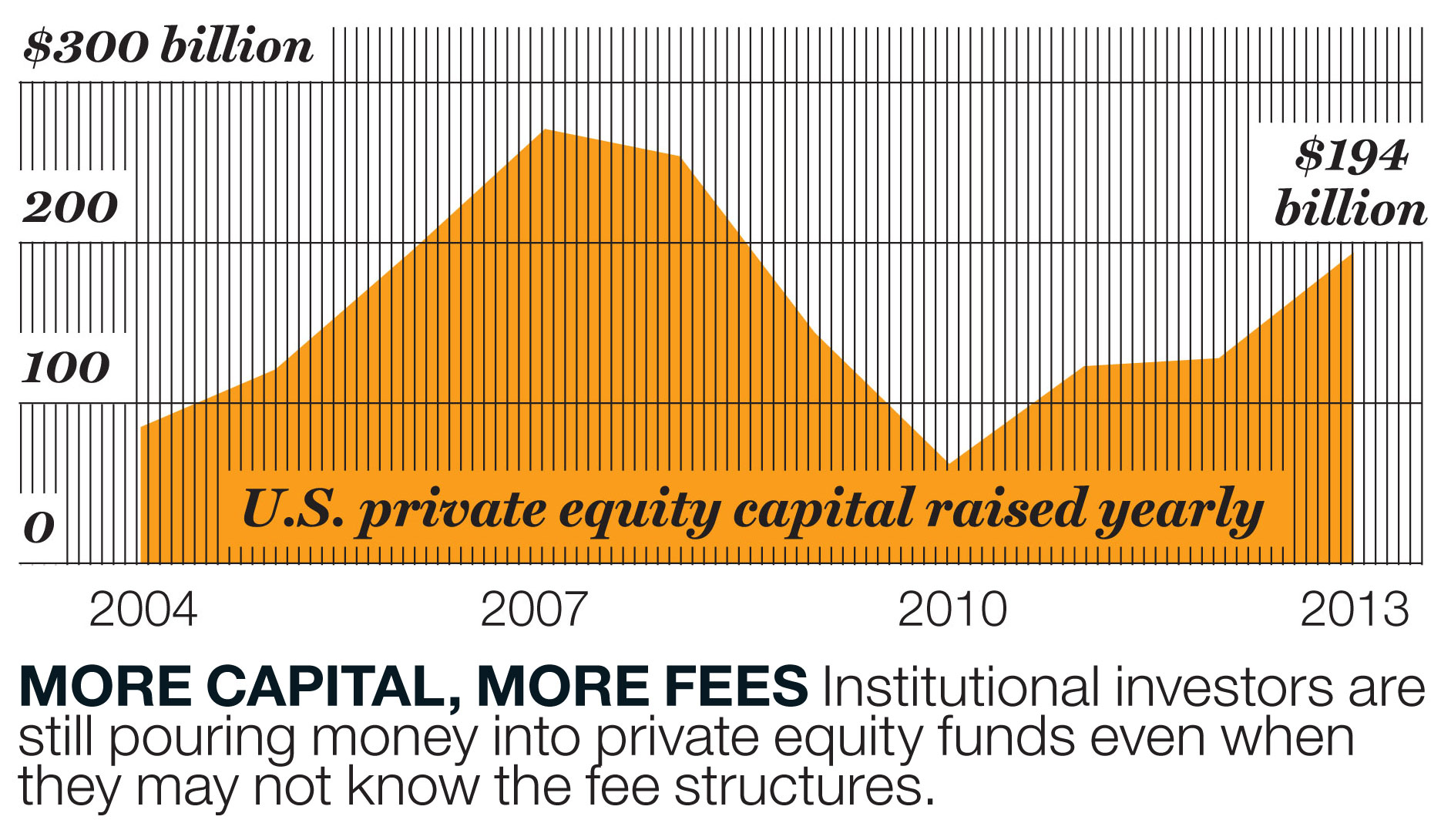
PRI.06.30.14-
Source: PitchBook

To be sure, this isn’t all about rapacious Wall Street vs. meek Main Street. Limited partners–even public pension systems–are supposed to be sophisticated investors with their own well-paid lawyers and accountants. The real problem, from my perspective, is that both sides have gotten too clever for their own good. Private equity firms long ago picked a lot of the low-hanging industrial fruit, so it is more difficult today to generate investment returns than it was a decade ago. They try to make up the difference any way they can, often writing ambiguous investor contracts that are as notable for what they don’t enumerate as for what they do. For example, if a contract says that the limited partner is entitled to 80% of nine specific types of fees charged to portfolio companies, what happens if the firm later conjures up a 10th type of fee?

On the flip side, limited partners also want to feel that they’ve gotten the best deal possible. That’s why many of them–particularly the large ones with clout–now insist on individualized “side letters” that include pet terms or clauses. No wonder Blackstone Group president Tony James recently said, “Legal and compliance is our fastest-growing part of the firm by far.”

What’s been largely lost in all this is the spirit of partnership that is supposed to underwrite the investor/firm relationship. Both sides still pay it plenty of lip service, of course, and may even have convinced themselves that it remains foundational. But it’s extremely difficult to have a true alignment of interests after negotiating such adversarial agreements. Even if investors aren’t technically being cheated, someone isn’t getting exactly what he thought he’d signed up for. And the SEC’s comments have caused even the most loyal limited partners to privately concede that they may have been bamboozled.

As with so many things, the best solution is simplicity. Private equity fund contracts needn’t be proprietary 150-page tomes whose size seems designed to mask what they didn’t include. Their language can be streamlined and standardized while still permitting differences in terms of specific percentages and fee adoptions. Side letters can be scrapped, outside of ones whose main purpose is to satisfy jurisdictional requirements.

In short, private equity should rebuild itself by using what I learned at TGI Friday’s as a goal to work toward, rather than as a starting point from which to deviate. If not, the SEC may move beyond just asking questions.

This story is from the June 30, 2014 issue of  Fortune.

About the Author
By Dan Primack
See full bioRight Arrow Button Icon

Latest in Finance

Finance
Lorem ipsum dolor sit amet, consectetur adipiscing elit, sed do eiusmod tempor incididunt ut labore et dolore magna aliqua. Ut enim ad minim veniam
By Fortune Editors
October 20, 2025
Finance
Lorem ipsum dolor sit amet, consectetur adipiscing elit, sed do eiusmod tempor incididunt ut labore et dolore magna aliqua. Ut enim ad minim veniam
By Fortune Editors
October 20, 2025
Finance
Lorem ipsum dolor sit amet, consectetur adipiscing elit, sed do eiusmod tempor incididunt ut labore et dolore magna aliqua. Ut enim ad minim veniam
By Fortune Editors
October 20, 2025
Finance
Lorem ipsum dolor sit amet, consectetur adipiscing elit, sed do eiusmod tempor incididunt ut labore et dolore magna aliqua. Ut enim ad minim veniam
By Fortune Editors
October 20, 2025
Finance
Lorem ipsum dolor sit amet, consectetur adipiscing elit, sed do eiusmod tempor incididunt ut labore et dolore magna aliqua. Ut enim ad minim veniam
By Fortune Editors
October 20, 2025
Finance
Lorem ipsum dolor sit amet, consectetur adipiscing elit, sed do eiusmod tempor incididunt ut labore et dolore magna aliqua. Ut enim ad minim veniam
By Fortune Editors
October 20, 2025

Most Popular

Finance
Lorem ipsum dolor sit amet, consectetur adipiscing elit, sed do eiusmod tempor incididunt ut labore et dolore magna aliqua. Ut enim ad minim veniam
By Fortune Editors
October 20, 2025
Finance
Lorem ipsum dolor sit amet, consectetur adipiscing elit, sed do eiusmod tempor incididunt ut labore et dolore magna aliqua. Ut enim ad minim veniam
By Fortune Editors
October 20, 2025
Finance
Lorem ipsum dolor sit amet, consectetur adipiscing elit, sed do eiusmod tempor incididunt ut labore et dolore magna aliqua. Ut enim ad minim veniam
By Fortune Editors
October 20, 2025
Finance
Lorem ipsum dolor sit amet, consectetur adipiscing elit, sed do eiusmod tempor incididunt ut labore et dolore magna aliqua. Ut enim ad minim veniam
By Fortune Editors
October 20, 2025
Finance
Lorem ipsum dolor sit amet, consectetur adipiscing elit, sed do eiusmod tempor incididunt ut labore et dolore magna aliqua. Ut enim ad minim veniam
By Fortune Editors
October 20, 2025
Finance
Lorem ipsum dolor sit amet, consectetur adipiscing elit, sed do eiusmod tempor incididunt ut labore et dolore magna aliqua. Ut enim ad minim veniam
By Fortune Editors
October 20, 2025
Fortune Secondary Logo
Rankings
  • 100 Best Companies
  • Fortune 500
  • Global 500
  • Fortune 500 Europe
  • Most Powerful Women
  • World's Most Admired Companies
  • See All Rankings
  • Lists Calendar
Sections
  • Finance
  • Fortune Crypto
  • Features
  • Leadership
  • Health
  • Commentary
  • Success
  • Retail
  • Mpw
  • Tech
  • Lifestyle
  • CEO Initiative
  • Asia
  • Politics
  • Conferences
  • Europe
  • Newsletters
  • Personal Finance
  • Environment
  • Magazine
  • Education
Customer Support
  • Frequently Asked Questions
  • Customer Service Portal
  • Privacy Policy
  • Terms Of Use
  • Single Issues For Purchase
  • International Print
Commercial Services
  • Advertising
  • Fortune Brand Studio
  • Fortune Analytics
  • Fortune Conferences
  • Business Development
  • Group Subscriptions
About Us
  • About Us
  • Press Center
  • Work At Fortune
  • Terms And Conditions
  • Site Map
  • About Us
  • Press Center
  • Work At Fortune
  • Terms And Conditions
  • Site Map
  • Facebook icon
  • Twitter icon
  • LinkedIn icon
  • Instagram icon
  • Pinterest icon

Latest in Finance

agentic
CommentaryAI agents
Why your data infrastructure — not your AI model — will determine whether Agentic AI scales
By Jeffrey Sonnenfeld, Stephen Henriques, Catherine Dai and Zander JeinthanuttkanontApril 30, 2026
18 minutes ago
Mohamed Aly El-Erian during a Bloomberg Television interview in London, UK, on Monday, Sept. 25, 2023.
EconomyRecession
The global economy has a month—eight weeks at most—to avoid a recession, warns top economist
By Eleanor PringleApril 30, 2026
2 hours ago
Global investors are shrugging off Iran worries and returning to markets in Asia, the ‘backbone of the whole AI value chain’
AsiaInvestment
Global investors are shrugging off Iran worries and returning to markets in Asia, the ‘backbone of the whole AI value chain’
By Angelica AngApril 30, 2026
2 hours ago
Photo: Donald Trump
Big TechMarkets
With no end in sight, Trump considers new options in Iran war—including the ‘Dark Eagle’ hypersonic missile
By Jim EdwardsApril 30, 2026
2 hours ago
Top CD rates today, April 30, 2026: Lock in up to up to 4.20%
Personal FinanceCertificates of Deposit (CDs)
Top CD rates today, April 30, 2026: Lock in up to up to 4.20%
By Glen Luke FlanaganApril 30, 2026
2 hours ago
Today’s top high-yield savings rates: Up to 5.00% on April 30, 2026
Personal FinanceSavings accounts
Today’s top high-yield savings rates: Up to 5.00% on April 30, 2026
By Glen Luke FlanaganApril 30, 2026
2 hours ago

Most Popular

Apple cofounder Ronald Wayne—whose stake would be worth up to $400 billion had he not sold it in 1976—says that at 91, he has no regrets
Success
Apple cofounder Ronald Wayne—whose stake would be worth up to $400 billion had he not sold it in 1976—says that at 91, he has no regrets
By Preston ForeApril 27, 2026
3 days ago
‘Take the money and run’: Johns Hopkins economist Steve Hanke on why the UAE quit OPEC
Energy
‘Take the money and run’: Johns Hopkins economist Steve Hanke on why the UAE quit OPEC
By Shawn TullyApril 29, 2026
1 day ago
Jamie Dimon gets candid about national debt: ‘There will be a bond crisis, and then we’ll have to deal with it’
Economy
Jamie Dimon gets candid about national debt: ‘There will be a bond crisis, and then we’ll have to deal with it’
By Eleanor PringleApril 29, 2026
1 day ago
‘The cost of compute is far beyond the costs of the employees’: Nvidia executive says right now AI is more expensive than paying human workers
AI
‘The cost of compute is far beyond the costs of the employees’: Nvidia executive says right now AI is more expensive than paying human workers
By Sasha RogelbergApril 28, 2026
2 days ago
‘They left me no choice’: Powell isn’t going anywhere—blocking Trump from another Fed appointee
Banking
‘They left me no choice’: Powell isn’t going anywhere—blocking Trump from another Fed appointee
By Eva RoytburgApril 29, 2026
17 hours ago
More than two-thirds of U.S. schools say they’re unable to afford the cost of student free lunch—and MAHA’s dietary guidelines may make it worse
Economy
More than two-thirds of U.S. schools say they’re unable to afford the cost of student free lunch—and MAHA’s dietary guidelines may make it worse
By Sasha RogelbergApril 29, 2026
1 day ago

© 2026 Fortune Media IP Limited. All Rights Reserved. Use of this site constitutes acceptance of our Terms of Use and Privacy Policy | CA Notice at Collection and Privacy Notice | Do Not Sell/Share My Personal Information
FORTUNE is a trademark of Fortune Media IP Limited, registered in the U.S. and other countries. FORTUNE may receive compensation for some links to products and services on this website. Offers may be subject to change without notice.