• Home
  • Latest
  • Fortune 500
  • Finance
  • Tech
  • Leadership
  • Lifestyle
  • Rankings
  • Multimedia
FinanceEconomy

Will allowing more foreign workers shrink the salary gap?

By
Nina Easton
Nina Easton
Down Arrow Button Icon
By
Nina Easton
Nina Easton
Down Arrow Button Icon
December 19, 2013, 12:44 PM ET
131217100316-eas13-graph2

Those looking to assign blame for income inequality in the U.S. have no shortage of institutions to cast as villains. The left’s perennial bad guy is Wal-Mart, most recently targeted by union leaders demanding that its new Washington, D.C., box stores pay 50% above the minimum wage (labor lost that battle). On the political right the culprit is often the Latino illegal immigrant, who stands accused of taking Americans’ jobs and keeping wages low by working off the books. And just about everyone cringes at CEO salaries that average 273 times that of their employees.

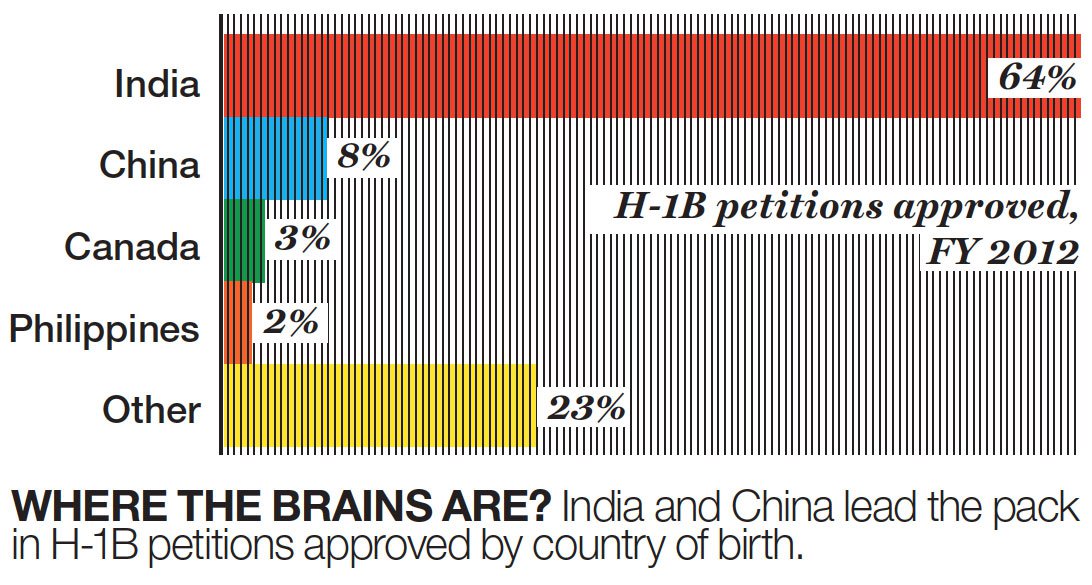
The policy prescriptions are just as familiar as the villains’ names: Raise wages at the bottom. Raise taxes at the top. To those old debates, Alan Greenspan offers up a provocative new idea: Let firms recruit as many brainy foreign employees to American soil as they want. In other words, instead of raising the cap on specialty green cards and H-1B visas, as the Senate-passed immigration bill does, drop the limits altogether.

The result? The former Fed chair argues that the subsequent crush of high-skilled foreign talent would squeeze salaries at the top. (That’s probably you, Fortune reader.) “They’d be competing for jobs against us — the well educated and high skilled,” he says. “Including me. I don’t know how many economists, but there would be some [foreign hires].” And there would be a bonus for lower-income workers: This infusion of talent would boost economic growth — and more jobs.

The demand for H-1B visas is huge and growing. Within days visas for 65,000, plus 20,000 advanced-degree holders, are filled each year, even with a regulatory stipulation that they can be granted only for jobs “so specialized and complex that the knowledge required to perform the duties is usually associated with the attainment of a bachelor’s or higher degree.” (Companies have to attest that none of their U.S. employees will be displaced, but they don’t have to prove that no other Americans are available.)

Loads of those visa applications come on behalf of foreign graduates and postgraduates from U.S. universities who otherwise will take their degrees home to compete against American firms. Last year a record 800,000 foreign students attended U.S. universities, and many study science or business. If the gates were open to more of those students, “they’d force prices and income down in the upper-income groups,” Greenspan tells me. “Not by a large amount, but it would be measurable.”

I’ve argued here that giving U.S. companies more leeway to hire foreigners reduces their incentive to invest in the skills and education of the American workforce. If Microsoft can pull all the employees it wants out from the Indians and Chinese and Brazilians populating Ivy League corridors, why bother investing in U.S. schools?

Greenspan, author of the new book The Map and the Territory, counters that there is no cause and effect on this score. Indeed, even with lower H-1B caps in place, the U.S. education system has stalled. A troubling OECD report released in November showed our 15-year-olds stuck far behind students in other developed countries in math, science, and reading. Despite outspending almost every other country, the U.S. came in 26th (out of 34 countries) in math and 21st in science. “Companies would love to train them, but the students who come out of American high schools are much lower quality than they used to be,” says Greenspan.

America’s widening income gap is the result of a complex stew of globalization, people-replacing technologies, and slowing educational attainment from the middle class on down. Toss into that stew other ingredients — like the huge salary premium granted to college grads, and the fact that a growing majority of low-income kids are born to single mothers and will struggle more. Greenspan’s idea can’t reverse any of that. But it does serve as a reminder that after 30 years of a widening income gap, we should consider thinking outside the usual boxes.

This story is from the January 13, 2014 issue of Fortune.
About the Author
By Nina Easton
See full bioRight Arrow Button Icon

Latest in Finance

Finance
Lorem ipsum dolor sit amet, consectetur adipiscing elit, sed do eiusmod tempor incididunt ut labore et dolore magna aliqua. Ut enim ad minim veniam
By Fortune Editors
October 20, 2025
Finance
Lorem ipsum dolor sit amet, consectetur adipiscing elit, sed do eiusmod tempor incididunt ut labore et dolore magna aliqua. Ut enim ad minim veniam
By Fortune Editors
October 20, 2025
Finance
Lorem ipsum dolor sit amet, consectetur adipiscing elit, sed do eiusmod tempor incididunt ut labore et dolore magna aliqua. Ut enim ad minim veniam
By Fortune Editors
October 20, 2025
Finance
Lorem ipsum dolor sit amet, consectetur adipiscing elit, sed do eiusmod tempor incididunt ut labore et dolore magna aliqua. Ut enim ad minim veniam
By Fortune Editors
October 20, 2025
Finance
Lorem ipsum dolor sit amet, consectetur adipiscing elit, sed do eiusmod tempor incididunt ut labore et dolore magna aliqua. Ut enim ad minim veniam
By Fortune Editors
October 20, 2025
Finance
Lorem ipsum dolor sit amet, consectetur adipiscing elit, sed do eiusmod tempor incididunt ut labore et dolore magna aliqua. Ut enim ad minim veniam
By Fortune Editors
October 20, 2025

Most Popular

Finance
Lorem ipsum dolor sit amet, consectetur adipiscing elit, sed do eiusmod tempor incididunt ut labore et dolore magna aliqua. Ut enim ad minim veniam
By Fortune Editors
October 20, 2025
Finance
Lorem ipsum dolor sit amet, consectetur adipiscing elit, sed do eiusmod tempor incididunt ut labore et dolore magna aliqua. Ut enim ad minim veniam
By Fortune Editors
October 20, 2025
Finance
Lorem ipsum dolor sit amet, consectetur adipiscing elit, sed do eiusmod tempor incididunt ut labore et dolore magna aliqua. Ut enim ad minim veniam
By Fortune Editors
October 20, 2025
Finance
Lorem ipsum dolor sit amet, consectetur adipiscing elit, sed do eiusmod tempor incididunt ut labore et dolore magna aliqua. Ut enim ad minim veniam
By Fortune Editors
October 20, 2025
Finance
Lorem ipsum dolor sit amet, consectetur adipiscing elit, sed do eiusmod tempor incididunt ut labore et dolore magna aliqua. Ut enim ad minim veniam
By Fortune Editors
October 20, 2025
Finance
Lorem ipsum dolor sit amet, consectetur adipiscing elit, sed do eiusmod tempor incididunt ut labore et dolore magna aliqua. Ut enim ad minim veniam
By Fortune Editors
October 20, 2025
Fortune Secondary Logo
Rankings
  • 100 Best Companies
  • Fortune 500
  • Global 500
  • Fortune 500 Europe
  • Most Powerful Women
  • Future 50
  • World’s Most Admired Companies
  • See All Rankings
Sections
  • Finance
  • Fortune Crypto
  • Features
  • Leadership
  • Health
  • Commentary
  • Success
  • Retail
  • Mpw
  • Tech
  • Lifestyle
  • CEO Initiative
  • Asia
  • Politics
  • Conferences
  • Europe
  • Newsletters
  • Personal Finance
  • Environment
  • Magazine
  • Education
Customer Support
  • Frequently Asked Questions
  • Customer Service Portal
  • Privacy Policy
  • Terms Of Use
  • Single Issues For Purchase
  • International Print
Commercial Services
  • Advertising
  • Fortune Brand Studio
  • Fortune Analytics
  • Fortune Conferences
  • Business Development
  • Group Subscriptions
About Us
  • About Us
  • Editorial Calendar
  • Press Center
  • Work At Fortune
  • Diversity And Inclusion
  • Terms And Conditions
  • Site Map
Fortune Secondary Logo
  • About Us
  • Editorial Calendar
  • Press Center
  • Work At Fortune
  • Diversity And Inclusion
  • Terms And Conditions
  • Site Map
  • Facebook icon
  • Twitter icon
  • LinkedIn icon
  • Instagram icon
  • Pinterest icon

Latest in Finance

EnergyOil
Energy secretary invokes Defense Production Act to force a Texas oil company to restore operations in California. Newsom condemns move
By The Associated PressMarch 14, 2026
27 minutes ago
EnergyIran
‘Peak war panic’ will likely hit financial markets in 1-3 weeks, strategist predicts, as the U.S. and Iran dig in for prolonged escalation
By Jason MaMarch 14, 2026
36 minutes ago
Middle EastIran
Iran openly threatens neighbor’s non-U.S. assets for first time, telling UAE ports to evacuate
By Jon Gambrell, Sam Mednick, Konstantin Toropin, Samy Magdy and The Associated PressMarch 14, 2026
2 hours ago
EnergyIran
Trump calls for countries to send warships to reopen Hormuz
By Arsalan Shahla and BloombergMarch 14, 2026
4 hours ago
Middle EastIran
Trump’s AI czar calls for U.S. to ‘get out’ of war and warns Iran has a ‘dead man’s switch’ that could render Gulf states almost uninhabitable
By Jason MaMarch 14, 2026
5 hours ago
EconomyTariffs
Trump seeks to close a $1.6 trillion revenue gap with new tariffs that will be easier for people to challenge
By Christopher Rugaber and The Associated PressMarch 14, 2026
6 hours ago

Most Popular

placeholder alt text
Commentary
Ray Dalio: I've studied 500 years of history and fear we're entering the most dangerous phase of the 'Big Cycle'
By Ray DalioMarch 14, 2026
11 hours ago
placeholder alt text
Success
When Jamie Dimon was fired from Citigroup, his daughters asked: 'Will we be homeless? Can I still go to college? Can I have your phone?'
By Eleanor PringleMarch 13, 2026
1 day ago
placeholder alt text
Personal Finance
The national debt isn't $39 trillion. One economist says it's actually $100 trillion
By Nick LichtenbergMarch 13, 2026
2 days ago
placeholder alt text
Success
Meet Chresten Wilson, the airline captain set to become United’s most senior female pilot ever—the job pays $400K and doesn’t require a college degree
By Preston ForeMarch 13, 2026
1 day ago
placeholder alt text
Law
‘Playing with fire’: Jeffrey Epstein bankrolled Bill Gates reported ex-girlfriend for years—then asked to be repaid five months before he died
By Eva RoytburgMarch 14, 2026
12 hours ago
placeholder alt text
Economy
'This cannot be sustainable': The U.S. borrowed $50 billion a week for the past five months, the CBO says
By Eleanor PringleMarch 10, 2026
4 days ago

© 2026 Fortune Media IP Limited. All Rights Reserved. Use of this site constitutes acceptance of our Terms of Use and Privacy Policy | CA Notice at Collection and Privacy Notice | Do Not Sell/Share My Personal Information
FORTUNE is a trademark of Fortune Media IP Limited, registered in the U.S. and other countries. FORTUNE may receive compensation for some links to products and services on this website. Offers may be subject to change without notice.