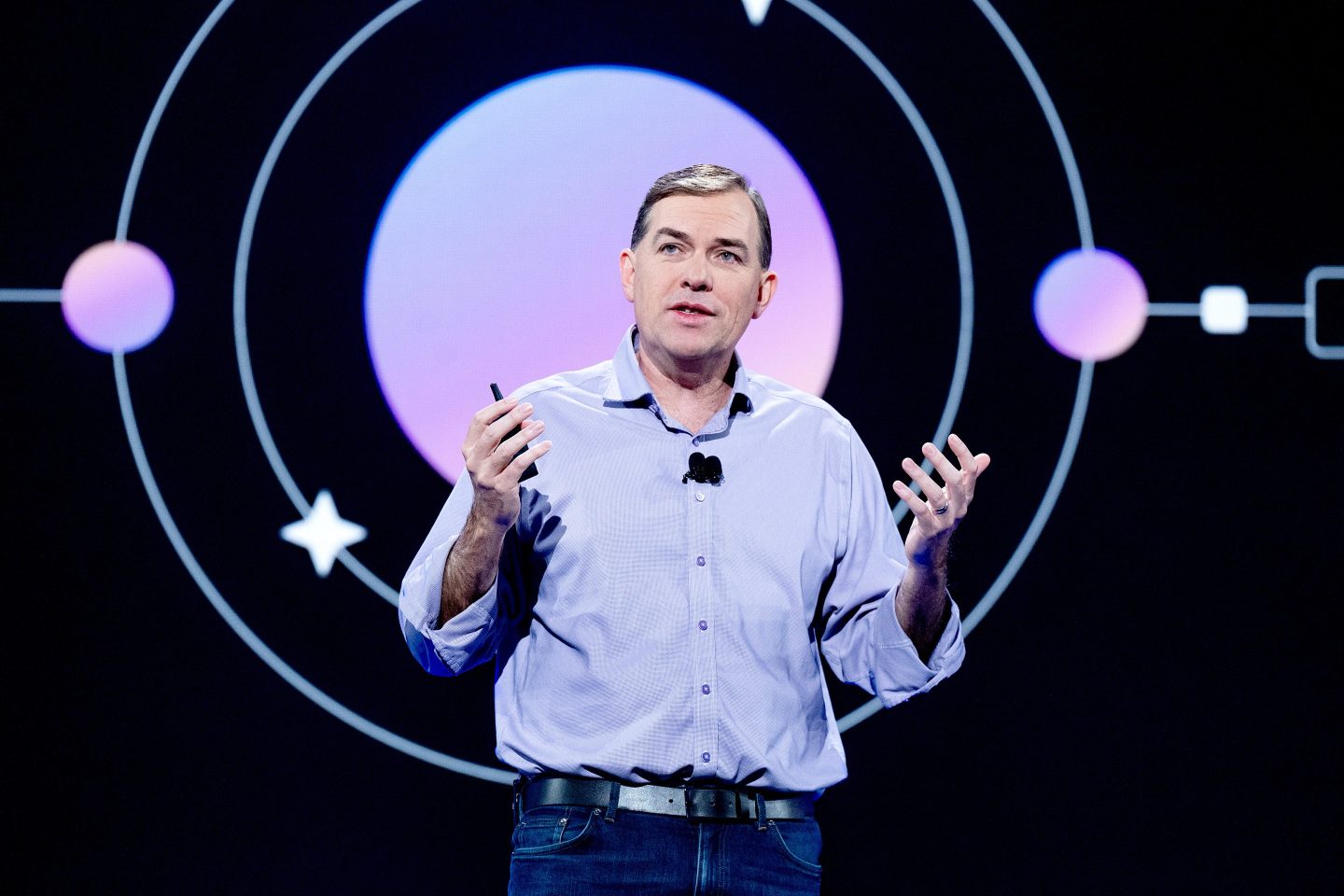
As Microsoft’s chief technology officer, Kevin Scott has the challenging job of keeping his company atop all of the tech trends.
Scott became Microsoft’s CTO two years ago after six years directing software engineering at LinkedIn, which Microsoft bought in 2016 for $26 billion. One of his first jobs at Microsoft was to identify all the technologies used by the company’s sprawling business units—to gauge their usefulness—and then make sure that the popular ones were available to every division.
The exercise reflects the philosophy of Microsoft CEO Satya Nadella, Scott says. Nadella not only spends a lot of time thinking about what to do, but also “what are we not doing that we���re going to regret.”
Microsoft missed out on a few tech revolutions, in particular the rise of smartphones, which rivals Apple and Google ended up capitalizing on. Nadella wants Scott to make sure that nothing similar happens again.
In this edited interview with Fortune, Scott talks about artificial intelligence, Microsoft’s continued push into mixed reality [Microsoft lingo for both virtual and augmented reality tech], and the challenges of deep learning.
Fortune: How do you distinguish Microsoft’s AI from other companies?
Kevin Scott: We’re a platform company by DNA. If you listen to how Bill Gates has always defined what a platform company is, it’s one that builds technology that creates all of this opportunity in which you don’t have all of the economic value concentrated in one company. We’re increasing the overall size of the pie. The PC, for instance, created an enormous economic opportunity. We see AI as essentially the same thing.
When I think of platforms, I think of things like Windows, which other companies can build apps on top of. Is this how you see AI?
The thing that we’re pushing hard on is that a lot of AI right now is still unnecessarily difficult for many people to get up to speed on. There are maybe in the high tens of thousands of developers out there who are hardcore machine learning/data science folks. Almost every customer we interact with is thinking about using AI to help its business run better. And you can’t expect each and every one of them to hire a bunch of Ph.Ds and machine learning engineers. At the rate AI is unfolding, not enough of those people exist.
One of our challenges is to build technologies that lower the barriers to entry so a much larger pool of developers can use machine learning in their products and services. Microsoft itself is a microcosm for this because we have about 55,000 developers in the company and not all of them are machine learning/data science experts.
I imagine it’s a challenge for companies exploring the AI technique of deep learning to get used to the idea that a lot of their experiments will fail.
It’s incumbent upon us as platform providers to give people better tools—to guide you in better ways toward paths that get you to success.
I think you do have to expect some of this stuff not to work. You have to get into it with this experimental mindset. It’s not like you’re proving a theorem and you walk through the steps and it’s done and predictable. It’s more like lab science.
The most technologically-savvy companies are used to this trial-and-error process. We just know through our own efforts that the first thing is not going to work, and you have to push and push. When you get the win, it totally covers all of the costs of the experimentation.
What’s your background in AI?
I’m writing a book on AI right now. It’s about why we should be optimistic about a future that includes AI. The contrarian thing is that I think it’s net beneficial even to people in rural parts of the country.
I was a poor kid from rural central Virginia—Campbell County, a little town called Gladys. I went back there a year ago for the book. All the industry there evaporated years ago. Tobacco, textiles, furniture manufacturing all went poof. But some interesting things are emerging there now, some of which is powered by AI and advanced automation.
What’s going on in Gladys?
I went to school with people whose families’ have been tobacco farmers for five generations. Their business basically went sideways when the tobacco markets collapsed, and they had to figure out what to do. They were fairly entrepreneurial and they knew technology would play a role in what they were doing.
All the land that they used to plant tobacco on is sod now, and the unit economics is about as good as tobacco. Part of the reason is that they use a bunch of advanced automation—tractors, and fairly sophisticated technology to let them grow sod on these very large tracks of land. It’s more labor intensive than tobacco was, but with the technology they have about the same number of employees. So technology hasn’t reduced jobs.
On the horizon are things like drones that can fly over crops to do aerial inspections. It’s not that you don’t need a human being, but you can fly over it more frequently and get more data about what’s going on in your field so you can better adjust fertilizers and water.
Because of the technology, you don’t need a giant factory with thousands of people in order to just get your unit economics right. You can start a business and have 30 people working in this place and have that 30-person business in Campbell County, Va. be a global business. Some people believe you won’t have jobs coming back where there are 100 companies with 10,000 jobs a piece, but you’ll have 100,000 companies with 100 higher-skilled jobs each.
Will those jobs pay more?
Yeah. I know for sure.
Some people are concerned that while automation will make companies more efficient, only management will benefit and not the workers.
I think both can happen and I think we should be cautious. What I’ve seen working on this book and talking with customers the size of Walmart all the way down to small and medium sized businesses is that there’s lots of things to be hopeful about.
Virtual reality and augmented reality seemed really big three years ago, and now many venture capital investors aren’t as focused on it because they couldn’t get returns fast enough. How do you plan for and adjust when a technology hasn’t caught on as fast as hoped?
Part of my job is making sure that we maintain our focus and our commitment to some of these investments over long periods. The thing I can say is we have not reduced our investments in mixed reality [Microsoft makes the HoloLens augmented reality headset]. If anything, we increased things—not dramatically up, but it’s growing.
If you’re thinking of yourself as a platform company, you have to be thinking about what the future platforms are going to be. We have three things that we believe are going to be important platforms that are in different stages of development.
Get Data Sheet, Fortune’s technology newsletter.
One is quantum computing, which at some point is going to be very important. There’s mixed reality, which we think is probably in a shorter time horizon is going to be a very important platform. And on a shorter time horizon than that, this notion of an intelligent edge, which you can think of as a mashup of IOT [Internet-connected devices], sensors, and AI.
We believe all three of those will be extremely important platforms in the future. And to make a global scale platform work, you have to invest and believe it’s real. It’s a question of when and not if.