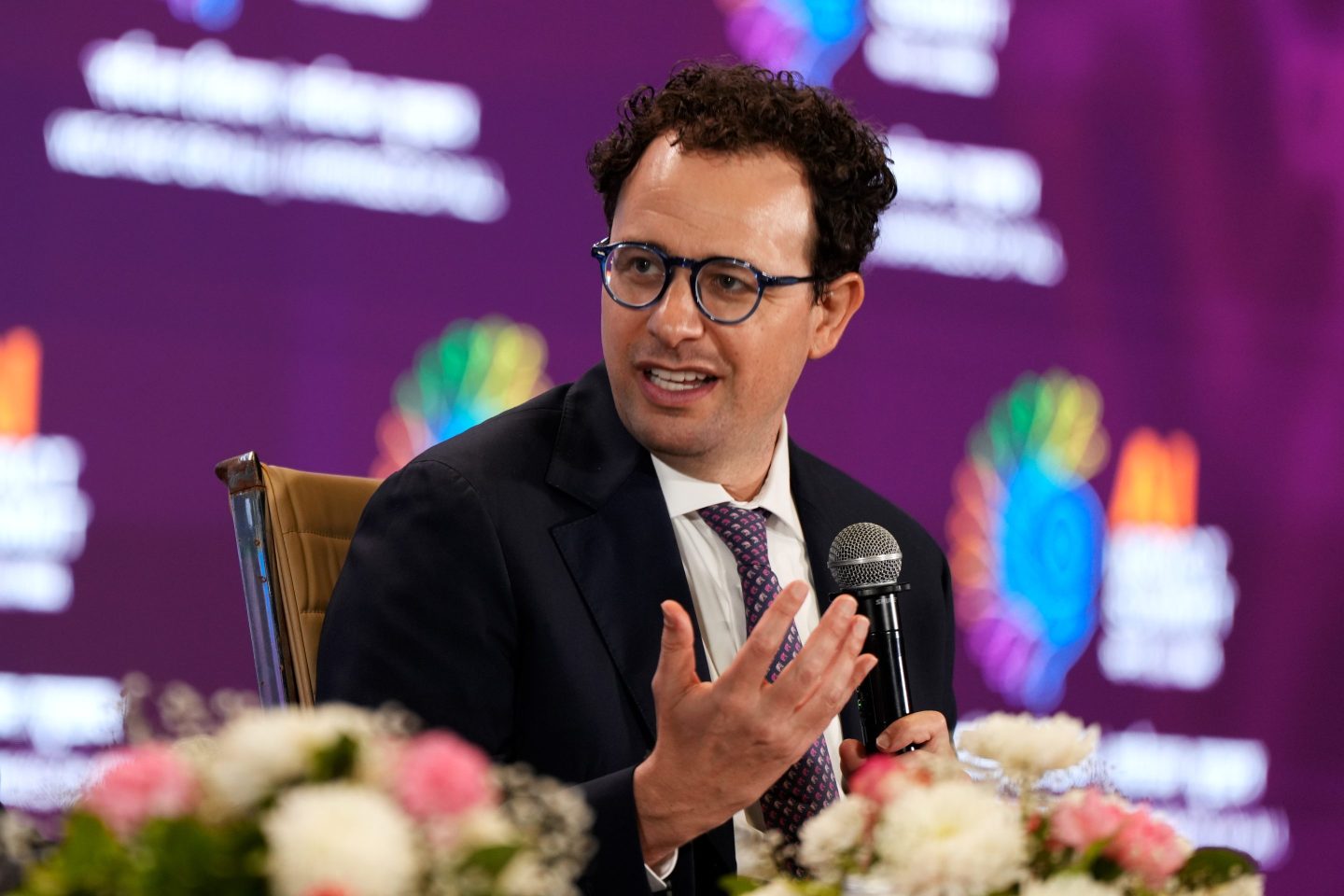
Microsoft CEO Satya Nadella is trying to distinguish the business technology giant from its technology brethren by focusing on digital privacy.
That’s one of the takeaways from Nadella’s opening talk on Monday from Microsoft’s annual Build conference for developers in Seattle, Wash. This year, Microsoft’s big coder conference was sandwiched between Facebook’s annual F8 developer conference last week and Google’s upcoming Google I/0 event, starting later this week.
Part of Nadella’s opening talk centered on user privacy, which Nadella referred to as “a human right,” echoing Apple CEO Tim Cook’s recent public comments in the aftermath of Facebook’s Cambridge Analytica scandal. Both Microsoft and Apple (AAPL) stand to benefit and win public trust if they can portray their companies as bastions of user privacy compared to companies like Facebook (FB) and Google (GOOG).
All of these giant tech companies are amassing large quantities of data that they in turn use to improve their respective artificial intelligence technologies—these AI technologies are then used to create more compelling products, like Amazon’s Alexa digital assistant, for example. But the controversy over political consulting firm Cambridge Analytica improperly obtaining Facebook user data highlights the issues these tech companies face as they must both protect the consumer and business data they collect while using that same information to improve their own services.
One way Nadella is attempting to convince businesses that Microsoft (MSFT) can improve its AI technology while protecting user data is by promoting a computing technique called homomorphic encryption. Although still a research-heavy technique, homomorphic encryption would presumably let companies analyze and crunch encrypted data without needing to unscramble that information.
Nadella is pitching the technique as a way for companies to “learn, train on encrypted data.” The executive didn’t explain how far along Microsoft is on advancing the encryption technique, but the fact that he mentioned the wonky terms shows that the company is touting user privacy as a selling point for its Azure cloud business.
Here’s a few more takeaways from Nadella’s talk:
Microsoft likes Drones and Chips
The business technology giant signed a partnership with Chinese drone-giant DJI and mobile computing giant Qualcomm.
Under the drone partnership, DJI will use the Azure cloud computing service as a “preferred cloud provider” (it can still choose competing cloud companies like Google, example), and will create a software development kit that works with Windows 10. The goal is for coders to build Windows apps that can be used during corporate drone projects, like using the robots to take pictures of rooftops for damage inspections. So the next time a company flies a drone out to look at a rooftop, the drone can take video and send it back to the laptop for someone to analyze.
Microsoft also partnered with Qualcomm (QCOM) on a new software developer kit to let coders build devices like cameras that can recognize objects. This initiative seems similar to Amazon’s (AMZN) DeepLens camera technology.
Microsoft Believes in AI and Ethics
Nadella briefly mentioned the company’s internal AI ethics team whose job is to ensure that the company’s foray into cutting-edge techniques like deep learning don’t unintentionally perpetuate societal biases in their products, among other tasks.
He said that coders need to concentrate on building products that use “good A.I.,” in which the “the choices we make can be good choices for the future.”
Expect more technology companies to talk about AI and ethics as a way to alleviate concerns from the public about the tech industry’s insatiable appetite for data.
He also talked about Microsoft’s Project Brainwave computer chip initiative that is now available for Azure coders in a test or preview version. Nadella pitched Project Brainwave as a way for developers to perform AI tasks quicker by using the company’s specialized chips (FPGAs) built by Intel. He bragged about Microsoft’s specialized chips when compared to Google’s own custom chips (TPUs), saying that they were faster at some tasks, a claim the search giant would likely differ on.
Project Brainwave is getting much more interesting. "5X lower hardware latency than (@Google) TPU". Will have to dig in on that claim. Also now moves to the edge. #MSBuild pic.twitter.com/gUwV7Yfy1a
— Patrick Moorhead (@PatrickMoorhead) May 7, 2018
The Kinect is Back
Microsoft may have killed its Xbox Kinect video game sensor in 2017, but the body-tracking device has since been reborn as a business tool.
Nadella talked about Microsoft’s Project Kinect for Azure, and said that the new hardware device has “some of the best skeletal tracking object recognition,” which could make it useful as a tool to incorporate on drones so they can avoid obstacles. The new Kinect won’t be sold to consumers, but developers can sign on to receive a Kinect hardware kit that they can use to build their own tracking devices.
Get Data Sheet, Fortune’s technology newsletter.
Microsoft Pledged $25 Million to AI for Accessibility Grants
Nadella ended his talk by saying that Microsoft will debut a five-year program in which the company will give $25 million worth in grants to researchers, non-government organizations, and developers so they can build AI-powered apps to help the lives of the disabled. These types of apps would do feats like look at the image of a signpost, and then say what the signpost means out loud to a person with hearing disabilities.
The purpose of the grants is “so you can bring your ingenuity and passion to help the 1 billion-plus people in the world who have disabilities,” Nadella said.