We often hear that nice guys finish last, or at least that it takes a degree of ruthlessness to make it in corporate America. But a new analysis of the data shows that it might actually be the nice bosses who propel their companies to the greatest heights.
The latest edition of the annual Fortune 100 Best Companies to Work For list shows that it’s the companies that employees say are great workplaces that demonstrate stronger financial performance, reduced turnover, and better customer and patient satisfaction than their peers. The annual ranking, produced in collaboration with research and consulting firm Great Place to Work, is based on the most extensive employee survey in corporate America. Anonymous input from 315,000 employees on leader quality, support for professional and personal lives and colleague relationships comprise a Trust Index to compare organizations against peers. The companies that make the list are known for their employee satisfaction but, importantly, generate strong business performance year after year.
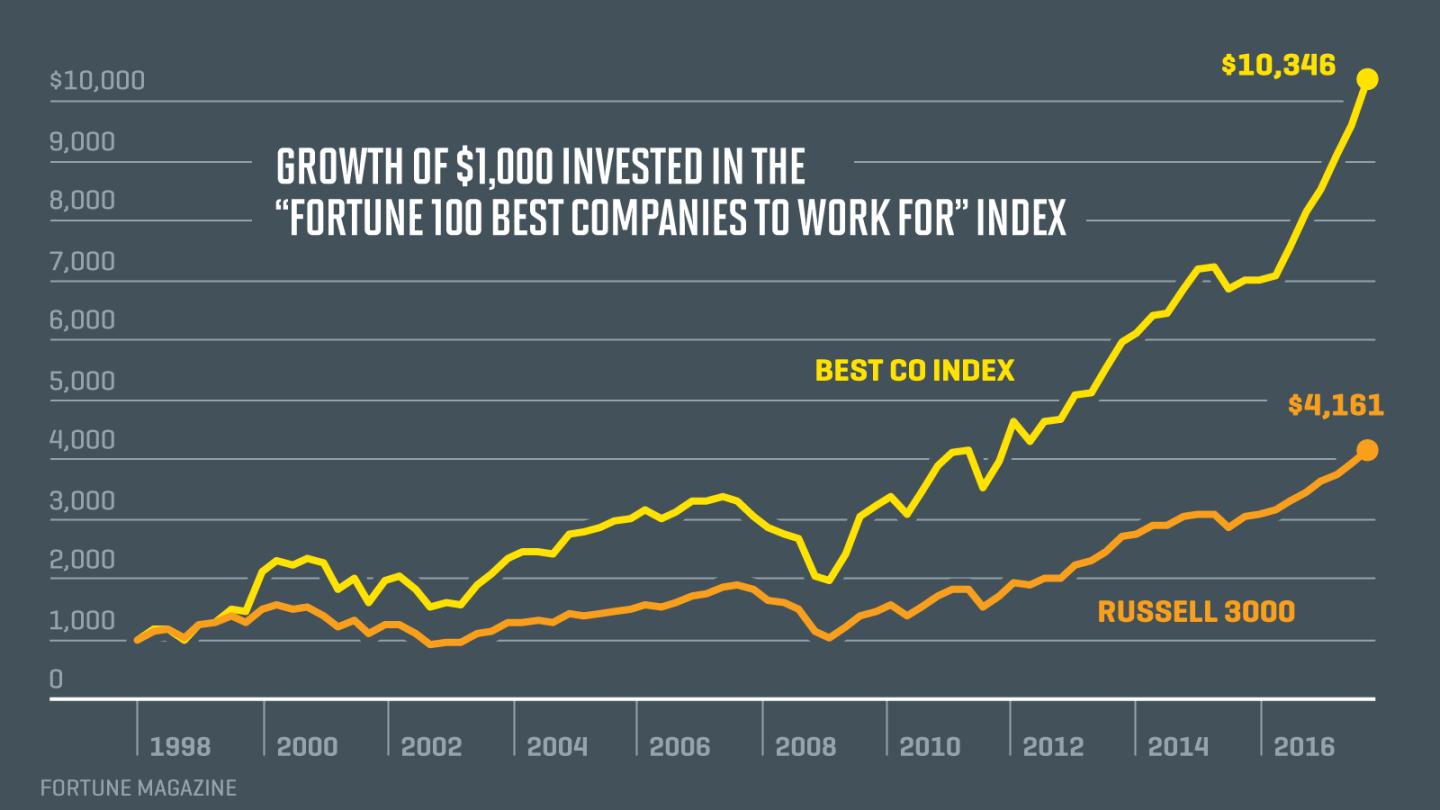
The outperformance is notable. Global index provider FTSE Russell—which annually analyzes the Fortune 100 Best Companies to Work For list—this year found that an equally-weighted index of the publicly-traded companies among the 100 best returned 11.66% annually from 1998 through the end of 2016, nearly 5% more than the equivalent returns for the benchmark US all-cap Russell 3000 Index (6.72%) and US large cap Russell 1000 Index (6.68%). How can an index outperform the market by 5% annually over nearly 20 years? We believe this can be attributed to art and science.
First, the art. A wide body of research and evidence supports the fact that engaged employees make for happy and successful companies. Caring and high-trust company cultures with a sense of purpose and clarity are consistently associated with strong revenue and stock performance. In their forthcoming book, A Great Place to Work For All, CEO Michael C. Bush and the research team of Great Place to Work argue that leading companies are racing ahead because they bring out the best in every employee, regardless of who they are or what they do for the organization. “Business success relies on developing all your human potential,” Bush and his co-authors write. “Every employee matters in an economy that is about connectivity, innovation, and human qualities like passion, character, and collaboration.”
Great Place to Work’s new methodology—baked into the rankings for this year’s Fortune 100 Best Companies to Work For list—rewards companies that create a consistently great culture across demographic groups and job levels. Bush and crew also have documented business advantages such as revenue outperformance for these new “Great Place to Work For All.” The way the 2017 Best Companies to Work For tap everyone’s potential may explain the bump in stock performance this past year.
The idea that “when companies take care of employees, employees take care of the business” isn’t new and may seem obvious to some. But as the Fortune 100 Best Companies to Work For show, it can play a critical role in performance. Don’t underestimate the power of culture.
Next, the science. When FTSE Russell creates its index of the publicly traded Fortune 100 Best Companies to Work For, it has a stellar crop of companies to measure. And the 100 Best Index, a hypothetical index created by FTSE Russell specifically for Fortune and Great Place to Work, is updated each year based on last year’s winners, ensuring it is continually refreshed with strong companies. Yet FTSE Russell takes its analysis a step further by equal weighting and quarterly rebalancing this hypothetical portfolio. Through equal weighting, all constituents are assigned the same index weight, regardless of market capitalization, to ensure that the largest companies don’t have an outsized impact on index performance. Quarterly rebalancing is a way to systematically re-weight the index to adjust for market performance.
Equal weighting with systematic rebalancing has historically delivered strong relative returns over time. In fact, when FTSE Russell performed an attribution analysis with the 100 Best Companies to Work For Index to determine the source of excess return over the broad market, 80% was due to the selection of the 100 Best companies but an additional 20% can be attributed to the equal weighting and quarterly rebalancing methodology of the index.
Investors can benefit from this simple formula. Bring together the art of recognizing cultures that are great for all their people, as well as the science of smart portfolio construction.

Catherine Yoshimoto is Senior Product Manager at global index provider FTSE Russell. Ed Frauenheim is Director of Research and Content at Great Place to Work, FORTUNE’s longtime research partner for the 100 Best Companies to Work For list. Ed also is co-author of the forthcoming book, A Great Place to Work For All.
©2018 London Stock Exchange Group plc. All information is provided for information purposes only. Every effort is made to ensure that all information given in this publication is accurate, but no responsibility or liability can be accepted by any member of the LSE Group nor their respective directors, officers, employees, partners or licensors for any errors or for any loss from use of this publication or any of the information or data contained herein. Past performance is no guarantee of future results. Charts and graphs are provided for illustrative purposes only. Index returns shown may not represent the results of the actual trading of investable assets. Certain returns shown may reflect back-tested performance. Any forward-looking statements speak only as of the date they are made and no member of the LSE Group nor their licensors assume any duty to and do not undertake to update forward-looking statements.