• Home
  • News
  • Fortune 500
  • Tech
  • Finance
  • Leadership
  • Lifestyle
  • Rankings
  • Multimedia
FinanceEconomy

One Way the Trump Economy Already Looks Like the Great Recession

By
Annalyn Kurtz
Annalyn Kurtz
Down Arrow Button Icon
By
Annalyn Kurtz
Annalyn Kurtz
Down Arrow Button Icon
March 23, 2017, 12:41 PM ET

An important indicator of the economy is now flashing, “Warning ahead.”

So-called “soft data” like surveys of consumers, small businesses, and homebuilders have pointed to a sugar-rush in optimism about the U.S. economy lately. Nonetheless, a measure of ability and willingness from businesses to borrow is telling a less cheerful story.

There’s been a sudden slowdown in new credit extended to businesses over the last year, one that strategists at UBS are calling “drastic” and “highly uncommon outside of economic downturns.”

The Swiss bank’s credit strategist Stephen Caprio and economist Robert Sockin looked at both business loans from banks, as well as corporate bonds, and found that both sources of credit are decelerating. As you can see from their chart below, the last two times this happened, it coincided with the dot-com bust and the Great Recession.

Commercial and industrial loans issued by U.S. banks grew by an average of 9.5% a year between 2012 and 2016. That, though, has suddenly slowed to just a 1.1% annualized growth rate from November to mid-March.

(Related: The Market You Really Should Be Watching Is Losing Faith In the Trump Bump)

What’s more, businesses don’t appear to be increasingly turning to the corporate bond market for their funding instead. When Caprio and Sockin exclude bond issuance that’s earmarked for refinancing, they find that new lending through the non-bank corporate bond market is decelerating at nearly the same rate as bank loans to businesses.

Why do we care? Well, when credit to businesses slows, it may signal one of two things: either banks are tightening their standards, for example by rejecting loan applications from riskier borrowers, or there’s simply less demand for loans. Neither is a good sign for where the economy is headed, likely signaling that firms will be less willing to invest in capital improvements like buying new machines or upgrading their technology.

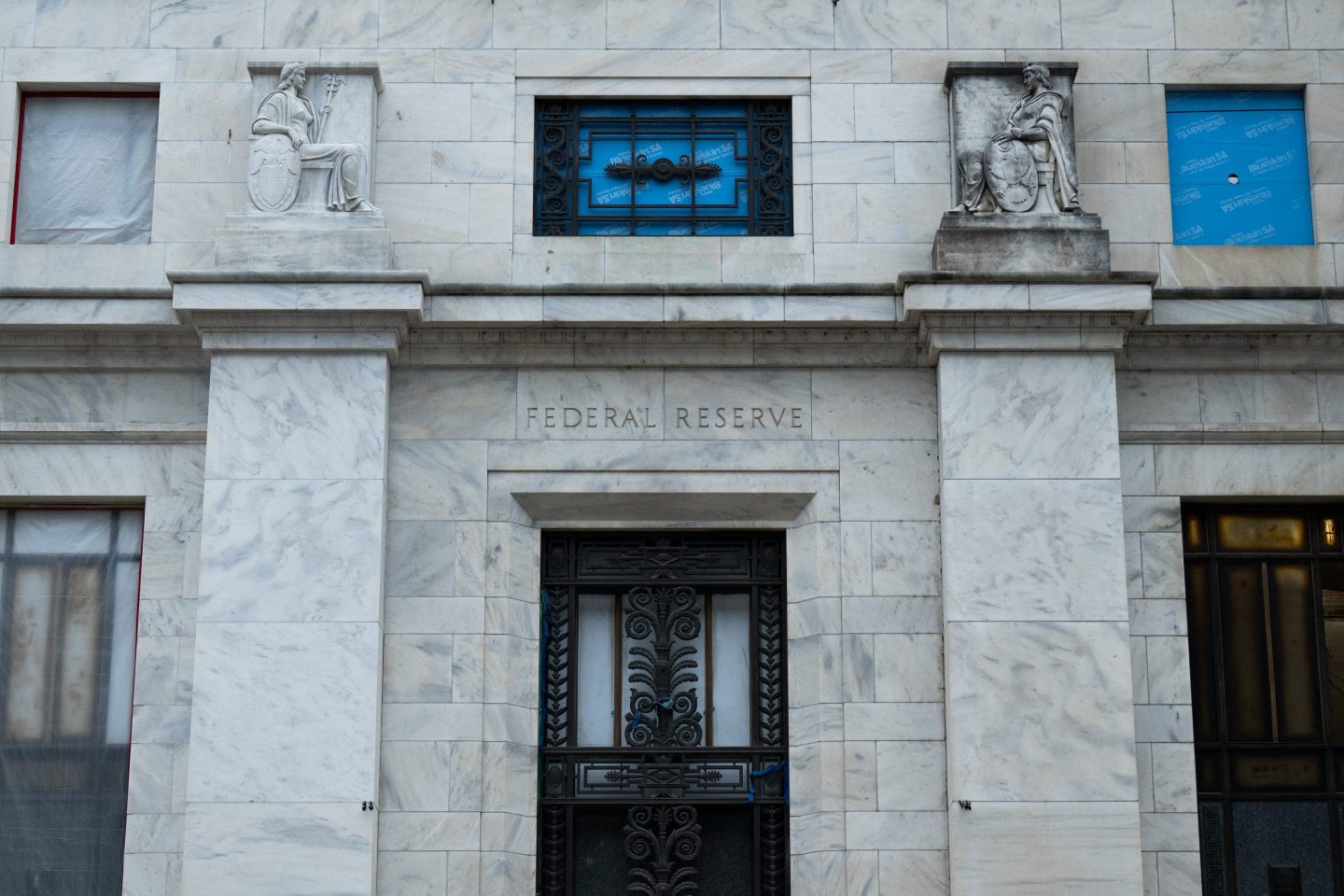
So what’s happening here? Well, the first theory—that banks are tightening credit standards for businesses—doesn’t hold. Bank loan officers surveyed by the Federal Reserve report that they largely left their standards unchanged at the end of 2016, and they intend to ease those standards in 2017.

The UBS team dug into the data further and are convinced the trend instead is being driven by weaker demand from businesses. They identify three key reasons this trend is happening.

First, political uncertainty may be leading business leaders to put new investments on hold. Second, firms are already highly leveraged. Third, rising interest rates, driven by the Federal Reserve, are making it more expensive to borrow.

Political uncertainty is perhaps the biggest driver, Caprio says. Although business leaders may welcome President Trump’s proposals to repeal Obamacare, reform the tax code, and invest in infrastructure, they’re still in a wait-and-see mode. Why start a large investment or project, if you don’t yet have much clarity on whether these policies can actually pass through Congress?

“The underlying animal spirits are still there,” says Caprio, who believes that political clarity today would lead to a pick up in credit demand. “On the other hand, the longer that we have political uncertainty, the more likely the data are going to disappoint.”

Today’s vote in the House of Representatives on the Republican health care bill is one of several pivotal moments that could fuel more uncertainty for businesses.

If the bill fails, Caprio says that could lead to what economists call a “negative feedback loop.”

As stocks fall, recent optimism in the various confidence surveys is likely to also become more subdued, leading to perhaps more economic uncertainty and as a result, more businesses putting more investments on hold. The cycle goes on. It’s Trump slump all the way down.
About the Author
By Annalyn Kurtz
See full bioRight Arrow Button Icon

Latest in Finance

MagazineMarkets
Why an AI bubble could mean chaos for stock markets—and how smart investors are protecting their portfolios
By Alyson ShontellDecember 3, 2025
10 minutes ago
SuccessThe Promotion Playbook
L’Oreal CHRO cut her teeth at luxury brands Chanel and Kiehl’s—like Walmart’s CEO she says the secret to her success was always saying yes
By Orianna Rosa RoyleDecember 3, 2025
30 minutes ago
Personal Financegold prices
Current price of gold as of December 3, 2025
By Danny BakstDecember 3, 2025
47 minutes ago
Rochelle Witharana is Chief Financial and Investment Officer for The California Wellness Foundation
Commentarydiversity and inclusion
Fund managers from diverse backgrounds are delivering standout returns and the smart money is slowly starting to pay attention
By Rochelle WitharanaDecember 3, 2025
1 hour ago
The Boeing logo is displayed on a sign at their building.
NewslettersCFO Daily
Boeing’s new CFO sees ‘performance culture’ driving a return to positive cash flow next year
By Sheryl EstradaDecember 3, 2025
1 hour ago
Price of silver for December 3, 2025
Personal Financesilver
Current price of silver as of Wednesday, December 3, 2025
By Joseph HostetlerDecember 3, 2025
1 hour ago

Most Popular

placeholder alt text
Economy
Ford workers told their CEO 'none of the young people want to work here.' So Jim Farley took a page out of the founder's playbook
By Sasha RogelbergNovember 28, 2025
5 days ago
placeholder alt text
North America
Jeff Bezos and Lauren Sánchez Bezos commit $102.5 million to organizations combating homelessness across the U.S.: ‘This is just the beginning’
By Sydney LakeDecember 2, 2025
24 hours ago
placeholder alt text
Success
Warren Buffett used to give his family $10,000 each at Christmas—but when he saw how fast they were spending it, he started buying them shares instead
By Eleanor PringleDecember 2, 2025
1 day ago
placeholder alt text
Economy
Elon Musk says he warned Trump against tariffs, which U.S. manufacturers blame for a turn to more offshoring and diminishing American factory jobs
By Sasha RogelbergDecember 2, 2025
22 hours ago
placeholder alt text
C-Suite
MacKenzie Scott's $19 billion donations have turned philanthropy on its head—why her style of giving actually works
By Sydney LakeDecember 2, 2025
1 day ago
placeholder alt text
North America
Anonymous $50 million donation helps cover the next 50 years of tuition for medical lab science students at University of Washington
By The Associated PressDecember 2, 2025
1 day ago
Rankings
  • 100 Best Companies
  • Fortune 500
  • Global 500
  • Fortune 500 Europe
  • Most Powerful Women
  • Future 50
  • World’s Most Admired Companies
  • See All Rankings
Sections
  • Finance
  • Leadership
  • Success
  • Tech
  • Asia
  • Europe
  • Environment
  • Fortune Crypto
  • Health
  • Retail
  • Lifestyle
  • Politics
  • Newsletters
  • Magazine
  • Features
  • Commentary
  • Mpw
  • CEO Initiative
  • Conferences
  • Personal Finance
  • Education
Customer Support
  • Frequently Asked Questions
  • Customer Service Portal
  • Privacy Policy
  • Terms Of Use
  • Single Issues For Purchase
  • International Print
Commercial Services
  • Advertising
  • Fortune Brand Studio
  • Fortune Analytics
  • Fortune Conferences
  • Business Development
About Us
  • About Us
  • Editorial Calendar
  • Press Center
  • Work At Fortune
  • Diversity And Inclusion
  • Terms And Conditions
  • Site Map

© 2025 Fortune Media IP Limited. All Rights Reserved. Use of this site constitutes acceptance of our Terms of Use and Privacy Policy | CA Notice at Collection and Privacy Notice | Do Not Sell/Share My Personal Information
FORTUNE is a trademark of Fortune Media IP Limited, registered in the U.S. and other countries. FORTUNE may receive compensation for some links to products and services on this website. Offers may be subject to change without notice.