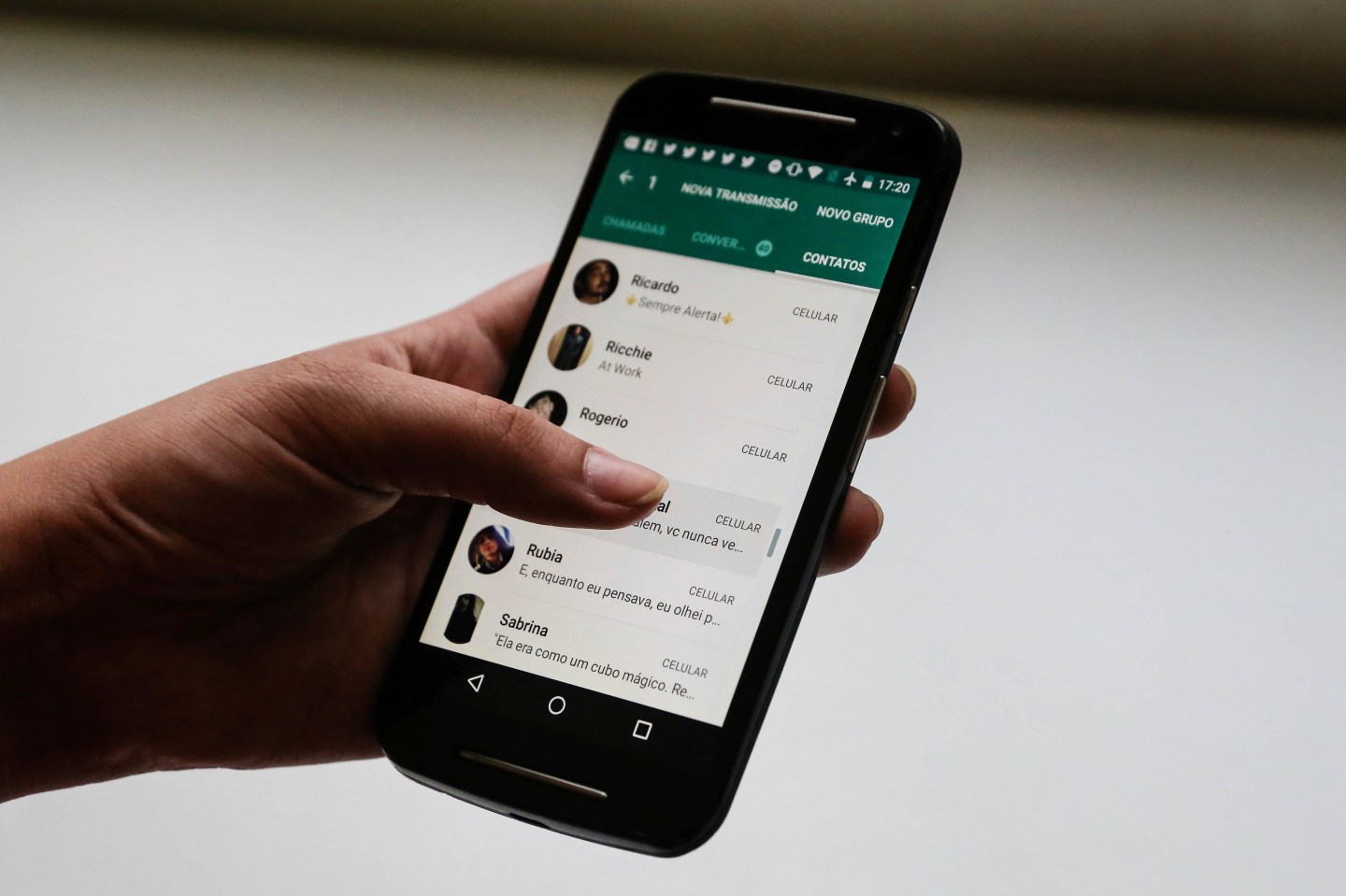
When messaging service WhatsApp announced in April that it would adopt end-to-end encryption, it rankled law-enforcement agencies worldwide (Brazilian officials briefly shut down the Facebook-owned (FB) app on two separate occasions this year). But the move may have also opened the door to better health care. Nearly nine out of 10 doctors in Brazil communicate with patients using WhatsApp, Cello Health Insight says, in part because of its strong privacy controls. And the app played a key role in tracking the country’s Zika virus outbreak, as doctors used it to share symptoms they were seeing as well as babies’ CT scans.
So far, U.S. doctors’ uptake has been slower—just 4% use it with patients, according to the Cello survey—mostly out of concerns about violating health information privacy regulations known as HIPAA (which stands for the Health Insurance Portability and Accountability Act). But as the company flaunts its commitment to encryption, that could change.

While WhatsApp doesn’t market itself specifically for health care, it’s just as HIPAA-compliant as other doctor-specific apps—if not more so—if used properly, says Katie Kenney, an attorney for Polsinelli specializing in health data privacy. WhatsApp is just one of 132 companies offering secure messaging, many of which declare themselves HIPAA-compliant but actually aren’t, according to Extension Healthcare, which makes communication technology for hospitals. “The distinguishing factor” with WhatsApp, says Kenney, is its end-to-end encryption—preventing messages containing personal health information from being intercepted or exposed (even WhatsApp itself can’t see them). “It’s about one of the best safeguards you can have in place,” she says.
For more on WhatsApp, watch this Fortune video:
However, there’s no official “HIPAA-compliant” sticker that can be slapped on apps. Rather, compliance is a “constant process of making sure that [data] is secure,” often depending less on the technology itself than on whether physicians using it are taking required precautions, says Kenney. For example, doctors would need to protect the electronic device itself (such as by using a password lock) and establish an authentication system to verify the person they are messaging is actually the right patient before sending any sensitive data (such as by asking patients to sign a form indicating the phone number attached to their WhatsApp account). “You can’t just say ‘I’m HIPAA-compliant’ because it’s just a lot of steps,” Kenney says. “You could be HIPAA-compliant one day and not the next.”
Already, there are signs of pent-up demand among doctors for a safe, efficient way to monitor and treat patients remotely, and health systems are eagerly eyeing WhatsApp and its health-focused competitors as a potential solution. The American health care system continues to shift towards compensating doctors for keeping patients healthier overall, rather than paying them per appointment and how many tests they order. That makes messaging increasingly attractive to physicians, enabling them to instantly reach and advise more patients all while on-the-go in a busy day—without worrying whether they’re getting paid for their time.
“Text messaging on any platform is preferred for its ease, asynchronous exchange and mobility,” says Sameer Badlani, chief health information officer for Sutter Health, whose network of 5000 doctors cares for more than three million patients per year. “It is one of the disruptive technologies that allows us to think of access to care in a new paradigm.” Physicians are already using WhatsApp and Apple’s iPhone texting app iMessage to talk to patients and each other, he says, which “often leads to a significant reduction in delays in care delivery.”
Read More: Supreme Court Gives WhatsApp Back to Millions of Brazilians
Though WhatsApp’s encryption is a huge benefit in the medical world (for one thing, a hospital wouldn’t have to report it as a data breach if a doctor forgot his or her phone on a train), not everyone is convinced U.S. doctors will flock to it. Barry Chaiken, president of DocsNetwork and an expert in public health and data management, says there are questions over how a WhatsApp exchange would be documented with the rest of a patient’s electronic medical record, and if the conversation would be admissible during a malpractice lawsuit. And there is still uncertainty about which messaging apps are kosher under privacy laws (the Health and Human Services department’s Office for Civil Rights, which regulates HIPAA, is developing guidance on text messages in response to questions).
But once doctors get more comfortable with encrypted texting, WhatsApp also offers another big advantage over the many healthcare-focused apps: Its price of $0. Todd Plesko, CEO of Extension Healthcare, thinks only a handful of the 132 secure messaging apps will be left standing in a few years. “If WhatsApp ever decided to say, ‘We offer a HIPAA-compliant module,’ that would expedite those other companies going out of business,” he says. “That would be a seismic shift in our industry.” WhatsApp wouldn’t comment on whether it plans to market itself that way in the future (and given the complexity of HIPAA compliance, lawyers say it might be smarter not to). But WhatsApp-ing your doctor would sure beat sitting around in the waiting room.
Read More: This WhatsApp Competitor in India Is Now Valued at Nearly $1.4 Billion
A version of this article appears in the September 1, 2016 issue of Fortune with the headline “The Doctor Will Instant Message You Now.”