• Home
  • Latest
  • Fortune 500
  • Finance
  • Tech
  • Leadership
  • Lifestyle
  • Rankings
  • Multimedia
Finance

When Donald Trump Got in Trouble with the SEC

Shawn Tully
By
Shawn Tully
Shawn Tully
Senior Editor-at-Large
Down Arrow Button Icon
Shawn Tully
By
Shawn Tully
Shawn Tully
Senior Editor-at-Large
Down Arrow Button Icon
March 14, 2016, 4:11 PM ET
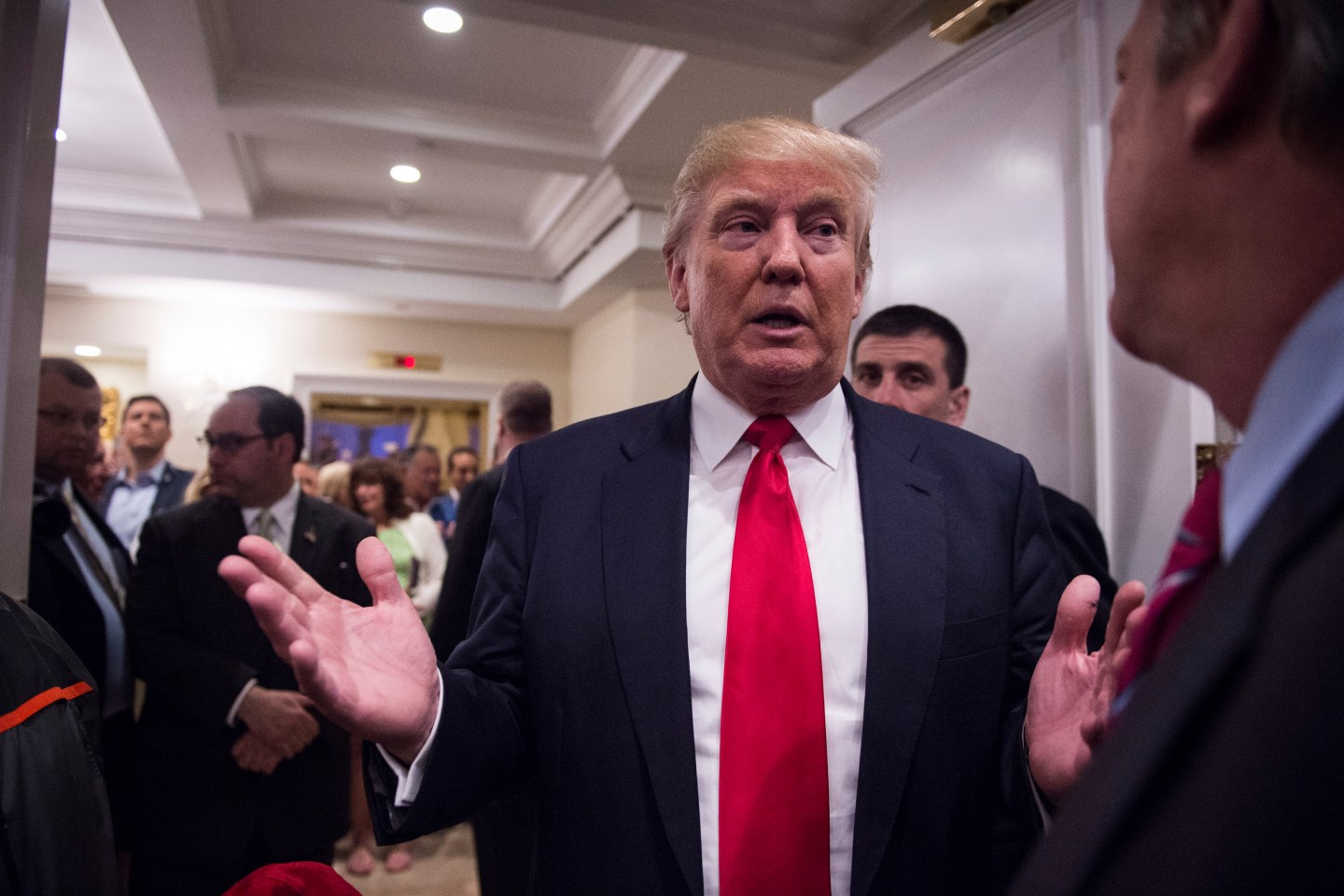
Donald Trump in Jupiter, Florida.
Photograph by The Washington Post/Getty Images

These days the charade of company-doctored earnings is getting increasing attention. But it’s important to recall that the first enterprise the Securities and Exchange Commission charged for this practice of rampantly spinning its results was an Atlantic City casino empire. Its founder, chairman, and promoter-in-chief at the time: None other than current GOP frontrunner Donald J. Trump.

Also notable: Trump settled the case with the SEC, rather than fight the charges—something that Trump recently has said he never does.

In the accounting world, few practices are attracting more widespread condemnation these days than the abuse of “pro-forma” or “adjusted earnings.” In his annual letter to shareholders, Warren Buffett once again assaulted “misleading numbers that can deceive investors,” endorsed by “Wall Street analysts parroting phony…’earnings’ figures fed to them by managements.” The Berkshire Hathaway (BRK-A) CEO argues that companies frequently use pro-forma reporting to choose the numbers that make them look good, and leave out the rest. Critics have roundly vilified Valeant Pharmaceuticals (VRX) for telling investors that what matters most are results that ignore such real, routine, and recurring costs as stock options and acquisitions expenses. After years in Valeant’s thrall, investors are no longer buying the doctored rap. Since last July, its shares have dropped 74%, erasing almost $70 billion in market value.

In June of 2002, when the SEC brought the landmark action against Trump Hotels and Casino Resorts, the agency said it pursued the Trump case—its first for this type of abuse—because it provided a “stark illustration of how pro-forma numbers can be used deceptively and the mischief they can cause.” The agency accused Trump Hotels of using “fraudulent” reporting used to “tout purportedly positive results.”

Prompting the SEC’s pioneering foray was a Trump Hotels press release from October of 1999. It appeared to announce a big improvement in Trump Hotels’ earnings. According to the release, the casino operator had $403 million in revenues and $14 million in net income in the third quarter of 1999, improvements over sales of $397 million and profits of $5.3 million for the same period in 1998. The release then boasts that its earnings per share of $0.63 handily bested analysts’ estimates of $0.54. The numbers, Trump’s press release said, demonstrated substantial progress towards making its money-losing operations profitable.

Those numbers however were inflated. Had Trump had correctly reported the company’s true results, it would been hard to find improvements.

The release didn’t use the words “pro-forma” or “adjusted.” It did mention that the results excluded an $81 million charge for shuttering the antiquated Trump World’s Fair hotel and casino. Leaving that out didn’t pose a problem, since it was a genuine, one-time expense.

Trump Hotels, however, in the numbers that they reported also included a thoroughly extraordinary item in an attempt to spin its lagging performance. Unmentioned in the release was that its revenues included an extra $17.2 million gain from the termination of a lease on the All Star Café, run by Planet Hollywood, an eatery in Trump’s Taj Mahal casino. Hence, Trump Hotels was both subtracting a giant one-time expense and adding a big non-recurring gain to arrive at a phantom number. The SEC found that correct pro-forma reporting means dropping all extraordinary items rather than erasing the ones with a negative sign and adding the big pluses.


In other words, Trump Hotels was creating its own parallel accounting universe.

At first, investors bought the story, even though the release showed revenues gaining only 2.9% over the past twelve months, but its profits jumping 164%. The day of the announcement, Trump Hotels shares rose 7.8% to $4.31. That was before analysts began digging into the results, and were rightly mystified by the pro-forma rendering.

Within three days, Deutsche Bank and Bear Stearns issued reports stating that Trump management was acknowledging that the big “improvements” were really the result of the one-time gain of $17.2 million. When that item was excluded, it emerged that revenues dropped 2.9%, and that profits hadn’t more than double, but instead had fallen by almost 43%. The shares quickly fell below $4, and Deutsche Bank lowered its forecast for 1999 for the company to a loss of $1.64 per share, lower than the $1.17 a share loss it had previously estimated.

Trump Hotels quickly agreed to a “cease and desist” agreement with the SEC, and never paid a fine for the matter. Still, looking back on the case, Trump Hotels took a truly extraordinary approach to inflating its results. Today, almost all the pro-forma abuses consist of excluding commonplace costs. Trump Hotels, however, was counting what was obviously a non-operating gain in its operating income. “It’s a different slant,” says Jack Ciesielski, author of the Analysts’ Accounting Observer. “Now it’s all about what you’re leaving out, and with Trump Hotels, it was what they were putting in.” Another big difference: The folks who unearthed the real numbers—in a rare show of righteousness—were the Wall Street analysts—the same people who now sell pro-forma as the new reality.

In retrospect, it’s hard to understand how any company could judge that big gain as revenue from the normal course of business. The company’s 10-Q reports that Trump Hotels booked the $17.2 million to reflect “all improvements, alternations, and All Star’s personal property” that it kept when All Star canceled the lease, as determined by an “independent appraisal.” Clearly, Trump Hotels couldn’t count on regular revenue from tenants’ canceling leases and handing back spaces with renovated bars, fancy banquettes, and glamorous lighting.

So who was Trump Hotels’ auditor at the time? What accounting firm could possibly call randomly inheriting an upgrade in décor as operating income? It was Arthur Andersen, the now-defunct firm that was overseeing Enron’s books at the during the same period, and that notoriously counted Enron’s sale of Nigerian barges as operating income, perpetuating one of the greatest frauds in corporate history. By 2005, Trump Hotels and Resorts was bankrupt. Now that its ex-chairman is running for president, it’s worth remembering where the big fuss over bogus numbers all got started.


About the Author
Shawn Tully
By Shawn TullySenior Editor-at-Large

Shawn Tully is a senior editor-at-large at Fortune, covering the biggest trends in business, aviation, politics, and leadership.

See full bioRight Arrow Button Icon

Latest in Finance

Finance
Lorem ipsum dolor sit amet, consectetur adipiscing elit, sed do eiusmod tempor incididunt ut labore et dolore magna aliqua. Ut enim ad minim veniam
By Fortune Editors
October 20, 2025
Finance
Lorem ipsum dolor sit amet, consectetur adipiscing elit, sed do eiusmod tempor incididunt ut labore et dolore magna aliqua. Ut enim ad minim veniam
By Fortune Editors
October 20, 2025
Finance
Lorem ipsum dolor sit amet, consectetur adipiscing elit, sed do eiusmod tempor incididunt ut labore et dolore magna aliqua. Ut enim ad minim veniam
By Fortune Editors
October 20, 2025
Finance
Lorem ipsum dolor sit amet, consectetur adipiscing elit, sed do eiusmod tempor incididunt ut labore et dolore magna aliqua. Ut enim ad minim veniam
By Fortune Editors
October 20, 2025
Finance
Lorem ipsum dolor sit amet, consectetur adipiscing elit, sed do eiusmod tempor incididunt ut labore et dolore magna aliqua. Ut enim ad minim veniam
By Fortune Editors
October 20, 2025
Finance
Lorem ipsum dolor sit amet, consectetur adipiscing elit, sed do eiusmod tempor incididunt ut labore et dolore magna aliqua. Ut enim ad minim veniam
By Fortune Editors
October 20, 2025

Most Popular

Finance
Lorem ipsum dolor sit amet, consectetur adipiscing elit, sed do eiusmod tempor incididunt ut labore et dolore magna aliqua. Ut enim ad minim veniam
By Fortune Editors
October 20, 2025
Finance
Lorem ipsum dolor sit amet, consectetur adipiscing elit, sed do eiusmod tempor incididunt ut labore et dolore magna aliqua. Ut enim ad minim veniam
By Fortune Editors
October 20, 2025
Finance
Lorem ipsum dolor sit amet, consectetur adipiscing elit, sed do eiusmod tempor incididunt ut labore et dolore magna aliqua. Ut enim ad minim veniam
By Fortune Editors
October 20, 2025
Finance
Lorem ipsum dolor sit amet, consectetur adipiscing elit, sed do eiusmod tempor incididunt ut labore et dolore magna aliqua. Ut enim ad minim veniam
By Fortune Editors
October 20, 2025
Finance
Lorem ipsum dolor sit amet, consectetur adipiscing elit, sed do eiusmod tempor incididunt ut labore et dolore magna aliqua. Ut enim ad minim veniam
By Fortune Editors
October 20, 2025
Finance
Lorem ipsum dolor sit amet, consectetur adipiscing elit, sed do eiusmod tempor incididunt ut labore et dolore magna aliqua. Ut enim ad minim veniam
By Fortune Editors
October 20, 2025
Rankings
  • 100 Best Companies
  • Fortune 500
  • Global 500
  • Fortune 500 Europe
  • Most Powerful Women
  • Future 50
  • World’s Most Admired Companies
  • See All Rankings
Sections
  • Finance
  • Leadership
  • Success
  • Tech
  • Asia
  • Europe
  • Environment
  • Fortune Crypto
  • Health
  • Retail
  • Lifestyle
  • Politics
  • Newsletters
  • Magazine
  • Features
  • Commentary
  • Mpw
  • CEO Initiative
  • Conferences
  • Personal Finance
  • Education
Customer Support
  • Frequently Asked Questions
  • Customer Service Portal
  • Privacy Policy
  • Terms Of Use
  • Single Issues For Purchase
  • International Print
Commercial Services
  • Advertising
  • Fortune Brand Studio
  • Fortune Analytics
  • Fortune Conferences
  • Business Development
About Us
  • About Us
  • Editorial Calendar
  • Press Center
  • Work At Fortune
  • Diversity And Inclusion
  • Terms And Conditions
  • Site Map

Latest in Finance

Delta plane flying
North AmericaAir Travel
These are the 10 most on-time airlines in the world, and only one American company made the cut
By Jacqueline MunisJanuary 7, 2026
17 hours ago
corner office
Future of WorkJobs
AI layoffs are looking more and more like corporate fiction that’s masking a darker reality, Oxford Economics suggests
By Nick LichtenbergJanuary 7, 2026
18 hours ago
Real EstateHousing
Trump threatens to ban Wall Street from buying the house next door, saying ‘American Dream is increasingly out of reach for far too many people’
By Nick LichtenbergJanuary 7, 2026
19 hours ago
trump
Economynational debt
The $38 trillion national debt is one thing 82% of Americans agree on: ‘Voters are understandably concerned,’ watchdog says
By Nick LichtenbergJanuary 7, 2026
19 hours ago
Real EstateHousing
Americans missed out on a ‘once-in-a-lifetime’ chance to buy a house—the 3 shifts it would take to make housing affordable are ‘very unlikely’
By Sydney LakeJanuary 7, 2026
19 hours ago
Donald Trump speaks into a microphone
PoliticsDonald Trump
Trump’s Greenland takeover would require ‘billions upon billions’ spent over decades for a mineral industry that doesn’t yet exist, experts say
By Lily Mae LazarusJanuary 7, 2026
19 hours ago

© 2025 Fortune Media IP Limited. All Rights Reserved. Use of this site constitutes acceptance of our Terms of Use and Privacy Policy | CA Notice at Collection and Privacy Notice | Do Not Sell/Share My Personal Information
FORTUNE is a trademark of Fortune Media IP Limited, registered in the U.S. and other countries. FORTUNE may receive compensation for some links to products and services on this website. Offers may be subject to change without notice.


Most Popular

placeholder alt text
Law
Amazon is cutting checks to millions of customers as part of a $2.5 billion FTC settlement. Here's who qualifies and how to get paid
By Sydney LakeJanuary 6, 2026
2 days ago
placeholder alt text
Economy
Mark Cuban on the $38 trillion national debt and the absurdity of U.S. healthcare: we wouldn't pay for potato chips like this
By Nick LichtenbergJanuary 6, 2026
2 days ago
placeholder alt text
Future of Work
'Employers are increasingly turning to degree and GPA' in hiring: Recruiters retreat from ‘talent is everywhere,’ double down on top colleges
By Jake AngeloJanuary 6, 2026
2 days ago
placeholder alt text
Personal Finance
Janet Yellen warns the $38 trillion national debt is testing a red line economists have feared for decades
By Eva RoytburgJanuary 5, 2026
3 days ago
placeholder alt text
Success
MacKenzie Scott sends millions to nonprofit that supports anti-Israel and pro-Muslim groups, two of which are facing federal probes
By Sydney LakeJanuary 6, 2026
2 days ago
placeholder alt text
Future of Work
AI layoffs are looking more and more like corporate fiction that's masking a darker reality, Oxford Economics suggests
By Nick LichtenbergJanuary 7, 2026
18 hours ago