• Home
  • Latest
  • Fortune 500
  • Finance
  • Tech
  • Leadership
  • Lifestyle
  • Rankings
  • Multimedia
FinanceFederal Reserve

Negative Interest Rates Won’t Save Us

By
Chris Matthews
Chris Matthews
Down Arrow Button Icon
By
Chris Matthews
Chris Matthews
Down Arrow Button Icon
February 11, 2016, 6:09 PM ET
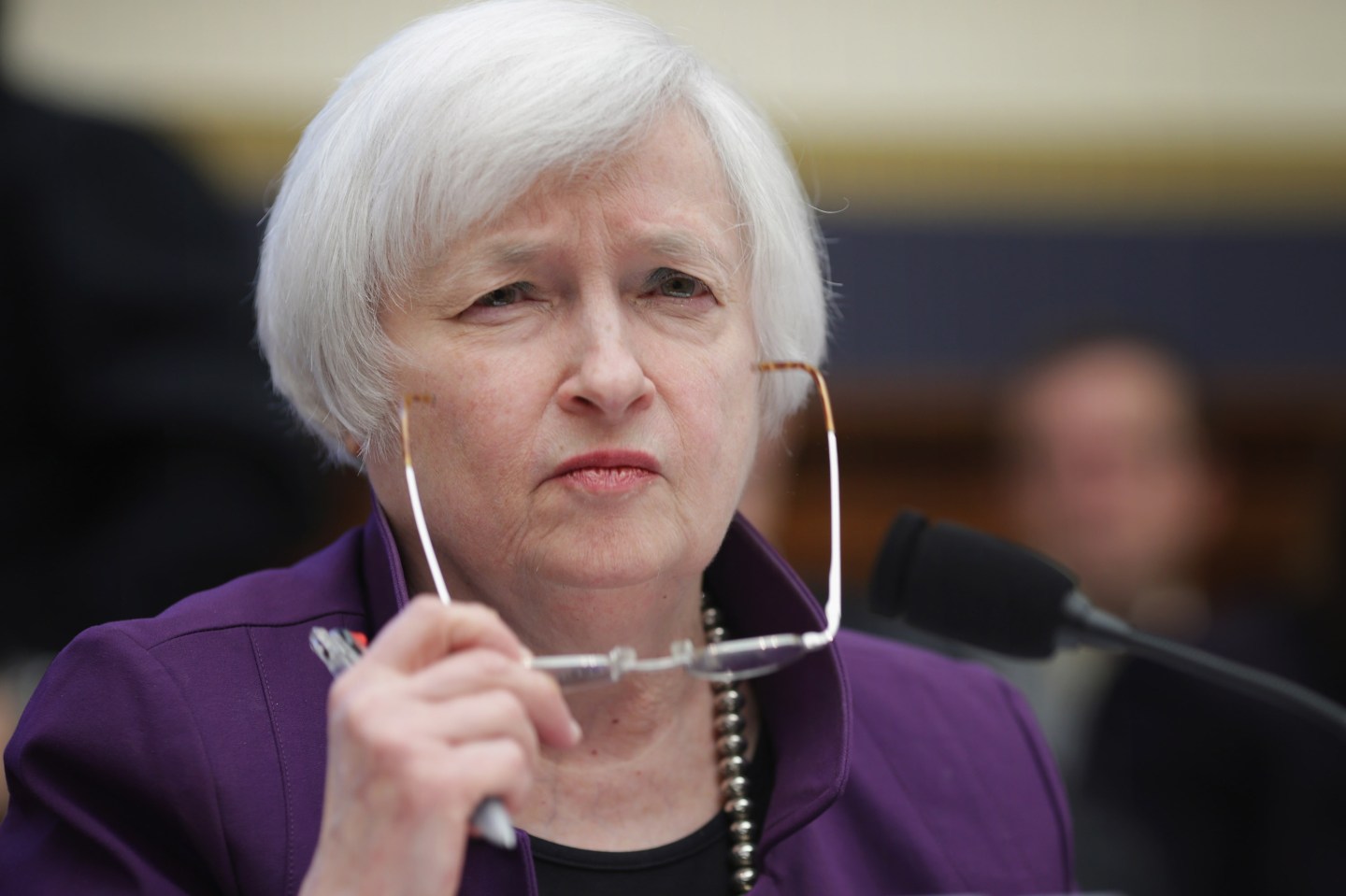
Janet Yellen Testifies Before House Financial Services Committee
WASHINGTON, DC - NOVEMBER 04: Federal Reserve Chair Janet Yellen testifies before the House Finance Committee in the Rayburn House Office Building November 4, 2015 in Washington, DC. Because the Obama administration has yet to appoint a vice chairman for supervision at the Federal Reserve -- as madated by the Dodd-Frank Law -- Yellen is assuming the semi-annual duty for reporting to the committee on the Fed's "supervision and regulation of the financial system." (Photo by Chip Somodevilla/Getty Images)Photograph by Chip Somodevilla — Getty Images

The hot topic on Capitol Hill is negative interest rates.

With central banks in Europe and Asia increasingly turning to the once unthinkable monetary policy to help jumpstart their moribund economies, lawmakers on Capitol Hill were keen to know, during a series of Congressional hearings Wednesday and Thursday, if Fed Chair Janet Yellen would consider forcing rates negative here in America.

Her answer was that the Fed isn’t taking negative rates off the table, but that she and her colleagues don’t think it will be necessary.

Negative interest rates would force banks to basically pay people for taking out a loan and charge people for leaving money in a savings account. So it would involve some adjustments to the financial system.

But what we should all be hoping for is a Federal Reserve that is preparing to take far bolder action than setting interest rates a few dozen basis points below zero. The experience of quantitative easing here and abroad, and the experience of negative interest rates in places like Japan and Europe, should be evidence enough that such a policy wouldn’t be nearly enough to jumpstart growth if the recession that Wall Street is fearing comes to fruition.

As former Treasury Secretary Larry Summers has pointed out, “History suggests that when recession comes it is necessary to cut rates more than 300 basis points.” Given how the Fed has struggled to justify raising rates even 25 basis points above zero, it’s highly unlikely that the Fed will be able to lower interest rates enough to bring the economy back into equilibrium, even if the central bank does decide to follow its peers into slightly-negative territory.

Pushing rates as low as 2 or 3 percent below zero, as I have explained before, would require a radical change in the public’s relationship with paper money:

As it stands now, the government guarantees that the nominal return on paper money is at least zero. But if the laws were changed so that paper money was not required to be accepted for “all debts public and private,” and the central bank was allowed to dictate new values of paper money, the Fed could engineer significantly negative interest rates. For instance, if the central bank were able to declare that a person depositing $100 in cash could only receive a credit of $98 when he deposited that money, that would in effect be the same as setting short-term interest rates at negative 2%.

And remember that would likely be on top of ATM charges and all the other fees we now pay banks. So there is a question of whether people would start to avoid banks.

But assuming they don’t, making such a change might be smart on its own terms. Nonetheless, it’s likely that come the next recession there will be limited political will for radical new government programs aimed at stimulating the economy. Considering that much of America met the Fed’s quantitative easing programs with reactions ranging from mistrust to outright apocalypticism, one can imagine how those same folks would react to the end of paper money as we know it.

Furthermore, there’s a much more elegant solution to the world’s economic problems that will only become more appealing if we suffer another global recession. All across the world, whether it’s Japan, China, Europe, or the U.S., economies are suffering from the twin economic ills of disinflation and too much debt. Another recession would only compound these problems. An obvious solution then is for central banks to support spending by the government by directly financing government programs, or by simply handing out money to citizens for them to spend.

This was labeled “helicopter money” by economist Milton Friedman when he argued that central banks could always fight deflation because at the last resort they could simply drop money out of helicopters. It is an idea that has been championed by British Labor Party leader Jeremy Corbyn when he advocated for “People’s QE,” or a central-bank financed program of infrastructure projects that could boost employment, economic growth, and inflation at the same time.

When the next recession hits, governments around the world will need to find the political will and the resources to engage in massive spending to drag their economies out of their demand-deficient comas. Given the high level of debt on government and private balance sheets, central banks can play a vital role in financing this spending. And such a partnership would be much more effective than simply reducing interest rates further.
About the Author
By Chris Matthews
See full bioRight Arrow Button Icon

Latest in Finance

Investingspace
SpaceX sets $800 billion valuation, confirms 2026 IPO plans
By Loren Grush, Edward Ludlow and BloombergDecember 13, 2025
41 minutes ago
PoliticsAffordable Care Act (ACA)
With just days to go before ACA subsidies expire, Congress is about to wrap up its work with no consensus solution in sight
By Kevin Freking, Lisa Mascaro and The Associated PressDecember 13, 2025
53 minutes ago
InnovationRobots
Even in Silicon Valley, skepticism looms over robots, while ‘China has certainly a lot more momentum on humanoids’
By Matt O'Brien and The Associated PressDecember 13, 2025
1 hour ago
HealthAffordable Care Act (ACA)
A Wisconsin couple was paying $2 a month for an ACA health plan. But as subsidies expire, it’s soaring to $1,600, forcing them to downgrade
By Ali Swenson and The Associated PressDecember 13, 2025
2 hours ago
Julian Braithwaite is the Director General of the International Alliance for Responsible Drinking
CommentaryProductivity
Gen Z is drinking 20% less than Millennials. Productivity is rising. Coincidence? Not quite
By Julian BraithwaiteDecember 13, 2025
3 hours ago
carbon
Commentaryclimate change
Banking on carbon markets 2.0: why financial institutions should engage with carbon credits
By Usha Rao-MonariDecember 13, 2025
4 hours ago

Most Popular

placeholder alt text
Economy
Tariffs are taxes and they were used to finance the federal government until the 1913 income tax. A top economist breaks it down
By Kent JonesDecember 12, 2025
1 day ago
placeholder alt text
Success
Apple cofounder Ronald Wayne sold his 10% stake for $800 in 1976—today it’d be worth up to $400 billion
By Preston ForeDecember 12, 2025
1 day ago
placeholder alt text
Success
40% of Stanford undergrads receive disability accommodations—but it’s become a college-wide phenomenon as Gen Z try to succeed in the current climate
By Preston ForeDecember 12, 2025
1 day ago
placeholder alt text
Economy
For the first time since Trump’s tariff rollout, import tax revenue has fallen, threatening his lofty plans to slash the $38 trillion national debt
By Sasha RogelbergDecember 12, 2025
21 hours ago
placeholder alt text
Economy
The Fed just ‘Trump-proofed’ itself with a unanimous move to preempt a potential leadership shake-up
By Jason MaDecember 12, 2025
19 hours ago
placeholder alt text
Success
At 18, doctors gave him three hours to live. He played video games from his hospital bed—and now, he’s built a $10 million-a-year video game studio
By Preston ForeDecember 10, 2025
3 days ago
Rankings
  • 100 Best Companies
  • Fortune 500
  • Global 500
  • Fortune 500 Europe
  • Most Powerful Women
  • Future 50
  • World’s Most Admired Companies
  • See All Rankings
Sections
  • Finance
  • Leadership
  • Success
  • Tech
  • Asia
  • Europe
  • Environment
  • Fortune Crypto
  • Health
  • Retail
  • Lifestyle
  • Politics
  • Newsletters
  • Magazine
  • Features
  • Commentary
  • Mpw
  • CEO Initiative
  • Conferences
  • Personal Finance
  • Education
Customer Support
  • Frequently Asked Questions
  • Customer Service Portal
  • Privacy Policy
  • Terms Of Use
  • Single Issues For Purchase
  • International Print
Commercial Services
  • Advertising
  • Fortune Brand Studio
  • Fortune Analytics
  • Fortune Conferences
  • Business Development
About Us
  • About Us
  • Editorial Calendar
  • Press Center
  • Work At Fortune
  • Diversity And Inclusion
  • Terms And Conditions
  • Site Map

© 2025 Fortune Media IP Limited. All Rights Reserved. Use of this site constitutes acceptance of our Terms of Use and Privacy Policy | CA Notice at Collection and Privacy Notice | Do Not Sell/Share My Personal Information
FORTUNE is a trademark of Fortune Media IP Limited, registered in the U.S. and other countries. FORTUNE may receive compensation for some links to products and services on this website. Offers may be subject to change without notice.