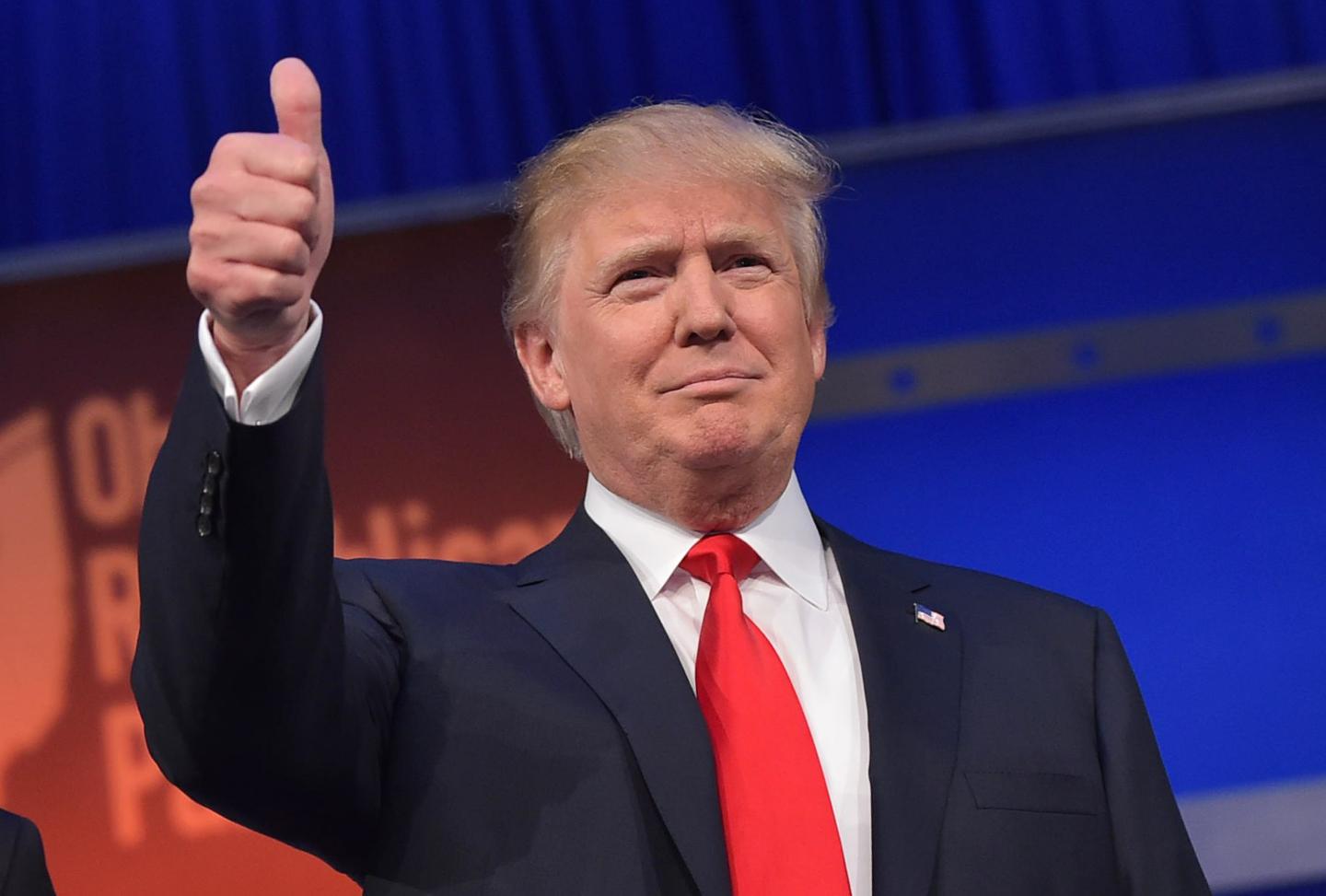
Millions of dollars pour into the political arena every week in an attempt to change people’s opinions and move them closer to one side or the other. But given that most voters make up their minds relatively early, they are largely unmoved by ongoing content, thanks to the way our brains filter what we hear — and it happens automatically. For tonight’s GOP debate, the brain’s “auto-correct” means that Republican presidential candidate Donald Trump could boycott the event and not change any minds one way or the other.
Here’s why: a recent neuroscience study shows that when people hear their favorite candidate speak, their brains will find a way to explain why everything he or she says is more engaging. At times, people must spend a lot more mental energy processing the content to align it with their views. But if a candidate they don’t like says the same thing, their brains filter that content through a different lens, to find that same message disturbing and alienating.
As a result, while polls, focus groups, surveys, and other sophisticated analytics may give clues as to whether anything nudges the voters, neuroscience can give candidates (and other “marketers”) clues about the types of content that are perceived to be acceptable or offensive. Needless to say, this does not end with politics. It is essentially true for many other situations in which we are confronted with opposing views or complex content.
This is backed by a neuroscience field study graduate students in business, neuroscience and engineering at Northwestern University’s Kellogg School of Management recently conducted involving brain reaction to messaging and content. Gathered together in one room to watch the televised Republican and Democratic presidential candidate debates earlier this month, 20 research participants wore special headgear to record their brain responses. As the candidates debated, neural data was collected to show how engaged the research participants’ brains were with the content and the effectiveness of some of the messages. Throughout the debate, another 40 participants in the same room were polled by researchers to rank who was winning. (Participants in the study were chosen following a survey identifying their political affinity to make sure they cover the full spectrum of political views)
Brain engagement (meaning how “active” brain waves were in certain areas, as well as how similar one brain was to another, when a favorite candidate spoke to his/her constituents) from research participants watching the Democratic debate on January 17 showed Hilary Clinton and Bernie Sanders to be tied (that is, in terms of the level of neural effort they conjured from Democrats’ brains). Martin O’Malley was a distant third. These results differed significantly from polling of the research participants—gathering their opinions after their subjective minds and brain filters weighed in—which showed Clinton as the clear winner, followed by Sanders and O’Malley. (This contrasts further with the pundits and media which called Sanders the winner.). Simply put, when Democrats listened to Clinton or Sanders speak their brains looked similar. At times, the content required more effort (in the form of increased focus, attention or engagement) to process. One interpretation is that the content might have sparked some internal debate within individuals, so that their brains worked harder to align with their conscious desire to rank Clinton and Sanders high.
For Republican candidates in the January 14 debate, the research results were even more surprising. Brain engagement data put Ted Cruz in first place, compared to fourth in the more subjective opinion polling of the research participants.
The same opinion polls ranked John Kasich first, followed by Jeb Bush, Ben Carson, and Ted Cruz. Trump, who did not show up in the top four in opinion polling, still ranked third in terms of how well he engaged the participants’ brains. (Trump was called the winner of the debate by the media, followed by Cruz.)
In looking at the issues, rather than individual candidates, in the Democratic debate, brain engagement was highest for immigration and terrorism, followed by elections and politics. Healthcare reform, which had sparked arguments between Clinton and Sanders in the debate, did not make the top four of the most brain-engaged topics. In the Republican debate, brain engagement sparked the most for the economy, terrorism, immigration, and guns, in that order.
Interestingly, terrorism and immigration had strong effects on participants’ brains for each party’s debate — which may very well reflect how emotionally charged these topics are for people, no matter what their opinions are on the subject.
The research was not meant to be predictive of the election. Rather, the purpose was to show the difference between neurological responses that show brain engagement (but before the brain “filter”) and subjective feedback from opinion polls (after the brain filter).
Admittedly, gathering and analyzing brain activity, as we have in other research using movie trailers and commercials, is expensive and requires neuroscience expertise. However, it’s easy to see why brain data might be especially insightful, compared to polling people’s subjective opinions. Brain data could show those moments and messages when people are most engaged. That, in turn, could inform candidates, marketers, or others trying to influence voters or other consumers how to best present information and positions for the most impact and engagement.
For any “campaign,” political or commercial, in which the stakes are high and the investment is large (for example on an ad in the upcoming Super Bowl, where every extra second increases the price by millions of dollars), brain data could prove far more insightful than traditional polling of consumers for their subjective opinions.
Moran Cerf is a professor of neuroscience and business at Kellogg School of Management at Northwestern University.