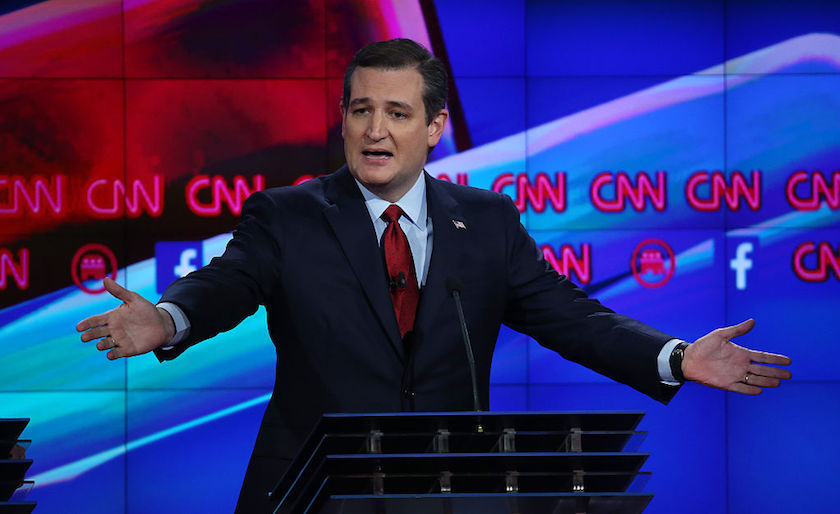
In Thursday night’s Republican debate, one of the most heated clashes was over tax policy that has never been tried in the U.S.
Marco Rubio said Ted Cruz’s tax plan was merely “a way to blindfold the people so the cost of government is not there for them.” Cruz fired back that his proposed levy was a “business tax that enables us to eliminate the corporate tax and the death tax, eliminates the IRS,” and in the process, will shrink your federal tax return to the size of a postcard.
At issue is something called a value-added tax. Cruz denies his brainchild is a VAT, but that’s precisely what it is. Under a VAT system, companies pay a government levy on the value that they add along the chain of production. Each company pays the tax as it sells its components or services to the next producer, which in turn uses those wares or expertise to make more parts, or a finished product. All told, a pure VAT taxes every dollar plowed into building an airplane or appliance, or furnishing services. That comprises labor, materials, interest, and all profit booked by the producers and retailers.
A VAT is also a relatively efficient tax, since it is easier to police than say sales taxes, which retailers and consumers often avoid by paying cash. Hence, in theory, governments can collect a lot more money with a VAT than a sales tax carrying the same rate, though companies will probably look to duck the VAT as well.
Many people believe that companies will respond to the added cost of a VAT by raising prices. So in effect, a VAT is a consumption tax paid by consumers, as opposed to a tax on our wages or gains from stocks, bonds or other investments. Hence, the VAT rewards folks for lavishing less on restaurants and vacations, and growing their nest eggs—savings that likely gets invested in companies that can use the money to build new plants and products that make economies grow faster and enrich their citizens.
Nonetheless, the Texas senator is already struggling, however ineffectively, to escape the label of a VAT, a system many Americans, like all taxes, distrust. America is the only developed nation that does not have a VAT. Instead, Cruz calls his proposed new levy “the business flat tax.” And his plan does differ from a traditional VAT in a significant way that would make it like no other levy on the planet.
So how would Cruz’s non-VAT VAT work? In most countries, the VAT is imposed separately on different products as they move through the chain of production, often at different rates. Cruz’s VAT doesn’t track individual products, frequently taxed at different rates, through each step of production. Instead, he would impose a flat 16% tax not on profits, but revenues, after a major adjustment.
The plan permits only one real deduction: a full writeoff for capital investment. So with the exception of capital expenditures, the 16% falls on all of the economy’s revenues, or practically our entire GDP: wages, benefits, profits, interest, services, and materials (taxed once). As Alan Cole, an economist at the non-partisan Tax Foundation notes, the effective rate is not 16%, but almost 19%. That’s because for technical reasons, a 16% VAT included in the price equals an 19% tax added to the pre-tax price.
So the real burden is 19%. According to Cruz, the levy is so broad, deduction-light, and simple to collect that it would generate the cash to replace all payroll taxes. Social Security and Medicare levies would vanish, too, and federal tax rates would drop to a flat 10%.
Sounds great? But where will all those new revenues come from? The answer is a big jump in all prices paid by consumers. How much of an increase can we expect? I did some simple math that while not at all exact, provides a rough idea. Today, companies already pay something like 1.5% of their revenues in corporate taxes, and another 7.65% to Social Security and Medicare, matched by the employee. The payroll taxes are imposed on wages that account for around 70% of corporate expenses. So, corporations are paying around 5.4% of sales (70% of 7.65%) in retirement benefits to the government on behalf of their employees. Assume they pass that cost along to customers, and our current corporate tax system already increases prices by around 7%.
Cruz wants to eliminate those taxes. But he would add new taxes totaling 19%. So all prices—for cars, cheeseburgers, bracelets, new houses—would immediately rise by something like 12%. According to Cruz, the big price hike would raise sufficient revenue to cover the total elimination of payroll taxes, and fund the shortfall from the big reduction in the federal income tax rate.
The plan has one major benefit: It’s broad base and simplicity. But it has two major drawbacks. The first is that it raises prices the same amount for everybody, rich and poor alike. Generally, nations put lower burdens on the basics, to make VATs progressive. They also make big transfer payments to middle class folks because their burden is perceived as higher than that of the upper class. Cruz isn’t proposing doing that.
The second problem is that the tax is hidden in the price of all products. People hate income taxes, and detest it when they’re raised, except sometimes on high earners. It would be extremely difficult for spending as a share of GDP to keep growing with our current tax system.
But it could explode with a VAT. That’s the lesson from Europe. Every time tax receipts drop in a recession, governments slyly lift the VAT. And it almost never comes back down, and neither does spending. Our current tax system should be simplified, and should not be vilified as an oddity because we’re the world’s only major non-VAT economy. Being different is not a bad thing. It’s kept the lid on our spending for years, and accounts for much of our dynamism and competitive advantage.
It’s far too early to tell if voters will warm to the Cruz solution. The price rise may shock people, but that’s not the big worry. If it were coupled with smaller government, his platform would be a triumph. Unfortunately, the lesson of the VAT is that it forever expands the public sector, and saps the vitality of spawned by investment, risk-taking and innovation.