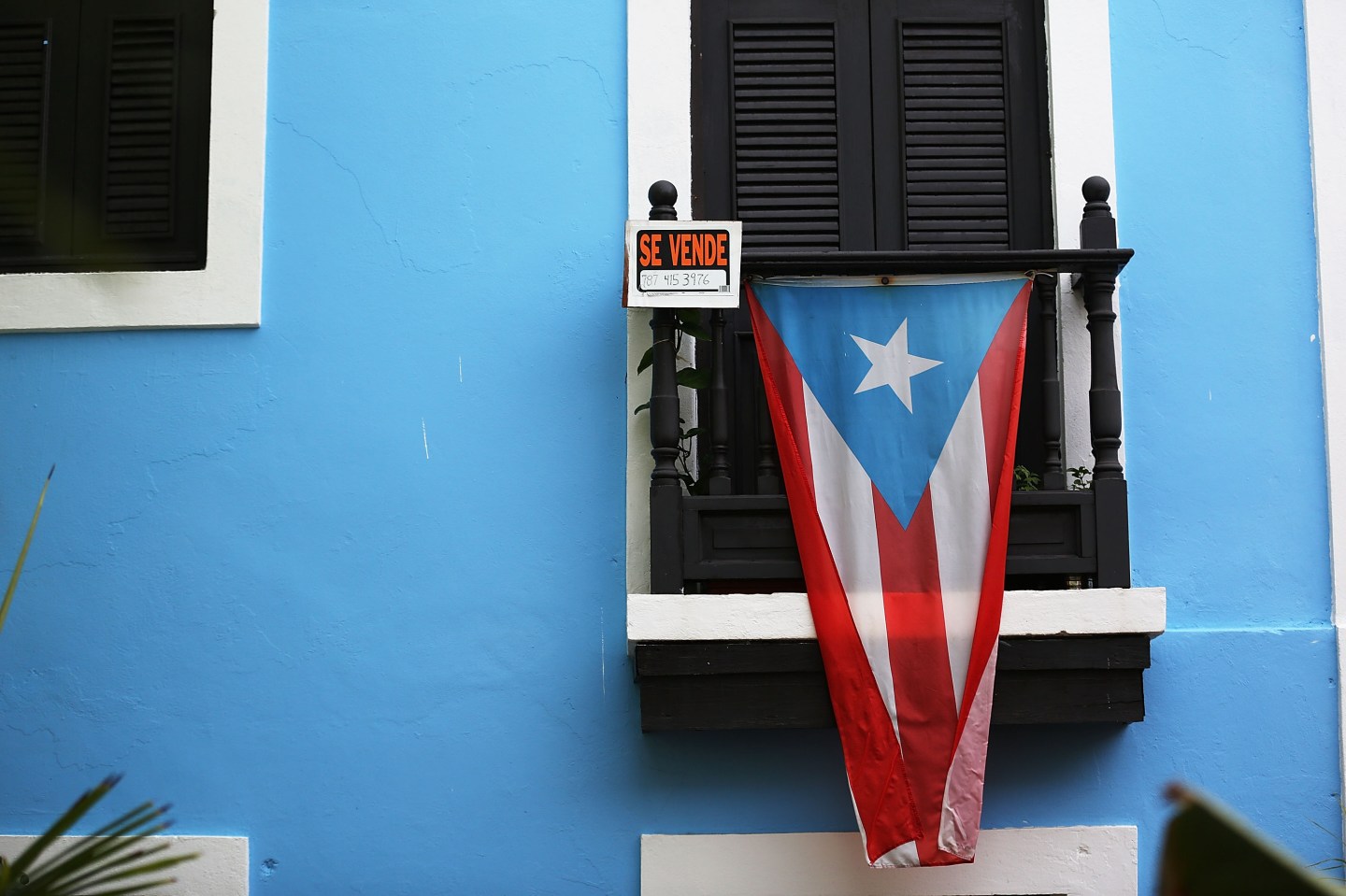
Puerto Rico is hurtling headlong into what could be the largest municipal default in United States’ history, and investors are kind of freaking out about it.
While the Puerto Rican government failed to make a relatively small $58 million payment due on its Public Finance Corp (PFC) bonds on August 1, the government took an even more dramatic step on Monday afternoon to convince investors that the island’s government is serious in its intentions to demand debt reduction. According to a report published Wednesday by Dealbook, Puerto Rico’s government also stopped making contributions to its general obligations fund. The report continues:
Unlike the bond payments that went into default on Monday, the ones coming due are on general obligation bonds—the kind many investors have been led to believe would never go into default because the issuer’s full faith, credit and taxing authority stand behind them.
If the island misses a payment on the general obligation bonds coming due on January 1, ““it would be an earthquake for the markets,” Matt Fabian, a partner at Municipal Market Analytics, a financial research firm, told Dealbook.
As with any debt crisis, there is plenty of blame to go around. Puerto Rico borrowed too much, sure, but by definition, this means that lenders were too eager to lend to a government whose economy and population have been shrinking for roughly a decade. But eager they were. A 2012 report by the Wall Street Journal describes how, “investors have flocked to its bonds because they have something fund managers crave: They pay high interest rates.”
On top of that, these bonds gave investors an even rarer advantage: a so-called “triple-tax exemption,” because investors don’t have to pay local, state, or federal taxes on income derived from owning Puerto Rican government debt. In other words, the combination of a reach for yield, tax incentives, and the belief that default is impossible all contributed to a debt crisis that is likely not going to end well. If the recent defaults in Argentina and Greece are any guide, it will be average Puerto Rican citizens who suffer the worst consequences, rather than those who borrowed or lent in the run up to this crisis.
But why, exactly, is the Puerto Rican government debt tax exempt?
The answer can be traced back to the Spanish American War, after which Puerto Rico became a possession of the United States, along with Guam and the Philippines. Despite its overwhelming victory over the Spanish, the U.S. government was divided over what to do with its new territories. José Alberto Cabranes, who later went on to become the first Puerto Rican to be appointed to a federal judgeship, published an exhaustive review of the legislative deliberations over the question of Puerto Rico’s political fate following America’s annexation of the island.
The debate culminated in the 1917 Jones–Shafroth Act, which both conferred American citizenship on Puerto Ricans and reformed the colonial government there. It also barred the federal government or any state or locality from taxing income from Puerto Rican government bonds. Why exactly Congress included this last provision is unclear, but what is clear is that Congress wanted to fund the government of Puerto Rico as cheaply as possible and through import and export taxes rather than those on income.
The idea that Puerto Rico’s government would be funded differently than the governments of other U.S. territories marked a reversal from what leaders proposed immediately following the annexation of the island in 1898. Writes Cabranes:
The original plans of the McKinley administration and the Republican congressional leadership for Puerto Rico seemed to call for the island’s “incorporation” into the United States—that is, annexation of Puerto Rico as an integral part of the United States and the bestowal of a constitutional and political status comparable to other American territories destined for statehood.
But such an arrangement would have required free trade between Puerto Rico and the United States, a prospect that agricultural interests on the mainland frowned upon. Soon, President McKinley and the ruling Republican party changed their tune and advocated for Puerto Rico to remain a colony, with only token representation in Congress and governed by different tax laws than the mainland. As William Sulzer, Democratic Representative from New York said:
Why, then, was the change made? Well, it is said, and not denied, that the majority of the Ways and Means Committee made this change at the request of the sugar trust, the tobacco trust, and the whisky trust. I believe this to be the truth about the matter. The agents of the trusts dictated this unjust discrimination against the citizens of Puerto Rico. . . . You dare not disobey the trusts. They own and control the Republican Party.
There were motivations beyond profit to keep Puerto Rico in territorial limbo. Some in Congress were opposed to annexing the territory at all. Others only wanted to do it if Puerto Rico could be put on a path to statehood. Others resisted incorporating places like Puerto Rico simply on racial grounds, as the island was home to hundreds of thousands of people with African roots. What the Congressional record makes clear, however, is that the actual welfare of the Puerto Rican people has never been of primary concern to Congress.
This is still the case today. Despite the fact that Puerto Rico’s debt crisis is partially the fault of Congress, it looks like Congress isn’t ready to do anything to help the island rectify the situation, for its own partisan reasons. Whether it’s starting the process to grant the island statehood (which island residents are now if favor of), or granting the island’s government the ability to go through the Chapter 9 bankruptcy process, Congress doesn’t seem ready to make policy decisions on Puerto Rico’s future based on what is best for Puerto Ricans themselves.