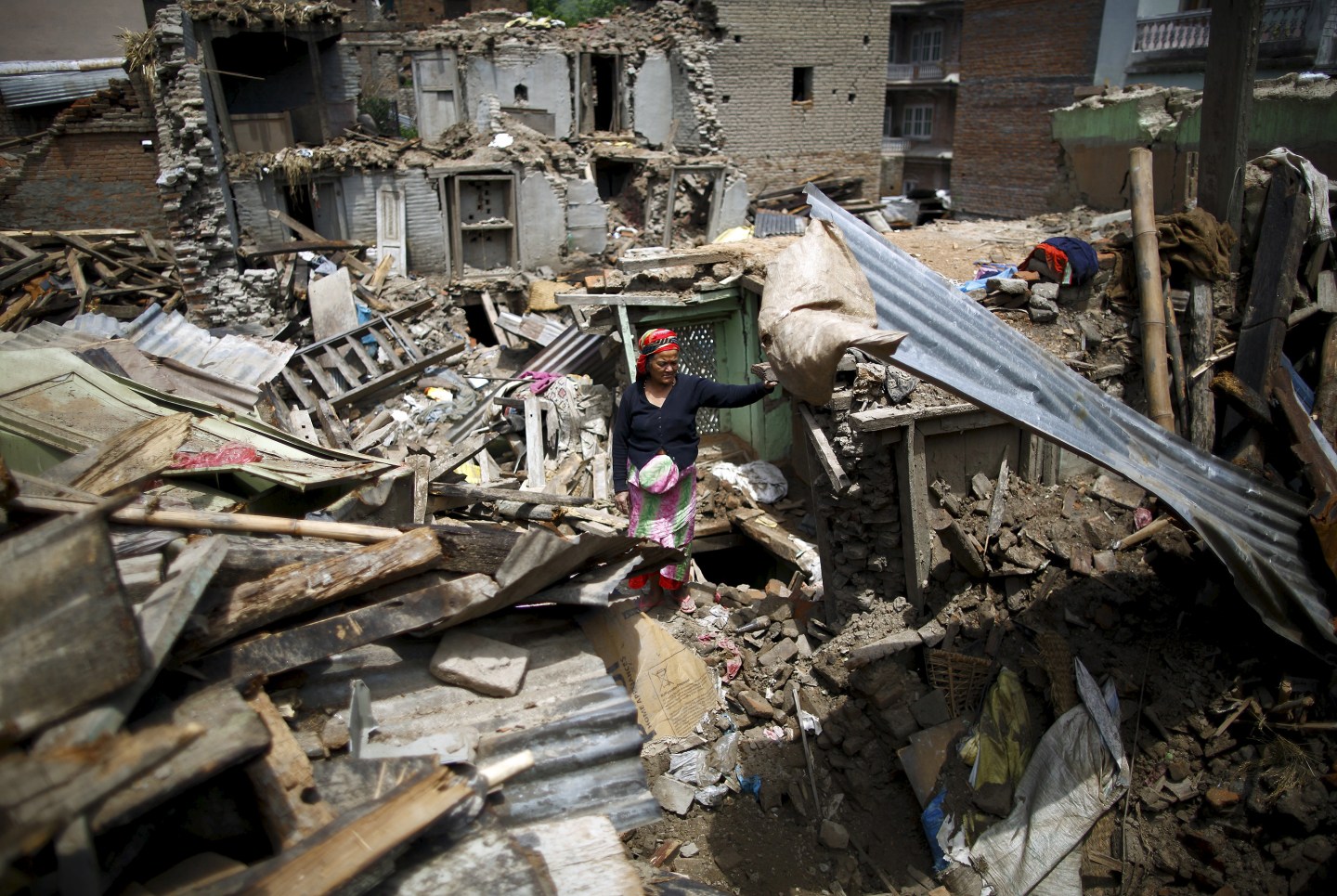
Two weeks after a 7.8-magnitude earthquake left thousands dead and destroyed much of the country’s infrastructure, another major, 7.3-magnitude earthquake struck Nepal on Tuesday, causing panic and adding to the damages. With the monsoon season beginning in six weeks, landsides and flooding could further complicate the recovery efforts and deteriorate the living conditions in an already impoverished nation. Nepal is one of the world’s poorest countries. Corruption is rife and it is politically unstable. After a decade of conflict that ended in 2006 with the creation of a Maoist government recently defeated in the 2013 elections, Nepal’s future seems uncertain. But will these tragic events resonate through global financial markets? Honestly, probably not.
The reason? Economics.
For all the destruction that natural disasters in recent history have caused, and for all the attention that they have gained in the public eye, they ultimately have had a negligible impact on the global economy over the past three centuries. While “domestic” disasters, earthquakes in particular, can have marked impacts on specific sectors such as insurance, construction and real estate, there are often economic winners as well as losers. On aggregate, earthquakes have had a small effect on GDP growth and long-term GDP for the countries affected (even if the immediate damages have been large). In a global and interconnected world, the ever-present concern is that disasters might impact countries other than those directly affected, for example neighbors or trading partners. But global financial markets have proven resilient to earthquake shocks and other natural disasters. More generally, noneconomic newsworthy events from president assassinations to election results to international conflicts— the type of major political and world events making headlines in major international newspapers and business magazines—have shown a surprisingly small effect on aggregate stock market returns.
There are exceptions to the rule, of course. The recent earthquakes in Nepal stand in contrast with the March 11, 2011 Tohoku-Oki earthquake and tsunami in Japan and the resulting Fukushima Daiichi nuclear accident that affected the third largest economy in the world. The earthquake and tsunami ravaged twenty prefectures in northeast Japan, killing thousands and causing an estimated $211-235 billion in damages. It hit the home of auto and semiconductor manufacturing, destroying factories, disrupting the supply of raw materials and causing power shortages across the country. In this age of global markets and just-in-time production processes, even a small disruption in the supply of a single component can cause turmoil in entire production lines. The 2011 earthquake had a negative impact across all the sectors in the Japanese stock market, with utilities experiencing the largest negative impact.
Were there ripple effects for the rest of the world? Did other economies feel the impacts of the disaster? Some economic sectors certainly did. Less than two months after the nuclear disaster, Chancellor Angela Merkel proclaimed an acceleration of the phase-out of nuclear power in Germany. Recent studies have shown that nuclear utilities across the world exhibited negative returns after Fukushima, an effect mainly driven by a heightened perception of nuclear risks. Even here, though, the impact on global financial markets was not uniformly negative. It varied across both countries and business sectors, arguably reflecting the nature of the trade linkages between Japan and the rest of the world. In general, for sectors whose supply chains rely on Japanese exports, there were negative abnormal returns, but substitution with domestic production or with imports from other trading partners reduced the magnitude of abnormal returns, and other sectors experienced abnormal positive returns.
If the global economic impact of the disaster in Japan was not large on aggregate, the global impact of the Nepali earthquakes will be negligible. Nepal’s main exports to the rest of the world are textiles. Its GDP is less than one percent of Japan’s, and it relies heavily on agriculture and on remittances from workers abroad. That an earthquake that has killed over 8,000 people, displaced hundred of thousands, and destroyed much of a country’s infrastructure will not register in global economic terms should not be a relief, however. It is a tragedy. It is a symptom that the assistance that the world is providing now should have arrived much earlier.
Susana Ferreira is an associate professor at the department of agricultural and applied economics at the University of Georgia.