• Home
  • Latest
  • Fortune 500
  • Finance
  • Tech
  • Leadership
  • Lifestyle
  • Rankings
  • Multimedia
CommentaryMoore's Law

Moore’s Law turns 50, but will it soon cease to exist?

By
Supratik Guha
Supratik Guha
Down Arrow Button Icon
By
Supratik Guha
Supratik Guha
Down Arrow Button Icon
April 19, 2015, 10:00 AM ET
INTEL MOORE
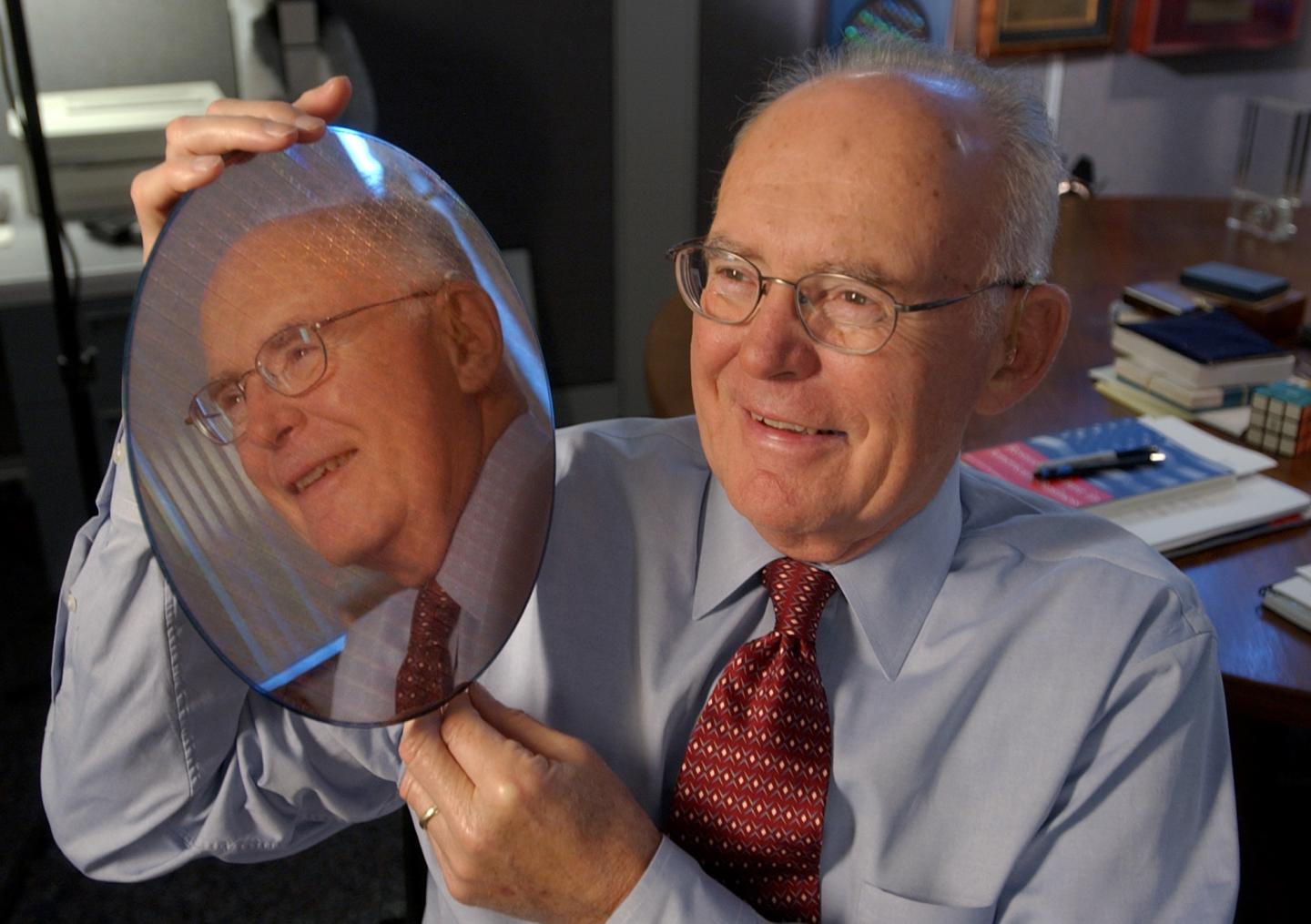
Intel Corp. co-founder Gordon Moore holds up a silicon wafer at Intel headquarters in Santa Clara, Calif., Wednesday, March 9, 2005. This is the 40th anniversary of "Moore's Law". Moore saw that the number of components on an integrated circuit had doubled every year and figured that rate would continue for a decade as transistors were made smaller. He saw that the per-component costs would fall as manufacturing improved. (AP Photo/Paul Sakuma)Photograph by Paul Sakuma — AP

In 1950, at a time when there were fewer than 10 digital computers worldwide, Bill Pfann, a 33-year-old scientist at Bell Laboratories in New Jersey, discovered a method that could be used to purify elements, such as germanium and silicon. He could not possibly have imagined then that this discovery would enable the silicon micro-chip and the rise of the computer industry, the Internet, and the emergence of the information age. Today, there are about 10 billion Internet-connected devices in the world, such as laptops and mobile phones, and at the heart of each of these devices, there is at least one such micro-chip that acts as its “engine”.

The reason behind this relentless progress is neatly contained in a prophetic law that was announced 50 years ago this Sunday, called Moore’s Law. The micro-chip is built with tiny electrical switches made of purified silicon called transistors and the law stated that the number of transistors on a chip would double every year. In 1975, Gordon Moore revised his forecast to state that the count would double every two years. The law has held true since.

Why is Moore’s Law relevant? Because this doubling of the number of transistors led to computer chips that could be packed with increasingly sophisticated circuitry that was both energy efficient and cheap. This led to the widespread adoption of computers, mobile phones, and the information technology revolution.

The price of computation is about 10 million times cheaper than it was 40 years ago, and the computing power held in a smart phone outstrips the workstations that computer scientists used in their offices in the 1990s. That we have been able to so far hold true to Moore’s Law is the reason that the electronic circulation of information has been commoditized, changing the way many of us learn, bank, travel, communicate and socialize.

Take the example of social networking using a mobile phone. It works because the cost of a transistor has dropped a million fold and computing is about 10,000 times more energy efficient since 1980, when this writer first went to engineering school. Consequently, a $200 smart phone powered by a biscuit-sized battery contains a micro-chip with a few billion transistors in it and enough computing power to digitally process an image, and then upload and share it wirelessly using powerful mathematics to encode the data. This is a consequence of Moore’s Law in action.

Yet, on its 50th anniversary, there are tell-tale signs that Moore’s Law is slowing, and we are almost certain that the law will cease to hold within a decade. With further miniaturization silicon transistors will attain dimensions of the order of only a handful of atoms and the laws of physics dictate that the transistors and electronic circuits will cease to work efficiently at that point. As Moore’s Law’s slows down, innovations in other areas, such as developments in software, will pick up the slack in the short-term.

But in the longer-term, there will be fundamental changes in the essential design of the classical computer that, remarkably, has remained unchanged since the 1950s. Designed for precise calculations, today’s computing machines do not make inferences, and qualitative decisions, or recognize patterns from large amounts of data efficiently. The next substantive leap forward will be in computers with human-like cognitive capabilities that are also energy efficient. IBM’s Watson, the computing system that won the television game show Jeopardy! in 2011, consumed about 4000 times more energy than its human competitors. This experience reinforced the need for new energy efficient computing machines that are designed differently from the sequential, calculative methodology of classical computers and are inspired, perhaps, by the way biological brains work.

A journalist recently asked me whether the continuation of Moore’s Law was indispensable. It is the beauty of the collective enterprise of human innovation, which ensures that nothing is indispensable indefinitely for technology to progress. Decades later one might look at the era of Moore’s Law as a golden period where computers came of age through a masterful display of an industry’s ability to miniaturize and create billions of flawless and identical copies of tiny circuits at factories throughout the world. But, much as a pack of migratory birds flying in V-formation rotate in at the lead position, there will, at that future time, be many other technologies that will have carried us forward in the information age.

Supratik Guha is director of physical sciences at IBM.

About the Author
By Supratik Guha
See full bioRight Arrow Button Icon

Latest in Commentary

Finance
Lorem ipsum dolor sit amet, consectetur adipiscing elit, sed do eiusmod tempor incididunt ut labore et dolore magna aliqua. Ut enim ad minim veniam
By Fortune Editors
October 20, 2025
Finance
Lorem ipsum dolor sit amet, consectetur adipiscing elit, sed do eiusmod tempor incididunt ut labore et dolore magna aliqua. Ut enim ad minim veniam
By Fortune Editors
October 20, 2025
Finance
Lorem ipsum dolor sit amet, consectetur adipiscing elit, sed do eiusmod tempor incididunt ut labore et dolore magna aliqua. Ut enim ad minim veniam
By Fortune Editors
October 20, 2025
Finance
Lorem ipsum dolor sit amet, consectetur adipiscing elit, sed do eiusmod tempor incididunt ut labore et dolore magna aliqua. Ut enim ad minim veniam
By Fortune Editors
October 20, 2025
Finance
Lorem ipsum dolor sit amet, consectetur adipiscing elit, sed do eiusmod tempor incididunt ut labore et dolore magna aliqua. Ut enim ad minim veniam
By Fortune Editors
October 20, 2025
Finance
Lorem ipsum dolor sit amet, consectetur adipiscing elit, sed do eiusmod tempor incididunt ut labore et dolore magna aliqua. Ut enim ad minim veniam
By Fortune Editors
October 20, 2025

Most Popular

Finance
Lorem ipsum dolor sit amet, consectetur adipiscing elit, sed do eiusmod tempor incididunt ut labore et dolore magna aliqua. Ut enim ad minim veniam
By Fortune Editors
October 20, 2025
Finance
Lorem ipsum dolor sit amet, consectetur adipiscing elit, sed do eiusmod tempor incididunt ut labore et dolore magna aliqua. Ut enim ad minim veniam
By Fortune Editors
October 20, 2025
Finance
Lorem ipsum dolor sit amet, consectetur adipiscing elit, sed do eiusmod tempor incididunt ut labore et dolore magna aliqua. Ut enim ad minim veniam
By Fortune Editors
October 20, 2025
Finance
Lorem ipsum dolor sit amet, consectetur adipiscing elit, sed do eiusmod tempor incididunt ut labore et dolore magna aliqua. Ut enim ad minim veniam
By Fortune Editors
October 20, 2025
Finance
Lorem ipsum dolor sit amet, consectetur adipiscing elit, sed do eiusmod tempor incididunt ut labore et dolore magna aliqua. Ut enim ad minim veniam
By Fortune Editors
October 20, 2025
Finance
Lorem ipsum dolor sit amet, consectetur adipiscing elit, sed do eiusmod tempor incididunt ut labore et dolore magna aliqua. Ut enim ad minim veniam
By Fortune Editors
October 20, 2025
Rankings
  • 100 Best Companies
  • Fortune 500
  • Global 500
  • Fortune 500 Europe
  • Most Powerful Women
  • Future 50
  • World’s Most Admired Companies
  • See All Rankings
Sections
  • Finance
  • Leadership
  • Success
  • Tech
  • Asia
  • Europe
  • Environment
  • Fortune Crypto
  • Health
  • Retail
  • Lifestyle
  • Politics
  • Newsletters
  • Magazine
  • Features
  • Commentary
  • Mpw
  • CEO Initiative
  • Conferences
  • Personal Finance
  • Education
Customer Support
  • Frequently Asked Questions
  • Customer Service Portal
  • Privacy Policy
  • Terms Of Use
  • Single Issues For Purchase
  • International Print
Commercial Services
  • Advertising
  • Fortune Brand Studio
  • Fortune Analytics
  • Fortune Conferences
  • Business Development
About Us
  • About Us
  • Editorial Calendar
  • Press Center
  • Work At Fortune
  • Diversity And Inclusion
  • Terms And Conditions
  • Site Map

© 2025 Fortune Media IP Limited. All Rights Reserved. Use of this site constitutes acceptance of our Terms of Use and Privacy Policy | CA Notice at Collection and Privacy Notice | Do Not Sell/Share My Personal Information
FORTUNE is a trademark of Fortune Media IP Limited, registered in the U.S. and other countries. FORTUNE may receive compensation for some links to products and services on this website. Offers may be subject to change without notice.


Latest in Commentary

Muddu
CommentaryIT
IT service is reaching its breaking point. At Salesforce, we see 3 tipping points
By Muddu SudhakarDecember 18, 2025
4 hours ago
small business
CommentaryLayoffs
Our data shows that companies of 500 and fewer workers mostly avoided the AI layoffs. They’re making AI work for them
By Gabby BurlacuDecember 18, 2025
4 hours ago
Sophia Romee is the General Manager of the GenAI Studio at the College Board
CommentaryEducation
Gen Z is on the fence about AI in the classroom. That’s a good thing
By Sophia RomeeDecember 18, 2025
4 hours ago
Tim Parker
CommentaryAutos
How Bentley’s brand is creating business advantage in disruptive times 
By Tim ParkerDecember 18, 2025
7 hours ago
layoffs
CommentaryLayoffs
The AI layoff wave is just beginning — and it’s by design
By Kevin OakesDecember 17, 2025
1 day ago
Norbert Jung
Commentary
Factory 2030 runs on more than code. As a CEO, I see the power of agentic AI—and the trust gap that we must close
By Norbert JungDecember 17, 2025
1 day ago

Most Popular

placeholder alt text
Economy
The $38 trillion national debt is to blame for over $1 trillion in annual interest payments from here on out, CRFB says
By Nick LichtenbergDecember 17, 2025
1 day ago
placeholder alt text
Success
As millions of Gen Zers face unemployment, McDonald's CEO dishes out some tough love career advice for navigating the market: ‘You've got to make things happen for yourself’
By Preston ForeDecember 16, 2025
2 days ago
placeholder alt text
AI
'Robots are going to be amongst us': Qualcomm exec says buckle up for the next 5 years. Your car is going to be the first shoe to drop
By Nino PaoliDecember 17, 2025
1 day ago
placeholder alt text
Economy
America's $38 trillion national debt 'exacerbates generational imbalances' with Gen Z and millennials paying the price, warns think tank
By Eleanor PringleDecember 16, 2025
2 days ago
placeholder alt text
C-Suite
Red Lobster CEO Damola Adamolekun says the key to being a better leader is being a better person: ‘Leadership is self-improvement’
By Sydney LakeDecember 17, 2025
1 day ago
placeholder alt text
Innovation
An MIT roboticist who cofounded bankrupt Roomba maker iRobot says Elon Musk's vision of humanoid robot assistants is 'pure fantasy thinking'
By Marco Quiroz-GutierrezDecember 16, 2025
2 days ago