• Home
  • Latest
  • Fortune 500
  • Finance
  • Tech
  • Leadership
  • Lifestyle
  • Rankings
  • Multimedia
Real EstateHomeownership

The collapse of Millennial homeownership could be a mirage

By
Chris Matthews
Chris Matthews
Down Arrow Button Icon
By
Chris Matthews
Chris Matthews
Down Arrow Button Icon
July 16, 2014, 9:48 AM ET
Monthly Sales Of Existing Homes Rise To Highest Level Since Nov. 2009
SAN ANSELMO, CA - MAY 22: A sale pending sign is posted in front of a home for sale on May 22, 2013 in San Anselmo, California. According to a report by the National Association of Realtors, sales of existing homes inched up 0.6% to a seasonally adjusted annual rate of 4.97 million, up from 4.94 million in March, the highest level since 2009. (Photo by Justin Sullivan/Getty Images)Justin Sullivan—Getty Images

The economic plight of the Millennial is no secret.

The job market for young Americans isn’t exactly on fire: A recent Pew report showed that the unemployment rate for 25-32 year olds was higher last year than for any post-war generation. And they’re entering the job market with significant student loan debt—nearly $30,000 per borrower. All of this has led commentators to assume that the drop in Census homeownership rates to the lowest on record is due to shaky finances.

But according to analysis released Wendesday by Trulia Chief Economist Jed Kolko, the decline in Millennial homeownership is simply a product of demographic changes, specifically the fact that young people are waiting longer to marry and have children. Most often, single people have less of a need to buy a home (and less of a desire to tie themselves down with a mortgage), and are less likely to be homeowners relative to married folks. In addition to there being fewer married Millennials, the share of non-Hispanic white people in the 18-34 population—the demographic group most likely to be homeowners—has also fallen in recent years. Both of these factors, according to Kolko, have conspired to create the impression that the housing market is less healthy than it should be. Writes Kolko:

“Once we adjust for the huge demographic shifts among young adults—far fewer young adults are married or have kids than two or three decades ago—homeownership in 2013 was roughly at late-1990s levels. That means that the demographic shifts among young adults account for the entire decline in homeownership for 18-34 year-olds over the last twenty years. In other words, if the pre-bubble years of the late 1990s can be considered relatively normal, then today’s lower homeownership rate for young adults might be the new normal, thanks to demographic changes.”

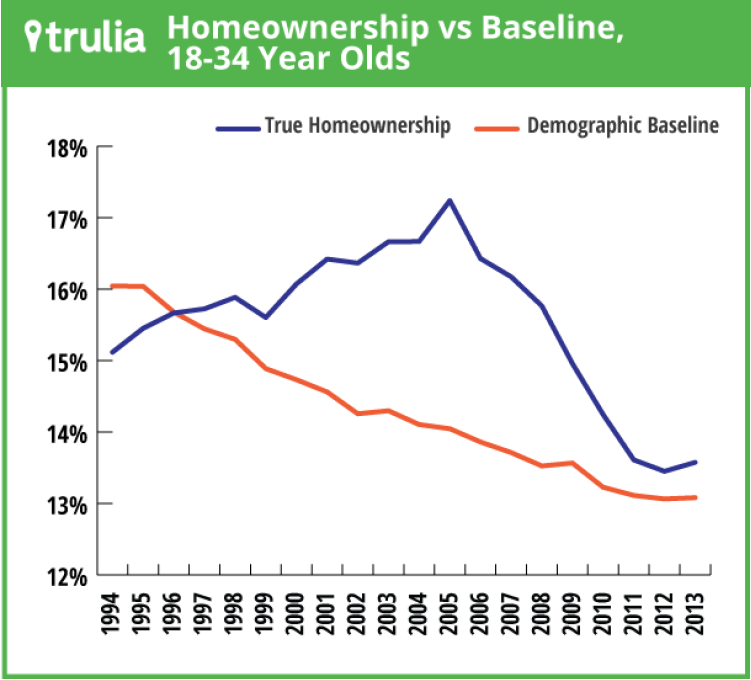
To figure out what homeownership rates would have been today had the housing bubble and recession never occurred, Kolko extrapolated what homeownership rates would have been by applying the demographic changes that actually occurred to pre-bubble trends in homeownership rates. The graph below shows both the homeownership rate (the number of owner-occupied homes divided by the 18-34 population) and where one would expect that homeownership rate to be given the demographic changes we’ve seen:
Screen Shot 2014-07-15 at 4.58.56 PM

The chart shows that the actual Millennial homeownership rate is higher than what you’d expect given demographic shifts. The group that is less likely to own a home, however—the 25-54 year old age group—owns homes at a lower rate than demographic trends would suggest, as you can see in the chart below:

Screen Shot 2014-07-15 at 5.08.33 PM

You can see the lingering effects of the housing bubble in these statistics. Nearly 20% of mortgagors owe more on their homes than they are worth. These homes, which are disproportionately represented by the cheaper end of the market, are actually the kind young Americans, and first-time homebuyers in general, are more likely to buy because they’re more affordable. In other words, weakness in the housing market is more likely a product of general economic weakness and the inequality of the recovery than due to the specific struggles of the young.

There is one caveat to Kolko’s analysis, however. He notes that, “some clear-cut demographic factors—like marital status and having children—are also affected by economic conditions, but the longer-term shifts pre-date the recession.” The obvious question is whether young people are getting married less frequently because of economic or cultural conditions. If it’s mainly cultural (which Kolko believes), then the drop in homeownership rates among the 25-34 age group is nothing to worry about insofar as it affects the economy; it’s just that Millennials are taking a bit longer to start families and put down roots. If the decrease in marriage rates are driven mostly for economic reasons, however, then we have reason to worry about the economic health of the generation now just coming of age.


About the Author
By Chris Matthews
See full bioRight Arrow Button Icon

Latest in Real Estate

housing affordability
Real EstateHousing
America’s mobile housing affordability crisis reveals a system where income determines exposure to climate disasters
By Ivis Garcia and The ConversationDecember 10, 2025
11 hours ago
Personal FinanceReal Estate
Current ARM mortgage rates report for Dec. 10, 2025
By Glen Luke FlanaganDecember 10, 2025
17 hours ago
Personal FinanceReal Estate
Current refi mortgage rates report for Dec. 10, 2025
By Glen Luke FlanaganDecember 10, 2025
17 hours ago
Personal Financemortgages
Current mortgage rates report for Dec. 10, 2025
By Glen Luke FlanaganDecember 10, 2025
17 hours ago
A man and a woman look at paperwork together
Real EstateHousing
You’re probably $30,000 short of what you need to buy a house—and you’re not alone
By Sydney LakeDecember 9, 2025
1 day ago
EconomyMalaysia
Malaysia’s Johor launches 7,300-acre innovation sandbox, part of new special economic zone with neighboring Singapore
By Angelica AngDecember 9, 2025
1 day ago

Most Popular

placeholder alt text
Politics
Exclusive: U.S. businesses are getting throttled by the drop in tourism from Canada: ‘I can count the number of Canadian visitors on one hand’
By Dave SmithDecember 10, 2025
13 hours ago
placeholder alt text
Economy
‘Fodder for a recession’: Top economist Mark Zandi warns about so many Americans ‘already living on the financial edge’ in a K-shaped economy 
By Eva RoytburgDecember 9, 2025
1 day ago
placeholder alt text
Success
At 18, doctors gave him three hours to live. He played video games from his hospital bed—and now, he’s built a $10 million-a-year video game studio
By Preston ForeDecember 10, 2025
15 hours ago
placeholder alt text
Economy
‘Be careful what you wish for’: Top economist warns any additional interest rate cuts after today would signal the economy is slipping into danger
By Eva RoytburgDecember 10, 2025
7 hours ago
placeholder alt text
Uncategorized
Transforming customer support through intelligent AI operations
By Lauren ChomiukNovember 26, 2025
14 days ago
placeholder alt text
Economy
The 'forever layoffs' era hits a recession trigger as corporates sack 1.1 million workers through November
By Nick Lichtenberg and Eva RoytburgDecember 9, 2025
1 day ago
Rankings
  • 100 Best Companies
  • Fortune 500
  • Global 500
  • Fortune 500 Europe
  • Most Powerful Women
  • Future 50
  • World’s Most Admired Companies
  • See All Rankings
Sections
  • Finance
  • Leadership
  • Success
  • Tech
  • Asia
  • Europe
  • Environment
  • Fortune Crypto
  • Health
  • Retail
  • Lifestyle
  • Politics
  • Newsletters
  • Magazine
  • Features
  • Commentary
  • Mpw
  • CEO Initiative
  • Conferences
  • Personal Finance
  • Education
Customer Support
  • Frequently Asked Questions
  • Customer Service Portal
  • Privacy Policy
  • Terms Of Use
  • Single Issues For Purchase
  • International Print
Commercial Services
  • Advertising
  • Fortune Brand Studio
  • Fortune Analytics
  • Fortune Conferences
  • Business Development
About Us
  • About Us
  • Editorial Calendar
  • Press Center
  • Work At Fortune
  • Diversity And Inclusion
  • Terms And Conditions
  • Site Map

© 2025 Fortune Media IP Limited. All Rights Reserved. Use of this site constitutes acceptance of our Terms of Use and Privacy Policy | CA Notice at Collection and Privacy Notice | Do Not Sell/Share My Personal Information
FORTUNE is a trademark of Fortune Media IP Limited, registered in the U.S. and other countries. FORTUNE may receive compensation for some links to products and services on this website. Offers may be subject to change without notice.