• Home
  • Latest
  • Fortune 500
  • Finance
  • Tech
  • Leadership
  • Lifestyle
  • Rankings
  • Multimedia

Trendingnow

1

As Big Tech showers employees with perks to win the talent war, Nvidia built a nearly $5 trillion company by making people pay for their own lunch

2

MacKenzie Scott alone accounted for one-third of America's $19.2 billion in megagifts last year

3

Today, Emily Blunt is worth $80 million thanks to her Hollywood career—but she actually wanted to be a UN Spanish translator on $80K

1

As Big Tech showers employees with perks to win the talent war, Nvidia built a nearly $5 trillion company by making people pay for their own lunch

2

MacKenzie Scott alone accounted for one-third of America's $19.2 billion in megagifts last year

3

Today, Emily Blunt is worth $80 million thanks to her Hollywood career—but she actually wanted to be a UN Spanish translator on $80K
Healthstroke

A scientific breakthrough researchers call ‘magic’ could transform treatment for a leading cause of death

By
Carolyn Barber
Carolyn Barber
Down Arrow Button Icon
By
Carolyn Barber
Carolyn Barber
Down Arrow Button Icon
June 27, 2025, 10:23 AM ET
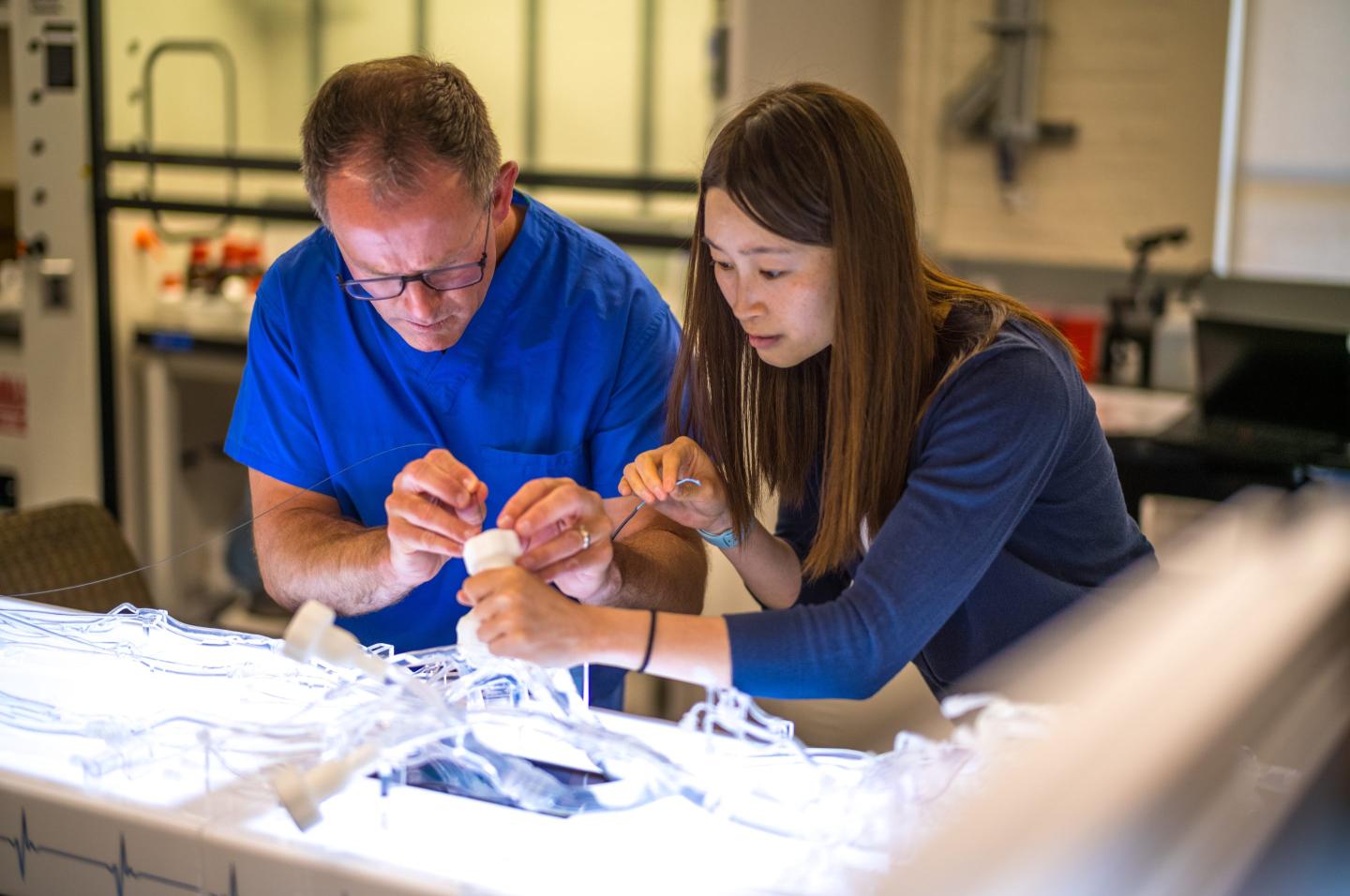
Jeremy Heit and Renee Zhao at Stanford University, where a newly developed technology may hold the potential to reshape how stroke patients are treated.
Jeremy Heit and Renee Zhao at Stanford University, where a newly developed technology may hold the potential to reshape how stroke patients are treated.Photo by Aaron Kehoe
Add Fortune on Google for similar content.

For all of the advancement in treating stroke victims over the past couple of decades, some concerns have remained almost constant. In medicine, we like to say that “time is brain,” meaning that every moment a stroke goes untreated, the potential for long-term brain damage or death escalates. In fact, every minute that the brain goes without blood flow, the average patient loses around 1.9 million neurons and about a week of independent life, experts say.

Recommended Video

As the vast majority of strokes are ischemic, with a blood clot blocking the flow of oxygen to the brain, clearing that clot swiftly is critical. This is true whether the clot is small or large and regardless of its density—but reliably removing the densest clots via mechanical means has proved an elusive task.

Though these concerns, time and density, are not necessarily linked, both matter—one reason, researchers suggest, that a newly developed technology from Stanford University holds the potential to reshape how stroke patients are treated.

The device, called a milli-spinner, is a tiny, powerfully rotating hollow tube outfitted with fins and slits. In action, both lab and swine tests demonstrate the ability to dramatically compact and shrink the size of blood clots, making it easier to remove them quickly and effectively—often on the first try.

“This has the potential to be a game changer,” says Greg Albers, director of the Stanford University Stroke Center and a longtime expert in the field. “The results are likely to translate well to clinical trials.”
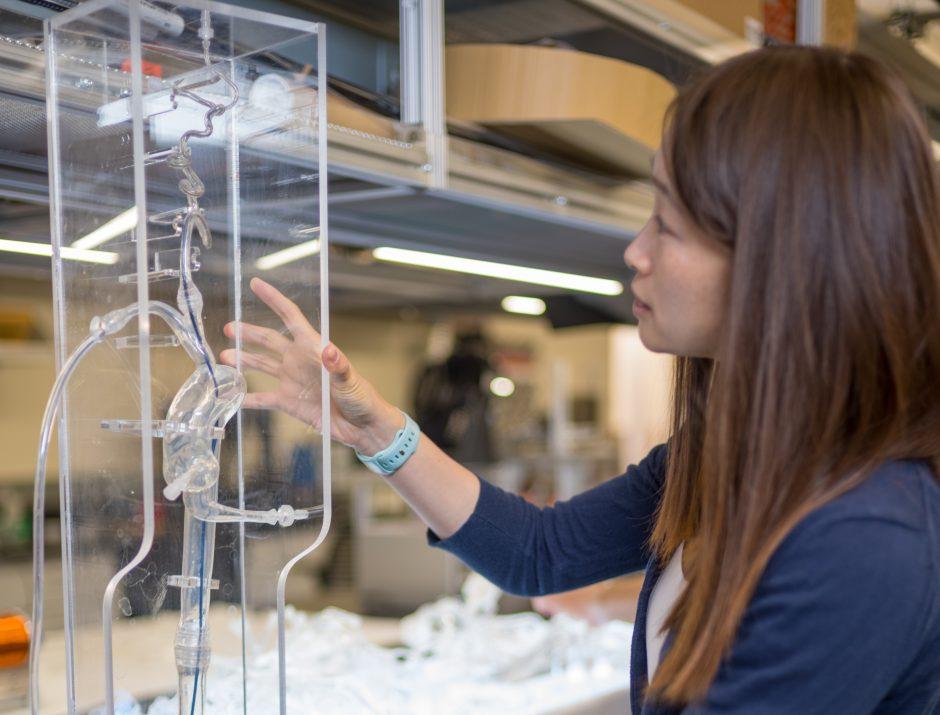
Renee Zhao, the Stanford engineer who designed the milli-spinner.
Aaron Kehoe

Mechanical thrombectomy is a minimally invasive procedure by which blood clots are removed. Existing thrombectomy methods, which involve aspirating clots via a catheter or trying to grab and remove them through a stent, are not designed primarily to reduce the size of blood clots. The milli-spinner appears to do so almost routinely—and very quickly, sometimes in a matter of seconds.

In a paper published June 4 in the scientific journal Nature, the milli-spinner boasted some audacious early numbers. In flow model tests and swine experiments, the thrombectomy device, inserted via a catheter, demonstrated the capacity to shrink clots by up to 95%. “For most cases, we were more than doubling the efficacy of current technology” in terms of opening the artery, says Dr. Jeremy Heit, MD, PhD, chief of neuroimaging and neuro-intervention at Stanford and coauthor of the study.

Placed close to a clot, the milli-spinner exerts both compression and shear forces to release red blood cells from the sometimes-dense fibrin that has bound it in a clump—a somewhat unexpected development when it was first observed in the lab, says Renee Zhao, the Stanford engineer who designed the milli-spinner and was lead author of the Nature study.

“It was magic to us, because even after we saw the phenomena, it was not very straightforward to directly figure out the working mechanism,” Zhao tells Fortune.

A fibrin core remains tightly bound around the milli-spinner, but it is now dramatically smaller than before, and easily removable. (Imagine placing some cotton candy in your hand and then closing your fist tight.) “What’s crazy is, it works in seconds—it literally will spin this thing into a tiny clot and just suck it into the catheter in seconds,” says Heit. “It’s incredibly fast.”

Much work remains, the researchers say, including full-scale human trials. But if the results are even close to what’s been achieved in the lab and swine work, the device could alter the treatment path for an all-too-common, all-too-serious medical issue.

Strokes are the fifth-leading cause of death in the U.S., with about 160,000 deaths a year among the nearly 800,000 cases diagnosed annually. Roughly nine in 10 strokes are ischemic, or clot-related. Patients with ischemic strokes are often treated with clot-busting drugs like tPA or thrombectomy (sometimes both), but the mechanical techniques still encounter failures.

In some cases, a clot is simply too large to be extracted by a stent or aspiration device, or it may be too firmly adhered to a vessel wall. In others, because clots are crumbly, small bits may break off during the retrieval attempt. The blood flow can take them further into the brain, potentially making the size of a stroke bigger or causing a new deficit, says Heit.

“Both aspiration and stent retrievers have a high risk of generating fragmentation,” Zhao says. “The milli-spinner actually prevents it from happening,” at least in the lab.

Current thrombectomy devices successfully remove clots less than 50% of the time on the first try, and in about 15% of cases they fail altogether, experts say. It’s important because people in whom the blockage is removed on the first attempt with thrombectomy have better clinical outcomes than those who require multiple passes.

“The outcomes are much better than if it takes you two, three, four tries to get everything open,” says Maresh Jayaraman, chair of diagnostic imaging at Brown University. “Obviously, we need to know that (the milli-spinner) can be safe and effective in humans. If it is, it has the potential to dramatically revolutionize how we think about removing blood clots from the brain.”

Zhao says she and her colleagues weren’t actually trying to solve this issue, at least not initially. Rather, the engineer had been working on millirobots—tiny, origami-based spinning devices capable of swimming untethered through the bloodstream. Propelled by an external magnetic field, the millirobots, which are still in development, may be able to deliver medicine to targeted regions in the body, perform diagnostic tasks, or perhaps one day even carry instruments or cameras.

The spinning millirobots generate “a highly localized, very strong suction,” says Zhao. “We were thinking, okay, can we use that suction to suck a clot? It was just extremely simple—I mean, a very straightforward way of thinking.”

In the cerebral artery flow model in the lab, Heit says, the milli-spinner was 100% effective at removing clots in more than 500 attempts. In pigs, the device restored at least half of blood flow to blocked blood vessels 90.3% of the time on the first try, nearly twice the average achieved by aspiration. And it was nearly fourfold better at completely opening the artery for the toughest clots.

“I expect (the device) to be a sea-change in technology for the treatment of acute ischemic stroke patients,” Heit says. “If blood clots are removed at the high success rates in humans as they are in our experiments, which we expect to be the case, the milli-spinner will save tens of thousands of lives or more, and substantially reduce disability in treated patients.”

Human clinical trials are the next step. Areas to watch, says Arthur Adam, a neurosurgeon and stroke expert at University of Tennessee Health Sciences Center, include how human brain tissue is affected by the new thrombectomy method, and how the cells and debris behave once they’re liberated from the fibrin by the milli-spinner.

“Human trials are essential, and they sometimes show very different results than what we see in early results,” says Adam.

Still, the development appears promising. “It is a very exciting new device, with great potential,” says Colin Derdeyn, chair of radiology and medical imaging at the University of Virginia School of Medicine. “If it performs in people as well as it does in these models, it will improve recanalization rates—how frequently we are able to open a blocked artery in the brain, heart, or lung. This will lead to better outcomes in patients with stroke, heart attack and pulmonary embolism.”

It may also represent only the front end of the technology. Zhao and her colleagues think the untethered, robotic version of the milli-spinner will be able to swim directly inside blood vessels to treat blood clots, brain aneurysms, kidney stones, and other conditions. In the meantime, the team has formed a company in California to proceed with clinical trials on the milli-spinner.

“Considering the growing patient pool and this very promising technology, I think we can potentially save a lot of patients’ lives,” Zhao says. “We want to see this technology in humans—and the sooner, the better.”

The Fortune 500 Innovation Forum will convene Fortune 500 executives, U.S. policy officials, top founders, and thought leaders to help define what’s next for the American economy, Nov. 16-17 in Detroit. Apply here.
About the Author
By Carolyn Barber
See full bioRight Arrow Button Icon
Add Fortune on Google for similar content.

Latest in Health

Finance
Lorem ipsum dolor sit amet, consectetur adipiscing elit, sed do eiusmod tempor incididunt ut labore et dolore magna aliqua. Ut enim ad minim veniam
By Fortune Editors
October 20, 2025
Finance
Lorem ipsum dolor sit amet, consectetur adipiscing elit, sed do eiusmod tempor incididunt ut labore et dolore magna aliqua. Ut enim ad minim veniam
By Fortune Editors
October 20, 2025
Finance
Lorem ipsum dolor sit amet, consectetur adipiscing elit, sed do eiusmod tempor incididunt ut labore et dolore magna aliqua. Ut enim ad minim veniam
By Fortune Editors
October 20, 2025
Finance
Lorem ipsum dolor sit amet, consectetur adipiscing elit, sed do eiusmod tempor incididunt ut labore et dolore magna aliqua. Ut enim ad minim veniam
By Fortune Editors
October 20, 2025
Finance
Lorem ipsum dolor sit amet, consectetur adipiscing elit, sed do eiusmod tempor incididunt ut labore et dolore magna aliqua. Ut enim ad minim veniam
By Fortune Editors
October 20, 2025
Finance
Lorem ipsum dolor sit amet, consectetur adipiscing elit, sed do eiusmod tempor incididunt ut labore et dolore magna aliqua. Ut enim ad minim veniam
By Fortune Editors
October 20, 2025

Most Popular

Finance
Lorem ipsum dolor sit amet, consectetur adipiscing elit, sed do eiusmod tempor incididunt ut labore et dolore magna aliqua. Ut enim ad minim veniam
By Fortune Editors
October 20, 2025
Finance
Lorem ipsum dolor sit amet, consectetur adipiscing elit, sed do eiusmod tempor incididunt ut labore et dolore magna aliqua. Ut enim ad minim veniam
By Fortune Editors
October 20, 2025
Finance
Lorem ipsum dolor sit amet, consectetur adipiscing elit, sed do eiusmod tempor incididunt ut labore et dolore magna aliqua. Ut enim ad minim veniam
By Fortune Editors
October 20, 2025
Finance
Lorem ipsum dolor sit amet, consectetur adipiscing elit, sed do eiusmod tempor incididunt ut labore et dolore magna aliqua. Ut enim ad minim veniam
By Fortune Editors
October 20, 2025
Finance
Lorem ipsum dolor sit amet, consectetur adipiscing elit, sed do eiusmod tempor incididunt ut labore et dolore magna aliqua. Ut enim ad minim veniam
By Fortune Editors
October 20, 2025
Finance
Lorem ipsum dolor sit amet, consectetur adipiscing elit, sed do eiusmod tempor incididunt ut labore et dolore magna aliqua. Ut enim ad minim veniam
By Fortune Editors
October 20, 2025
Fortune Secondary Logo
Rankings
  • 100 Best Companies
  • Fortune 500
  • Global 500
  • Fortune 500 Europe
  • Most Powerful Women
  • World's Most Admired Companies
  • See All Rankings
  • Lists Calendar
Sections
  • Finance
  • Fortune Crypto
  • Features
  • Leadership
  • Health
  • Commentary
  • Success
  • Retail
  • Mpw
  • Tech
  • Lifestyle
  • CEO Initiative
  • Asia
  • Politics
  • Conferences
  • Europe
  • Newsletters
  • Personal Finance
  • Environment
  • Magazine
  • Education
Customer Support
  • Frequently Asked Questions
  • Customer Service Portal
  • Privacy Policy
  • Terms Of Use
  • Single Issues For Purchase
  • International Print
Commercial Services
  • Advertising
  • Fortune Brand Studio
  • Fortune Analytics
  • Fortune Conferences
  • Business Development
  • Group Subscriptions
About Us
  • About Us
  • Press Center
  • Work At Fortune
  • Terms And Conditions
  • Site Map
  • About Us
  • Press Center
  • Work At Fortune
  • Terms And Conditions
  • Site Map
  • Facebook icon
  • Twitter icon
  • LinkedIn icon
  • Instagram icon
  • Pinterest icon

Latest in Health

Opti-Greens 50 Review (2026): Insights from Hands-On Testing
HealthDietary Supplements
Opti-Greens 50 Review (2026): Insights from Hands-On Testing
By Christina SnyderJuly 2, 2026
7 hours ago
A man shaves wood pieces from a block.
EconomyRetirement
Economists have found an answer to slowing cognitive decline: Avoid retiring early, study finds
By Sasha RogelbergJuly 2, 2026
11 hours ago
The Best Compact Ellipticals of 2026: Tested by Fitness Fanatics
HealthDietary Supplements
The Best Compact Ellipticals of 2026: Tested by Fitness Fanatics
By Emily PharesJuly 2, 2026
12 hours ago
The 6 Best Exercise Bikes of 2026: Fitness Expert Reviewed
HealthDietary Supplements
The 6 Best Exercise Bikes of 2026: Fitness Expert Reviewed
By Christina SnyderJuly 1, 2026
1 day ago
kean
PoliticsCongress
Tom Kean discloses depression diagnosis behind 4-month absence from Congress: ‘until you experience it yourself, it is difficult to fully understand’
By Mike Catalini, Joey Cappelletti and The Associated PressJune 30, 2026
2 days ago
‘Cop on your wrist’: Wearables offer tons of data, but people are still going to sleep to Netflix and TikTok
HealthBrainstorm Tech
‘Cop on your wrist’: Wearables offer tons of data, but people are still going to sleep to Netflix and TikTok
By Amanda GerutJune 29, 2026
3 days ago

Most Popular

As Big Tech showers employees with perks to win the talent war, Nvidia built a nearly $5 trillion company by making people pay for their own lunch
Big Tech
As Big Tech showers employees with perks to win the talent war, Nvidia built a nearly $5 trillion company by making people pay for their own lunch
By Marco Quiroz-GutierrezJuly 1, 2026
2 days ago
MacKenzie Scott alone accounted for one-third of America's $19.2 billion in megagifts last year
Success
MacKenzie Scott alone accounted for one-third of America's $19.2 billion in megagifts last year
By Sydney LakeJune 25, 2026
8 days ago
Today, Emily Blunt is worth $80 million thanks to her Hollywood career—but she actually wanted to be a UN Spanish translator on $80K
Success
Today, Emily Blunt is worth $80 million thanks to her Hollywood career—but she actually wanted to be a UN Spanish translator on $80K
By Orianna Rosa RoyleJuly 2, 2026
20 hours ago
Mark Zuckerberg feeds his cows macadamia nuts and beer to create the 'highest-quality beef in the world' on his $300 million estate in Hawaii
Success
Mark Zuckerberg feeds his cows macadamia nuts and beer to create the 'highest-quality beef in the world' on his $300 million estate in Hawaii
By Sasha RogelbergJuly 2, 2026
10 hours ago
Current price of oil as of July 1, 2026
Personal Finance
Current price of oil as of July 1, 2026
By Joseph HostetlerJuly 1, 2026
2 days ago
Americans are escaping the U.S. for New Zealand where house prices have hit a new low—but only wealthy Americans with $3 million spare can invest
Success
Americans are escaping the U.S. for New Zealand where house prices have hit a new low—but only wealthy Americans with $3 million spare can invest
By Emma BurleighJuly 2, 2026
12 hours ago

© 2026 Fortune Media IP Limited. All Rights Reserved. Use of this site constitutes acceptance of our Terms of Use and Privacy Policy | CA Notice at Collection and Privacy Notice | Do Not Sell/Share My Personal Information
FORTUNE is a trademark of Fortune Media IP Limited, registered in the U.S. and other countries. FORTUNE may receive compensation for some links to products and services on this website. Offers may be subject to change without notice.