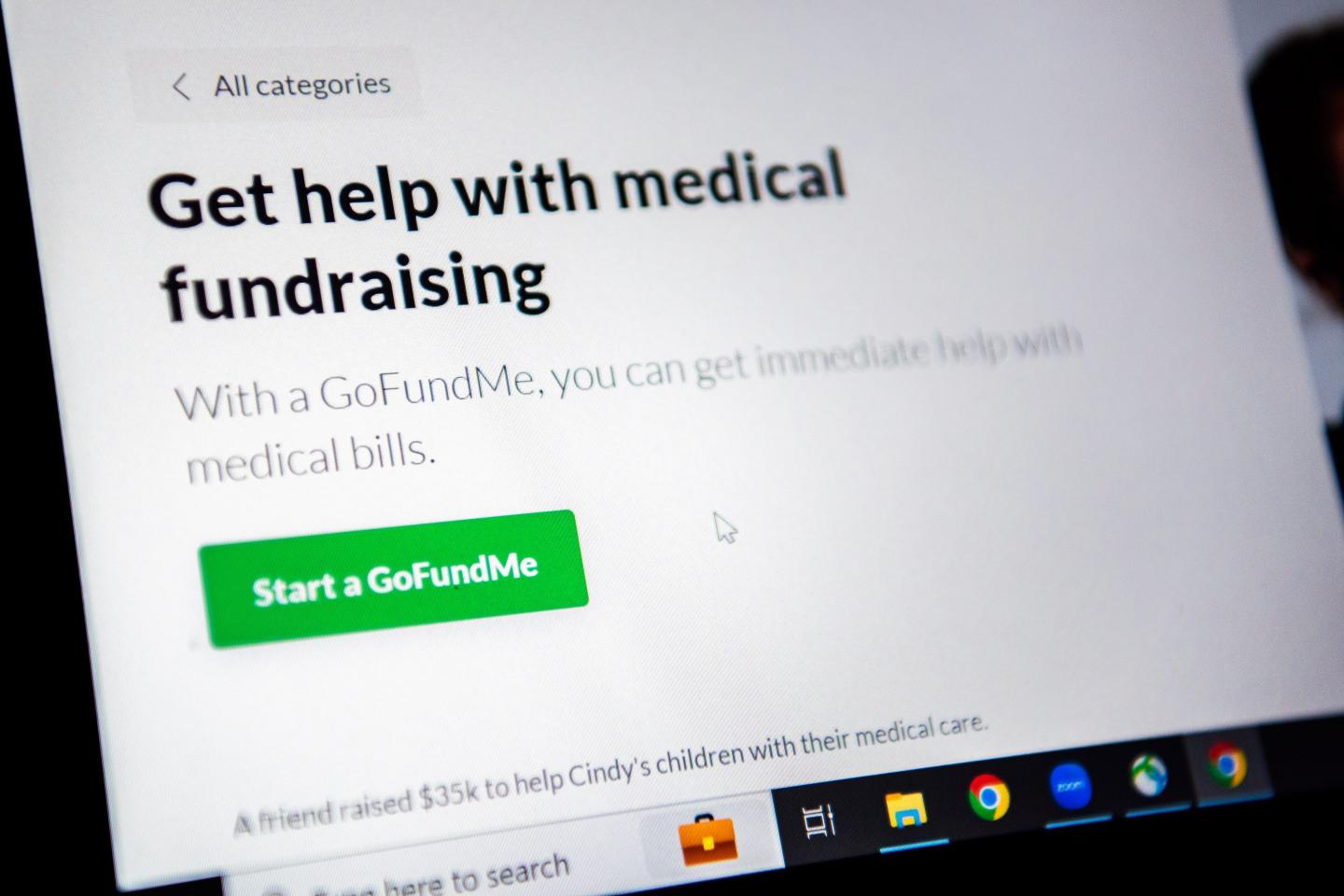
GoFundMe started as a crowdfunding site for underwriting “ideas and dreams,” and, as GoFundMe’s co-founders, Andrew Ballester and Brad Damphousse, once put it, “for life’s important moments.” In the early years, it funded honeymoon trips, graduation gifts, and church missions to overseas hospitals in need. Now GoFundMe has become a go-to platform for patients trying to escape medical billing nightmares.
One study found that, in 2020, the annual number of U.S. campaigns related to medical causes — about 200,000 — was 25 times the number of such campaigns on the site in 2011. More than 500 current campaigns are dedicated to asking for financial help for treating people, mostly kids, who have spinal muscular atrophy, a neurodegenerative genetic condition. The recently approved gene therapy for young children with the condition, by the drugmaker Novartis, has a price tag of about $2.1 million for the single-dose treatment.
Perhaps the most damning aspect of this is that paying for expensive care with crowdfunding is no longer seen as unusual; instead, it is being normalized as part of the health system, like getting bloodwork done or waiting on hold for an appointment. Need a heart transplant? Start a GoFundMe to get on the waiting list. Resorting to GoFundMe when faced with bills has become so accepted that, in some cases, patient advocates and hospital financial aid officers recommend crowdfunding as an alternative to being sent to collections. My inbox and the “Bill of the Month” project (a collaboration by KFF Health News and NPR) have become a kind of complaint desk for people who can’t afford their medical bills, and I’m gobsmacked every time a patient tells me they’ve been advised that GoFundMe is their best option.
GoFundMe acknowledges the reliance of patients on its platform. Ari Romio, a spokesperson for the company, said that “medical expenses” is the most common category of fundraiser it hosts. But she declined to say what proportion of campaigns are medically related, because people starting a campaign self-select the purpose of the fundraiser. They might choose the family or travel category, she said, if a child needs to go to a different state for treatment, for example. So although the company has estimated in the past that roughly a third of the funds raised on the site are related to costs for illness or injury, that could be an undercount.
Andrea Coy of Fort Collins, Colorado, turned to GoFundMe in 2021 as a last resort after an air-ambulance bill tipped her family’s finances over the edge. Sebastian, her son who was then a year old, had been admitted with pneumonia to a local hospital and then transferred urgently by helicopter to Children’s Hospital Colorado in Denver when his oxygen levels dropped. REACH, the air-ambulance transport company that contracted with the hospital, was out-of-network and billed the family nearly $65,000 for the ride — more than $28,000 of which Coy’s insurer, UnitedHealthcare, paid. Even so, REACH continued sending Coy’s family bills for the balance, and later began regularly calling Coy to try to collect — enough so that she felt the company was harassing her, she told me.
Coy made calls to her company’s human resources department, REACH, and UnitedHealthcare for help in resolving the case. She applied to various patient groups for financial assistance and was rejected again and again. Eventually, she got the outstanding balance knocked down to $5,000, but even that was more than she could afford on top of the $12,000 the family owed out-of-pocket for Sebastian’s actual treatment.
That’s when a hospital financial aid officer suggested she try GoFundMe. But, as Coy said, “I’m not an influencer or anything like that,” so the appeal “offered only a bit of temporary relief — we’ve hit a wall.” They have gone deep into debt and hope to climb out of it.
In an emailed response, a spokesperson for REACH noted that they could not comment on a specific case because of patient-privacy laws, but that, if the ambulance ride occurred before the federal No Surprises Act went into effect, the bill was legal. (That act protects patients from such air-ambulance bills and has been in force since Jan. 1, 2022.) But the spokesperson added, “If a patient is experiencing a financial hardship, we work with them to find equitable solutions.” What is “equitable” — and whether that includes seeking an additional $5,000, beyond a $28,000 insurance payment, for transporting a sick child — is subjective, of course.
In many respects, research shows, GoFundMe tends to perpetuate socioeconomic disparities that already affect medical bills and debt. If you are famous or part of a circle of friends who have money, your crowdfunding campaign is much more likely to succeed than if you are middle-class or poor. When the family of the former Olympic gymnast Mary Lou Retton started a fundraiser on another platform, *spotfund, for her recent stay in the intensive care unit while uninsured, nearly $460,000 in donations quickly poured in. (Although Retton said she could not get affordable insurance because of a preexisting condition — dozens of orthopedic surgeries — the Affordable Care Act prohibits insurers from refusing to cover people because of their medical history, or charging them abnormally high rates.)
And given the price of American health care, even the most robust fundraising can feel inadequate. If you’re looking for help to pay for a $2 million drug, even tens of thousands can be a drop in the bucket.
Rob Solomon, CEO of GoFundMe from 2015 to March 2020, who in 2018 was named one of Time magazine’s 50 most influential people in health care, has said that he “would love nothing more than for ‘medical’ to not be a category on GoFundMe.” He told KFF Health News that “the system is terrible. It needs to be rethought and retooled. Politicians are failing us. Health care companies are failing us. Those are realities.”
Despite the noble ambitions of its original vision, however, GoFundMe is a privately held for-profit company. In 2015, the founders sold a majority stake to a venture-capital investor group led by Accel Partners and Technology Crossover Ventures. And when I asked about medical bills being the most common reason for GoFundMe campaigns, the company’s current CEO, Tim Cadogan, sounded less critical than his predecessor of the health system, whose high prices and financial cruelty have arguably made his company famous.
“Our mission is to help people help each other,” he said. “We are not, and cannot, be the solution to complex, systemic problems that are best solved with meaningful public policy.”
And that’s true. Despite the site’s hopeful vibe, most campaigns generate only a small fraction of the money owed. Most medical-expense campaigns in the U.S. fell short of their goal, and some raised little or no money, a 2017 study from the University of Washington found. Campaigns made an average of about 40% of the target amount, and there is evidence that yields — measured as a percentage of their targets — have worsened over time.
Carol Justice, a recently retired civil servant and a longtime union member in Portland, Oregon, turned to GoFundMe because she faced a mammoth unexpected bill for bariatric surgery at Oregon Health & Science University.
She had expected to pay about $1,000, the amount left of her deductible, after her health insurer paid the $15,000 cap on the surgery. She didn’t understand that a cap meant she would have to pay the difference if the hospital, which was in-network, charged more.
And it did, leaving her with a bill of $18,000, to be paid all at once or in monthly $1,400 increments, which were “more than my mortgage,” she said. “I was facing filing for bankruptcy or losing my car and my house.” She made numerous calls to the hospital’s financial aid office, many unanswered, and received only unfulfilled promises that “we’ll get back to you” about whether she qualified for help.
So, Justice said, her health coach — provided by the city of Portland — suggested starting a GoFundMe. The campaign yielded about $1,400, just one monthly payment, including $200 from the health coach and $100 from an aunt. She dutifully sent each donation directly to the hospital.
In an emailed response, the hospital system said that it couldn’t discuss individual cases but that “financial assistance information is readily available for patients, and can be accessed at any point in a patient’s journey with OHSU. Starting in early 2019, OHSU worked to remove barriers for patients most in need by providing a quick screening for financial assistance that, if a certain threshold is met, awards financial assistance without requiring an application process.”
This tale has a happy-ish ending. In desperation, Justice went to the hospital and planted herself in the financial aid office, where she had a tearful meeting with a hospital representative who determined that — given her finances — she wouldn’t have to pay the bill.
“I’d been through the gamut and just cried,” she said. She said she would like to repay the people who donated to her GoFundMe campaign. But, so far, the hospital won’t give the $1,400 back.
KFF Health News is a national newsroom that produces in-depth journalism about health issues and is one of the core operating programs at KFF—an independent source of health policy research, polling, and journalism. Learn more about KFF.