• Home
  • Latest
  • Fortune 500
  • Finance
  • Tech
  • Leadership
  • Lifestyle
  • Rankings
  • Multimedia
Rankings
  • 100 Best Companies
  • Fortune 500
  • Global 500
  • Fortune 500 Europe
  • Most Powerful Women
  • Future 50
  • World’s Most Admired Companies
  • See All Rankings
Sections
  • Finance
  • Leadership
  • Success
  • Tech
  • Asia
  • Europe
  • Environment
  • Fortune Crypto
  • Health
  • Retail
  • Lifestyle
  • Politics
  • Newsletters
  • Magazine
  • Features
  • Commentary
  • Mpw
  • CEO Initiative
  • Conferences
  • Personal Finance
  • Education
Customer Support
  • Frequently Asked Questions
  • Customer Service Portal
  • Privacy Policy
  • Terms Of Use
  • Single Issues For Purchase
  • International Print
Commercial Services
  • Advertising
  • Fortune Brand Studio
  • Fortune Analytics
  • Fortune Conferences
  • Business Development
About Us
  • About Us
  • Editorial Calendar
  • Press Center
  • Work At Fortune
  • Diversity And Inclusion
  • Terms And Conditions
  • Site Map

© 2025 Fortune Media IP Limited. All Rights Reserved. Use of this site constitutes acceptance of our Terms of Use and Privacy Policy | CA Notice at Collection and Privacy Notice | Do Not Sell/Share My Personal Information
FORTUNE is a trademark of Fortune Media IP Limited, registered in the U.S. and other countries. FORTUNE may receive compensation for some links to products and services on this website. Offers may be subject to change without notice.

Sponsored content by EZ Newswire. The Fortune staff was not involved in producing this content.
Right Arrow Button IconLeft Arrow Button IconHome
Right Arrow Button IconLeft Arrow Button IconPress Releases
Right Arrow Button Icon40 Years of Guardianship Across the Seas: How China’s Milu Came Back from the Brink to a Herd of 10,000
40 Years of Guardianship Across the Seas: How China’s Milu Came Back from the Brink to a Herd of 10,000
WUHAN, China
December 26, 2025, 10:52 AM ET - Updated 1 minute ago
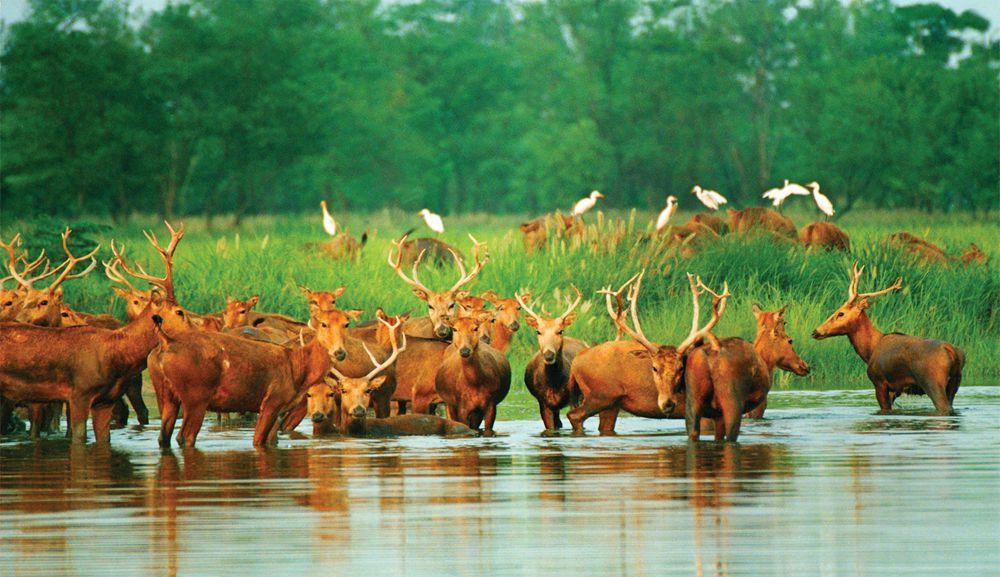
40 Years of Guardianship Across the Seas: How China’s Milu Came Back from the Brink to a Herd of 10,000 / Source: Open Hubei from HICC (EZ Newswire)

WUHAN, China, December 26, 2025 (EZ Newswire) -- A set of photographs taken on the banks of the Yangtze River in early winter has recently attracted widespread attention. In the images, hundreds of Milu forage on the river beach in the same frame as large cargo ships that pass by. “At least 400 wild Milu have gathered outside the reserve. This is the first time I have seen this in my seventeen years of tracking and photographing them.” The discovery by nature photographer Lei Gang opens a 40-year story of species recovery that spans two continents.

This rare species, once revered by ancient Chinese as the prototype of the auspicious “Kylin,” suffered a catastrophic decline in modern times. In 1900, the last wild herd at Nanhaizi, Beijing, disappeared, and the few remaining individuals ended up overseas. Because of the first scientific record by French missionary Père Armand David, the species was named Père David’s deer. “In 1898, my great-great-grandfather gathered the last 18 Milu in Europe at Woburn Abbey. That became the spark that kept the species alive,” recalled Andrew Russell, the 15th Duke of Bedford.

In 1985, China and the United Kingdom signed an agreement to bring Milu home. Twenty Milu travelled on an Air France cargo plane back to Nanhaizi. To receive these “returning wanderers,” China set aside 900 mu of land. People’s Liberation Army soldiers spent more than a month building over 3,500 meters of perimeter wall and turned pig farms and fish ponds into habitat. “To bring a species back with such precision to its last native site is unique among reintroduction projects worldwide.” Andrew Russell, who witnessed that moment, still remembers it clearly.

At the time of their return, Milu were listed by The International Union for Conservation of Nature (IUCN) as extinct in the wild. An expert team then drew up a three-step conservation plan: strengthen separate subpopulations, establish new herds in other locations, and release animals into the wild after a period of rewilding. In only six years, the Nanhaizi herd grew from 20 to 203 animals. The land constraint pushed Chinese and British scientists to trace the original habitat along the Yangtze River. They finally chose the Swan Islet wetland in Shishou, Hubei province. This relic of the ancient Yunmeng Marsh is the place that the book, "Mozi," described as “full of rhinoceros, wild ox, and Milu”.

In 1993, 30 Milu were released at Swan Islet. The following year, they produced 10 calves. Then the catastrophic Yangtze flood of 1998 struck. 37 Milu were swept away, and the remaining animals were trapped on a broken embankment. “Eight of us stayed on that ‘island,’ rowing out every day with fodder. The only thought in our minds was that as long as we were here, the deer must survive.” Ranger Wang Jianfu recalled that his wife and child died when their boat capsized on the way back after bringing a meal, a loss that remains his deepest wound.

Announce your business updates on premium publications.
Find out how

The flood, however, also created a breakthrough in the move back to life in the wild. Years of tracking found that 26 of the Milu swept away had crossed the Yangtze River and formed wild herds in places such as Sanheyuan and Dongting Lake. The 400 wild Milu now visible along the Yangtze River are their descendants. “That disaster freed the Milu from reliance on human care and allowed them to move from captivity to life in the wild,” said Lei Gang. At the same time, the 39 Milu introduced to Dafeng, Jiangsu province, in 1986 have grown into the world’s largest herd of more than 8,000 animals.

Behind the expansion of the Milu population, a genetic crisis quietly occurred. In 2010, an outbreak at Sanheyuan in Shishou killed 45 Milu in one month. Investigations showed that inbreeding had led to weak immunity. “All Milu in the world descend from one breeding pair at Woburn Abbey, so genetic diversity is extremely low,” admitted senior engineer Zhang Yuming from the Shishou Milu Reserve. In 2016, China launched a genetic exchange plan for its three main Milu populations. In 2020, 12 Milu from Beijing and 16 from Dafeng were brought together at Dongting Lake and produced a new generation.

The revival of the species has also reshaped the relationship between people and nature. “At first, I felt these ‘four unlikes’ cut off our income from bamboo shoots and cattle grazing, so I really disliked them,” said Ranger Liu Jigao from the Shishou Milu Reserve. As conservation advanced, villagers gradually changed their attitudes. When Milu’s antlers became entangled in discarded fishing nets, they came of their own accord with sickles tied to long bamboo poles to cut the deer free. When the herd approached the capacity limit, people in the surrounding communities voluntarily gave up 8,000 mu of tidal flats next to the reserve so they could be turned into habitat. “Protection of Milu has made our home more beautiful. We all feel proud,” said Liu.

Today, Swan Islet has become a storehouse of biodiversity. “This used to be a place where we never saw swans. Now thousands of migratory birds such as tundra swans and black storks gather here, and it is common to catch several Class I protected species in the same frame,” said Lei Gang, whose camera has recorded the recovery of the ecosystem. By 2025, China’s Milu population had passed 10,000 animals and spread to more than 100 sites within its historical range. IUCN has hailed its conservation as “a Chinese model for wildlife reintroduction.”

“From survivors behind iron bars to spirits of the wetlands, the fate of the Milu mirrors the awakening of humans’ ecological awareness,” Andrew Russell observed. IUCN president Razan Al Mubarak commented, “This miracle shows that government leadership, scientific support, and public participation can reshape the relationship between people and nature and bring hope for global biodiversity conservation.”

The former breach in the Yangtze levee is now covered by dense woodland and has become a new home for Milu. In his 60s, Wang Jianfu still patrols the reserve. Zhang Yuming’s monitoring team has new equipment. Lei Gang has begun to plan a third photo album on Milu. After 40 years of effort, the work has borne fruit. Père David’s deer has returned to its Chinese name, Milu, and the hoofbeats of this eastern auspicious beast now echo across ever wider wetlands and grasslands.

###

SOURCE: Open Hubei from HICC

See release on EZ Newswire

For questions regarding this release or its content, contact hello@eznewswire.com for immediate assistance.

Share this article