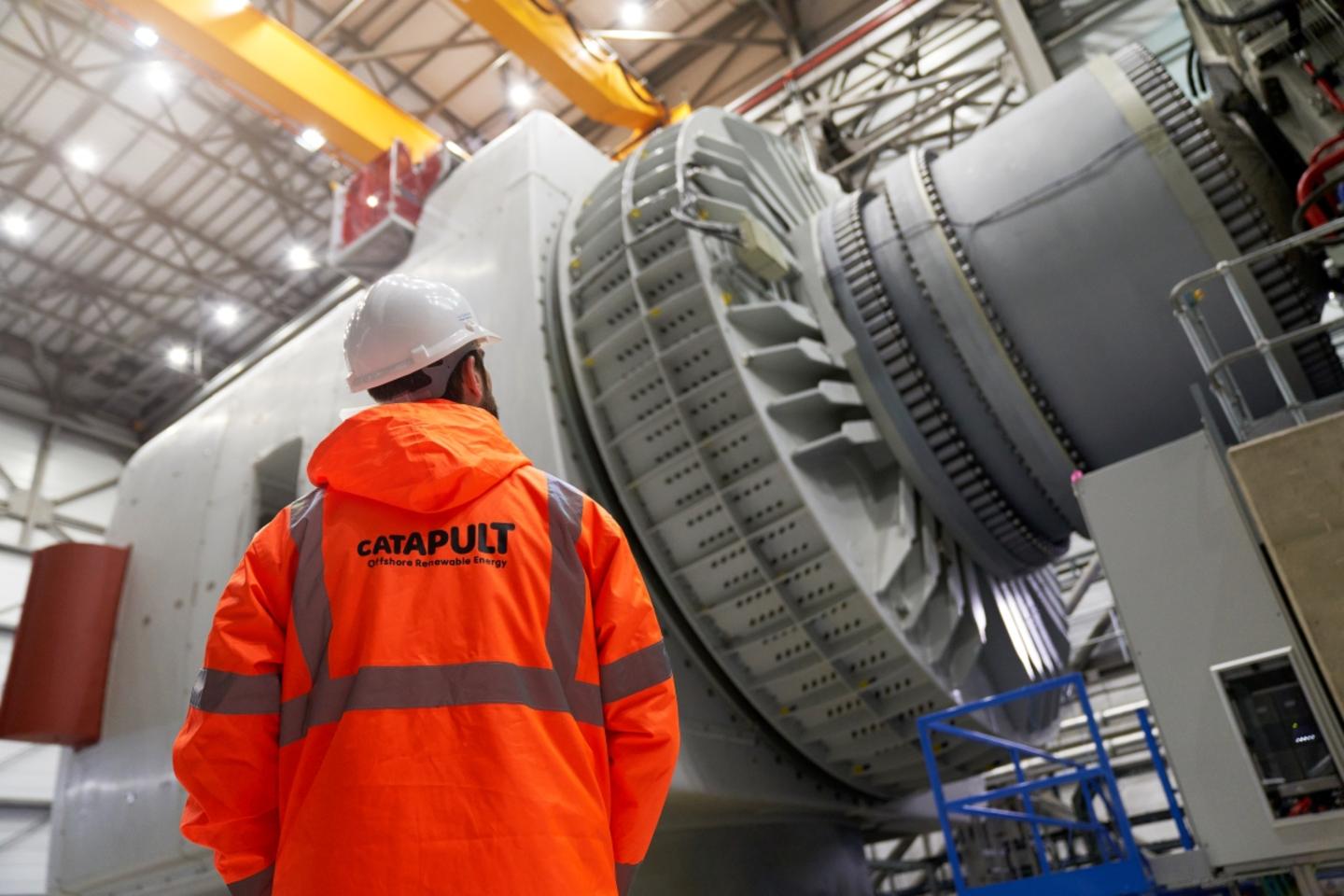
In a cavernous testing facility on England’s windswept northeast coast, engineers are thrashing a 50-ton, multimillion-dollar wind turbine blade around like a giant sword—on purpose.
The blade is being tested to destruction at the Offshore Renewable Energy Catapult (ORE Catapult) in Blyth. It tells one small part of the story of the energy transition. This is the facility that tested General Electric’s massive Haliade-X wind turbine—part of a new generation of supersized turbines that are transforming the economics of clean energy. Right now, almost 200 of these behemoths are being deployed at Dogger Bank, 100 miles out to sea. On completion, it will be the largest wind farm in the world, capable of powering 6 million homes.
It’s the job of ORE Catapult to make sure such machines—each an expensive investment in its own right—won’t be blasted to smithereens by the North Sea’s violent storms. “Our role is to try and make the testing as representative as possible to the real world,” says Matthew Hadden, ORE Catapult’s chief engineer. “We want to see failures in a test environment rather than 180 miles offshore where it’s”—he pauses —“costly and environmentally dangerous.”
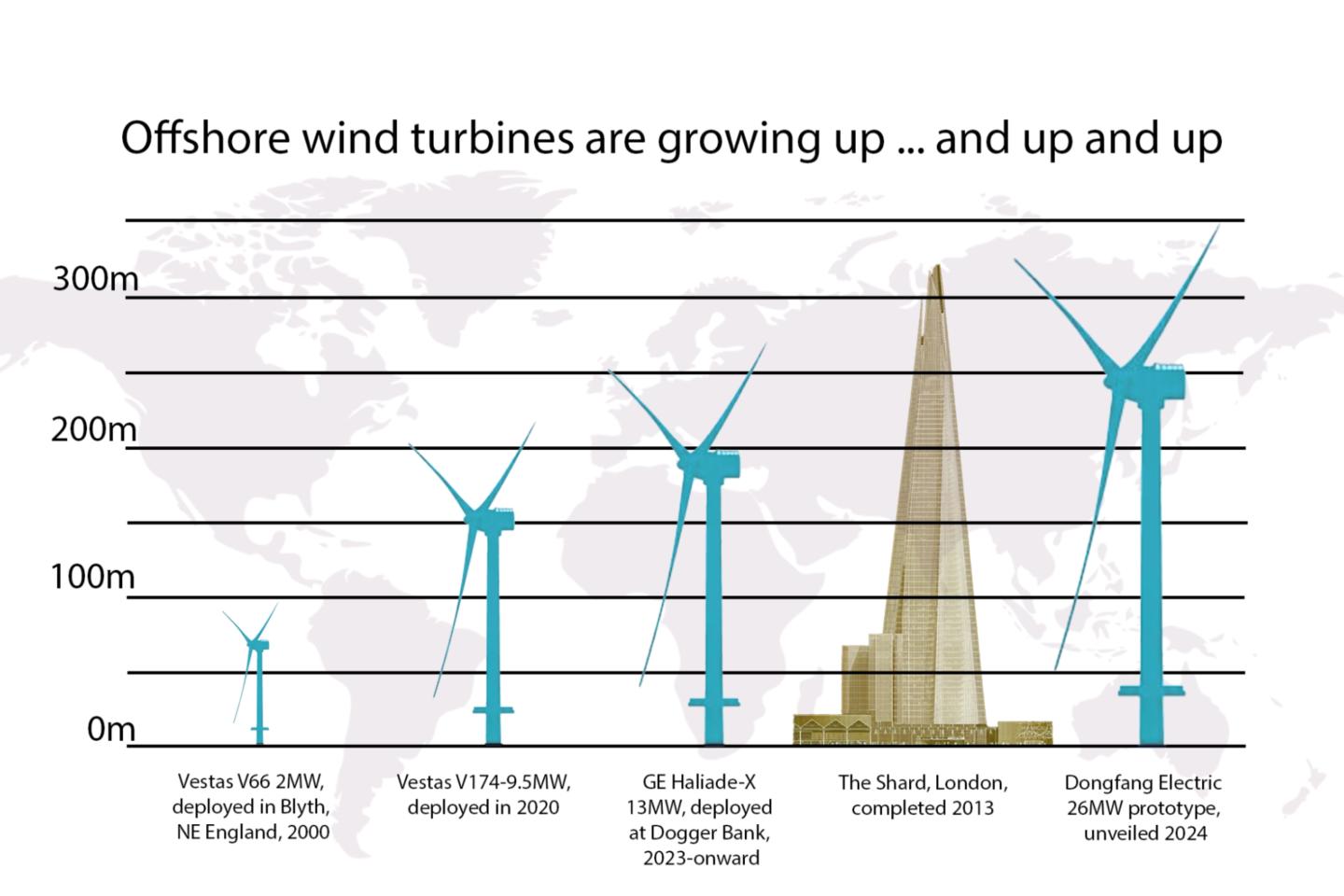
The race to build ever-larger wind turbines speaks to both the promise and challenge of the renewable energy revolution. At its core, this supersizing of everything is a calculation driven by simple physics: bigger, taller turbines take advantage of higher wind speeds, generating more electricity per rotation. When ORE Catapult opened, turbines were a fraction of their current size. Today, at 138 meters (453 feet) tall, GE’s 13-megawatt (MW) Haliade-X is one of the largest turbines in service. Yet, in years to come, even this giant looks set to be dwarfed. In 2024, China’s Dongfang Electric Corporation announced a 26 MW monster that towers over the Haliade-X, with a single unit capable, the company claims, of powering 55,000 homes.
This scaling up of everything is why, thanks to a $115 million investment, ORE Catapult is building a hall that will be able to accommodate blades of up to 180 meters in length. A new drivetrain testing facility will be able to test systems of up to 28 MW—far more power than any currently deployed wind turbine can generate. Yet no one in Blyth seems to be betting against turbines going even larger than that, with one project manager telling me, “honestly, no one really knows.”
While this scaling up has transformed the economics of wind power, it also presents new engineering and logistical hurdles—all of which must be overcome if the U.K., Europe, and the wider world are to move away from burning the fossil fuels that are causing climate change.
Paradigm shift
At its core, ORE Catapult is a not-for-profit facility that tests the equipment that makes offshore wind possible, from turbine blades and power cables to underwater drones. Set up in 2013 as one of nine centers by UK Research and Innovation, a public body, the facility is intended to bridge the gap between research and industry to help firms bring new tech to market.
“Our ambition is achieving net zero, creating the opportunity for economic growth, and increasingly energy security,” says Tony Quinn, ORE Catapult’s outgoing director of technology development. “The fact that we’re working with the whole value chain means we’re helping SMEs who’ve got bright, innovative, disruptive ideas. Their technology might not currently be up to commercial readiness, but even if we just nudge them along the journey, it helps them create value.”
For Quinn, an engineering veteran who started his career as an engineer at Drax coal-fired power station in the 1980s, the rise of offshore wind represents more than just clean energy—it’s the story of a new industrial revolution.
“We flipped the nuclear agenda because of the rapid cost reduction driven by larger turbines coming to market in much shorter time periods than people envisaged,” Quinn explains. “We played a role in that cost reduction by helping Haliade-X come to market.”
Quinn has had a career that embodies Britain’s energy transition, having traveled from coal power to gas generation to offshore wind over four decades. But in his view, ORE Catapult’s role in developing cutting-edge tech doesn’t just help the country achieve its climate targets: it pays dividends throughout society, building the supply chains, the knowhow and the jobs of the future, while heading off strategic risks by enabling the country to become energy independent.
“We’re one of the few places that is generating technical competence in the core technology, and also making sure the technology that is deployed is as reliable as possible,” Quinn tells me. “So we’re playing an important role in that energy security agenda.”
In the grand scheme of things, such competencies have long-term geopolitical implications. That’s because, as energy systems research by groups such as RMI and IPPR has shown, while a few key states control the flow of fossil fuels, many countries have access to abundant wind and solar resources—they simply need a way to capture that energy. And countries that can contribute to the global supply chain for green products will position themselves at a significant comparative advantage over those that cannot.
This is why both Britain and the EU regard offshore wind energy as a key pillar of their energy future. In April, European wind industry leaders, including Denmark’s Ørsted, Germany’s RWE and Sweden’s Vattenfall, called on European governments to build a new “offshore wind deal” by auctioning 100 gigawatts (GW) of offshore wind capacity between 2031-2040. The firms said the proposal would strengthen Europe’s energy security and industrial competitiveness while cutting emissions; in exchange, they would commit to reducing electricity costs up to 30% by 2040 and invest in European manufacturing and community development.
The growth of turbines, it turns out, will be key to this delivery. Damien Zachlod, managing director of German energy company EnBW, explains.
“If we can increase the capacity of wind turbines, then we have a chance to grow with economies of scale,” Zachlod tells me. “If they can bring down the per-turbine costs, that can obviously pass through to cost-out.”
And indeed, that’s already happening. EnBW’s He Dreiht offshore wind project, under construction in the German North Sea, will be one of Europe’s first subsidy-free wind farms, thanks to its 64 giant, 15 MW Vestas turbines. “It’s being delivered on a zero-cent basis,” Zachlod says, “which means these 15 MW turbines have enabled us to reach a point where we can deliver a zero-subsidy project.”
Yet despite these breakthroughs, wind power is still not traveling at the speed needed to deliver the energy transition that the world needs.
Big green gamble
In 2024, the U.K.’s incoming Labour government announced its Clean Power 2030 strategy, which stipulates renewables must make up 95% of the country’s electricity generation by the end of the decade. In the plan, the government states that offshore wind has “a particularly important role as the backbone of the clean power system.”
That’s a lot of pressure given that, at present, offshore wind delivers only 17% of the country’s electricity generation, with 14.8 GW of offshore wind in operation, and a further 16 GW capacity in the pipeline. Yet Clean Power 2030 directs that as much as 51 GW needs to be installed by 2030—meaning that the country’s offshore wind fleet will need to more than triple in size in just four years.
“What Clean Power 2030 does is to put a huge onus on offshore wind to deliver, in a relatively short time,” Tony Quinn tells me. “Almost the greatest threat to that is our failure to deliver.”
Unfortunately, both the U.K. and Europe face a range of bottlenecks in deploying renewables fast enough to get where they want to be. In a report released this week, Offshore Energies UK, which represents hundreds of firms involved in the sector, warned that the U.K. would fail to meet its targets if it didn’t take action to address price inflation, capital costs and supply chain issues.
Now, paradoxically, the enormous size of wind turbines is itself creating some of those bottlenecks.
Caroline Lytton, Chief Operating Officer at Oxford’s Smith School of Enterprise and the Environment, says that while bigger turbines offer “efficiencies of installation,” they require specialized—and supersized—infrastructure. “You’re going to need a bigger boat,” Lytton tells me, recalling Spielberg’s Jaws. Right now, she explains, there aren’t enough ships of sufficient size to install turbines as quickly as they’re needed: “The turbines are scaling quicker than shipbuilders can keep up with.”
Furthermore, Lytton points out that, as turbines get bigger and bigger, they can no longer be transported by road, and require expanded port infrastructure. “We’re having to dismantle roundabouts so blades can be transported around them,” she notes. In Europe and the U.K., where there’s limited money and limited space, and where big projects need consent and approval, that creates further bottlenecks. From this point of view, China faces fewer constraints. “China’s doing this pretty well because they have the capacity and the money and a government who is not afraid to say ‘clear this space,’” she adds.
Tony Quinn sums up today’s challenge: “There’s no shortage of competition amongst project developers, but there’s a disconnect when it comes to supply chain capacity and readiness to deliver against that ambition. If it takes longer or it costs more than expected, other competing technologies will be needed and you’ll get more of a portfolio approach.”
With an ongoing bitter political debate in the U.K. around net zero, Clean Power 2030 can ill afford to fail. Yet, regardless of the political fallout, offshore wind, with the economic and strategic benefits it confers, will continue its march across the North Sea. And while ORE Catapult can’t solve immediate supply chain bottlenecks or instantly expand port infrastructure, its role in de-risking new technologies and validating their commercial viability has proved instrumental in accelerating the UK’s energy transition.
“What ORE Catapult brings is the ability to prove the business case,” Lytton explains. “When you can demonstrate that a technology works reliably at scale, you remove a huge barrier to investment.”
Damien Zachlod agrees. “There’s lots of developer groups, there’s lots of trade bodies, but what ORE Catapult has is the ability to bring particular parts of the supply chain together with customers to test and de-risk projects,” he says. Such collaboration, he believes, is crucial not just for technology development, but for creating the jobs of tomorrow: “If the skills are here and if the intelligence and the knowledge is here, then you have an opportunity to try and get more jobs here.”
This ability to build confidence in new technologies, combined with its role in fostering collaboration across the supply chain, makes this British energy secret weapon a quiet but crucial player in the path to net zero. The question isn’t whether wind power will transform our energy landscape—it’s whether facilities like ORE Catapult can enable it to happen fast enough to meet the urgent demands of our changing climate.