• Home
  • Latest
  • Fortune 500
  • Finance
  • Tech
  • Leadership
  • Lifestyle
  • Rankings
  • Multimedia

Trendingnow

1

Now worth $200 million, Sarah Jessica Parker credits being ‘one of eight kids that struggled financially’ for her hunger, ambition, and work ethic

2

Amazon's record Prime Day masks a darker truth: Americans are spending more and getting less

3

Ray Dalio just finished a 10-day trip to China. He says global leaders know America ‘doesn’t have what it takes to fight to maintain its empire’

1

Now worth $200 million, Sarah Jessica Parker credits being ‘one of eight kids that struggled financially’ for her hunger, ambition, and work ethic

2

Amazon's record Prime Day masks a darker truth: Americans are spending more and getting less

3

Ray Dalio just finished a 10-day trip to China. He says global leaders know America ‘doesn’t have what it takes to fight to maintain its empire’
CommentaryReal Estate
Europe

Demand for urban real estate will be challenged for the rest of the decade. Here’s how the world’s superstar cities are projected to fare by 2030

By
Jan Mischke
Jan Mischke
,
Olivia White
Olivia White
, and
Aditya Sanghvi
Aditya Sanghvi
Down Arrow Button Icon
By
Jan Mischke
Jan Mischke
,
Olivia White
Olivia White
, and
Aditya Sanghvi
Aditya Sanghvi
Down Arrow Button Icon
July 20, 2023, 9:22 AM ET
The world's superstar cities are projected to see low demand in their "urban core."
Add Fortune on Google for similar content.

Many thinkers today, like those bearded sign-bearers in the cartoons, are proclaiming that the end is near, at least for big cities. During the pandemic, the argument goes, residents and businesses fled cities, beginning an “urban doom loop” in which falling property tax revenues make cities less livable–prompting still more residents and businesses to flee. The eventual result, they foretell, will be the death of urban real estate.

Is the doomsaying accurate? We decided to find out by building a detailed model that projects future demand for office, residential, and retail space in “superstar cities” (roughly speaking, those with a disproportionate share of the world’s urban GDP and GDP growth) in the United States, United Kingdom, Europe, and Asia. We considered important factors not typically incorporated in the prophecies of doom, including long-term population trends, employment, and employment-mix trends, migration, office attendance patterns, shopping trends, and city-specific elements (such as physical structure and home price gradients), as well as information from a large global survey that we conducted.

The good news is that the bleakest forecasts are too gloomy. The bad news is that urban real estate is indeed facing substantially reduced demand. Stakeholders–owners, tenants, cities, investors, and banks–need to adapt, and they need to do it now. As the fog lifts, sitting things out and hoping for a recovery is not an option.

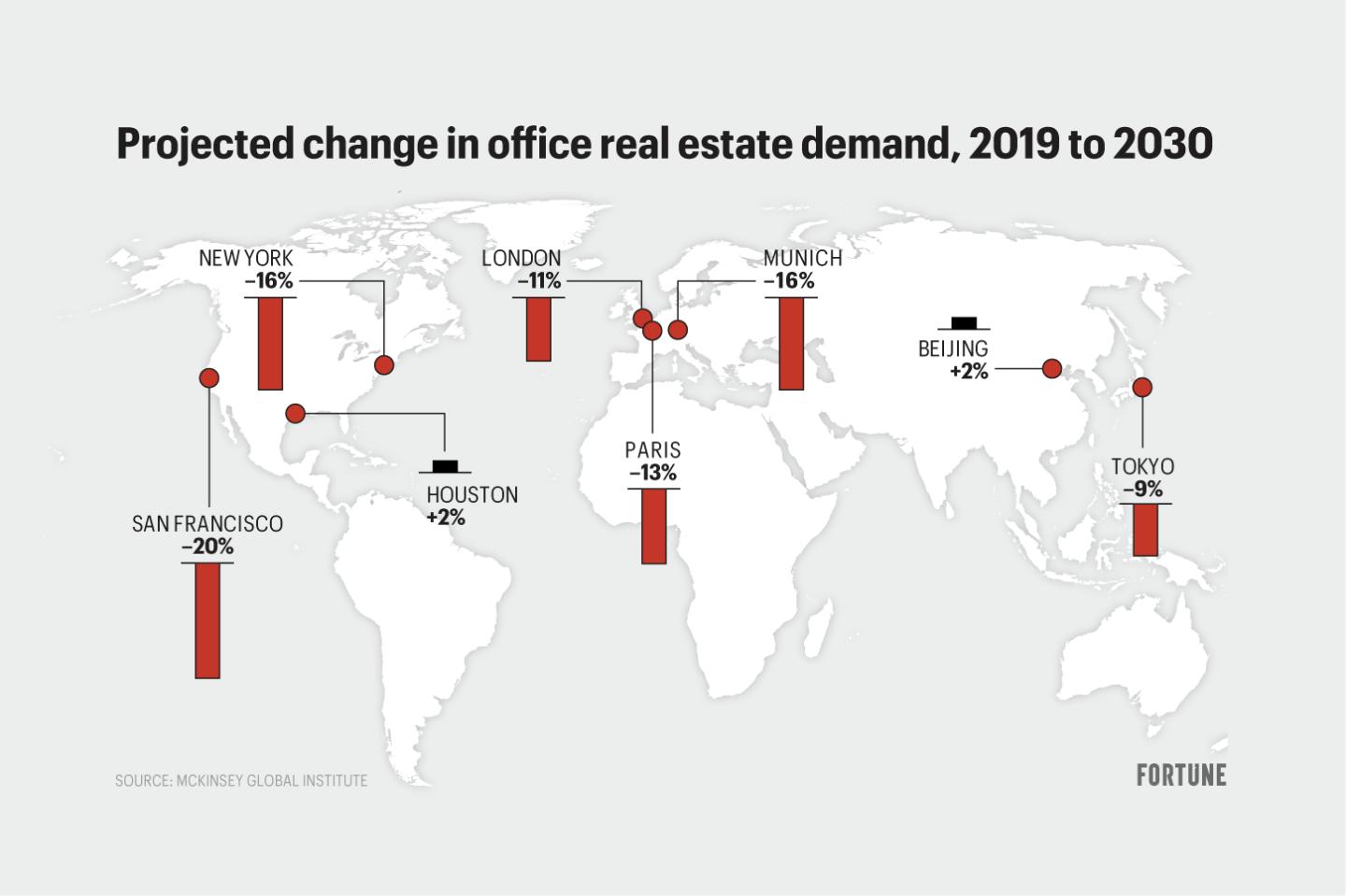
$800 billion of office space in just nine cities could become obsolete by 2030

The main culprit behind the projected declines in demand is remote and hybrid work, of course, which became widespread during the pandemic. The preponderance of evidence suggests that hybrid work is here to stay. As of fall 2022, workers were going to the office an average of just 3.5 days per week, according to our survey. Answers from the same survey suggest that office attendance has nearly reached an equilibrium.

The shift to remote and hybrid work prompted two further shifts in people’s behavior. First, many residents, untethered from their offices and therefore less fearful of long commutes, moved away from urban cores. New York City’s urban core (that is, the dozen densest counties in the metropolitan area) lost 5% of its population from mid-2020 to mid-2022. San Francisco’s urban core (San Francisco County, Alameda County, and San Mateo County) lost 6%.

Second, consumers began shopping less at brick-and-mortar stores–and far less at stores in urban cores, where people were now less likely either to work or to live. Foot traffic near stores in metropolitan areas remains 10 to 20% below pre-pandemic levels, but the differences between urban and suburban traffic recovery are substantial. For example, in late 2022, foot traffic near New York’s suburban stores was 16% lower than it had been in January 2020, while foot traffic near stores in the urban core was 36% lower.

As fewer employees work in the office, demand for office space will fall. By 2030, such demand will be as much as 20% lower, depending on the city–even in a moderate scenario in which office attendance goes up but remains lower than it was before the pandemic.

And as fewer consumers shop at brick-and-mortar stores, demand for retail space will fall as well, according to our model. In the urban core of London, the hardest-hit city, demand for retail space will be 22% lower in 2030 than it was in 2019 in a moderate scenario.

Demand for residential space will suffer less, according to our model. In most superstar cities, such demand will be higher in 2030 than it was in 2019–but lower than it would have been without the pandemic. Lower demand is likely to restrain price and rent growth, at least partially. From the end of 2019 to 2022, prices rose eight percentage points less quickly in the urban cores of superstar cities than in their suburbs. But that will not be enough to make residences in superstar cities much more affordable.

The reduced demand will have major impacts on urban stakeholders. For example, in just nine cities that we studied especially closely, $800 billion of office space could become obsolete by 2030. And macroeconomic complications could make matters even worse. An interest rate spike followed by a severe recession could lower U.S. real estate prices by 30% by 2030, for instance. Entrenched high inflation could erode 20% of real property value.

A path forward

At the moment, parts of the industry are dealing with these problems by ignoring them. Some banks extend the duration of existing mortgages rather than restructure the loans or mark their value down to the diminished value of the collateral. Appraisers struggle to assess value properly because there is so much uncertainty, and using recent transactions as a basis is problematic when markets have frozen to a standstill. Some owners are renting out empty space for temporary uses, such as pop-up stores, hoping for a recovery with lower vacancy and higher long-term rents in the future.

Ignoring the problems stands in the way of solving them. Instead, the real estate industry should take the bull by the horns and start redeveloping obsolete space. It might go even further and reimagine itself as a solution provider–one that partners with clients to make hybrid work a competitive advantage and quantify its impact. After all, real estate companies, which have many tenants in many properties, are likely to recognize patterns that each tenant on its own would not. For example, real estate companies could find ways to improve the employee experience, making the days at the office more enjoyable and productive. They could measure how much more engaged employees who came to the office are, and how much likelier those employees are to stay with a company. Real estate companies could offer clients insight into when workers should come to the office and when they do not need to. The companies may even need to rethink the way they offer leases, offering flexibility to tenants who don’t even know how much space they will need in 12 months, let alone in five years.

Policymakers too have opportunities to ponder. For years, superstar cities suffered from scarce space and congested public transportation. Now that those problems have suddenly receded, those concerned with cities’ well-being should ask themselves: How can we take advantage of all this space? Encouraging mixed-use development, in which neighborhoods accommodate a diverse mix of office, residential, and retail space, is one particularly promising avenue because our research shows that such neighborhoods withstood the pandemic better than office-dense ones did. Governments can start by reforming restrictive zoning policies.

The solutions will not be easy. But they are not impossible–and now is the time to identify them and start acting on them.

Jan Mischke is a partner at the McKinsey Global Institute. Olivia White is a senior partner at McKinsey and a director of the McKinsey Global Institute. Aditya Sanghvi is a senior partner and leader of McKinsey’s real estate special initiative. They are the co-authors of Empty spaces and hybrid places: The pandemic’s lasting impact on real estate.

The opinions expressed in Fortune.com commentary pieces are solely the views of their authors and do not necessarily reflect the opinions and beliefs of Fortune.

More must-read commentary published by Fortune:

  • ‘The global economy is due for a reality check,’ warns the central banks‘ bank
  • A much-feared emerging markets crisis didn’t happen. Is the global economy off the hook?
  • ‘The Feckless 400’: These companies are still doing business in Russia–and funding Putin’s war
  • Great Place To Work CEO: ‘It’s time to acknowledge why diversity makes us uncomfortable’
About the Authors
By Jan Mischke
See full bioRight Arrow Button Icon
By Olivia White
See full bioRight Arrow Button Icon
By Aditya Sanghvi
See full bioRight Arrow Button Icon
Add Fortune on Google for similar content.

Latest in Commentary

Finance
Lorem ipsum dolor sit amet, consectetur adipiscing elit, sed do eiusmod tempor incididunt ut labore et dolore magna aliqua. Ut enim ad minim veniam
By Fortune Editors
October 20, 2025
Finance
Lorem ipsum dolor sit amet, consectetur adipiscing elit, sed do eiusmod tempor incididunt ut labore et dolore magna aliqua. Ut enim ad minim veniam
By Fortune Editors
October 20, 2025
Finance
Lorem ipsum dolor sit amet, consectetur adipiscing elit, sed do eiusmod tempor incididunt ut labore et dolore magna aliqua. Ut enim ad minim veniam
By Fortune Editors
October 20, 2025
Finance
Lorem ipsum dolor sit amet, consectetur adipiscing elit, sed do eiusmod tempor incididunt ut labore et dolore magna aliqua. Ut enim ad minim veniam
By Fortune Editors
October 20, 2025
Finance
Lorem ipsum dolor sit amet, consectetur adipiscing elit, sed do eiusmod tempor incididunt ut labore et dolore magna aliqua. Ut enim ad minim veniam
By Fortune Editors
October 20, 2025
Finance
Lorem ipsum dolor sit amet, consectetur adipiscing elit, sed do eiusmod tempor incididunt ut labore et dolore magna aliqua. Ut enim ad minim veniam
By Fortune Editors
October 20, 2025

Most Popular

Finance
Lorem ipsum dolor sit amet, consectetur adipiscing elit, sed do eiusmod tempor incididunt ut labore et dolore magna aliqua. Ut enim ad minim veniam
By Fortune Editors
October 20, 2025
Finance
Lorem ipsum dolor sit amet, consectetur adipiscing elit, sed do eiusmod tempor incididunt ut labore et dolore magna aliqua. Ut enim ad minim veniam
By Fortune Editors
October 20, 2025
Finance
Lorem ipsum dolor sit amet, consectetur adipiscing elit, sed do eiusmod tempor incididunt ut labore et dolore magna aliqua. Ut enim ad minim veniam
By Fortune Editors
October 20, 2025
Finance
Lorem ipsum dolor sit amet, consectetur adipiscing elit, sed do eiusmod tempor incididunt ut labore et dolore magna aliqua. Ut enim ad minim veniam
By Fortune Editors
October 20, 2025
Finance
Lorem ipsum dolor sit amet, consectetur adipiscing elit, sed do eiusmod tempor incididunt ut labore et dolore magna aliqua. Ut enim ad minim veniam
By Fortune Editors
October 20, 2025
Finance
Lorem ipsum dolor sit amet, consectetur adipiscing elit, sed do eiusmod tempor incididunt ut labore et dolore magna aliqua. Ut enim ad minim veniam
By Fortune Editors
October 20, 2025
Fortune Secondary Logo
Rankings
  • 100 Best Companies
  • Fortune 500
  • Global 500
  • Fortune 500 Europe
  • Most Powerful Women
  • World's Most Admired Companies
  • See All Rankings
  • Lists Calendar
Sections
  • Finance
  • Fortune Crypto
  • Features
  • Leadership
  • Health
  • Commentary
  • Success
  • Retail
  • Mpw
  • Tech
  • Lifestyle
  • CEO Initiative
  • Asia
  • Politics
  • Conferences
  • Europe
  • Newsletters
  • Personal Finance
  • Environment
  • Magazine
  • Education
Customer Support
  • Frequently Asked Questions
  • Customer Service Portal
  • Privacy Policy
  • Terms Of Use
  • Single Issues For Purchase
  • International Print
Commercial Services
  • Advertising
  • Fortune Brand Studio
  • Fortune Analytics
  • Fortune Conferences
  • Business Development
  • Group Subscriptions
About Us
  • About Us
  • Press Center
  • Work At Fortune
  • Terms And Conditions
  • Site Map
  • About Us
  • Press Center
  • Work At Fortune
  • Terms And Conditions
  • Site Map
  • Facebook icon
  • Twitter icon
  • LinkedIn icon
  • Instagram icon
  • Pinterest icon

Latest in Commentary

nido
Commentary250 Years of Innovation
As an immigrant turned entrepreneur and college president, here is why I celebrate our nation as it turns 250
By Nido R. QubeinJune 25, 2026
3 hours ago
Asia’s defense boom is rewiring the global arms supply chain
Commentaryarms, weapons, and defense
Asia’s defense boom is rewiring the global arms supply chain
By Chris OberoiJune 24, 2026
17 hours ago
steve
Commentary250 Years of Innovation
Steve Case: America was built by entrepreneurs. Here’s how we keep that edge for the next 250 years
By Steve CaseJune 24, 2026
1 day ago
t
CommentaryWhite House
Trump mistakes the bully pulpit for bullying leadership — history’s villains were never heroes
By Jeffrey Sonnenfeld and Steven TianJune 24, 2026
1 day ago
mg
CommentaryHealth
The ‘tech neck’ time bomb: why 43 million young Americans could cripple U.S. health care within a generation
By Michael GerlingJune 24, 2026
1 day ago
sb
Commentaryclimate change
The climate policy triangle: why leaders can no longer choose between growth, security and sustainability
By Sebastian BuckupJune 23, 2026
2 days ago

Most Popular

Now worth $200 million, Sarah Jessica Parker credits being ‘one of eight kids that struggled financially’ for her hunger, ambition, and work ethic
Success
Now worth $200 million, Sarah Jessica Parker credits being ‘one of eight kids that struggled financially’ for her hunger, ambition, and work ethic
By Orianna Rosa RoyleJune 24, 2026
1 day ago
Amazon's record Prime Day masks a darker truth: Americans are spending more and getting less
Retail
Amazon's record Prime Day masks a darker truth: Americans are spending more and getting less
By Nick LichtenbergJune 24, 2026
23 hours ago
Ray Dalio just finished a 10-day trip to China. He says global leaders know America ‘doesn’t have what it takes to fight to maintain its empire’
Asia
Ray Dalio just finished a 10-day trip to China. He says global leaders know America ‘doesn’t have what it takes to fight to maintain its empire’
By Nick LichtenbergJune 24, 2026
1 day ago
MacKenzie Scott alone accounted for one-third of America's $19.2 billion in megagifts last year
Success
MacKenzie Scott alone accounted for one-third of America's $19.2 billion in megagifts last year
By Sydney LakeJune 25, 2026
7 hours ago
After forcing workers back to the office, Goldman Sachs and JPMorgan Chase are now letting their staff work remotely—but only for the World Cup
Success
After forcing workers back to the office, Goldman Sachs and JPMorgan Chase are now letting their staff work remotely—but only for the World Cup
By Orianna Rosa RoyleJune 23, 2026
2 days ago
Trump’s international student crackdown kicked off a domino effect that could shave nearly $500 billion off the economy
Economy
Trump’s international student crackdown kicked off a domino effect that could shave nearly $500 billion off the economy
By Tristan BoveJune 24, 2026
20 hours ago

© 2026 Fortune Media IP Limited. All Rights Reserved. Use of this site constitutes acceptance of our Terms of Use and Privacy Policy | CA Notice at Collection and Privacy Notice | Do Not Sell/Share My Personal Information
FORTUNE is a trademark of Fortune Media IP Limited, registered in the U.S. and other countries. FORTUNE may receive compensation for some links to products and services on this website. Offers may be subject to change without notice.