
SJ Group is using its multidisciplinary expertise to modernize airports and set a new standard for the aviation industry.
The world’s largest airports are swelling with people as a record number of travelers take flight. In 2025, most major travel hubs had surpassed their pre-COVID passenger numbers. Globally, many airport terminals have reached their passenger traffic capacities, and air travel is set to continue its ascent. While this industry growth presents a welcome boost in business, it also introduces an array of challenges for airport operators. During the pandemic lull, airports largely halted or delayed infrastructure development plans. But now, as they return to full operation amid rapid urbanization and advancing technology, the aviation sector has become more and more complex.
“Airports are investing in modernization, embracing sustainability initiatives, lobbying for regulatory reforms, and adopting advanced technologies to keep up with growing industry demand,” says Caspar Baum, sector lead, aviation, buildings, and cities, at SJ Group, a global urban, infrastructure, and managed services consultancy. “Through these advancements, airports are redefining their role in society, creating spaces that serve as both functional transit points and thriving urban environments for engagement, relaxation, and discovery.”
From smaller regional airports to international terminals, aviation leaders are partnering with consultants with specialized expertise in aviation, such as SJ, to spearhead these necessary upgrades. But Baum and other executives at the firm are focused on delivering more than basic improvements. They are redefining the new era of travel by driving advancements in sustainability, operational efficiency, technology, and enhanced passenger experience.
A customized approach to aviation challenges
Travel hubs worldwide are dealing with increasingly complex challenges. Difficulties range from overcapacity and congestion to aging facilities that can no longer support modern aircraft or expanded terminal operations. These pressures are driving a critical need for resilient, future-ready solutions. At the same time, aviation industry leaders are under growing pressure to upgrade operations with stronger sustainability considerations, such as reducing carbon emissions, modernizing ground and airside systems, and integrating technology to streamline passenger flow and enhance overall travel experience.
“Embarking on construction projects while the airport continues to operate can be very complex and therefore costly,” says Baum. “This results in airports with aging infrastructure, as older airports often struggle to adapt to modern aviation demands, such as accommodating larger aircraft or integrating advanced technology within existing structures and facilities.”
With an ecosystem of international companies, SJ’s 16,000 specialists serve as the foundation for its global expertise. Focused on shaping seamless connectivity for communities and businesses, the consultancy brings together a comprehensive suite of capabilities across strategic advisory services, master planning, architecture, specialized engineering, and facilities management.
“Our emphasis on sustainable biophilic design and community-centric facilities ensures that airports are not only functional transit hubs but are also welcoming and engaging environments for travelers and visitors alike,” says Baum.
At Jewel Changi Airport in Singapore, the mixed-use development connected to the airport terminals is a testament to how architecture can harmoniously blend sustainability with human experience. A design and engineering marvel, Jewel features the world’s largest indoor waterfall and one of the largest air-conditioned gardens ever built. Arching over the gardens is a large glass roof measuring more than three times a football pitch. Balancing the demands of abundant heat and light needed for plants and superior ventilation for passengers was one of the key challenges.
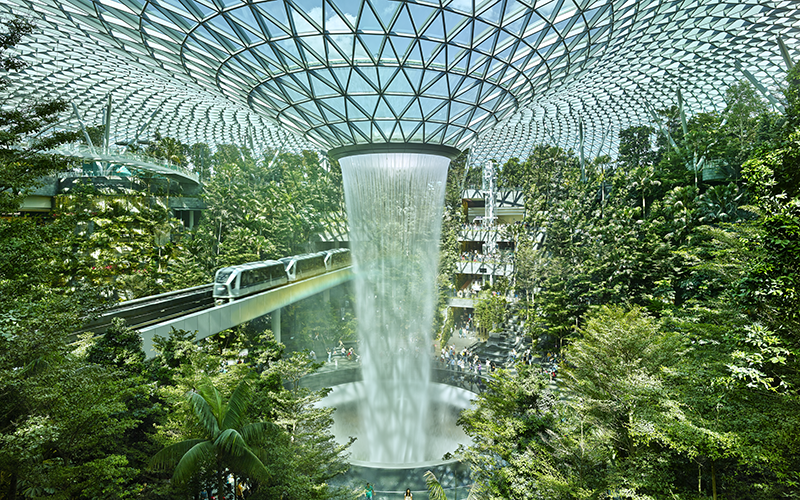
Understanding Singapore’s tropical climate, engineers at Atelier Ten, an SJ company, crafted a strategic environment design solution that carefully balanced daylight penetration, airflow and cooling to create a lush, comfortable environment. Through comprehensive daylight and solar heat flux simulations, an optimal solar selective coated double-glazing was selected for the glass roof, allowing natural light to filter through while blocking excessive heat. Shading devices and fritted glass were introduced in areas where daylight wasn’t essential, significantly reducing cooling demands.
Every element of Jewel’s design was a careful negotiation between nature, technology and experience. Through meticulous planning, it became an environmental and architectural masterpiece, seamlessly blending sustainability with a vibrant, immersive guest journey.
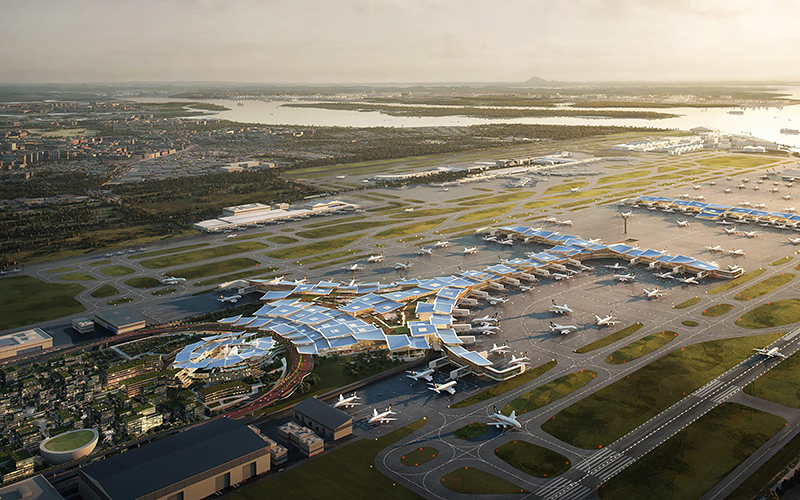
To meet the growing demand for air travel, Singapore Changi Airport is currently building Terminal 5 (T5). It is designed to handle approximately 50 million passenger movements a year when it starts the first phase of operations in the mid-2030s, augmenting its current capacity of 90 million passenger movements. SJ is currently leading the engineering consortium for the terminal. Another SJ company, SAA, is part of the architecture consortium undertaking the design. Once completed, T5 will be connected to the other Changi Airport terminals, allowing the expanded airport to operate as an integrated air hub, facilitating seamless passenger transfer between terminals.
T5 is also designed to incorporate renewable energy sources, carbon-neutral materials, and circular waste management systems, setting a new standard for eco-friendly infrastructure.
SJ is also playing a critical role in protecting airport infrastructure through its company, Prostruct, a leading infrastructure protection consultancy specializing in security, blast consultancy, and testing. With Prostruct’s unique security and blast consultancy expertise, SJ offers an augmented suite of civil and structural engineering and security solutions to help build airports that can resist blast and hazardous explosions.
“SJ has an impressive portfolio of aviation and related projects, including stakeholder management and vision planning, airport master planning, terminal design, and infrastructure development,” says Baum. “Its work on Changi Airport and other major aviation projects underscores its ability to deliver cutting-edge, operationally resilient facilities that set benchmarks in the industry.”
Rising to meet the demands of increased air travel
Across its projects, SJ is helping airports not only expand their capacity but also evolve from transit hubs into vibrant, sustainable community spaces. By integrating innovations such as electric air taxis, autonomous systems, and smart city integration, SJ is delivering forward-looking solutions that enhance passenger navigation, streamline airport operations, and create more spaces dedicated to leisure and convenience for travelers.
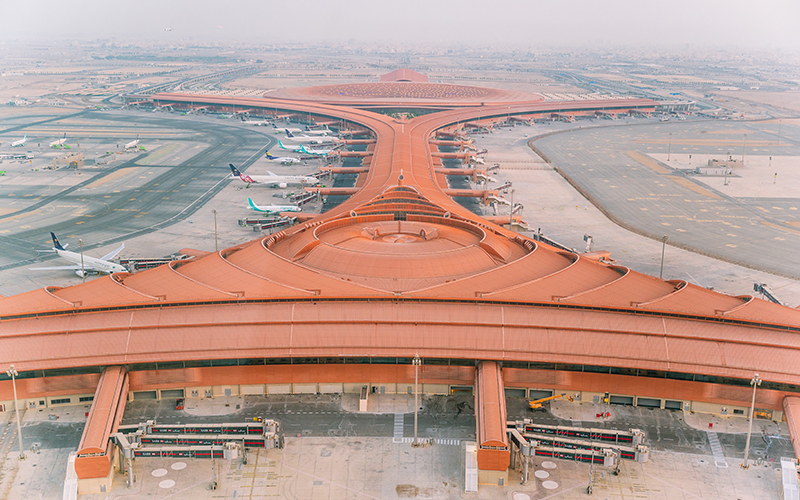
Building on its experience in Singapore, SJ is bringing passenger-centric solutions to the King Abdulaziz International Airport (KAIA) redevelopment in the Kingdom of Saudi Arabia. As the gateway to the holy cities of Makkah and Madinah, KAIA is one of the busiest airports in the country, serving as the main thoroughfare for the millions of people who travel each year during the traditional Hajj and Umrah pilgrimages. SJ is providing a project management consultancy for the airport’s facilities development plan, focusing on passenger experience and efficient processing for these travelers. The planned infrastructure upgrades will increase the airport’s capacity from 29 million to 114 million passengers annually by 2030.
“SJ is leveraging its know-how and experience to advance world-class aviation initiatives that deliver real and meaningful impact to communities,” says Baum. “We apply proven design principles and operational expertise across projects, ensuring each airport becomes more efficient and welcoming. The result is not just bigger airports but gateways that connect people and commerce and improve travel for millions.”