
Forget hierarchies—here’s how modern organizations are restructuring to survive in the era of AI.
Walking the halls of Mobile World Congress (MWC) 2026 in Barcelona, the narrative traditionally centers on speeds and feeds. The air was thick with 5G evolution, the early whispers of 6G, and the sleek industrial design of the latest hardware. In this environment, progress is typically measured in latency and bandwidth.
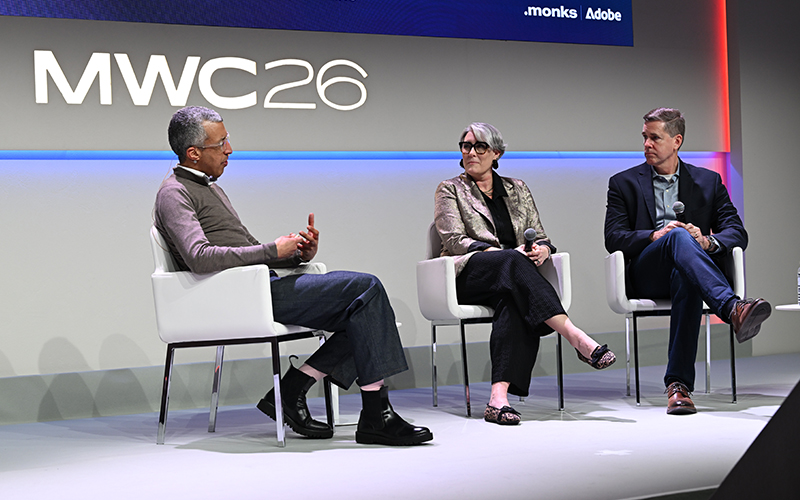
However, a different conversation took hold during a series of sessions hosted by Monks and Adobe. While the show floor focused on the technical infrastructure of the future, industry leaders gathered to discuss a more human challenge: restructuring the modern organization to survive the sheer velocity of the AI era.
The traditional vertical silos of the C-suite, in which the chief marketing officer (CMO) handles creative and the chief information officer (CTO) manages the tech stack, have become a liability. As AI moves from experimental pilots to foundational infrastructure, the real competitive moat lives within the organizational DNA as enterprise evolves to support it.
The urgency for this shift was a central theme in the session, “Aligning creative vision with organizational transformation.” During the discussion, Juanita Draude, executive vice president at Monks, introduced a key challenge: the “half-life” of AI solutions. When technological breakthroughs occur weekly, a bespoke technical solution can move from cutting-edge to commodity in a single fiscal quarter.
“The reality is we provided a fantastic agentic solution for an organization six months ago that required quite a bit of heavy lift,” she noted. “All of that work was completely obsolete by December because there was a new tool out there that could do exactly the same task within about half an hour.”
Essentially, the value of the solution isn’t the code itself—it is the speed at which the organization can adapt with minimal friction. To build a long-term strategy, leaders must move away from a software-first mindset and toward an architectural one. For the modern enterprise, the goal is to design a horizontal, integrated mesh where human intuition and machine delivery work in a continuous, agile loop.
The CMO and CIO are the new power couple
When software enters a state of obsolescence in months, the traditional linear hand-off between departments becomes a structural bottleneck. Historically, the relationship between the CMO and the CIO functioned as a relay: marketing would design a creative vision, and IT would determine if the existing stack could support it. In an AI-native enterprise, this model is too slow.
As a result, these roles are merging into a singular, horizontal force as traditional boundaries blur. The expansion of data-driven marketing has moved the CMO’s remit deep into technical territory, while the CIO has simultaneously evolved into a primary architect of the brand experience. This convergence transforms technical fluency into a core requirement for marketing leadership, as modern CMOs must now navigate data and orchestration layers with the same precision they apply to creative strategy.
Draude defines this evolution as “horizontal leadership.” Rather than operating in vertical silos that report upward independently, the CMO and CIO function as a unified front, coauthoring the organizational DNA. This partnership removes the latency of traditional departmental approvals, allowing the enterprise to pivot as quickly as the underlying technology.
When these roles align, the content supply chain functions as a competitive engine. The CIO manages integration and security, while the CMO maintains creative integrity and strategic direction. By working in tandem, these leaders move the organization beyond isolated experiments and toward the scalable returns of agentic engineering.
From content supply to agentic orchestration
This horizontal alignment of marketing and technology provides the strategic framework required for the next decade of enterprise evolution. While the last decade focused on the manual production of assets at scale, the unified C-suite allows the organization to move into agentic orchestration. In this phase, the enterprise shifts from managing libraries of static content to overseeing an ecosystem of autonomous AI agents.
During the live “25 minutes of AI” session, Luisa Consuegra, chief digital officer at Monks, and Victoria Milo, vice president of social media and content at Monks, demonstrated this shift through the lens of agentic engineering. They explored how large language models have evolved from simple text generators into agents capable of executing complex, multistep software experiences.
This technological leap provides the foundation for solving one of marketing’s most persistent challenges: delivering true relevance across a fragmented global audience. Milo bridged this gap in a subsequent discussion, “Reinventing telco marketing with AI-driven creative,” during which she moved from the theory of agentic loops to the practical reality of hyper-personalization at scale.
Using agentic workflows, a brand can take a single core message and generate hundreds of individual variations that respect local cultural nuances and technical disparities. For example, a single campaign from a telecommunications brand might need to reach a 6G-ready consumer in an urban hub and a user on a stabilized 4G network in a rural market. Agentic systems can automatically adjust the weight of the creative assets, the tone of the copy, and the legal disclaimers based on the recipient’s specific technical and regional context.
By moving to agentic orchestration, the enterprise stops being a factory for assets and becomes a conductor of experiences. The goal is no longer to fill a database but rather to deploy an intelligent mesh that can sense a customer’s need and build the appropriate response in the moment.
The talent blueprint: Human-led, machine-executed
Operating this intelligent mesh demands a fundamental shift in how human talent is deployed. To address this, Draude introduced a talent framework that distinguishes between machine efficiency and human resonance. In this model, the machine layer handles the heavy lifting of variations, translations, and technical disclaimers. Meanwhile, the human layer focuses on strategy, emotional resonance, and the creative soul of the brand.
While AI can generate thousands of assets in seconds, humans must remain in control to ensure those assets align with long-term brand equity. “Humans are always in orchestration,” Draude noted. “They’re always in design strategy, enabled by the machine.”
Human oversight is most critical when navigating legal review. During the telco panel, Milo emphasized that the human-in-the-loop is nonnegotiable for compliance and risk management.
“Geography comes into a lot of the testing scenarios,” Milo explained. “Every country is going to have different regulations about how data can be used, general data protection regulation… even just imagery generation.”
An agentic system can suggest a localized campaign, but a human must verify that the creative adheres to specific legal and cultural standards. This ensures that as an organization scales its output, it does not simultaneously scale its liability.
The blueprint for the AI-native enterprise
The technological spectacle of MWC 2025 serves as a reminder that the pace of innovation has surpassed the ability of traditional vertical organizations to keep up. When the half-life of an AI solution is measured in months, success is found in organizational design rather than a static tech stack. As Draude summarized: “We plan for the structures and the shapes of our organization that will enable us to embrace whatever those changes are.”
The horizontal C-suite removes structural friction, allowing the enterprise to deploy an intelligent mesh that responds to customer needs in real time. Within this framework, agentic engineering provides the machine layer of efficiency, while the human-in-the-loop provides the strategy, ethics, and emotional resonance that define a brand.
Ultimately, the only sustainable competitive moat in the AI era is organizational agility. Transformation is an architectural challenge focused on orchestrating outcomes rather than managing commoditized tools. By building for adaptability, the AI-native enterprise ensures it can pivot as fast as the technology it utilizes.
Note: This content was created by Monks.