
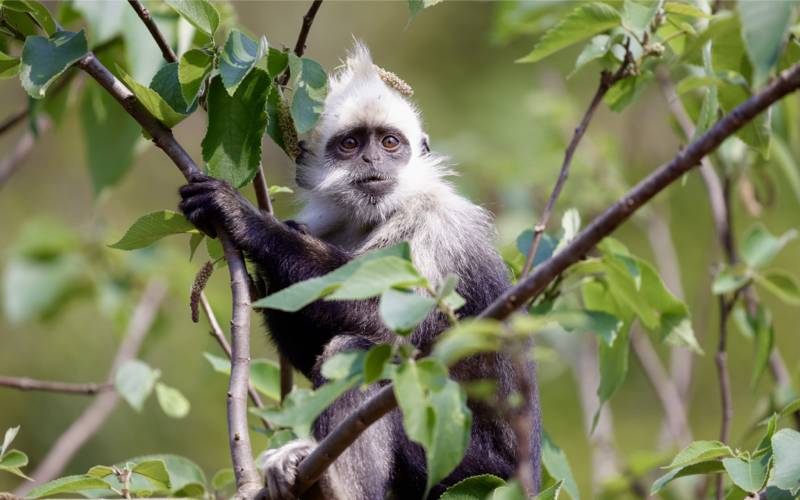
In China’s Karst mountains, AI-driven monitoring, new regulations, and habitat restoration are helping a once-vanishing primate species rebound.
In the rugged mountains of southern China dwells an animal even more rare than the giant panda. The “stone mountain elf,” or white-headed langur, is a primate once on the brink of extinction. But thanks to a coordinated push bringing together technology, law enforcement, and ecological restoration, the species is mounting a comeback.
Listed as critically endangered on the International Union for Conservation of Nature Red List of Threatened Species and the Red List of China’s Vertebrates, the animal is found in the Guangxi Chongzuo White-headed Langur National Nature Reserve. But the reserve’s terrain of steep karst limestone cliffs poses major challenges for traditional patrols and field monitoring.
To address those obstacles, the reserve teamed up with Huawei and the China-ASEAN Artificial Intelligence Application Cooperation Center to develop an intelligent monitoring platform powered by AI computing. Video-based animal monitoring devices installed along the cliffs now collect real-time data on the langurs’ distribution, surroundings, and activity patterns
Using AI-driven automated labeling and data analytics, the reserve has built a dashboard for visualized management that improves the efficiency of data retrieval and analysis. The system has recorded more than 37,200 detections of langur activity, which provide critical data for research and conservation.
“The growth of the white-headed langur population can largely be attributed to a combination of technology, legislation, and ecological restoration,” says Nong Dengpan, director of the Guangxi Chongzuo White-headed Langur National Nature Reserve Management Center. “Digital technology allows us to observe these limestone langurs more precisely and to manage their habitat more effectively. Taken together, this kind of integrated conservation model could offer a useful reference for protecting and restoring other endangered primate populations as well.”
Policy has evolved alongside technology. The Chongzuo White-Headed Langur Habitat Protection Regulations—the first of its kind in China—provide the legal framework for the reserve’s efforts. Under this framework, 77.6 hectares of habitat have been restored, two drinking water sources and 18 water drinking points have been built for the langurs, and two ecological corridors have been constructed to reconnect fragmented areas. The population has now increased to more than 1,400 langurs across 130 groups, up from just upwards of 300 individuals in the 1980s.
As an umbrella species of the local karst ecosystem, the langurs’ recovery is critical to the region’s biodiversity and long-term health of this fragile environment. As conditions improve, signs of broader ecosystem restoration are emerging. Wild duck lettuce, a protected species in China, was recently recorded in the reserve for the first time.
Huawei views the project as part of its wider commitment to “conserving nature with technology,” says Tian Yongsheng, deputy general manager of Huawei Guangxi. “We work with global partners to support ecosystem conservation using digital technologies, such as 5G, cloud, and AI.”
By the end of 2025, Huawei’s digital inclusion projects for environmental protection had been implemented in 65 protected areas worldwide, improving the efficiency of biodiversity conservation and the sustainable use and management of natural resources.
“The success of the white-headed langur project demonstrates AI’s immense value in processing complex geographical data and massive volumes of species data,” says Tian. “We will continue using innovative technologies to protect biodiversity and enable the harmonious coexistence of humanity and nature.”
Note: This content was created by Huawei.