
Wealth creators in Hong Kong and mainland China face a test: turning informal succession into adaptable legacy structures that protect assets, values, and family continuity.
For decades, Asia’s wealth story was about accumulation. Now, the challenge is what happens after assets are created: how to preserve, structure, and pass them on in a way that keeps pace with increasing market volatility, the complexities of global families operating across multiple jurisdictions, and increasingly intricate corporate holding structures.
That shift is creating a legacy-planning gap that many wealthy families are still trying to close. HSBC Life’s new report From fragility to fortress across generations: Navigating the evolving legacy landscape in Hong Kong & mainland China found that two-thirds of high-net-worth individuals (HNWIs) in Hong Kong and mainland China have no formal legacy structure in place, and 71% of respondents cite a lack of technical information as the main barrier. In other words, significant wealth often remains exposed because families lack a clear plan for its transfer.
Daisy Tsang, co-CEO, Insurance, HSBC, describes this as a “structural weakness” and refers to situations in which families hold substantial assets without a road map for transition. “This leaves a family’s lifework exposed to market volatility, geopolitical shifts, and rapid technological disruption,” she says.
A tale of two mindsets
HSBC Life’s research draws a sharp distinction between two regional mindsets. In Hong Kong, the “responsible protector” is focused on capital preservation and shielding the family from volatility. In mainland China, the “growth strategist” is more focused on empowering the next generation and supporting stable growth.
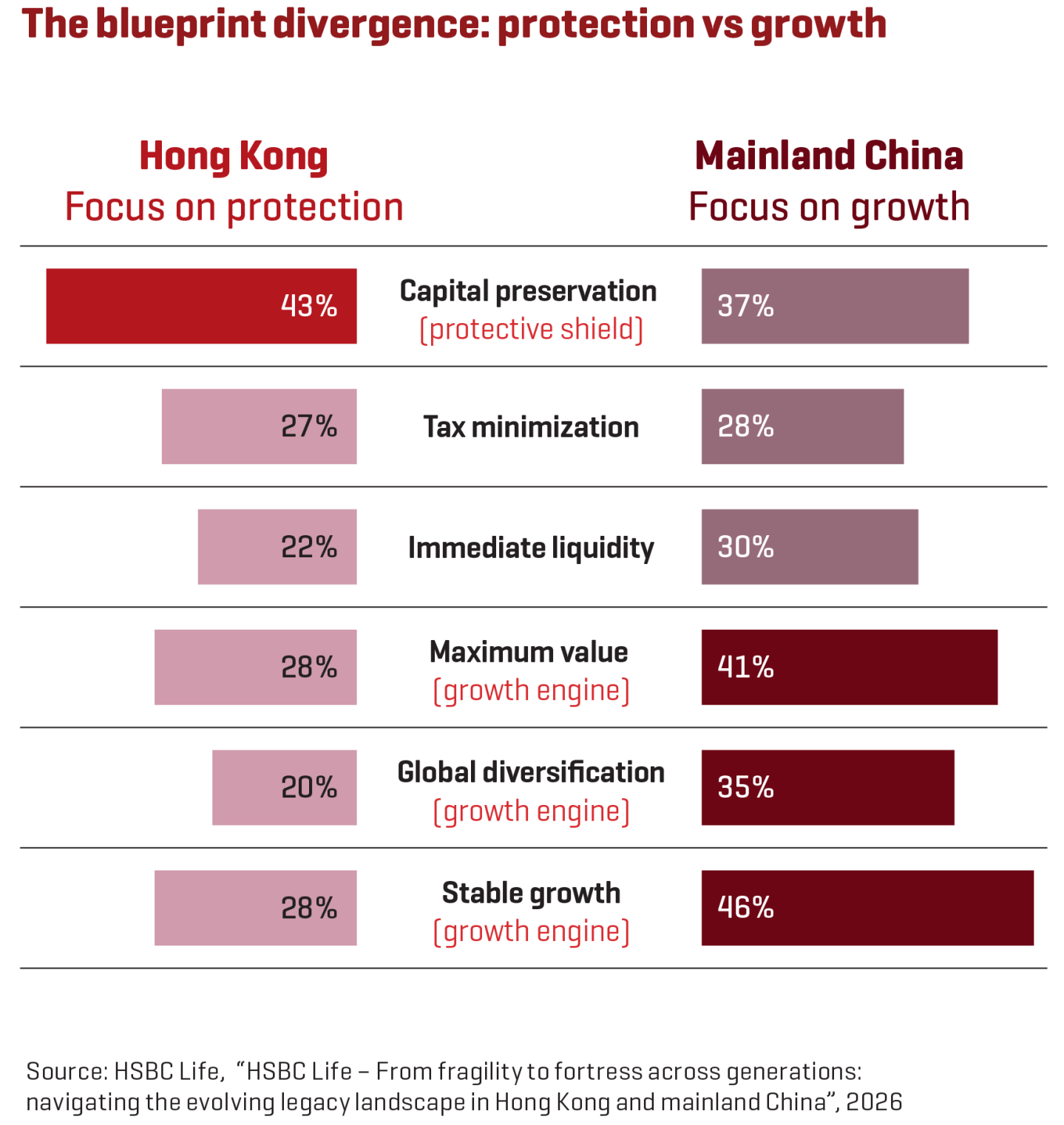
Tsang says the difference reflects history as much as preference. Hong Kong families are often second-or third-generation wealth holders, who have already lived through economic cycles and financial shocks. Consequently, their priority is to preserve capital and shield the family from market swings. In mainland China, by contrast, many affluent families are first-generation wealth creators, meaning the emphasis shifts from protection alone to preparing heirs to manage and grow the family’s wealth without squandering it.
“At HSBC Life, we have reframed our strategy to support both mindsets,” Tsang says. “My team has developed legacy planning solutions with first-in market, highly adaptable benefits.”
“At HSBC Life, we have reframed our strategy to support both mindsets,” Tsang says.
She points to the HSBC Luminous Global Insurance Plan, a newly launched insurance solution built with market-first capabilities such as currency diversification option and staggered payouts aligned to personalized life events and milestones. The aim is to help families adapt their plans across changing life stages, jurisdictions, and generational needs. Just as importantly, the staggered payouts can help clients move away from a risky lump-sum inheritance and toward a better-governed transfer of wealth over time—answering the need of many families for stable wealth management among the succeeding generation.
Why insurance matters
Life insurance sits at the center of legacy planning because it can provide speed, privacy, liquidity, and structured governance.
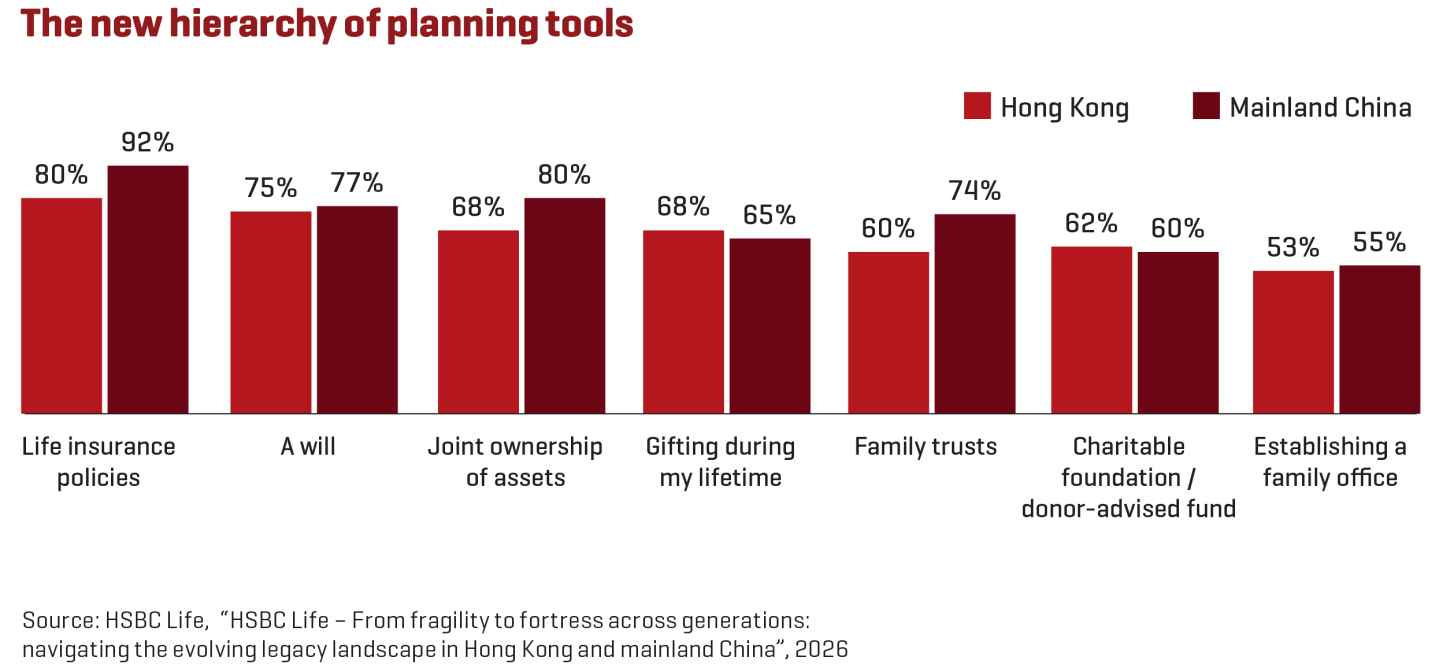
HSBC Life’s research shows that insurance is the leading legacy tool for 80% of respondents in Hong Kong and 92% in mainland China, with 73% valuing it for confidentiality and protection from scrutiny, 72% prioritizing its ability to deliver immediate payouts outside lengthy probate, and 73% seeing it as an effective vehicle for multigenerational wealth transfer.
“While wills face lengthy, frozen probate, insurance provides timely liquidity directly to beneficiaries to ensure business continuity,” Tsang points out.
From assets to purpose
The research also shows an evolution in what legacy means. More than one in three respondents in Hong Kong and mainland China said they want family ethos to be passed down as well. “Today, a successful legacy is not just about transferring wealth, but also human capital,” Tsang says, referring to the values, ambition, and work ethic that created the wealth in the first place.
That insight has given rise to HSBC Life’s new value-added service provided by third-party service providers —Wisdom Heirloom Legacy Service, which is designed to translate personal values into calligraphy, a written biography, or a documentary film. The service draws on three of Hong Kong’s most respected cultural figures: Chui Pui Chee, an award-winning ink artist and calligrapher whose works are housed at the University of Oxford and the Hong Kong Museum of Art; Kam Shing, editor-in-chief of a renowned Hong Kong arts and culture magazine; and Yung Tsz Kwong, a Hong Kong Film Awards-calibre filmmaker, supporting a legacy that goes beyond wealth.
The same logic runs through HSBC Life’s H+ Bespoke Multi-Gen Membership, created with wellness retreat Humansa to extend health care planning to three generations. In an era of rising climate risk—where heat waves, air quality, and changing disease patterns can erode well-being—the dedicated family health office helps families treat health as a core asset, reinforcing the idea that a legacy plan should protect the people named in it.
The master architect
High-net-worth families often deal with separate lawyers, tax advisers, and bankers across multiple jurisdictions—a complexity that nearly 70% of Hong Kong respondents describe as a burden and one in five call a significant burden, according to HSBC Life’s report.
Tsang says HSBC Life has responded by building a system that links its flagship insurance solution with complementary value-added services. Besides the Wisdom Heirloom Legacy Service and H+ Bespoke Multi-Gen Membership, these also include the Chief Legacy Planner Service provided by the leading consultancy firm, enabling clients to review global assets, understand cross-border rules and explore options for wills, trusts, financial structures, and family offices in a unified process.
Together, the plan and these services embody HSBC Life’s shift from product issuer to dynasty architect—an evolution underscored by its recent recognition as the World’s Best Insurance Provider for Wealth Management at the Euromoney Private Banking Awards 2026.
“We will continue to deepen our partnerships with broader industry experts to deliver a seamless wealth, health, and heritage ecosystem that competitors cannot replicate,” says Tsang.